Camera Focal Length Guide: What Lens Millimeters Really Mean
Understand what focal length changes, how sensor size affects field of view, and which lens ranges suit portraits, landscapes, travel, sports, and wildlife.
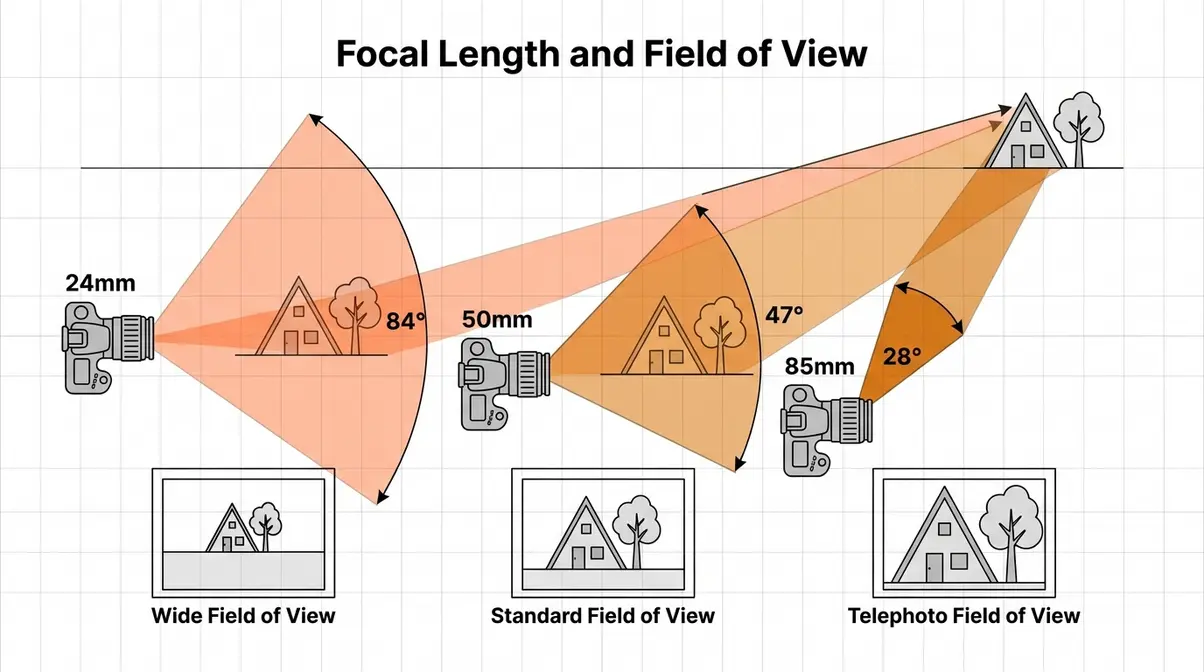
The millimeter number on a lens is one of the most useful specifications to understand. Once it makes sense, lens names become less mysterious and choosing what to carry becomes much easier.
What is focal length?
Focal length is an optical measurement, expressed in millimeters, that describes how strongly a lens converges light when focused at infinity. It is not simply the physical length of the lens barrel. A compact 50mm lens and a large 50mm lens can produce the same field of view on the same camera even though they look completely different.
For photographers, focal length has two immediately visible effects:
- Field of view: how much of the scene fits inside the frame.
- Subject size in the frame: how large distant details appear when the camera stays in the same position.
A short focal length, such as 24mm, includes a broad area. A long focal length, such as 200mm, shows a much smaller slice of the scene. Lens makers often call long lenses telephoto lenses, while short lenses are described as wide-angle.
Short, normal, and long focal lengths
The ranges below use full-frame equivalent values. The boundaries are approximate rather than universal rules.
- 14–20mm: ultra-wide. Includes a very large scene and exaggerates the apparent size difference between near and far objects when you work close to the foreground.
- 24–35mm: wide. Popular for landscapes, architecture, interiors, environmental portraits, travel, and street scenes.
- 40–60mm: normal. Gives a balanced view that often feels natural and is useful for everyday photography.
- 70–105mm: short telephoto. Offers comfortable working distance for portraits, details, events, and tighter landscapes.
- 135–300mm: telephoto. Useful for field sports, stage events, compressed landscape compositions, and animals that cannot be approached closely.
- 400mm and longer: super-telephoto. Common for birds, distant wildlife, motorsports, aircraft, and other small or remote subjects.
These labels describe fields of view, not permitted uses. A 24mm lens can make an energetic close portrait, and a 300mm lens can isolate layers in a landscape. The question is whether its framing and required shooting distance support the photograph you want.
Field of view: what the lens includes
Field of view is the portion of the scene recorded by the camera. On a full-frame camera, a 24mm lens has an approximate diagonal angle of view of 84 degrees, a 50mm lens about 47 degrees, and an 85mm lens about 29 degrees. Exact figures vary slightly with lens design, focus distance, and the recorded image area.
If you stand still and change from 24mm to 85mm, the 85mm frame includes less of the scene. The house, person, or mountain in the middle also occupies more pixels. This is why changing focal length is sometimes described as optical magnification.
Cropping a 24mm photograph can imitate the framing of a longer lens, but only if the original file has enough resolution and detail. A long lens normally records more pixels on the distant subject, and it may also offer a wider aperture or autofocus performance suited to that subject.
Focal length does not directly control perspective
This is the part most simplified lens guides miss: perspective is controlled by camera position. It describes the apparent size relationship between near and far objects.
Suppose you photograph a person with a 24mm lens and then switch to an 85mm lens without moving the camera. The second image is a tighter crop, but the size relationship between the person's nose, ears, and background remains the same. If you crop the 24mm frame to match, the perspective will match too.
In normal use, however, photographers move. To keep the person's head the same size with an 85mm lens, you must stand farther away. That greater camera-to-subject distance makes facial features appear more even and the background appear larger relative to the subject. This is the familiar telephoto compression look.
With a wide lens, you usually move closer to fill the frame. Nearby features then appear much larger than features only a little farther away. The lens has not distorted the spatial relationship by itself; your closer position created the stronger perspective.
Simple rule: choose your camera position for the perspective you want, then choose a focal length that frames the scene from that position.
Sensor size and crop factor
A lens's actual focal length never changes. A 50mm lens remains a 50mm lens on full-frame, APS-C, and Micro Four Thirds cameras. What changes is how much of the projected image the sensor records.
A smaller sensor captures a narrower central area, so the result looks like the field of view from a longer lens on a full-frame camera. Crop factor is a convenient way to compare those views:
- Full frame: focal length × 1
- Most Nikon, Sony, and Fujifilm APS-C cameras: focal length × about 1.5
- Canon APS-C cameras: focal length × about 1.6
- Micro Four Thirds cameras: focal length × about 2
For example, 35mm on a 1.5× APS-C camera gives roughly the same field of view as 52.5mm on full frame. A 25mm lens on Micro Four Thirds gives a field of view similar to 50mm on full frame.
This converted number is the full-frame-equivalent focal length. It helps compare framing across camera systems. It does not convert the lens into a different optical design or change the focal length engraved on it.
Depth of field comparisons require more care. When two camera systems produce the same framing from the same position, sensor size, focal length, aperture, focus distance, and final viewing size all affect how much looks acceptably sharp. Do not multiply focal length and assume every other visual property changes in exactly the same way.
Which focal length should you use?
Landscapes and interiors
A 16–35mm equivalent range is useful when you need to include a broad view or cannot step farther back. Wide lenses make near foreground objects prominent, which can give a landscape depth. They also make tilted vertical lines more obvious when the camera points upward or downward.
Wide is not mandatory for landscapes. A 70–200mm lens can isolate distant ridges, light, trees, or patterns and remove empty foreground.
Street and travel
28mm and 35mm equivalents include context and work well when you want the surroundings to remain part of the story. A 50mm equivalent produces a tighter, calmer frame. A small standard zoom—roughly 24–70mm equivalent—covers all three without changing lenses.
Portraits
For head-and-shoulders portraits, 70–105mm equivalents provide a comfortable distance and make it easy to exclude a distracting background. A 35mm or 50mm equivalent is often better for full-body or environmental portraits in which the location matters.
Avoid treating 85mm as a magic portrait number. The available room, desired background, number of people, and communication distance matter more. If a wide lens makes a face look exaggerated, step back instead of blaming the lens alone.
Sports and wildlife
Outdoor sports and wildlife commonly need 200–600mm equivalents because the subject is distant or access is restricted. Indoor courts and stage events may favor 70–200mm with a wide maximum aperture because light levels are lower and working distances are shorter.
Long focal lengths amplify visible camera movement. Image stabilization helps reduce blur from the photographer's hands, but it cannot freeze a moving animal or athlete. You still need an appropriate shutter speed. Our exposure triangle guide explains how shutter speed, aperture, and ISO work together.
Close-ups and macro
Focal length alone does not tell you how large a small object can appear. Check the lens's minimum focus distance and maximum magnification. A true 1:1 macro lens records a subject at life size on the sensor. Longer macro lenses usually provide more working distance for lighting or easily disturbed insects.
Prime lens or zoom lens?
A prime lens has one focal length, such as 35mm or 85mm. A zoom lens covers a range, such as 24–70mm or 70–200mm.
Primes can be smaller, lighter, sharper, or brighter for their price, although none of those advantages is guaranteed. Zooms let you adjust framing quickly when you cannot move freely, making them practical for travel, events, sports, and changing weather.
Zooming and moving are not interchangeable. Zooming changes what fits in the frame from the current position. Moving changes perspective and the relationship between the subject and background. Good photographers use both deliberately.
How to choose a useful focal length
- Identify your sensor format. Convert to full-frame equivalent if you are comparing recommendations made for another system.
- Start with working distance. Consider how close you can safely or comfortably stand and whether obstacles prevent movement.
- Decide how much context belongs in the frame. Choose wider for more surroundings or longer to isolate a smaller area.
- Check the whole lens, not just its millimeters. Maximum aperture, autofocus, stabilization, minimum focus distance, size, weight, weather sealing, and price may matter just as much.
- Use photographs you already made. Editing software can show the focal length recorded in each file. Look for the values you use most and the situations in which your current lens feels too wide or too short.
If you are still learning the controls, begin with our camera guide for beginners. A standard kit zoom is ideal for this lesson because it lets you compare several focal lengths immediately.
A ten-minute focal length exercise
Find a scene with a clear foreground object and a background at least several meters away.
- Stand in one position and photograph it at the widest, middle, and longest settings on your zoom. Compare how much of the scene is included. Perspective should remain the same.
- Now make the foreground object the same size in all three frames by moving closer with the wide setting and farther away with the long setting. Compare the apparent spacing and background size. The changed camera position changes perspective.
- Repeat the exercise with a person, but do not move so close that the wide-angle frame becomes uncomfortable. Notice which distance supports the expression and amount of context you want.
This test teaches more than memorizing a list of recommended numbers because it separates framing, distance, and perspective.
Common focal length mistakes
- Comparing millimeters without comparing sensor sizes. Use equivalent focal length when discussing field of view across formats.
- Calling every wide-angle portrait distorted. Extreme facial perspective usually comes from placing the camera too close.
- Assuming a long lens automatically blurs the background. Aperture, subject distance, background distance, sensor size, and framing also matter.
- Using a wide lens only to fit everything in. A frame with no visual priority can feel cluttered even when it contains the whole scene.
- Buying more reach before improving access and timing. Better positioning, patient fieldcraft, and a clean background may improve a wildlife photograph more than another 100mm.
- Ignoring minimum focus distance. Some lenses cannot focus closely enough for the detail shot you imagined.
The simplest way to remember focal length
Shorter focal lengths show more; longer focal lengths isolate more. Sensor size changes the field of view you record, and camera position changes perspective. Once you treat these as three separate decisions, choosing a lens becomes far more predictable.
Sources and further reading
The optical explanations and examples in this guide were checked against Nikon's Understanding Focal Length and DX and FX Formats guides, Canon's explanations of focal length and field of view and perspective, Sony's Focal Length guide, and Fujifilm's Focal Lengths Demystified.
Frequently Asked Questions
-
A standard zoom around 24–70mm full-frame equivalent is an adaptable starting point. It covers wide, normal, and short-telephoto views so you can discover which framing you prefer before buying a specialized lens.
-
The lens remains 50mm, but its field of view depends on sensor size. It looks like roughly 75mm equivalent on most 1.5× APS-C cameras, 80mm equivalent on Canon 1.6× APS-C, and 100mm equivalent on Micro Four Thirds.
-
A higher focal length gives a narrower field of view and makes a distant subject larger in the frame from the same camera position. However, “zoom” technically means that a lens can change focal length. A 400mm prime is a long lens but not a zoom lens.
-
There is no exact match because human vision combines a broad peripheral view with a small area of detailed attention. On full frame, lenses around 40–50mm often create a natural-looking perspective when photographs are viewed at a normal size and distance.
-
Focal length affects framing and can change the apparent size of out-of-focus background details, but blur also depends on aperture, focus distance, subject-to-background distance, sensor size, and viewing conditions. A longer lens does not guarantee a blurred background.