What Focal Length Is Best for Portraits?
Choose portrait focal length by camera distance, framing, sensor size, background, room, and communication—not by one universal number.
The flattering-lens myth
People often say an 85mm lens flatters a face and a 24mm lens distorts it. The deeper cause is distance.
To fill the frame with a head at 24mm, you must move very close. The nose is then much closer to the camera than the ears, so it appears proportionally larger. To make the same head size at 85mm, you stand farther away, reducing that near-to-far size difference.
If you photograph both lenses from the same position and crop the 24mm image to match, facial perspective is the same. The crop simply has fewer pixels.
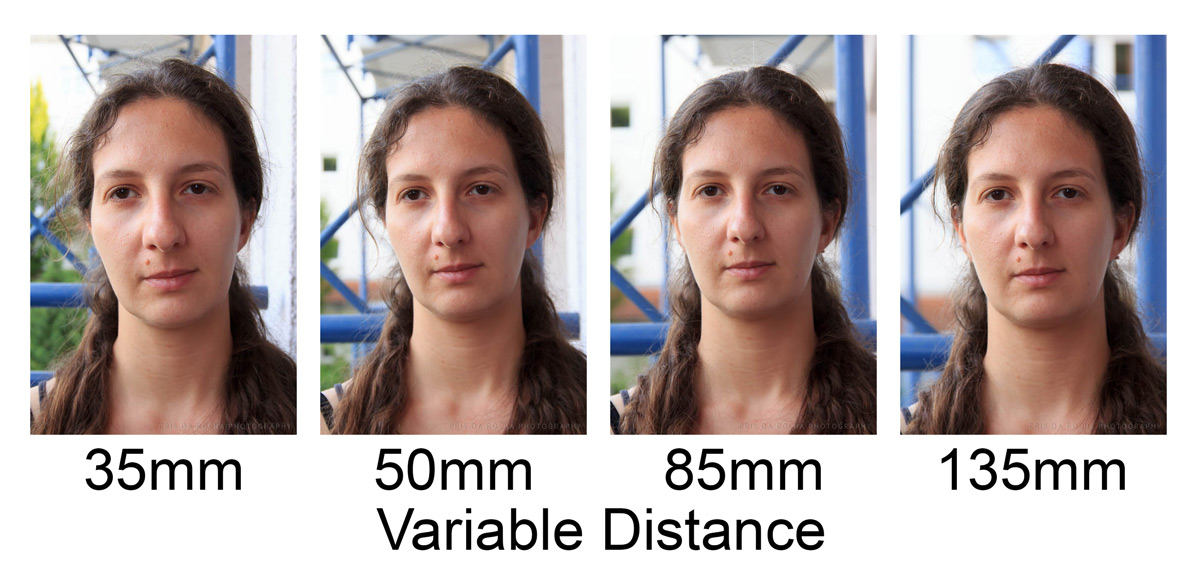
Choose distance before focal length
For a natural adult headshot, a camera distance around 5–10 feet is often comfortable, depending on framing and style. The photographer can direct the subject without crowding them, and facial proportions appear balanced.
Once you choose the working distance, pick the lens that includes the intended amount of body and environment. This turns focal length from a rule into a framing tool.
24mm: dramatic environmental portraits
On full frame, 24mm includes a broad environment and exaggerates the visual size of nearby elements. It works for athletes, musicians, workers, interiors, and editorial portraits where place is part of the story.
Keep faces away from the corners, where stretching and lens correction are strongest. Avoid moving extremely close unless exaggeration is intentional. A vertical full-body portrait can work well when the camera stays level and the subject is near the center.
Best for: energetic environmental work, tight spaces, groups with careful positioning, and deliberate wide-angle style.
35mm: context without extreme width
35mm is a classic environmental portrait focal length. It can show a person from the waist or full body along with a room, street, workplace, or landscape without the stronger edge behavior of 24mm.
It remains wide enough that distance matters. A tight headshot from very close can exaggerate features. Keep the camera a reasonable distance away and include the surroundings it is designed to show.
Best for: documentary portraits, couples, small groups, travel, and interiors.
50mm: flexible and conversational
A 50mm lens on full frame offers a moderate view. It works for half-body portraits in ordinary rooms, full-body photographs outdoors, and tighter portraits when you have space to step back.
Fast 50mm primes are often affordable and compact. At very close headshot distances they can still emphasize the center of the face, so an 85mm may feel more natural for tight framing.
Best for: first portrait lens, everyday sessions, half-body work, and one-lens travel kits.
85mm: the headshot starting point
85mm creates a comfortable working distance for head-and-shoulders framing on full frame. Its narrower view makes it easier to exclude clutter and select a clean background.
It is long enough for natural facial perspective in typical use but short enough to communicate easily with the subject. Fast f/1.8 and f/1.4 versions can separate the background, though shooting every portrait wide open may leave only one eye sharp.
Best for: headshots, half-body portraits, weddings, fashion details, and outdoor sessions.
105mm: tighter control and close-up detail
105mm increases working distance and narrows the background further. Classic 105mm portrait lenses may prioritize smooth rendering, while 105mm macro lenses add close-up capability with very high correction.
At the same framing and aperture, depth of field depends strongly on magnification. The perceived blur character also comes from background distance, aperture shape, aberration correction, and foreground.
Best for: polished headshots, beauty, outdoor portraits, and photographers who also need macro.
135mm: strong separation with more distance
135mm can create clean, isolated portraits and a compressed-looking background because the photographer must stand farther back. It is excellent outdoors and on larger sets.
In a small room, it may be impossible to frame more than a face. Communication becomes less direct, and camera shake is more visible.
Best for: outdoor headshots, fashion, candid moments, stage work, and busy backgrounds.
200mm: distant and highly selective
At 200mm, a portrait can isolate a narrow slice of the background and make distant features appear large behind the subject. A 70–200mm zoom offers this option without committing to one view.
The required distance can make directing difficult and flatten spatial depth. Heat shimmer can reduce outdoor sharpness over long paths, and the setup is larger and more conspicuous.
Best for: candid events, outdoor compression, stage portraits, and situations where you cannot approach.
Sensor-size conversions
To obtain a similar field of view, divide the full-frame focal length by crop factor:
| Full-frame view | 1.5x APS-C | 1.6x APS-C | Micro Four Thirds |
|---|---|---|---|
| 35mm | 23mm | 22mm | 17mm |
| 50mm | 33mm | 31mm | 25mm |
| 85mm | 56mm | 53mm | 42.5mm |
| 105mm | 70mm | 66mm | 52.5mm |
| 135mm | 90mm | 84mm | 67.5mm |
These are field-of-view equivalents. The printed lens focal length remains unchanged. For matched framing and f-number, smaller formats produce more depth of field; see APS-C Cameras Explained for equivalence details.
Background size and “compression”
When you step back and use a longer lens to maintain subject size, a distant background occupies more of the frame. Mountains, architecture, or lights appear larger behind the person. This is often called telephoto compression.
The spatial relationship comes from the farther camera position. The long lens crops a narrower view from there. Use it deliberately: a large background can feel dramatic, while a wider view can make the subject feel connected to the place.
Depth of field is not focal length alone
For the same subject framing, aperture, sensor format, and final display, depth of field can be surprisingly similar across focal lengths. What changes visibly is the amount and scale of the background included.
To increase separation:
- open the aperture;
- move the subject farther from the background;
- frame tighter;
- choose a longer working distance and narrower background view; and
- avoid backgrounds with sharp, high-contrast details.
Groups and couples
Use enough distance to avoid exaggerated faces near the camera and stop down so everyone is within depth of field. A 35mm or 50mm lens is often practical on full frame; larger groups or tight rooms may need 24–35mm.
Keep people near the same focus plane, avoid placing faces in extreme corners, and leave room for lens-profile correction. A longer lens can look excellent outdoors if you have enough distance to fit the group.
Room size decides more than preference
Measure the longest usable camera-to-subject distance. An 85mm recommendation is useless if a wall prevents full-body framing. In small home studios, 35mm or 50mm may be the correct tool.
Also consider the distance behind the subject. A wide lens may include clutter; a longer lens may exclude it but force the person against the background, reducing blur.
Prime versus zoom for portraits
A prime can be smaller, brighter, and less expensive for a given aperture. A zoom changes framing quickly when the photographer or subject cannot move, and a 24–70mm or 70–200mm covers several portrait styles.
The best lens is not defined by maximum aperture. Autofocus accuracy, minimum focus, flare, color, weight, and how confidently you communicate during the session all affect results.
A simple selection method
- Choose headshot, half-body, full-body, group, or environmental framing.
- Find a camera distance that gives the perspective and interaction you want.
- Select the focal length that frames correctly from that position.
- Check room boundaries and background coverage.
- Choose aperture for the number of people and focus tolerance.
- Make test frames and adjust distance before buying another lens.
Common mistakes
- Calling close-distance perspective “lens distortion.” The camera position creates the facial proportion change.
- Using 85mm in a room that is too small. Select for the space and framing.
- Shooting every portrait at maximum aperture. Enough depth of field is part of a successful image.
- Ignoring the frame edges with wide lenses. People near corners can stretch.
- Assuming longer always means more flattering. Excessive distance can flatten the portrait and weaken communication.
Frequently Asked Questions
-
50mm is more flexible for half-body and environmental portraits in moderate spaces. 85mm provides a comfortable distance for headshots and a narrower background. The framing and available room decide.
-
On full frame, 85–105mm is a dependable starting range. On 1.5x APS-C, about 56–70mm gives similar framing. Maintain enough distance for natural facial perspective.
-
Yes. It is excellent for environmental and full-body portraits. Avoid extremely close headshots unless exaggerated perspective is intentional, and keep faces away from stretched frame corners.
-
To fill the frame with a wide lens, the photographer usually moves closer. The nose is then proportionally much closer to the camera than the ears, so it appears larger. Distance causes the perspective effect.
-
It narrows the background view and often encourages greater camera distance. Actual depth of field also depends on aperture, subject magnification, sensor format, and focus distance; background character depends on its distance and the lens design.