Beginner's Guide to Camera Lens Types
Learn how prime, zoom, wide-angle, telephoto, macro, fisheye, and tilt-shift lenses differ—and how to choose a useful lens for your camera.
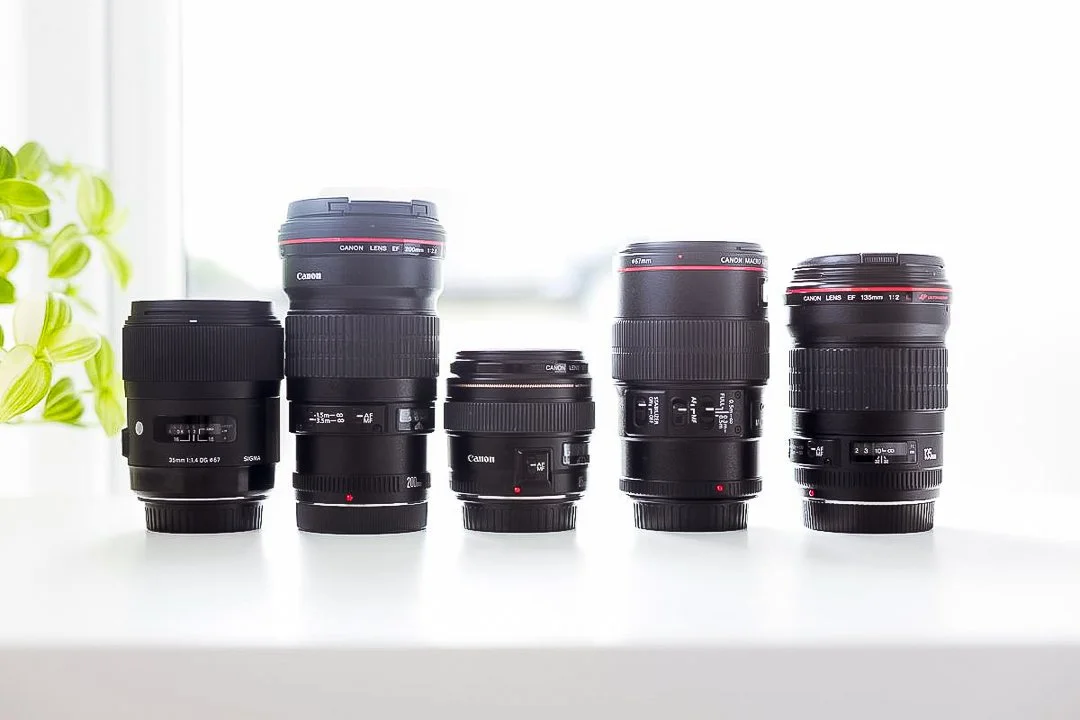
Lens terminology is confusing because it mixes different questions. Does the lens zoom? How wide is its view? How closely can it focus? Which camera does it fit? Is it designed to create a special projection or move its optics?
A clear lens guide should answer each question separately. That is what we will do here.
The four ways camera lenses are classified
Most lens descriptions fit into one of four groups:
- Focal-length behavior: prime or zoom.
- Field of view: ultra-wide, wide, standard, telephoto, or super-telephoto.
- Special purpose: macro, fisheye, tilt-shift, cinema, and other specialized designs.
- Compatibility: lens mount and the sensor format the lens is designed to cover.
These groups overlap. A 100mm macro lens may be a full-frame, short-telephoto prime. A 10–20mm APS-C lens may be an ultra-wide zoom. That is why product pages can attach several labels to one lens without contradicting themselves.
Prime lenses: one fixed focal length
A prime lens has one focal length, such as 24mm, 50mm, or 85mm. You cannot rotate a zoom ring to change how much of the scene fits in the frame. You either change your camera position, accept a different composition, or switch lenses.
Many primes offer a relatively wide maximum aperture such as f/1.8 or f/1.4. That can admit more light, help maintain a faster shutter speed, and produce shallower depth of field. Primes can also be compact and light because they do not need to cover a range of focal lengths.
However, a prime is not automatically sharper, brighter, smaller, or cheaper than every zoom. Modern premium zooms can be excellent, while large-aperture primes can be heavy and expensive. Compare actual lenses rather than treating the category as a guarantee.
Good for: low light, portraits, street photography, compact kits, and photographers who prefer a consistent field of view.
Zoom lenses: a range of focal lengths
A zoom lens lets you select multiple focal lengths within a stated range. An 18–55mm zoom can use any marked or intermediate setting between 18mm and 55mm. A 70–200mm zoom stays within the telephoto range, so “zoom” does not mean “long lens.”
Zooms make it easier to reframe when you cannot move freely, when the subject changes distance, or when changing lenses would be slow or risky. One zoom may replace several primes in a travel bag.
Some zooms have a constant maximum aperture, such as 24–70mm f/2.8. Others have a variable maximum aperture, such as 18–55mm f/3.5–5.6. In the second example, the widest available aperture changes from f/3.5 at the wide end to f/5.6 at the long end.
Good for: travel, family events, reportage, sports, wildlife, video, and any situation where framing must change quickly.
Prime versus zoom is not “quality versus convenience.” It is a choice between a fixed view and an adjustable range, followed by comparisons of aperture, optical performance, size, features, and price.
Lens types by field of view
The numbers below are approximate full-frame-equivalent focal lengths. On a smaller sensor, use the equivalent field of view rather than comparing the engraved millimeter number directly. Our camera focal length guide explains crop factor and perspective in detail.
Ultra-wide-angle lenses
Ultra-wide lenses cover roughly 14–20mm equivalent. They include a broad scene and can emphasize the apparent distance between nearby foreground objects and the background. They are useful when space is tight or when a dramatic foreground is part of the composition.
Common uses: interiors, architecture, night skies, expansive landscapes, action cameras, and creative close perspectives.
Watch for: converging vertical lines when the camera is tilted, stretched-looking subjects near frame edges, flare, and cluttered compositions.
Wide-angle lenses
Wide-angle lenses cover roughly 24–35mm equivalent. They show more context than a normal lens without always looking extreme. A 28mm or 35mm equivalent can stay on a camera all day for travel and documentary work.
Common uses: landscapes, street photography, groups, environmental portraits, events, travel, and smaller rooms.
Standard or normal lenses
Standard lenses sit around 40–60mm equivalent. Their field of view often produces balanced-looking photographs without the obvious expansion of an ultra-wide or isolation of a telephoto. The familiar 50mm prime belongs here on full frame; on a 1.5× APS-C camera, a lens around 33–35mm gives a similar view.
Common uses: everyday photography, food, details, street scenes, half-length portraits, and learning composition.
Telephoto lenses
Telephoto generally starts around 70mm equivalent. A narrower view helps a distant subject fill the frame and makes it easier to exclude distracting surroundings. Short telephotos around 70–105mm are popular for portraits and details, while 135–300mm lenses suit events, stage work, sports, landscapes, and larger wildlife.
Long lenses show camera movement clearly, so stabilization and sound handholding technique can help. Stabilization reduces blur caused by camera movement; it does not freeze a moving subject.
Super-telephoto lenses
Super-telephoto lenses usually begin around 400mm equivalent. They are built for subjects that are small, distant, unsafe to approach, or separated by a field boundary. Some are large-aperture primes; others are flexible zooms such as 100–500mm or 200–600mm.
Common uses: birds, wildlife, field sports, motorsports, aircraft, and tightly framed details of the moon.
Watch for: high cost, weight, a narrow field of view that makes subjects harder to find, atmospheric haze, and shutter speeds that are too slow.
Special-purpose lens types
Macro lenses
A true macro lens is designed for high magnification at close focus. The most useful specification is maximum reproduction ratio, not focal length alone. A lens capable of 1:1 magnification can project a subject onto the sensor at life size: a 10mm detail occupies 10mm on the sensor.
Macro lenses come in different focal lengths. A longer macro lens normally gives more working distance at the same magnification, leaving room for lighting and making it easier to avoid disturbing insects. Many macro primes also work well for portraits and general photography.
Do not assume every lens carrying the word “macro” reaches 1:1. Some zooms use the term for a closer-than-usual focus mode. Check the stated maximum magnification.
Fisheye lenses
A fisheye lens records an extremely wide view using a deliberately curved projection. Straight lines away from the center bow outward. This is a design feature, not a correction failure.
A circular fisheye creates a round image inside the frame, while a diagonal or full-frame fisheye fills the rectangular image. Fisheyes are used for stylized action, immersive scenes, scientific coverage, and some virtual-reality workflows. A corrected ultra-wide lens is a better choice when straight architectural lines must remain straight.
Tilt-shift lenses
A tilt-shift lens allows controlled movement between the optics and the camera. Shift can change framing while the camera remains level, helping architectural photographers manage converging verticals. Tilt changes the orientation of the focus plane, allowing unusual control over which parts of a scene appear sharp.
These lenses are specialized, commonly manual focus, and slower to operate. They are most useful for architecture, interiors, products, studio still life, and deliberate landscape work.
Pancake lenses
Pancake describes a very thin lens body rather than a field of view or optical purpose. Most are compact primes, although small zooms also exist. Their advantage is portability: a camera that fits easily in a small bag is more likely to be carried.
All-in-one or superzoom lenses
An all-in-one zoom spans a large range, such as 18–200mm on APS-C or 24–240mm on full frame. It can cover wide scenes and distant details without a lens change. The tradeoffs may include a variable, relatively narrow maximum aperture; more distortion; softer extremes; and a larger barrel than a basic kit zoom.
“Superzoom” describes range, not professional status. It can be an excellent travel choice when changing lenses is impractical.
Cinema lenses
Cinema lenses are designed around motion-picture operation. They may offer geared focus and aperture rings, long and repeatable focus rotation, minimal focus breathing, consistent dimensions across a set, and aperture marked in transmission values called T-stops. They can make still photographs, but their manual operation, size, and price often make a photography lens more practical for beginners.
Lens mount and sensor coverage come first
A good lens is useless if it cannot communicate with or physically mount on your camera. Check the exact lens mount, not just the brand. Canon RF and EF, Nikon Z and F, Sony E, Fujifilm X and G, Micro Four Thirds, and Leica L are different systems. Some older lenses work through adapters, but autofocus, stabilization, burst speed, and other functions may be limited.
Also check sensor coverage. A lens made for full frame normally works on a compatible APS-C body with a narrower field of view. An APS-C lens on a full-frame camera may force a cropped recording area or produce dark corners. Mount compatibility and image-circle coverage are separate checks.
How to read a lens name
Consider a fictional 24–70mm f/2.8 lens:
- 24–70mm means it is a zoom covering wide through short-telephoto views on full frame.
- f/2.8 is its widest available aperture. Because only one value is shown, it remains f/2.8 across the zoom range.
- Macro, IS, VR, OSS, OIS, STM, USM, LM, and similar letters describe focusing, stabilization, or product-family features that vary by brand.
A name such as 18–55mm f/3.5–5.6 has a variable maximum aperture: f/3.5 at 18mm and f/5.6 at 55mm. Smaller f-numbers represent wider apertures. See our exposure triangle explanation if aperture labels still feel backward.
Which lens should a beginner buy first?
Use the kit zoom before replacing it. Photograph several real situations, then inspect the focal length stored in your image files. Your frustrations will point toward the next lens:
- If indoor photographs are too tight, consider a wider lens.
- If distant animals remain tiny, consider a telephoto.
- If shutter speeds become too slow indoors, consider a wider-aperture prime or add light.
- If small subjects cannot fill the frame in focus, consider a macro lens.
- If carrying the camera feels burdensome, consider a pancake or compact prime.
For many photographers, a small 35mm or 50mm-equivalent prime is a useful second lens because it adds portability and a wider aperture without duplicating a whole zoom range. It is not mandatory. A telephoto, macro, or ultra-wide may solve your actual limitation better.
A practical lens-selection checklist
- Confirm the camera mount and sensor format.
- Choose the field of view and working distance your subject requires.
- Decide whether a prime or zoom better fits how quickly the framing changes.
- Check maximum aperture, minimum focus distance, and maximum magnification.
- Consider autofocus, stabilization, weather resistance, filter size, and video behavior.
- Compare size and weight on the camera—not only in isolation.
- Rent, borrow, or try the lens in a store when the purchase is significant.
The best lens is the one that removes a real obstacle while remaining practical enough to carry and use.
Sources and further reading
This guide was checked against Sony's official Understanding and Choosing Lenses and Zoom and Prime Lenses guides, Nikon's explanations of prime versus zoom lenses and macro and all-in-one lenses, and Canon's reference material on basic lens features.
Frequently Asked Questions
-
Lenses can be prime or zoom; ultra-wide, wide, standard, telephoto, or super-telephoto; and specialized designs such as macro, fisheye, or tilt-shift. These descriptions overlap, so one lens can belong to several types.
-
Neither type is universally better. Primes often offer a wide aperture or compact design, while zooms let you change framing quickly and reduce lens changes. Compare the specific lenses and choose around the way your subject moves and the conditions in which you work.
-
A standard zoom around 24–70mm full-frame equivalent is versatile for everyday photography. An all-in-one zoom adds telephoto reach for travel, usually with compromises in maximum aperture, size, or optical performance.
-
No. The lens mount must match the camera or a compatible adapter, and the lens must cover the recording format you intend to use. Even when an adapter makes the physical connection possible, some autofocus, stabilization, or burst features may not work fully.
-
No. A macro lens is optimized for high magnification and close focus, but it can normally focus at ordinary distances too. Many 50–105mm macro primes also work well for portraits, products, and general detail photography.