Beginner's Guide to Camera Types
Compare smartphones, compact cameras, bridge cameras, mirrorless cameras, DSLRs, action cameras, instant cameras, and other common camera types.
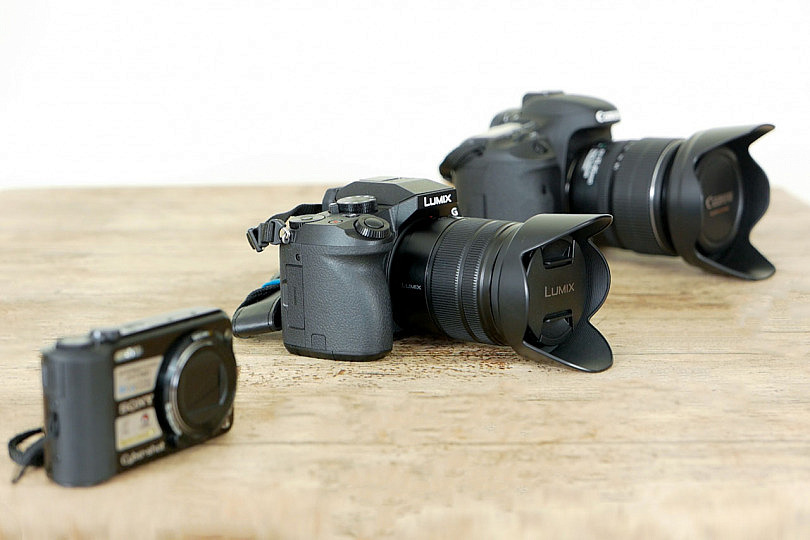
Camera categories overlap. A mirrorless camera can be full frame or APS-C, stills-focused or video-focused, inexpensive or professional. A compact camera can use a tiny sensor or a large one. Understanding the design and tradeoffs is more useful than relying on the label.
The two biggest camera groups
Most everyday cameras belong to one of two broad groups:
- Fixed-lens cameras have a lens permanently attached. Smartphones, compact cameras, bridge cameras, and action cameras fit here.
- Interchangeable-lens cameras let you remove the lens and select another compatible lens. Mirrorless cameras and DSLRs are the main digital examples.
A fixed lens makes the complete camera simpler and often smaller. An interchangeable system gives you more ways to adapt the camera, but it also adds decisions, cost, and equipment to carry.
Smartphone cameras
A smartphone is the most accessible camera because it is already with you, connected, and ready to edit or share. Its software can combine several exposures, recognize scenes, reduce noise, simulate shallow depth of field, and produce a finished-looking image with little work.
Most phones contain several small camera modules rather than one optical zoom lens. Switching from an ultra-wide to a main or telephoto view may switch physical cameras. Intermediate settings can use cropping or computational blending, so image quality may vary across the displayed zoom range.
Best for: everyday life, family moments, travel records, social media, location scouting, notes, and anyone who values speed and simplicity.
Limitations: small controls, limited optical reach, less natural background separation, and declining detail in low light or with heavy digital zoom. Manual control and external accessories also vary by phone and app.
A smartphone is not merely a beginner device. It is a capable camera with a particular balance of size, automation, and connectivity.
Compact or point-and-shoot cameras
A compact camera combines a fixed lens, sensor, screen, controls, and battery in one portable body. The common phrase point-and-shoot emphasizes automatic operation, but some premium compacts offer manual exposure, RAW files, fast lenses, viewfinders, and sophisticated autofocus.
Compact cameras vary widely. A pocket zoom may use a small sensor to fit a long focal range into a slim body. A premium compact may use a larger 1-inch, Four Thirds, or APS-C sensor with a shorter zoom or fixed prime lens.
Best for: travel, daily carry, quiet events, photographers who want physical controls without building a lens collection, and situations where a phone is distracting or inappropriate.
Limitations: the lens cannot be replaced, and compactness can mean a smaller grip, shorter battery life, or limited buttons. A damaged lens can also make the whole camera unusable.
Bridge cameras
A bridge camera is a fixed-lens camera shaped somewhat like a small DSLR. Its defining feature is usually a very large zoom range, often stretching from wide angle to extreme telephoto.
The small sensor used in many bridge cameras makes that reach possible without the lens becoming enormous. This is helpful for distant birds, the moon, travel, and daylight sports. A deep grip and electronic viewfinder can make a bridge camera easier to hold than a pocket compact.
Best for: photographers who want one body with extensive reach and do not want to change lenses.
Limitations: image noise and dynamic range can suffer in dim light, and a narrow aperture at the telephoto end may require higher ISO. The attached lens cannot be upgraded separately.
Mirrorless cameras
A mirrorless interchangeable-lens camera sends light from the lens directly to the image sensor. The sensor supplies the live image shown on the rear screen or in an electronic viewfinder, commonly shortened to EVF.
The electronic preview can show exposure, white balance, picture style, focus aids, and playback without moving your eye away from the viewfinder. Modern mirrorless cameras also use sensor-based autofocus for stills and video, often with face, eye, animal, vehicle, or other subject recognition depending on the model.
Removing the DSLR mirror box can reduce body depth and gives lens designers a shorter distance between mount and sensor. The complete kit is not automatically small, however. A fast full-frame zoom remains large because of the image circle, aperture, focal range, and construction it requires.
Best for: beginners who want room to grow, hybrid photo and video work, travel with a carefully chosen small kit, portraits, sports, wildlife, and professional systems.
Limitations: the viewfinder and sensor consume power continuously, menus can be complex, and building a lens system can cost much more than the initial kit. An EVF may also show lag or noise in very dark conditions.
DSLR cameras
DSLR means digital single-lens reflex. Light entering the lens reflects from a mirror into an optical viewfinder. When you take a photograph, the mirror moves out of the way so light can reach the sensor.
The optical finder shows the scene directly through the taking lens without turning it into a video feed. This gives a natural view and uses little battery power while you compose. DSLR bodies often have substantial grips, dedicated controls, long battery life, and access to large used-lens markets.
When using the rear screen, a DSLR operates in live view with the mirror raised. Autofocus behavior in live view depends heavily on the generation and model.
Best for: photographers who enjoy an optical viewfinder, need long battery life, want strong value from used equipment, or already own compatible lenses.
Limitations: the mirror mechanism adds size and moving parts, and the optical finder cannot preview final exposure or white balance. New product development and the widest selection of newly designed lenses have largely moved toward mirrorless systems.
A DSLR is not obsolete merely because newer systems are mirrorless. If it meets your needs and compatible lenses are available, it remains capable of excellent photographs.
Action cameras
An action camera is a small, durable fixed-lens camera designed for mounting, movement, and a wide view. Electronic stabilization, water resistance or waterproof housings, slow motion, and simple remote control are common priorities.
The very wide lens helps keep the subject in frame when precise composition is difficult. It also creates an immersive sense of speed when mounted close to a bicycle, helmet, surfboard, vehicle, or body.
Best for: sports, underwater use, first-person video, harsh environments, vehicle mounting, and angles that would risk a larger camera.
Limitations: small sensors and batteries, limited low-light performance, fixed wide perspective, and audio that may suffer in wind or inside a waterproof enclosure.
360 cameras
A 360 camera usually uses two or more ultra-wide lenses to record nearly everything around the camera. Software stitches the views into a spherical image or video. You can then choose a conventional-looking frame afterward, create an interactive view, or display the footage in a headset.
Best for: immersive tours, creative reframing, action footage where pointing the camera is difficult, property documentation, and virtual-reality content.
Limitations: stitching seams, vulnerable protruding lenses, large files, extra processing, and lower detail in any one reframed direction than the headline total resolution may imply.
Instant cameras
An instant camera produces a physical print shortly after exposure. Some expose instant film optically; others combine a digital camera with a small printer. The limited number of frames and tangible result can make the process social and deliberate.
Best for: parties, guest books, gifts, travel keepsakes, creative projects, and photographers who value an object more than technical perfection.
Limitations: recurring film cost, limited exposure control on basic models, sensitivity to temperature, and results that can vary between film stocks and storage conditions.
Film cameras
A film camera records light on photosensitive film rather than a digital sensor. Common types include 35mm SLRs, rangefinders, compact cameras, instant cameras, medium-format cameras, and large-format view cameras.
The camera type affects focusing and handling, while the chosen film affects sensitivity, color, grain, and processing. Film must be developed before the images can be printed or scanned.
Best for: photographers who enjoy a physical process, particular film rendering, mechanical cameras, darkroom printing, or a slower shooting rhythm.
Limitations: film and processing cost, delayed feedback, aging equipment, uncertain light seals or meters, and the need to scan for a digital workflow.
Digital rangefinder-style cameras
A true rangefinder camera focuses by aligning two images in a separate optical viewing system rather than looking directly through the lens. Some modern digital cameras are true rangefinders, while many others only borrow the compact, flat-topped body shape and use an electronic viewfinder.
Rangefinders can offer a quiet, direct way of working with small prime lenses. Their separate view introduces framing differences at close distances, and long or macro lenses are less natural to use than on through-the-lens systems.
Medium-format digital cameras
Medium format refers to sensors larger than the 36 × 24mm full-frame format, though current digital sizes vary. The larger recording area can support high resolution, wide dynamic range, subtle tonal transitions, and shallow depth of field for the same field of view and framing.
Best for: commercial products, fashion, studio portraits, fine art, landscapes, and other work where image quality and controlled technique outweigh speed and portability.
Limitations: system cost, larger files, fewer lens choices, and in some models slower autofocus, bursts, or video features than general-purpose full-frame cameras.
Cinema and professional video cameras
A cinema camera is designed around motion-picture production. Priorities may include robust recording formats, high bit depth, log or RAW capture, cooling for long takes, timecode, professional audio, monitoring tools, and a body that can be rigged with accessories.
A mirrorless camera may be more convenient for one person shooting both stills and video. A cinema camera becomes valuable when recording reliability, post-production flexibility, crew workflow, and connections matter more than compactness or still-photo features.
Sensor size is not a camera type
Full frame, APS-C, Micro Four Thirds, 1-inch type, and medium format describe the approximate recording area—not whether a camera is mirrorless, compact, or professional.
Larger sensors can offer advantages in low light, dynamic range, resolution, or depth-of-field control when comparing similar technology and output. Smaller sensors can enable smaller lenses, greater apparent reach, lower cost, and deeper depth of field. The complete system and final image matter more than sensor size in isolation.
How to choose the right camera type
- Start with the result. Decide whether you mainly need family photographs, wildlife reach, video, prints, travel portability, or professional production.
- Be honest about carrying it. A smaller camera used daily is more valuable than a larger one left at home.
- Choose fixed or interchangeable lenses. Lens choice adds flexibility but also expense, dust exposure, and bag space.
- Try the controls. Grip, viewfinder, screen movement, menu clarity, and button placement affect every photograph.
- Check the whole system. Price the lenses, spare batteries, memory cards, microphone, flash, bag, and computer storage you will actually need.
- Plan for difficult conditions. Consider autofocus, low light, weather sealing, heat limits, battery life, and recording duration for your real subjects.
If you choose an interchangeable-lens system, our guide to camera lens types explains what the major lens labels mean. If you already have a camera, the beginner camera guide provides a practical first setup.
Common buying mistakes
- Choosing by megapixels alone. Lens quality, autofocus, handling, light, and technique can have greater impact.
- Buying a body before checking lenses. The available and affordable lenses define an interchangeable system.
- Assuming full frame is always necessary. Many subjects benefit from smaller, lighter, or less expensive formats.
- Ignoring used equipment. A well-kept DSLR or earlier mirrorless body can offer excellent value, but inspect condition and battery availability.
- Paying for features you will not carry. Rugged construction and large batteries add weight; tiny bodies may sacrifice grip and controls.
- Expecting a new camera to replace practice. Better equipment expands possibilities, but it does not choose light, timing, focus, or composition for you.
Sources and further reading
The DSLR and mirrorless design explanations were checked against Nikon's official Mirrorless vs. DSLR Cameras guide. Sensor-format details were cross-checked with Nikon's DX and FX Formats reference, and Sony's APS-C and Full-Frame Compatibility guide was used to verify the distinction between camera mount and recording area.
Frequently Asked Questions
-
A smartphone or compact camera is best when simplicity and portability matter most. An entry-level mirrorless camera with a kit lens is a flexible choice when the beginner wants manual controls, lens options, and room to grow. The best starting camera is one the person will carry and practice with.
-
A DSLR reflects light through a mirror into an optical viewfinder, then raises the mirror for the exposure. A mirrorless camera sends light directly to the sensor and displays the sensor's live feed on a screen or electronic viewfinder.
-
It depends on the models and use. A compact may offer an optical zoom, physical controls, viewfinder, RAW files, or more comfortable handling. A phone normally wins for convenience, computational processing, editing, and immediate sharing.
-
No. Professionals use full frame, APS-C, Micro Four Thirds, medium format, smartphones, action cameras, and specialized systems according to the assignment. Reliability, lenses, workflow, access, and the final output matter more than a single sensor format.
-
Choose interchangeable lenses if you expect to need specialized views, apertures, close focus, or professional accessories. If portability and a complete one-piece solution matter more, a fixed-lens compact, bridge, or action camera may be more practical.