DSLR vs. Mirrorless Camera: The Differences That Matter
Compare DSLR and mirrorless cameras by viewfinder, autofocus, battery life, lenses, size, video, shutter behavior, and long-term system value.
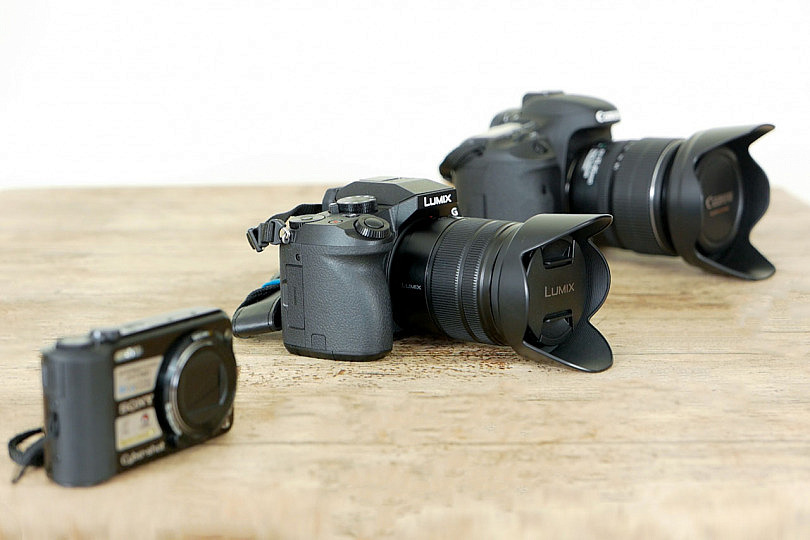
How a DSLR works
DSLR means digital single-lens reflex. Light enters the taking lens and strikes a mirror angled toward a focusing screen and optical viewfinder. When you press the shutter, the mirror rises, the shutter exposes the sensor, and the mirror returns.
The optical viewfinder shows the scene directly through the lens. It uses almost no battery while you compose, has no display refresh lag, and remains natural-looking in bright or dark conditions. It cannot preview the final exposure, white balance, or picture style.
How a mirrorless camera works
A mirrorless camera removes the reflex mirror and optical finder path. Light reaches the image sensor continuously, and the sensor sends a live image to the rear screen or an electronic viewfinder.
The EVF can preview brightness, color, depth of field, histograms, magnification, focus peaking, and playback. Because it is a display, it consumes power and can show noise, reduced refresh, or lag in difficult light. Modern finders vary widely in resolution, refresh rate, blackout, and dynamic-range rendering.
Image quality
Neither design is inherently sharper or less noisy. Image quality depends on sensor size and generation, lens, exposure, processing, stabilization, and technique. A DSLR and mirrorless camera with comparable sensors can produce comparable RAW files.
Mirrorless mounts can give lens designers a shorter flange distance and additional optical options, especially for wide or compact designs. That does not make every mirrorless lens better than every DSLR lens; compare specific products.
Autofocus
Traditional DSLR viewfinder autofocus uses a separate phase-detection module. It can be fast and efficient, especially on higher-end bodies, but focus points often cover a smaller central region. Calibration differences between the separate AF path and imaging sensor can produce front- or back-focus with some lens/body combinations.
Mirrorless cameras focus using the imaging sensor. Current systems commonly offer wide-frame coverage and detection for eyes, faces, animals, vehicles, and other subjects. Performance varies dramatically by model, lens, firmware, light level, and subject.
When a DSLR uses rear-screen live view, it also focuses from the sensor, but speed and tracking depend on its generation. Do not compare categories without comparing the exact cameras in the intended shooting mode.
Viewfinder experience
Optical finder advantages
- direct view with no pixelation or refresh delay;
- very low power use;
- natural scene brightness rather than a simulated exposure; and
- comfortable continuous observation for some photographers.
Electronic finder advantages
- exposure and white-balance preview;
- image review without lowering the camera;
- focus magnification, peaking, histogram, and zebras where supported;
- brightened viewing in dim light; and
- the same general display behavior for stills and video.
An EVF preview is still a processed representation. It can hide highlight detail or brighten darkness in a way the final file does not. Use exposure tools as well as appearance.
Size and weight
Removing the mirror box can make a mirrorless body thinner and lighter. The saving is most noticeable with a small sensor, compact prime, or collapsible kit zoom.
The lens often dominates the kit. A 70–200mm f/2.8 or 600mm wildlife lens remains large because of focal length, aperture, image circle, and construction. Some mirrorless bodies are intentionally large for cooling, battery, controls, durability, or balance.
Compare the full setup you will carry: body, two or three lenses, spare batteries, adapter, charger, and accessories.
Battery life
A DSLR can compose through its optical finder without continuously powering the sensor and display, so it generally makes more viewfinder photographs per charge. Mirrorless cameras power the sensor and screen or EVF whenever you view the scene.
Real use depends on bursts, review time, wireless connections, temperature, video, stabilization, and power-saving settings. A spare battery is a straightforward solution, but it adds cost and charging management.
Lenses and adapters
DSLR systems have decades of native lenses and a large used market. Compatibility within one mount may still vary by autofocus motor, aperture control, stabilization, and camera generation.
Mirrorless mounts have rapidly expanding native lens selections. Their shorter flange distance often makes it possible to adapt DSLR lenses while retaining infinity focus. Autofocus speed, continuous tracking, stabilization, burst rate, corrections, and teleconverter use can be limited by the exact lens and adapter.
An adapter is useful for transition, not a guarantee that an old lens behaves like a new native one. Consult official compatibility tables. Our camera lens types guide explains the other labels you will encounter.
Video
Mirrorless cameras are designed around continuous sensor viewing, so modern models generally receive the newest video autofocus, codecs, frame rates, stabilization, monitoring tools, and cooling designs.
DSLRs can make excellent video, and some introduced important hybrid features. Their optical finder cannot be used while the sensor records video, and older live-view autofocus may be less capable. Compare recording limits, rolling shutter, overheating, crop, audio connections, and autofocus rather than resolution alone.
Mechanical and electronic shutters
Every DSLR exposure moves the reflex mirror unless the camera is already in mirror-up or live view. Mirror slap adds sound and can add vibration.
Mirrorless cameras may use a mechanical shutter, electronic first curtain, fully electronic shutter, or—on a few designs—only electronic exposure. Silent electronic operation is valuable, but rolling-shutter distortion and banding under artificial light can appear. “Silent” does not automatically mean artifact-free.
Stabilization
Both designs can use stabilized lenses. In-body image stabilization is common across current mirrorless systems and exists in some DSLR systems. Stabilization reduces blur from camera movement; it cannot freeze a moving subject.
Adapter and lens combinations may require manual focal-length entry or may not coordinate lens and body stabilization fully.
Durability and reliability
A DSLR mirror mechanism adds moving parts, but professional models are proven over extensive service lives. A mirrorless camera removes the mirror but may still contain a mechanical shutter and sensor-stabilization assembly. Reliability is model-specific.
Weather resistance also depends on body construction, sealed lens, closed doors, and correct use. Marketing terms rarely mean waterproof.
Which is better for beginners?
A current mirrorless system is usually the most straightforward new purchase because development, lenses, autofocus, and video features are concentrated there. Exposure preview can also shorten the learning loop.
A well-kept used DSLR can be a better value when budget matters, the required lenses are inexpensive, and video or advanced subject detection is not central. It remains a better camera than a mirrorless body whose lenses you cannot afford.
Buy a system, not a body. The lenses and accessories you can realistically own matter longer than one generation of autofocus or menus.
Should an existing DSLR owner switch?
Keep the DSLR if it reliably delivers the work, the viewfinder suits you, and the lenses meet your needs. Switching is most valuable when a mirrorless feature removes a specific limitation:
- eye or subject recognition improves a real assignment;
- silent operation is necessary;
- video tools or autofocus are required;
- in-body stabilization helps unstabilized lenses;
- wide focus coverage changes composition freedom; or
- a native lens unavailable in the DSLR system solves a need.
Price the full migration and test adapted lenses. Selling a complete mature kit to recreate the same focal lengths can cost more than expected.
Decision checklist
- List the photographs and video you actually make.
- Choose the required lenses and price them before the body.
- Compare grip, controls, menu, screen, and viewfinder in person.
- Test autofocus on your subject, not only a static store display.
- Check battery, card, computer, and file-workflow needs.
- Evaluate used condition, shutter count, service, and battery availability.
For a broader comparison that includes compact, bridge, action, instant, and cinema systems, see the guide to camera types.
Sources and further reading
The optical and electronic viewfinder designs, battery tradeoff, and system differences were checked against Nikon's official Mirrorless vs. DSLR Cameras guide. Mount, adapter, autofocus, and video considerations were cross-checked with Nikon's DSLR to Mirrorless documentation. Exact performance remains model-specific.
Frequently Asked Questions
-
Not inherently. Comparable sensors and lenses can produce comparable files. Mirrorless features may improve the chance of focus, exposure preview, or timing, but light and technique still determine the photograph.
-
No. They remain capable tools with strong used-lens ecosystems. New development is concentrated in mirrorless systems, which matters more for a long-term new purchase than for a DSLR that already meets its job.
-
Many current mirrorless cameras offer broader sensor-based coverage and advanced subject detection. Performance varies by body, lens, firmware, light, subject, and settings, so compare exact models.
-
The optical viewfinder does not require the sensor and display to run continuously. A mirrorless camera powers its sensor and rear screen or electronic finder while composing.
-
Often, with the correct adapter. Autofocus, stabilization, burst speed, corrections, and teleconverter compatibility vary, so consult official compatibility information for the exact combination.