What Is an ND Filter? Stops, Strengths, and Uses Explained
Learn how neutral-density filters reduce light, how ND numbers and stops relate, and how to use fixed, variable, and graduated filters for photos and video.
What “neutral density” means
Density describes how much light the filter blocks. Neutral means it should reduce red, green, and blue light evenly instead of changing white balance. No physical filter is perfectly neutral, especially at high strengths, but a good one keeps any color shift small and correctable.
The filter does not change the light within the scene. It reduces all light reaching the lens or sensor through its covered area. The camera must compensate with shutter speed, aperture, ISO, or a combination.
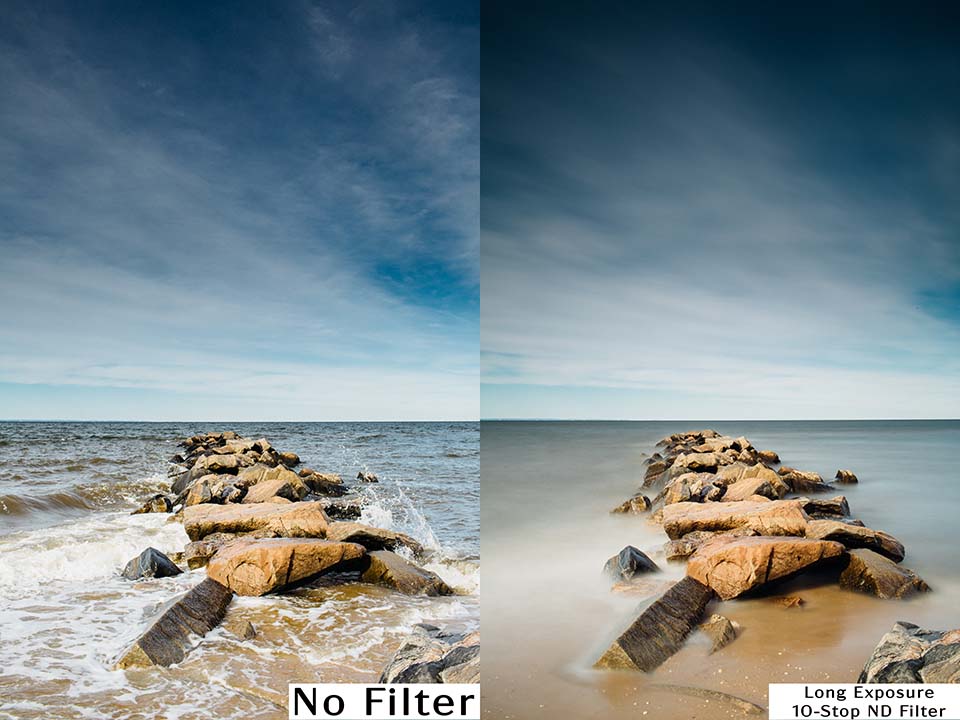
Three naming systems
Manufacturers label strength in stops, filter factor, or optical density. These systems describe the same reduction:
| Stops | Filter factor | Optical density | Light transmitted |
|---|---|---|---|
| 1 | ND2 | ND 0.3 | 1/2 |
| 2 | ND4 | ND 0.6 | 1/4 |
| 3 | ND8 | ND 0.9 | 1/8 |
| 6 | ND64 | ND 1.8 | 1/64 |
| 10 | ND1000 or ND1024 | ND 3.0 | about 1/1,000 |
Confusion arises because some brands print “ND8” to mean an eight-times factor—three stops—while other product names emphasize “ND 0.9.” Read the specification rather than assuming the largest number means the darkest filter.
Fixed ND filters
A fixed ND has one strength across the frame. Common choices include 3, 6, and 10 stops. Fixed filters generally offer predictable density and fewer polarization artifacts than variable models.
A 3-stop filter is useful for opening the aperture or modestly slowing motion. Six stops can turn 1/125 second into roughly half a second. Ten stops can turn 1/125 second into about eight seconds.
Round screw-in filters are compact and sealed at the edges. Square or rectangular systems fit a holder and make it easier to combine solid and graduated filters or use one set across several lens diameters.
Variable ND filters
A variable ND uses two polarizing layers. Rotating one changes how much light passes through. It is fast for video or changing outdoor light because the photographer can adjust density without swapping glass.
The usable range is limited. Near maximum density, wide lenses can show a dark X-shaped pattern or uneven sky. Color shift and polarization can change as the filter rotates. A variable ND can also alter reflections and blue-sky brightness because polarization is part of its operation.
Respect the marked minimum and maximum stops. If the image develops a cross, backing off is the solution; editing cannot restore evenly blocked light.
Graduated ND filters
A graduated ND transitions from dark to clear. It can hold back a bright sky while leaving land or water less affected. Options include hard-edge, soft-edge, medium, and reverse gradients.
- Hard edge: works with a level, clearly defined horizon such as the sea.
- Soft edge: blends more gently through mountains, trees, or uneven horizons.
- Reverse grad: is darkest near the center and lighter toward the top, useful when the horizon itself is brightest.
Buildings, trees, and mountains that rise into the dark area also become darker. Exposure bracketing can provide more selective control for stationary scenes, but a physical grad remains useful when movement prevents merging or when you want a near-finished single capture.
ND versus a polarizing filter
A circular polarizer reduces reflections from nonmetallic surfaces and can deepen parts of a blue sky. It also costs light—often around one to two stops—but that is a side effect, not its primary purpose.
A solid ND is designed to reduce exposure uniformly. It does not remove reflections in the same controlled way. Combining the two can increase flare, vignetting, and uneven skies, especially on wide lenses.
How to calculate a long exposure
- Compose and focus without a very dark filter.
- Set Manual exposure and low ISO.
- Make a correct unfiltered test exposure.
- Convert the shutter speed by doubling it once per stop.
- Attach the filter without moving focus or the zoom ring.
- Cover the optical viewfinder on a DSLR if stray light can enter.
- Make the filtered exposure and check the histogram.
Starting from 1/30 second:
- 3 stops → 1/4 second;
- 6 stops → about 2 seconds; and
- 10 stops → about 34 seconds.
Camera rounding means displayed values may differ slightly. For exposures beyond 30 seconds, use Bulb or Time mode and a timer or remote release.
Our shutter-speed stops guide provides the complete doubling sequence.
Focus and metering with strong ND
A 10- or 15-stop filter can leave too little light for reliable autofocus, live-view refresh, or metering. Focus first, then switch to manual focus if the lens or camera might refocus during release.
Some mirrorless cameras can meter through strong ND in good light, but verify with the histogram. Long-exposure reciprocity is reliable for digital sensors, yet light leaks, temperature, changing clouds, and filter color can still affect the result.
Long exposures of water and clouds
Shutter time determines the visual effect:
- around 1/4 to 1 second shows flowing streaks while retaining texture;
- several seconds smooths waves and waterfalls;
- 30 seconds to several minutes can make water glassy and stretch clouds dramatically.
There is no universally correct duration. It depends on movement speed, focal length, distance, wind, and the story. A little texture can feel more natural than completely featureless water.
Wide-aperture portraits in daylight
Bright sun may exceed the camera's maximum shutter speed when you want f/1.4 or f/2. Adding ND allows the wider aperture without lowering ISO below its useful base setting.
For flash portraits, ND can keep shutter speed at or below normal flash-sync speed while preserving a wide aperture. The filter also reduces ambient and flash light passing through the lens, so the flash must provide more power or move closer. High-speed sync solves a similar exposure problem but loses flash efficiency in a different way.
ND filters for video
Video often uses a shutter time near half the frame interval for familiar motion blur—for example, around 1/50 second at 25 fps or 1/60 at 30 fps. In bright daylight, base ISO and the desired aperture may overexpose at that shutter.
ND controls exposure without forcing an unnaturally fast shutter or unwanted depth of field. Cinema cameras may have built-in switchable ND; mirrorless and compact cameras often use screw-in, magnetic, matte-box, or adapter-mounted filters.
The “180-degree shutter” is a creative convention, not a law. Fast action, stabilization, slow motion, or a deliberate staccato effect may require another setting.
Filter size and step-up rings
Buy for the largest lens diameter you plan to use, then attach it to smaller lenses with step-up rings. This is cheaper than duplicating expensive filters. A large filter can block a lens hood, make caps awkward, and add leverage, so balance convenience against size.
Thin frames help avoid mechanical vignetting on ultra-wide lenses. Stacking filters increases the risk because the front rim enters the field of view.
Color cast and infrared pollution
Strong ND can transmit wavelengths unevenly, creating warm, cool, green, or magenta color. Shoot RAW, set a stable white balance, and make a reference frame. A color correction is easiest when the cast is uniform.
During very heavy filtration, visible light may be reduced more than infrared. Some sensors and dark fabrics then take on a reddish or brown cast. Filters designed with infrared control can reduce the problem for demanding stills and cinema work.
Reflections, flare, and cleanliness
Every flat glass surface can reflect light. Use coated filters, shade the lens, and avoid unnecessary stacks. A tiny smear can glow across a long exposure when the sun or a streetlight strikes it.
Clean both sides before mounting. Strong ND may make viewfinder inspection difficult, so dust discovered after a two-minute exposure is expensive.
Common mistakes
- Confusing ND8 with eight stops. It normally means an eight-times factor, or three stops.
- Turning variable ND beyond its limit. The dark cross is an optical interaction, not extra usable density.
- Focusing through an extremely dark filter. Establish and lock focus first.
- Using ND to fix every bright sky. A solid filter darkens the whole frame; a grad, bracket, or changed light may be better.
- Stacking several cheap filters. Flare, softness, color shift, and vignetting accumulate.
- Assuming neutral means colorless. Test and correct the actual filter.
Frequently Asked Questions
-
It reduces the amount of light entering the lens, allowing a slower shutter speed or wider aperture without overexposing. A good filter aims to preserve color while changing exposure.
-
ND8 as a filter factor means three stops because it transmits one-eighth of the light. An optical-density label of ND 0.9 also represents three stops.
-
A 3- or 6-stop fixed ND is versatile for moderate motion blur and wide apertures. A 10-stop filter is specialized for long daylight exposures. Video shooters may prefer a high-quality variable ND within its usable range.
-
It is usually unnecessary. The filter forces slower shutter speeds or higher ISO in dim light and adds surfaces that can flare. Mount it when you need deliberate exposure reduction.
-
No. ND is intended to reduce exposure evenly. A polarizer controls certain reflections and sky brightness while also losing some light. Variable ND filters use polarizing layers but are designed primarily for adjustable density.