How to Choose a Tripod Head for Landscape Photography
Compare ball, three-way, geared, leveling, panoramic, and gimbal heads for precise landscape framing, panoramas, long lenses, and travel.
What the head controls
Tripod legs establish the stable platform. The head connects that platform to the camera and controls orientation. It must resist gravity and vibration while allowing deliberate movement.
A poor head can sag after locking, twist during a long exposure, or let the camera flop when loosened. A good one disappears from the process.
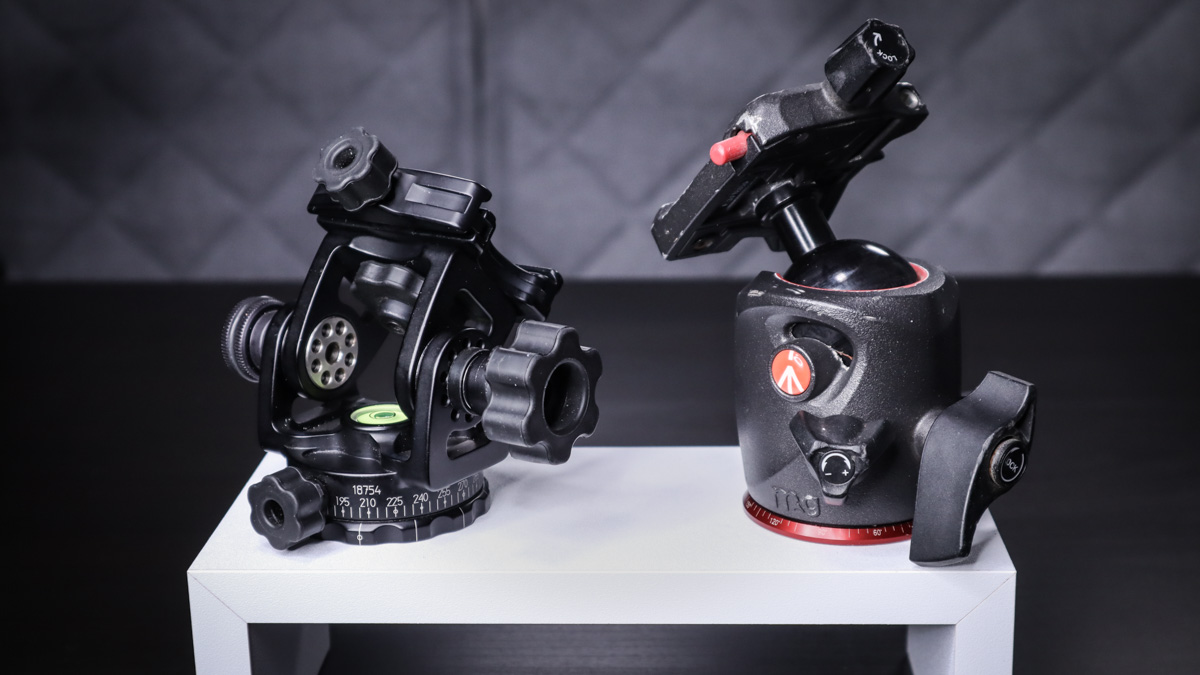
Ball heads: the versatile default
A ball head places the camera platform on a metal ball. Loosen one main knob and the camera can tilt, roll, and rotate freely. Tighten it to lock every direction.
Advantages:
- fast composition;
- compact size and low weight;
- easy camera orientation;
- wide price and capacity range; and
- separate panoramic base on many models.
Limitations:
- loosening the ball changes several axes at once;
- heavy off-center gear can flop suddenly;
- the camera may droop after locking; and
- leveling one axis can disturb another.
For hiking, changing light, and general landscapes, a high-quality ball head with friction control is difficult to beat.
Three-way pan-and-tilt heads
A three-way head provides independent controls for pan, forward/back tilt, and side tilt. You can correct a sloping horizon without changing camera pitch.
This is useful for deliberate landscapes, architecture, stitched images, and photographers who dislike a ball head's free movement. Handles make controls obvious but add bulk and can catch on a bag.
Folding-handle designs pack more easily. Check whether the camera remains balanced when tilted into portrait orientation.
Geared heads
A geared head also separates the axes, but knobs move the camera in small mechanical increments. Many allow a clutch release for a large adjustment, followed by geared fine-tuning.
They excel when a few pixels of horizon or building alignment matter. They are popular for architecture, interiors, macro, product work, and careful landscape composition.
The tradeoffs are weight, cost, slower movement, and more mechanisms exposed to sand or ice. Lightweight geared heads exist, but payload and stiffness vary.
Leveling bases and leveling heads
A leveling base tilts a limited amount beneath the main head. It lets you make the head's panning axis truly vertical without adjusting three tripod legs repeatedly.
This is particularly valuable for multi-row panoramas and video pans. Once the base is level, panning does not make the horizon rise and fall.
A tripod bowl and half-ball provide the same quick leveling concept in many video systems. Confirm diameter and flat-base compatibility.
Panoramic heads and rails
A panoramic rotator provides measured click stops or degree markings. A rail moves the camera so the lens's entrance pupil sits near the rotation axis, reducing parallax between close foreground and distant background.
You may not need a full panoramic head when all subjects are far away. For interiors, railings, trees, and nearby rocks, careful alignment makes stitching much more reliable.
An L-bracket helps keep the lens centered over the rotation axis when switching to vertical orientation.
Gimbal heads
A gimbal balances a long lens around its center of gravity, allowing nearly effortless pan and tilt. It is intended for wildlife and sports rather than ordinary wide-angle landscape work.
It becomes useful for telephoto landscapes when the lens is large and you must track changing light or moving subjects. It is bulky and does not naturally provide fine three-axis leveling for architecture.
Fluid video heads
A fluid head applies controlled resistance to pan and tilt for smooth motion. It uses a long plate so the camera can slide into balance and may include counterbalance.
For still landscapes it can hold a camera securely, but it normally lacks easy roll adjustment unless paired with a leveling base. Hybrid creators may accept that tradeoff to avoid carrying two heads.
Load capacity: use it carefully
Manufacturers test payload under their own conditions, and numbers are not perfectly comparable. A head that safely holds 20 pounds may still droop with a long lens whose center of gravity sits far from the clamp.
Add the camera, lens, collar, bracket, filter system, microphone, and anything mounted on the hot shoe. Choose margin for off-center torque and wind, but do not buy an enormous head that makes you leave the tripod at home.
Ball diameter and droop
Larger ball heads generally offer more contact area and smoother control under heavy load. Quality of machining, surface coating, socket design, and lock mechanism also matter.
Test by framing a detailed object, tightening normally, and watching whether the camera settles downward. A tiny shift becomes visible with telephoto or macro lenses.
Friction control
Friction sets the minimum resistance when the main lock is loosened. Adjust it so the camera can move deliberately but will not collapse if you release your grip.
This improves safety and fine framing. It is not a substitute for locking the head before letting go.
Independent pan lock
A separate panning base allows horizontal rotation while the ball or axes remain fixed. For a level panorama, the pan base itself must be horizontal. A camera's hot-shoe bubble can show the camera is level while the base below it remains tilted.
Some ball heads place an additional pan mechanism above the ball. Level the camera with the ball, then use the top pan for a convenient single-row panorama.
Quick-release plates and clamps
The Arca-style dovetail has become common across many brands, but dimensions and safety stops are not perfectly universal. Test the exact plate and clamp.
Lever clamps are fast but sensitive to plate width. Screw clamps adjust across small variations and are slower. Proprietary plates can be secure but may lock you into one manufacturer.
Use the correct screw length. A screw that bottoms out before tightening can let the camera rotate.
Why an L-bracket helps landscapes
An L-bracket places compatible dovetails along the camera's bottom and side. To switch orientation, remove the camera and clamp the other side rather than dropping the ball into a portrait notch.
This keeps the camera centered over the tripod, preserves height, and improves panorama alignment. Confirm access to the screen, ports, battery, and remote socket.
Bubble levels
A level on the tripod, head, clamp, camera, or screen can measure different parts of the system. For a single image, level the camera if that is your compositional goal. For a panorama, level the rotation axis.
Built-in bubbles can be slightly inaccurate after impact. Compare them with the camera's electronic level and a known reference.
Cold, gloves, sand, and rain
Large textured knobs are easier with gloves. Grease can feel stiffer in cold conditions. Open ball designs shed debris differently from enclosed sockets, and gears can trap sand.
Do not force a gritty mechanism. Brush away loose debris and follow manufacturer cleaning guidance. A head cover can protect controls during blowing rain or sand.
Matching head to landscape style
- Travel and hiking: compact ball head with independent pan and secure Arca-style clamp.
- Architecture and interiors: geared or three-way head for independent axes.
- Panoramas: leveling base, rotator, and rail when foreground is close.
- Telephoto landscapes: strong ball head, gimbal, or fluid head depending on movement.
- Hybrid photo/video: compact fluid or hybrid head with leveling capability.
- Macro in the field: geared head or precise ball head with rail.
A store test
- Mount your heaviest real camera and lens.
- Set the lens at its longest or most front-heavy position.
- Frame a small target and lock the head normally.
- Watch for droop, twist, and plate movement.
- Loosen it while holding the camera and assess control.
- Switch between horizontal and vertical orientation.
- Operate every knob with gloves.
- Pack the head with your tripod to check total carried size.
Common mistakes
- Choosing by payload alone. Torque, droop, control, and balance matter.
- Leveling the camera but not the pan axis. Panorama horizons can still arc.
- Using a ball head without friction for heavy gear. The camera can flop suddenly.
- Assuming every Arca-style plate is identical. Verify clamp fit and safety stops.
- Dropping the camera into a portrait notch unnecessarily. An L-bracket keeps it centered.
- Buying precision you will not carry. A heavy geared head is useless if it stays home.
Frequently Asked Questions
-
A quality ball head is the best general balance of speed, weight, and flexibility. Choose a three-way or geared head when independent-axis precision is more important than fast composition.
-
A ball head is faster and more compact. A three-way head lets you adjust pan, pitch, and roll independently, making careful horizons and architecture easier.
-
Not for every distant panorama. A leveling base and normal pan mechanism may work. A rail or full panoramic head becomes important when close foreground objects create parallax during rotation.
-
Add the complete setup and choose reasonable margin, but test real droop and control. Published load numbers use different methods and do not fully describe off-center torque from long lenses.
-
It lets the camera clamp in horizontal or vertical orientation while staying centered over the tripod. This improves stability, height consistency, and panorama alignment.