Fill-The-Frame Photography Composition
Give a subject more visual weight by moving closer, changing focal length, or cropping—while preserving perspective, meaningful context, and clean frame edges.
What filling the frame means
A frame is filled when the main subject, detail, color, or pattern dominates the image area. That does not require the subject to touch all four sides. It means the viewer does not need to search for what matters.
This technique is useful when the background adds clutter, the subject contains important detail, or you want an immediate and intimate feeling.
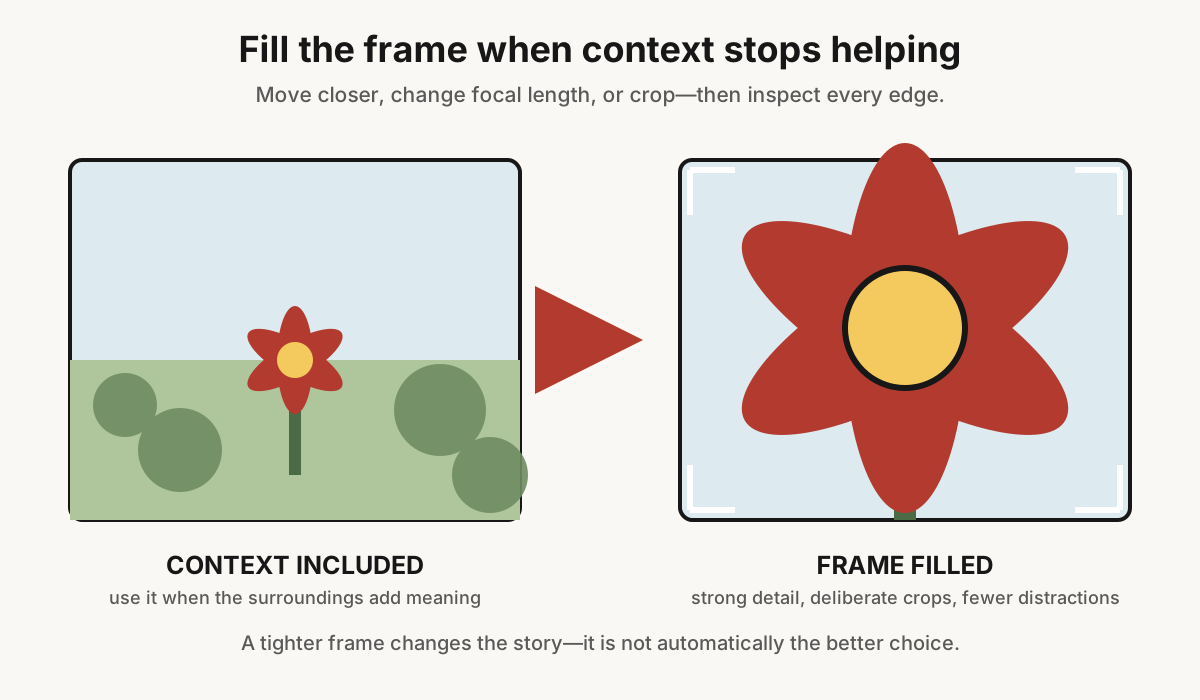
Move closer, zoom, or crop?
All three make the subject larger in the final image, but they change the process differently.
- Move closer: changes camera-to-subject distance and therefore perspective. Near-far size relationships become more pronounced.
- Use a longer focal length from the same position: narrows the angle of view and magnifies the same perspective.
- Crop later: uses fewer recorded pixels and gives flexibility, but cannot add detail the camera never resolved.
Choose distance for the perspective you want, then choose focal length for framing. Crop as a finishing tool, not a substitute for every in-camera decision.
Why distance changes the look
In a close wide-angle portrait, a nose can appear larger relative to ears because the camera is much nearer to it. Step back and use a longer lens for the same head size, and those relative distances become less pronounced.
For a flower or product, moving close can enlarge the foreground dramatically and reveal depth. For a building detail, stepping back may align shapes more cleanly and reduce convergence.
Know the minimum focus distance
Every lens has a closest distance at which it can focus. If autofocus hunts as you approach, back away slightly or switch to a lens designed for closer work. Extension tubes and close-up lenses can help in specific situations but change working distance and optical behavior.
At close range, depth of field becomes thin. Place focus on the most important detail, stabilize the camera or subject where appropriate, and stop down only as far as shutter speed, background, and diffraction allow.
Clean the background before tightening
Filling the frame reduces background area but does not automatically make it clean. A bright stripe through a head, branch touching a wing, or sign emerging from a shoulder may become more noticeable.
Move sideways, raise or lower the camera, rotate the subject if possible, or wait for the background to clear. A small position change often separates edges better than a wider aperture.
Control the frame edges
Tight compositions live or fail at the boundaries. Scan clockwise before pressing the shutter:
- Are fingers, feet, petals, ears, or equipment cut unintentionally?
- Does a line merely touch the subject and create a tangent?
- Is a bright sliver entering a corner?
- Does one side have less breathing room for no reason?
- Will a publication crop or social-media interface cover an important detail?
Make deliberate cuts through simple areas rather than trimming tiny fragments. An intentional close crop usually looks stronger than almost—but not quite—including the whole subject.
Cropping people
There is no absolute list of forbidden crop points, but avoid accidental-looking cuts through fingertips, toes, or small parts of joints. Cropping through broader areas of the torso, upper arm, thigh, or shin often reads more clearly.
For a face, decide whether hair, chin, ears, and shoulders are part of the design. Extreme crops can emphasize eyes, skin, expression, or makeup, but critical focus and retouching choices become more visible.
Portraits
A tight portrait removes location and directs attention to expression. Use eye autofocus or a carefully placed focus point, keep shutter speed high enough for small movements, and communicate closely with the subject rather than surprising them with an intrusive distance.
A longer lens provides working distance and a narrow background view. A wider lens close to the subject includes more spatial energy and can feel immediate, but perspective must be intentional.
Wildlife and sports
Filling the frame reveals feathers, fur, faces, and athletic detail, but moving closer may be unsafe, unethical, or prohibited. Use appropriate focal length, maintain distance, and prioritize animal behavior and venue rules.
Leave extra room for unpredictable movement, wings, a ball, racket, or spray. High-resolution cropping can refine composition, but severe crops amplify noise, softness, atmospheric haze, and focus errors.
Macro and close-up subjects
A leaf, insect, texture, watch, or food detail can become an abstract field when its edges extend beyond the picture. Decide whether recognition matters. One complete shape gives context; a partial shape emphasizes pattern, surface, or color.
At high magnification, tiny camera movements change framing. Use a stable support, focus rail, burst, or careful handheld technique as appropriate, and watch the corners where out-of-focus clutter may enter.
Street photography
Move closer only when safe, respectful, and culturally appropriate. A tight frame can isolate a gesture, sign, hand, or relationship, but removing surroundings can also change the event's meaning.
Photograph a contextual version first when possible, then a detail. In documentary work, be cautious about cropping away information that materially changes interpretation.
Events and performances
Alternate wide establishing frames, medium interactions, and tight details. A gallery of only close faces has intensity but no sense of place; a gallery of only wide scenes lacks emotional specificity.
Tight frames are ideal for hands, rings, instruments, awards, expressions, and small reactions. Check shutter speed because subject movement becomes more visible at higher magnification.
Architecture, products, and food
Fill the frame with a material, joint, label, facade rhythm, or plated detail when it carries the story. Keep required product features readable and avoid lens choices that distort proportions.
For reflective products, a tighter angle may reveal the camera, photographer, or room in the surface. Shape the reflection with larger diffusion and flags rather than hoping to remove everything later.
Context is not clutter
Background can explain scale, location, relationship, risk, occupation, season, or mood. Removing it may make the image cleaner but less meaningful.
Ask what the viewer loses when the frame gets tighter. If the answer is essential story information, make a medium composition instead. If the answer is only a trash can and empty pavement, move closer.
Negative space can be the subject
Filling the frame is not always literal size. A small silhouette may dominate a large empty field because contrast and isolation give it visual weight. Do not enlarge a subject automatically when scale or solitude is the idea.
The useful question is whether every area of the frame contributes—not whether every area contains the object.
Resolution and image quality
Cropping reduces pixel dimensions. A modest crop from a sharp high-resolution file may still support large output; a severe crop from a noisy, motion-blurred, or soft file may not.
Judge at the intended display size and viewing distance. Do not use AI enlargement as an excuse for weak focus or unethical proximity. Enlargement can create plausible pixels, not recover authentic detail that was never captured.
Focus and depth of field
As the subject grows in the frame, small focus errors become obvious. Focus on the eye, label, texture, or edge that carries meaning. Review critical frames at useful magnification, especially when depth of field is shallow.
Stopping down increases depth of field but may reveal more background and demand a slower shutter or higher ISO. Balance technical sharpness with the visual hierarchy you want.
A two-frame habit
Whenever time allows, make:
- a contextual frame that explains where and what;
- a medium frame that balances subject and environment; and
- a tight frame that emphasizes expression or detail.
This takes seconds with a zoom or a few careful steps and gives an editor—or your future self—real choices.
Common mistakes
- Zooming instead of choosing perspective. Set camera distance for the desired spatial relationship first.
- Clipping small body parts accidentally. Make edge cuts clear and intentional.
- Ignoring minimum focus distance. Back up or change tools rather than accepting soft focus.
- Removing useful context. Clean is not the same as meaningful.
- Cropping too aggressively. Consider output resolution and file quality.
- Approaching wildlife or people irresponsibly. No composition justifies unsafe or disrespectful behavior.
A practice exercise
- Choose one stationary subject in a real environment.
- Make a wide frame that explains the location.
- Move to a distance with pleasing perspective.
- Use three focal lengths without moving.
- Move closer with a shorter lens and compare perspective.
- Create one extreme detail and inspect every edge.
- Review which information each version gains and loses.
Filling the frame is a method of emphasis. Use it when detail and immediacy serve the story, and step back when context is the story.
Frequently Asked Questions
-
It means making the main subject or detail dominate the image area so its importance is clear and unrelated background has less influence.
-
No. Moving changes camera-to-subject distance and therefore perspective. Zooming from the same position changes angle of view and framing without changing that perspective.
-
Compose closely in camera when practical, then use a modest crop for refinement. Cropping offers flexibility but reduces pixel dimensions and cannot restore missing detail.
-
Choose cuts that look deliberate and avoid trimming tiny parts such as fingertips or toes by accident. Expression, pose, clothing, and final layout should guide the exact crop.
-
Keep more space when the environment explains scale, location, relationship, movement, or mood, or when negative space is central to the idea.