Field of View in Photography: Sensor Crop, Aspect Ratio, and Framing
Learn what field of view means, how focal length and sensor size determine it, and how aspect ratio, crop modes, focus distance, and output affect framing.
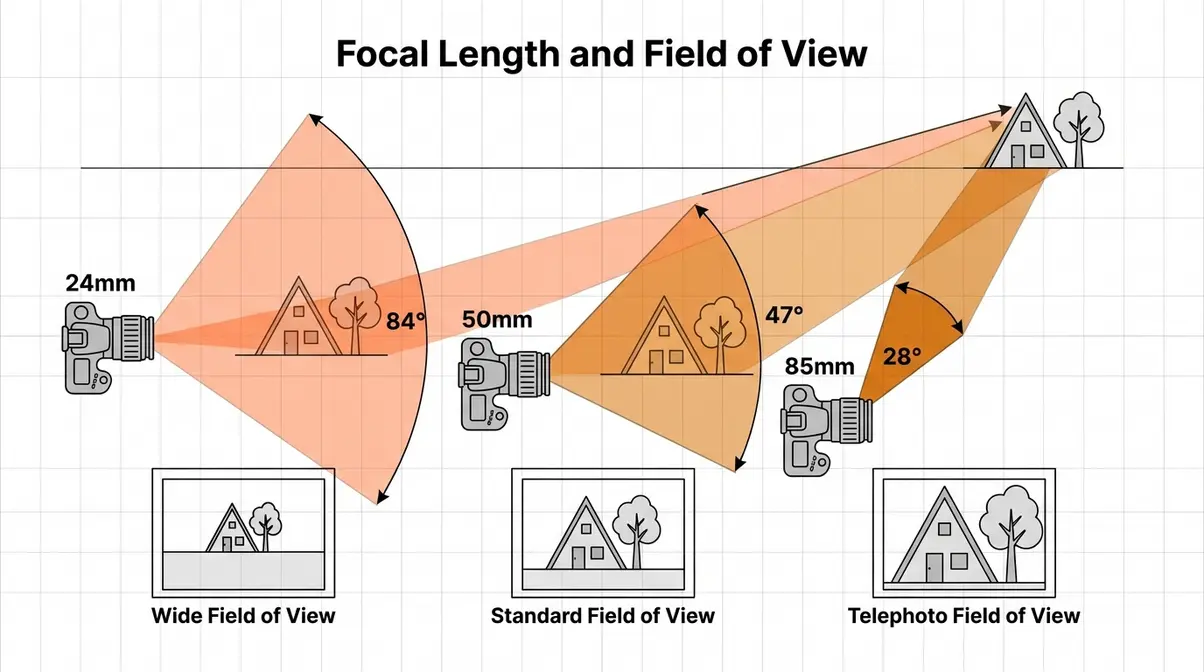
Field of view versus angle of view
The terms are often used interchangeably, but they can describe two related measurements:
- Angle of view is the angular extent the camera records, such as 84 degrees diagonally.
- Field of view is the width or height of the real scene included at a particular subject distance, such as 12 feet across at 10 feet away.
A lens specification normally lists an angle because it remains useful at many distances. A studio, security, or architectural calculation may need the actual width and height at a known distance.
The two main controls
Focal length
With sensor size fixed, shorter focal lengths include a wider angle and longer focal lengths include a narrower one. On a full-frame camera, 24mm is wide, 50mm is moderate, and 200mm is narrow. Those labels shift with sensor format.
Recorded sensor area
With focal length fixed, a larger recorded area captures more of the lens's image circle. A smaller sensor, crop mode, or digital crop records a central portion and therefore narrows the view.
The approximate rectilinear angle for one dimension is:
angle of view = 2 × arctan(sensor dimension ÷ (2 × focal length))
Use sensor width for horizontal angle, sensor height for vertical angle, or sensor diagonal for diagonal angle. The simple formula assumes a lens whose stated focal length and projection behave ideally; actual lens specifications can differ because of distortion and focus behavior.
Horizontal, vertical, and diagonal are not the same
A 36 × 24mm full-frame sensor has a diagonal of about 43.3mm. With a 50mm rectilinear lens, its approximate angles are:
- 40 degrees horizontally;
- 27 degrees vertically; and
- 47 degrees diagonally.
Manufacturers often publish the diagonal value because it is the largest and makes one comparison across formats. For fitting a room, building, or group into the frame, horizontal and vertical coverage can be more useful.
How crop factor predicts the view
Crop factor compares a sensor's diagonal with full frame. A 1.5x APS-C camera records a view similar to a full-frame camera using a lens 1.5 times longer:
- 16mm on APS-C resembles 24mm on full frame;
- 35mm resembles about 52.5mm; and
- 200mm resembles 300mm.
The lens does not become longer. The smaller recording area excludes the outside of the projected image. See APS-C Cameras Explained for depth-of-field and lens-compatibility implications.
Aspect ratio changes what the frame includes
Aspect ratio is the relationship between width and height. Common camera ratios include 3:2, 4:3, 16:9, 5:4, and 1:1.
Changing from 3:2 to 16:9 on the same sensor often crops pixels from the top and bottom. The horizontal view may remain the same while the vertical and diagonal views become smaller. Switching to 1:1 usually removes pixels from both sides, narrowing the horizontal view.
This matters when a camera advertises several image formats. A 16:9 preview may help compose for video or a display, but it does not make the lens optically wider. It changes the recorded boundaries.
Sensor crop, aspect crop, and post-production crop
All three can make the final composition tighter, but they occur at different stages:
- Sensor format: the camera's physical recording area, such as full frame or APS-C.
- In-camera crop mode: the camera reads or saves a smaller area, often to simulate another format or aspect ratio.
- Post-production crop: editing removes outer pixels after capture.
If each uses the same source pixels and processing, equal crops can produce equal coverage. Differences arise from preview accuracy, autofocus coverage, file resolution, readout speed, RAW behavior, and workflow.
Field of view at a known distance
Once you know the angular view, scene width at a given distance can be estimated:
field width = 2 × distance × tan(horizontal angle ÷ 2)
For example, a horizontal angle near 40 degrees covers roughly 7.3 feet at a perpendicular distance of 10 feet. Double the distance and the covered width doubles.
Use the same units for distance and width. Measure from the lens's effective optical reference rather than the front of a long lens when precision is critical.
Why focusing distance can change the view
Many lenses change effective focal length as they focus, especially modern internal-focus zooms and telephoto lenses. The effect is often called focus breathing.
A lens marked 200mm is specified according to manufacturer conventions, normally at infinity focus. At a close distance, its field may become noticeably wider. Video shooters see this as framing expands or contracts during a focus pull.
Macro work adds another complication: extension and magnification make simple infinity-focus formulas less accurate. For precise copy work, test the actual lens at the intended focus and distance.
Lens distortion affects the edges
The standard angle formula assumes a rectilinear projection that keeps straight scene lines straight. Real wide-angle lenses can have barrel, pincushion, or more complex distortion. Cameras and RAW software may correct that distortion by stretching and cropping the image.
The corrected file can therefore have a slightly narrower field than the uncorrected sensor capture. Some mirrorless lenses are designed with software correction as part of the imaging system, so compare the final corrected output.
A fisheye uses a different projection on purpose and can cover an extremely wide angle while bending straight lines away from the center. Its focal length cannot be compared with a rectilinear lens using field of view alone.
Field of view does not create perspective
A wide-angle photograph often appears to exaggerate near objects and a telephoto photograph often appears compressed. The direct cause is the camera position chosen to get the desired framing.
If you photograph from exactly the same position with different focal lengths and crop the wider frame to match, the perspective relationships remain the same. The cropped image may have less detail, but near and far objects keep the same relative sizes.
When you move close with a wide lens to keep a person large in the frame, nearby facial features become relatively prominent. When you move far away and use a long lens, distances appear compressed. Position sets perspective; focal length selects the framing from that position.
Portraits: choose distance before focal length
- Choose a camera distance that renders facial proportions naturally and gives you room to work.
- Select a focal length that frames the desired headshot, half-body, or environmental portrait from that position.
- Check background coverage and working distance.
- Adjust aperture for depth of field, not to fix perspective.
A longer lens does not inherently flatter a face. It encourages a longer shooting distance for the same framing, and that distance changes perspective.
Landscapes and architecture
A wider field can include foreground, sky, and surrounding context, but inclusion is not automatically better composition. Very wide views make distant mountains and buildings occupy fewer pixels and can fill the frame with empty foreground.
For architecture, calculate whether the horizontal and vertical coverage fits from the available camera position. Tilting a wide lens upward introduces converging verticals. A shift lens, higher camera position, stitched panorama, or perspective correction may solve the geometry more effectively than simply going wider.
Wildlife and sports
A narrow field helps a distant subject fill the frame. Before buying a longer lens, consider:
- how easily you can find and track a moving subject;
- whether atmospheric heat shimmer limits detail;
- the shutter speed and aperture available at the long end;
- autofocus and stabilization performance; and
- whether a high-resolution crop already supplies enough pixels.
More focal length narrows context and magnifies camera shake as well as the subject.
Viewfinder coverage and preview differences
Field of view describes what the image records. A viewfinder can show less than 100% of that frame, particularly on some DSLRs, so extra content appears around the saved image. Electronic viewfinders generally preview the sensor output and can display chosen aspect-ratio boundaries, digital zoom, or stabilization crops.
Video stabilization may crop further and can vary dynamically. Confirm the recorded frame rather than trusting the uncropped standby preview.
A practical field-of-view test
- Place the camera on a tripod facing a wall with visible details near all edges.
- Make images at several focal lengths without moving the tripod.
- Switch through available aspect ratios or crop modes.
- Focus once near infinity and once at the minimum distance.
- Compare corrected RAW or JPEG outputs at equal size.
The test reveals crop boundaries, focus breathing, distortion correction, and the difference between focal length and camera position.
Common mistakes
- Quoting an angle without saying horizontal, vertical, or diagonal. The three values differ.
- Treating crop factor as optical magnification. It describes recorded coverage.
- Ignoring aspect ratio. A crop can change one dimension more than another.
- Assuming the marked focal length gives an exact close-focus view. Focus breathing can be substantial.
- Blaming a lens for perspective. Camera position determines spatial relationships.
- Using a formula for a fisheye. Projection mapping changes the relationship between focal length and angle.
Sources and further reading
Focal-length categories and DX/FX fields of view were checked against Nikon's official Understanding Focal Length guide. Sensor dimensions, image-circle coverage, and 1.5x crop behavior were cross-checked with Nikon's DX and FX Formats reference. Aspect-ratio and crop-mode behavior was checked against Nikon's official crop-mode guide.
Frequently Asked Questions
-
It is the extent of the scene included in the image from a given camera position. It can be described as an angular view or as the real width and height covered at a known distance.
-
Focal length and the recorded sensor dimensions are the main controls. Aspect ratio, crop mode, focus breathing, distortion correction, and video stabilization can also change the final boundaries.
-
No. It records a smaller central part of the lens's image circle, creating a narrower field of view. The lens's physical focal length stays the same.
-
Angle of view measures coverage as an angle at the camera. Field of view can mean the actual scene width or height included at a particular distance. In general photography, the terms are often used interchangeably.
-
Camera position directly controls perspective. Changing focal length changes framing from that position. Perspective changes when you move closer or farther to restore the subject's size in the frame.