6 Best Wide Angle Lens of 2026: Match Your Mount and Light

Which wide angle lens suits your camera mount, shooting style, and low-light needs — without paying for features you won't use.

Most wide-angle buyers start with focal length, but the decisions that actually determine satisfaction are mount compatibility, autofocus behavior, and low-light capability. A lens can be sharp in the center yet still frustrate at the edges or indoors when the aperture is too slow.

The trade-off is between zoom flexibility and prime speed. A wide zoom covers more scenes and is often stabilized, while a fast prime lets you shoot in dim interiors, night streets, and astrophotography without pushing ISO to the ceiling. Neither choice is wrong; it depends on how much light your usual scenes demand.

This guide separates those decisions so you can match a lens to your camera mount and your work — not just the spec sheet. Know that edge distortion and corner softness at the widest setting are common, even on highly rated lenses; the best pick for you is the one whose weaknesses you can live with.

1

Best Overall

Canon EF-S 10-18mm IS STM

94 /100
Studio Score High Confidence

Key details

Autofocus
STM
Max Aperture
f/4.5-5.6
Focal & Angle
10-18mm zoom
Mount & Sensor
Canon EF-S
Check Price on Amazon

The Canon EF-S 10-18mm f/4.5-5.6 IS STM gives Canon APS-C DSLR owners a genuinely wide 10-18mm zoom with optical image stabilization and quiet STM autofocus at an entry-level price. It is one of the few budget ultra-wide zooms that keeps the features that matter for everyday shooting: a useful 10mm starting point, stabilization that works for stills and video, and a focus motor that will not make itself the centerpiece of a vlog clip. That combination is rare at this price.

At 10mm, the lens frames room interiors, landscape foregrounds, and tight streets without forcing you to back up. The compact build keeps it from dominating a DSLR during full-day walks, and the image stabilizer shows up clearly in handheld video: wide shots stay steadier than they would with a non-IS zoom. The STM focus pulls are quiet enough for in-camera audio, which matters for vloggers on Canon EF-S bodies. For real-estate walkthroughs, the smooth autofocus and IS make it easier to move through a room without visible hunting.

Center sharpness is acceptable for the price, and the 10-18mm range covers the angles people actually use for interiors and travel. It skips the extreme 8-9mm zone and instead gives a practical width that does not require aggressive correction in every frame. The lens takes standard 67mm filters, so a polarizer or variable ND can move between other lenses in the kit.

This is for Canon EF-S shooters who want an affordable ultra-wide for landscape, real estate, travel, and vlogging. The slow f/4.5-5.6 aperture and corner softness at 10mm are boundaries for low-light and edge-critical work; tripod users and daylight shooters can work around both. Full-frame Canon owners and anyone who needs f/2.8 for handheld low-light should look elsewhere.

For Canon APS-C owners who already have an 18-55mm kit zoom, the 10-18mm adds the width that the kit lens cannot reach. It fills the wide end without forcing a jump to full-frame, and the IS means you do not have to treat every wide shot as a tripod shot.

💡 When shooting in manual, check exposure after changing focal length because the maximum aperture narrows to f/5.6 at 18mm.

Pros

  • Cost-effective way to add a stabilized ultra-wide zoom to a Canon APS-C kit.
  • Center sharpness is solid for the price, with usable detail at common landscape apertures.
  • 10mm coverage gives interiors and landscapes a genuinely wide field of view.
  • Lightweight build and quiet STM autofocus make it practical for video and travel.
  • Optical IS steadies handheld stills and video at shutter speeds that would blur without it.

Cons

  • At 10mm, corners can look soft and barrel distortion may show in straight-lined subjects.
  • The f/4.5-5.6 maximum aperture can force higher ISO or a tripod in dim spaces.
Our verdict

Canon APS-C shooters who need width without full-frame cost get a stabilized, quiet ultra-wide zoom that handles everyday landscape, real estate, and travel work.

Check Latest Price
2

Best Compact RF Prime

Canon RF16mm F2.8 STM

92 /100
Studio Score High Confidence

Key details

Autofocus
STM
Max Aperture
f/2.8
Focal & Angle
16mm, 108°
Mount & Sensor
Canon RF (full-frame)
Check Price on Amazon

The RF16mm F2.8 STM is the easy-carry answer to ultra-wide on Canon mirrorless: 163g and short enough to leave mounted on a full-frame body all day. The 108-degree view fits more of a scene into a vlog frame or a tight interior than a 24mm kit lens, and f/2.8 gives handheld available-light shooting a workable edge.

Image quality holds up well in this price tier: center detail stays clean from f/2.8, and the small build turns an ultra-wide into a walkaround lens rather than a specialty item. The light body also keeps handheld video work manageable on a gimbal.

Autofocus can move slower than expected in low-contrast scenes and may wander during focus pulls. For landscape, real-estate, and vlog work, that tradeoff is easy to live with; for fast action or repeated critical focus snaps, it is a boundary.

This lens fits Canon RF full-frame and APS-C mirrorless owners who want an everyday ultra-wide prime without carrying a zoom. Vloggers get quiet STM autofocus; landscape and astro shooters on a budget get f/2.8 in a body that disappears into a bag. It is not for zoom-flexible framing, and EF/EF-S DSLR owners without an RF adapter should look elsewhere. On some RF bodies, manual focus is only available after a camera setting change.

Pros

  • Sharp center detail and clean rendering in a body small enough to leave on the camera.
  • Budget-friendly RF entry point for fast ultra-wide shooting.
  • Tiny 163g body carries all day and stays out of the way on a gimbal.
  • Covers vlogging, landscape, and real estate with one lens.

Cons

  • Autofocus can be slower than expected in low-contrast scenes and may wander during focus pulls.
Our verdict

For RF shooters, this is the grab-and-go ultra-wide prime that brings f/2.8 into a lightweight kit.

Check Latest Price
3

Best Sony APS-C Creator Prime

Sony E 11mm F1.8

91 /100
Studio Score High Confidence

Key details

Autofocus
Linear motor
Max Aperture
f/1.8
Focal & Angle
11mm, 104°
Mount & Sensor
Sony E (APS-C)
Check Price on Amazon

The Sony E 11mm f/1.8 puts a 104-degree view on Sony APS-C bodies with the quiet linear-motor autofocus that keeps vloggers and hybrid shooters moving. It pairs an f/1.8 aperture with a compact body, so low-light interiors and gimbal work both stay practical. Compared with a manual-focus 12mm f/2 astro prime, this lens gives up a little speed and budget appeal but gains autofocus that keeps up as you move the camera.

Build quality feels dense without adding bulk, and the center holds sharp detail from wide open. Autofocus is quiet enough for event and interview work, and the f/1.8 aperture keeps indoor handheld shots from turning into a blur. The lens body is light enough for a full day on a small gimbal, which matters for solo creators who shoot in one take.

This is the lens for Sony APS-C vloggers and hybrid creators who want one compact ultra-wide for photo and video. The 11mm rectilinear view means near-edge proportions stretch — an inherent property of the focal length that is easy to manage by framing key subjects toward the center. Full-frame Sony owners need FE lenses; manual-focus shooters have a dedicated astro alternative. For working creators, the autofocus speed and optical polish pull their weight.

💡 Compose with main subjects toward the center at 11mm to avoid the edge stretch that comes with any ultra-wide prime.

Pros

  • Sharp, high-contrast stills from a compact body that feels far more robust than budget primes.
  • Quiet linear-motor autofocus is fast enough for vlogging and video without hunting on camera.
  • Compact and light for an f/1.8 ultra-wide, so gimbal and travel setups stay manageable.
  • One lens covers a wide range of hybrid still-and-video jobs with minimal switching.

Cons

  • Premium price sits above manual-focus alternatives that cover similar framing.
  • At 11mm, near-edge objects can stretch
Our verdict

For Sony APS-C creators who shoot both stills and video, this is the fast, quiet ultra-wide that stays on the camera.

Check Latest Price
4

Best Nikon DX Ultra-Wide Zoom

Nikon 10-24mm f/3.5-4.5 DX

90 /100
Studio Score High Confidence

Key details

Autofocus
AF-S
Max Aperture
f/3.5-4.5
Focal & Angle
10-24mm, 109°
Mount & Sensor
Nikon F (DX)
Check Price on Amazon

The Nikon 10-24mm f/3.5-4.5G ED AF-S DX is the range-first ultra-wide zoom for Nikon F-mount APS-C bodies. It reaches a true 10mm at the wide end, delivering a 109-degree angle of view that lets landscape, interior, and travel shooters cover a scene without switching primes.

Sharpness and contrast are strong through the middle of the zoom range. At 10mm the center holds up, and the 77mm filter thread makes it easy to mount graduated NDs for landscape work. The lens handles daylight and tripod shooting without fuss.

This lens suits Nikon DX DSLR owners who prioritize 10mm coverage over compactness or the absolute lowest price. The variable f/3.5-4.5 aperture keeps it in daylight and tripod territory rather than handheld low-light work, which is the right profile for landscape and interior shooting. Check the price against newer DX alternatives before buying.

Build quality has a solid, field-ready feel, and autofocus is quiet enough for landscape work. Travel photographers get a single wide-range addition to an F-mount kit without adding much bulk.

Pros

  • True 10mm ultra-wide coverage on Nikon DX bodies for landscapes, interiors, and architecture
  • Strong center sharpness and image quality across the zoom range
  • Solid AF-S performance and build quality for field use
  • Landscape and travel shooters get one wide zoom that covers the angles they need

Cons

  • At 10mm, distortion and edge softness are noticeable; high-contrast edges may show chromatic aberration.
Our verdict

Shooters who need 10-24mm coverage on a Nikon DX body and work from a tripod will find the F-mount wide zoom they are after.

Check Latest Price
5

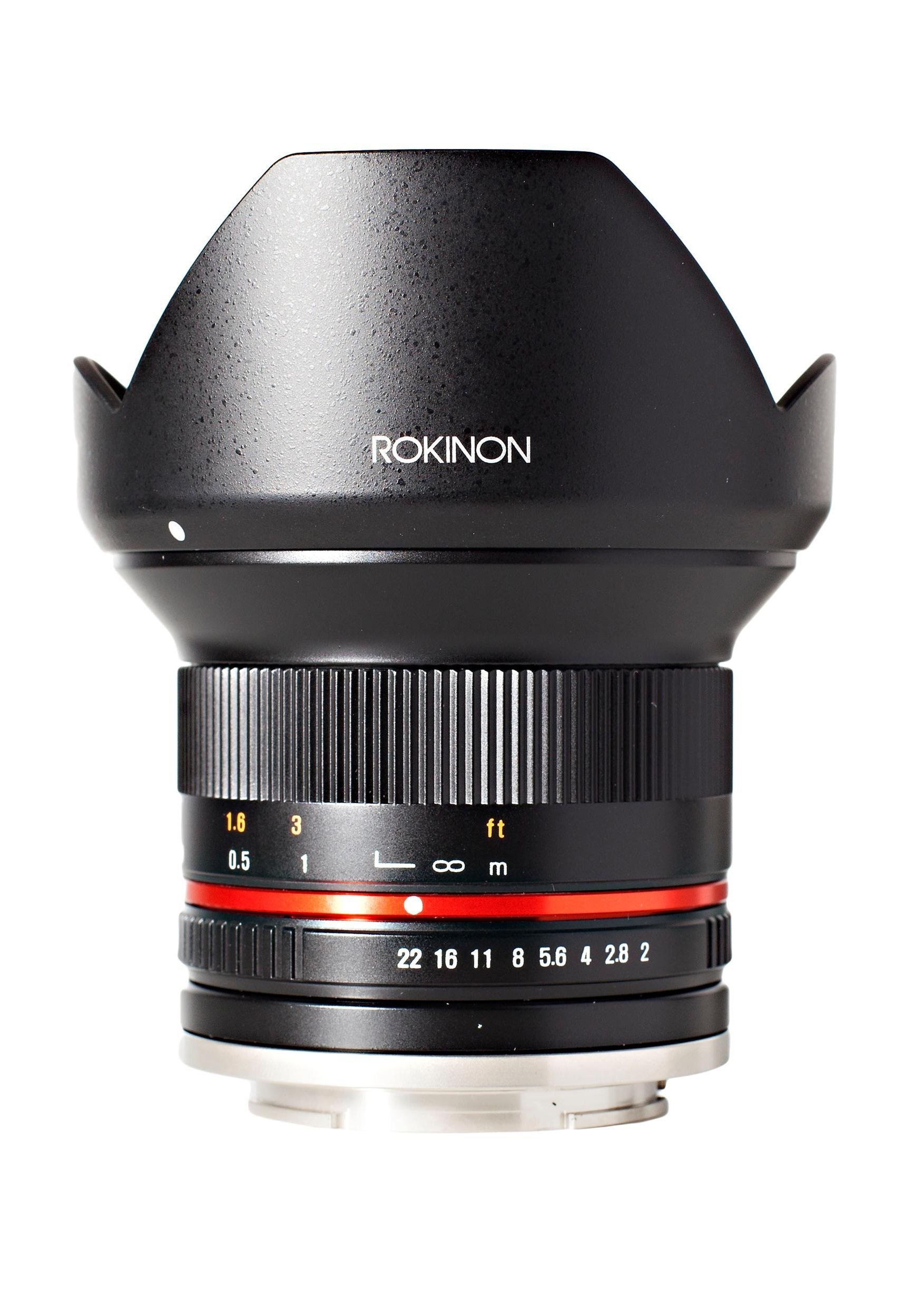
Astro Manual Focus

Rokinon 12mm f/2 Sony E

89 /100
Studio Score Strong Evidence

Key details

Autofocus
Manual only
Max Aperture
f/2.0
Focal & Angle
12mm, 98.9°
Mount & Sensor
Sony E (APS-C)
Check Price on Amazon

The Rokinon 12mm f/2.0 pairs a 98.9-degree angle of view with a fast aperture and strong center sharpness, making it a capable ultra-wide prime for Sony APS-C landscape and astro work. Its barrel feels solid at a budget price and stays compact enough for travel. Manual focus has a learning curve, and the infinity mark can be inaccurate, so live-view confirmation is part of the routine. That deliberate process is why this is a specialist choice rather than a general recommendation: tripod-based night-sky and landscape shooters get strong value for the money.

Pros

  • Solid, compact barrel that does not feel like a budget lens once it is mounted.
  • Center sharpness holds up well for landscape detail and astro point sources.
  • The f/2.0 aperture and 12mm view make a real difference in low-light and night-sky work at this price.

Cons

  • Vloggers or event shooters who rely on autofocus will not get the speed they need here.
Our verdict

For tripod-based Sony APS-C shooters, the 12mm f/2.0 is the budget route to sharp, fast ultra-wide landscapes and night skies.

Check Latest Price
6

Sony FE Walkaround

Viltrox 20mm f/2.8 FE

90 /100
Studio Score High Confidence

Key details

Autofocus
AF
Max Aperture
f/2.8
Focal & Angle
20mm, 91.6°
Mount & Sensor
Sony FE (full-frame)
Check Price on Amazon

At 157g, the Viltrox 20mm f/2.8 is a light full-frame prime that makes wide-angle shooting easy on a Sony FE body. The 91.6-degree view captures travel scenes and interior or handheld vlog footage without the bulk of a zoom, while image quality stays sharp enough for the price.

Autofocus can hunt in busy or low-contrast scenes, so this is a travel and vlog lens rather than an event or action lens. For static subjects and gimbal work, the occasional hunt is tolerable, and the tiny body plus budget price make the tradeoff fair.

Pros

  • A 157g full-frame prime that disappears into a bag and balances well on a gimbal.
  • Gives Sony FE shooters an inexpensive wide prime without sacrificing full-frame coverage.
  • Sharp images with a gradual background blur make it easy to use for travel and street scenes.

Cons

  • A physical AF/MF switch is not included; changing focus modes means a stop in camera menus.
  • Critical focus work will be more assured with native Sony glass, especially for moving subjects.
Our verdict

This fits if your subject is mostly still and your priority is a small full-frame prime that won't stretch the budget.

Check Latest Price

How to Choose

Focal Length and Angle

Focal length sets the field of view, but sensor format changes the result; a 16mm full-frame lens is far wider than a 16mm APS-C lens.

Zooms cover multiple angles in one unit, while primes at the same length are smaller and often sharper. The widest end is where distortion appears, so choose based on the actual scenes you frame.

Maximum Aperture

Maximum aperture controls how much light reaches the sensor. f/1.8 gathers roughly two stops more light than f/4 — the difference between ISO 1600 and ISO 6400 at the same shutter speed.

If you shoot handheld in dim rooms or at night, a fast prime is a better match; if you use a tripod or a stabilized body, f/4 is acceptable.

Mount and Sensor Format

Mount and sensor format are the first compatibility filter. Canon RF, Canon EF-S, Sony E, Sony FE, and Nikon F are not interchangeable without an adapter, and an APS-C lens like EF-S or DX does not cover a full-frame sensor.

Check your camera's mount before comparing focal lengths or prices.

Autofocus Behavior

Autofocus motors differ in speed, noise, and tracking consistency. Quiet motors such as STM and linear-motor systems suit video and vlogs, while budget AF can hunt in low contrast or lag during continuous shooting.

For manual-focus lenses, verify the infinity mark with live view; some budget primes are calibrated inaccurately.

Size and Weight

Size and weight determine whether the lens stays on the camera or stays home. A small prime around 150-180g is easy on a gimbal and comfortable for all-day walks, while an L-series zoom adds balance and bag weight.

Handle the body and lens together if you can, because weight distribution matters more than the spec number alone.

Distortion and Corner Sharpness

Ultra-wide rectilinear lenses stretch the scene to fit a huge field onto a flat sensor. That stretch causes barrel distortion and edge softness at the widest focal length, and stopping down to f/5.6 or f/8 usually improves the corners.

Judge a lens by edge behavior at the focal length you use most, not just center sharpness.

Frequently Asked Questions