5 Best Nikon Wide-Angle Lens of 2026: Match It to Your Camera

Which Nikon wide-angle lens fits your camera body and shooting style, with mount, focal length, and autofocus compatibility explained before you buy.

Ultra-wide zoom listings look similar, but the first question is not sharpness or price: it's whether the lens covers your sensor and autofocuses on your body. A DX lens on a full-frame Nikon may force crop mode or produce dark corners. An F-mount lens on a Z body needs an adapter, and some AF-P lenses will not focus on older DSLRs.

The wide-angle label is also relative: 35mm behaves like a normal lens on a DX body, not a true wide angle. Most crop-sensor shooters need 10-24mm for expansive framing, while full-frame Z shooters may prefer a compact 14-30mm zoom that still takes screw-in filters.

The main trade-off is between compact f/4 zooms and heavier f/2.8 lenses. If you work handheld at night, events, or astro, aperture matters more than size. If you shoot daylight landscapes and travel, the lighter zoom is the more useful tool.

1

Best Overall

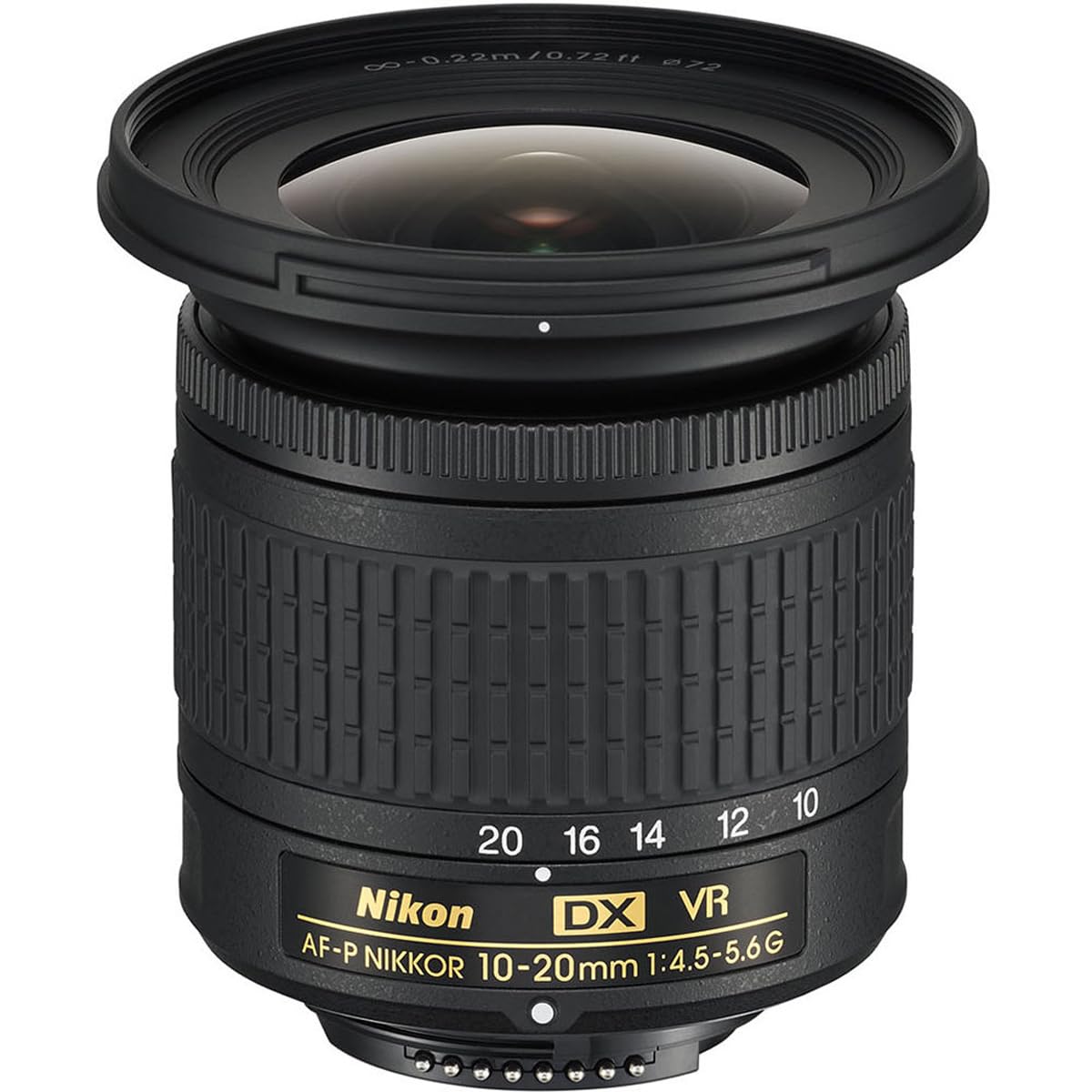
Nikon 10-20mm f/4.5-5.6G VR

92 /100
Studio Score High Confidence

Key details

Mount
Nikon F (DX)
Filter
72mm front
Focal Range
10-20mm zoom
Max Aperture
f/4.5-5.6 variable
Check Price on Amazon

The Nikon 10-20mm f/4.5-5.6G VR gives DX DSLR shooters a rare combination: optical VR and a genuine 10mm ultra-wide view in a barrel that does not weigh down a travel bag. At the wide end, the lens opens up tight interiors, canyon overlooks, and street corners in a way that a standard 18-55mm kit zoom cannot. Landscape work is where the lens earns its keep, with sharpness that holds up for prints and social sharing. The zoom range is modest, but the wide end is the whole point for architecture and outdoor scenes.

Handheld 10mm shots are steadier than the focal length suggests because VR compensates for the camera shake that shows up at wide angles. That makes the lens a natural fit for real-estate walkthroughs and travel snaps where setting up a tripod is impractical. VR is effective enough to shoot static scenes at shutter speeds that would normally blur at 10mm, making the lens feel faster than its aperture number. The AF-P motor focuses quietly on Nikon bodies that support it, and the compact build keeps the camera easy to pull out for a quick shot.

Buyers here are Nikon DX DSLR owners looking for a standalone ultra-wide zoom for travel, landscape, or interior shooting. For daytime and bright indoor work, this is the affordable option to weigh against third-party rivals. Rivals with constant f/3.5 add light-gathering but in a heavier barrel without VR; for the travel audience, this Nikon keeps the better balance. Full-frame Nikon shooters should look at FX lenses instead, because the DX image circle will not cover a full-frame sensor.

Compared with constant-aperture third-party ultra-wide zooms, the Nikon is the one that disappears into a daypack and still steadies the frame. That focus on portability over raw light-gathering makes it a better match for travel and landscape shooters than for event work where low light is the norm. For owners comparing multiple ultra-wide options, the decision comes down to sensor format and bag space, not image quality.

Two boundaries matter before purchase: AF-P autofocus depends on body support, and the f/4.5-5.6 aperture is slow in low light. On a compatible body, both are manageable tradeoffs for the weight savings and optical VR, so the lens keeps its appeal for daytime and bright interior shooting. Neither limitation should stop the intended buyer, but both deserve a check before purchase.

๐Ÿ’ก In dim interiors, raise ISO before dropping shutter speed; VR steadies the frame, but moving subjects will still blur.

Pros

  • Sharpness is strong for the price, especially at the wide end where landscape details stay clean.
  • True 10mm coverage fits interiors and broad vistas in one frame without swapping lenses.
  • Lightweight barrel keeps the lens easy to carry on full-day hikes and travel shoots.
  • Landscape performance delivers clean, detailed outdoor shots across the zoom range.
  • Overall satisfaction is high; the lens gets the basics right for its price.

Cons

  • Autofocus speed can feel slow or hunt in low-contrast scenes on certain camera bodies.
  • Slow maximum aperture forces higher ISO or a tripod for handheld work after sunset.
Our verdict

The 10-20mm VR is the DX ultra-wide to reach for when you want a lens that disappears into a bag but still captures the room, the canyon, or the street corner.

Check Latest Price
2

Best Z-Mount Wide Zoom

Nikon Z 14-30mm f/4 S

93 /100
Studio Score High Confidence

Key details

Mount
Nikon Z (FX)
Filter
82mm front
Focal Range
14-30mm zoom
Max Aperture
f/4 constant
Check Price on Amazon

The 14-30mm f/4 S pairs S-line corner-to-corner sharpness with a retractable barrel and standard 82mm screw-in filters, a combination that is uncommon among full-frame wide zooms. The 14mm end is wide enough to capture foreground and sky in one landscape frame, while distortion stays low enough that post-processing is a minor tweak.

The front element sits behind a filter thread, so polarizer and ND work does not require a bulky adapter. The 14-30mm range covers common travel and architecture angles, and the retractable design keeps the lens short in the bag. For travel and gimbal use, the light barrel makes a real difference when the lens is hanging off the front of a Z body.

This is Z-mount only; F-mount DSLR bodies need a different lens. Landscape, travel, architecture, and real-estate shooters get a compact wide zoom that stays sharp across the frame. The f/4 aperture and no lens VR make low-light handheld work depend on the camera body's IBIS, so tripod and bright-light use is where it fits best. Architecture shooters who need filters can use a standard circular polarizer without a special holder. Hybrid shooters get a small wide zoom that balances well on a gimbal.

๐Ÿ’ก Keep the barrel retracted when stowed; it extends into shooting position as you zoom.

Pros

  • S-line optics produce sharp, controlled images across the frame.
  • 14mm wide end frames interiors and landscapes without switching lenses.
  • Compact, light barrel is easy to pack for travel and hiking.
  • Standard 82mm filter thread works with common polarizers and NDs.

Cons

  • f/4 maximum aperture is slower than f/2.8 alternatives.
  • No in-lens VR; stabilization is left to the Z body.
Our verdict

For Z-mount shooters who want a compact full-frame wide zoom that takes standard filters, this is the most balanced option in the set. If you need f/2.8 for events or astro, the faster prime is the direction to go.

Check Latest Price
3

Best F-Mount Constant-Aperture Alternative

Sigma 10-20mm f/3.5

93 /100
Studio Score High Confidence

Key details

Mount
Nikon F (DX)
Filter
82mm front
Focal Range
10-20mm zoom
Max Aperture
f/3.5 constant
Check Price on Amazon

Constant f/3.5 across the whole zoom range is this Sigma's main edge over Nikon's variable-aperture DX ultra-wides, and the built-in HSM motor extends autofocus to older DSLR bodies that lack an internal focus motor. The 10-20mm coverage is genuinely wide on APS-C, with distortion controlled well enough that straight interior lines stay straight for real-estate shots. Optical performance is sharp for a mid-priced ultra-wide, and the 82mm filter thread takes screw-in polarizers without a dedicated adapter.

This lens is for Nikon DX shooters on a mid budget who want f/3.5 for interiors and landscapes, including owners of older Nikon DSLRs that need a built-in AF motor. It is not for full-frame Nikon shooters. Since optical stabilization is not built in, expect to raise ISO or use a tripod for handheld low-light work. Some copies may hunt in low-contrast autofocus situations, and chromatic aberration can appear at high-contrast edges on the wide end, both correctable in post.

The barrel is solidly constructed but larger than the stabilized 10-20mm zoom in this guide, so weight-conscious travel kits will feel the difference. The focus ring has a smooth manual-override action, and the HSM drive lets older Nikon DSLRs autofocus without needing a screw-drive body.

Pros

  • Strong value for a constant-aperture ultra-wide on a mid budget.
  • Sharp, clear images with very good overall optical performance.
  • Built-in HSM motor gives older Nikon DSLRs autofocus support.
  • Solid build quality that holds up in regular use.

Cons

  • Chromatic aberration can show at high-contrast edges near the wide end.
  • Autofocus can slow or hunt in low-contrast scenes on some bodies.
  • No optical stabilization, so handheld low-light interiors need a tripod or higher ISO.
Our verdict

Nikon DX shooters who want constant f/3.5 and older-body autofocus get a durable, sharp ultra-wide here; the stabilized top pick is a better fit for handheld travel.

Check Latest Price
4

Best Fast Prime for Z Astro

Viltrox AF 16mm f/1.8 Z

85 /100
Studio Score Strong Evidence

Key details

Mount
Nikon Z (FX)
Filter
โ€”
Focal Range
16mm prime
Max Aperture
f/1.8
Check Price on Amazon

At f/1.8, this Viltrox prime gathers roughly two stops more light than the compact f/4 S-line zoom, and the aperture ring plus LCD display makes manual night-sky control feel deliberate. The all-metal barrel is more substantial than the price suggests, and the optical output is sharp with strong contrast across the frame. Lens quality and construction land above the price tier.

Landscape and architecture shooters get a wide 16mm view with a physical aperture ring and a display that shows distance and aperture without looking through the viewfinder. The lens pairs naturally with a tripod for long exposures, and manual focus work is comfortable because the LCD removes guesswork. The 16mm focal length is wide enough for interiors and nightscapes, while f/1.8 keeps shutter speeds manageable in dim light.

This is a price-conscious Z shooter's astro prime, not a native-S-line all-rounder. It suits photographers who want f/1.8 light collection for nightscapes and can accept third-party copy-to-copy AF variance and corner coma at f/1.8 as tradeoffs; manual focus covers typical astro work.

๐Ÿ’ก Use the aperture ring and LCD readout together for repeatable manual exposures in the dark.

Pros

  • All-metal build feels more substantial than the price suggests.
  • Sharp full-frame output with strong contrast for landscape and astro framing.
  • Fast f/1.8 light collection gives night-sky shooters a two-stop advantage over f/4 zooms.
  • Aperture ring and LCD display make manual night-sky control easier.

Cons

  • Fixed 16mm focal length means composition changes require moving the camera rather than zooming.
  • Handheld low-light work depends on the camera body's IBIS because the lens has no stabilization.
Our verdict

For a Z-mount shooter building a night-sky kit on a budget, the Viltrox 16mm f/1.8 delivers the aperture and manual controls that make astro work possible without the S-line price.

Check Latest Price
5

Budget FX Street

Yongnuo YN35mm f/2N

87 /100
Studio Score Strong Evidence

Key details

Mount
Nikon F (FX/DX)
Filter
โ€”
Focal Range
35mm prime
Max Aperture
f/2
Check Price on Amazon

At entry-level pricing, the YN35mm f/2N gives Nikon F shooters a full-frame 35mm prime with a fast f/2 aperture and compact barrel. On FX bodies it works as a natural street length, and the manual-focus position makes walkaround shooting comfortable. The tradeoffs are explicit: autofocus can hunt and produce soft focus in dim conditions, and wide-open image quality sharpens only after stopping down. On DX bodies, 35mm becomes a 52mm-equivalent normal view, so shoppers seeking true ultra-wide coverage should look elsewhere. Its slower, noisier AF and narrower field of view keep it from matching the general-purpose zooms on this list.

Pros

  • Gives budget Nikon FX shooters a fast f/2 prime without paying premium lens prices.
  • Compact and usable for street and walkabout photography, especially when set to manual focus.
  • Works as a low-cost landscape or general-purpose prime for full-frame F-mount bodies.

Cons

  • Image quality can be soft at f/2 until the lens is stopped down a step or two.
  • Autofocus can be slow and noisy in low light, with hunting that may produce soft focus.
Our verdict

Choose the YN35mm f/2N when you shoot mostly full-frame street scenes in daylight and can manage manual focus; skip it for fast event work or DX ultra-wide needs.

Check Latest Price

How to Choose

Mount Type and Sensor Format

Nikon currently uses two lens mounts: the older F-mount for DSLRs and the Z-mount for mirrorless bodies. F-mount lenses can be adapted to Z cameras, but autofocus behavior and features like VR depend on the adapter and the lens generation.

Sensor format matters just as much. A DX lens projects a smaller image circle, so on a full-frame FX body it either forces crop mode or produces heavy vignetting. A Z DX lens on an FX Z body has the same issue.

Focal Length and Angle of View

Focal length determines angle of view, but the number on the barrel changes meaning with sensor size. On a DX body, multiply by 1.5: 10mm behaves like 15mm on FX, while 35mm behaves like a 52mm normal lens.

This is why many wide-angle primes disappoint on crop-sensor cameras. True ultra-wide on DX starts below 24mm and gets more dramatic at 10-14mm, where distortion at the edges is common and usually correctable in software.

Maximum Aperture

Maximum aperture controls how much light reaches the sensor and how often the lens can shoot handheld in low light. A variable f/4.5-5.6 zoom is about one stop slower at the long end than a constant f/3.5, and two stops slower than f/2.8.

That difference changes your ISO and shutter speed at dusk, indoors, or under dark skies. Event and astro shooters should prioritize a constant f/2.8 or a fast prime; landscape and travel shooters can accept f/4 if the lens is sharp and light.

Image Stabilization

Lens-based VR steadies the image before it reaches the sensor and helps you frame a sharp shot in the viewfinder. It matters most on F-mount DSLRs, which lack built-in sensor stabilization.

Z-mount cameras rely on in-body IBIS, so a lens without VR can still produce steady handheld shots at moderate shutter speeds. The trade-off is that VR and IBIS are not interchangeable: a non-VR F-mount lens on an old DSLR needs faster shutter speeds or a tripod.

Filter Compatibility

Flat-front wide zooms take standard screw-in filters; bulbous front elements do not. A filter-friendly design with an 82mm thread makes ND and polarizer use simple for landscape and long-exposure work.

Lenses with protruding front elements use rear drop-in filter holders, which are more expensive and less practical for graduated ND work. If filters are essential, a flat-front 14-30mm-style design is the more usable everyday tool.

Frequently Asked Questions