9 Best Lens for Landscapes in 2026: Match the Angle to Your Camera

Find the best lens for landscapes for your camera mount, from budget ultrawide zooms to fast wide primes for low-light and night scenes.

Searching for a landscape lens gets confusing because the word 'landscape' in listings is used loosely. Many of the highest-rated lenses are 50mm primes that reviewers love for portraits, not sweeping mountain views. The spec that matters first is angle of view: a lens made for your camera's sensor size and a focal length wide enough for the scene you actually shoot.

After that, the trade-off is speed versus flexibility. A lightweight ultra-wide zoom handles daytime and tripod work well but struggles after dark. A fast wide prime opens up handheld golden hour and night photography, at the cost of zoom range. Choose based on when and where you shoot, not on star ratings alone.

Zoom range and aperture also change what you carry: an f/2.8 zoom covers landscapes and portraits in one lens but adds weight; a fast prime saves weight but locks you into one composition. That trade-off is worth making on purpose.

1

Best Overall

Canon EF-S 10-18mm f/4.5-5.6

94 /100
Studio Score High Confidence

Key details

Focal Length
10-18mm zoom
Max Aperture
f/4.5-5.6
Mount / Sensor
Canon EF-S APS-C
Type And Weight
Zoom, 240g
Check Price on Amazon

The Canon EF-S 10-18mm puts a true 10mm field in front of APS-C bodies at a price that undercuts other ultrawide zooms. Optical stabilization steadies handheld landscape shots and video, while the STM motor keeps focus quiet enough for vlog microphones. At 10mm, the frame takes in far more of a ridgeline or interior than the standard 18mm kit lens, and the 18mm end still works for environmental shots. The whole zoom is light enough to leave in a daypack, which is exactly where a landscape walkaround lens belongs.

This lens fits Canon APS-C shooters who want ultrawide coverage for landscape, real-estate, and travel photos without carrying a heavy zoom. It is not the lens for low-light and action work; after dark, a tripod or a faster prime becomes part of the kit. For daylight scenery and tight interiors, the 10mm end delivers the wide perspective those subjects need. Vloggers get the same quiet focus and stabilizer, so the lens pulls double duty between stills and handheld video. That makes it a sensible pick for hikers and real-estate photographers who cover one scene after another.

Pros

  • True 10mm coverage captures wide landscapes and tight interiors that a kit lens cannot reach.
  • Optical stabilization and quiet STM focus make handheld video and vlogging practical without a rig.
  • Lightweight build suits hiking and travel daypacks without dominating a small APS-C body.

Cons

  • Corners soften and vignette at 10mm, visible in architectural lines and large prints.
  • f/4.5-5.6 aperture limits handheld low-light shots and makes night landscapes a tripod affair.
Our verdict

For Canon APS-C shooters whose subjects are landscapes and interiors, this zoom belongs in your bag.

Check Latest Price
2

Best Sony APS-C Low-Light Wide Prime

Sigma 16mm f/1.4 DC DN

96 /100
Studio Score High Confidence

Key details

Focal Length
16mm prime
Max Aperture
f/1.4
Mount / Sensor
Sony E APS-C
Type And Weight
Prime, 405g
Check Price on Amazon

The Sigma 16mm f/1.4 DC DN is a fast ultra-wide prime for Sony APS-C that gathers two stops more light than the constant f/2.8 zoom in this set. Sharpness is strong in the center and mid-frame, making handheld dusk and night landscapes practical without pushing ISO too far.

Buy it for astro, night, and low-light landscape work on APS-C bodies. The lens is a fixed 16mm prime, so zoom flexibility isn't part of the package. Close-range straight lines can bow outward, though distant landscape scenes show little of it. If your landscape sessions run past sunset, this prime earns its bag space.

Pros

  • Ultra-wide 16mm with f/1.4 gathers light for astro and twilight landscapes.
  • Sharp center and mid-frame rendering keeps night scenes detailed.
  • Fast autofocus locks in dim light on Sony APS-C bodies.

Cons

  • Corner sharpness at f/1.4 trails the center; stopping down to f/2.8 or f/4 restores edge detail for distant scenes.
Our verdict

Night and astro landscape shooters should pick this prime over the constant f/2.8 zoom; choose the zoom only if reach matters more.

Check Latest Price
3

Best Nikon APS-C Budget Ultra-Wide

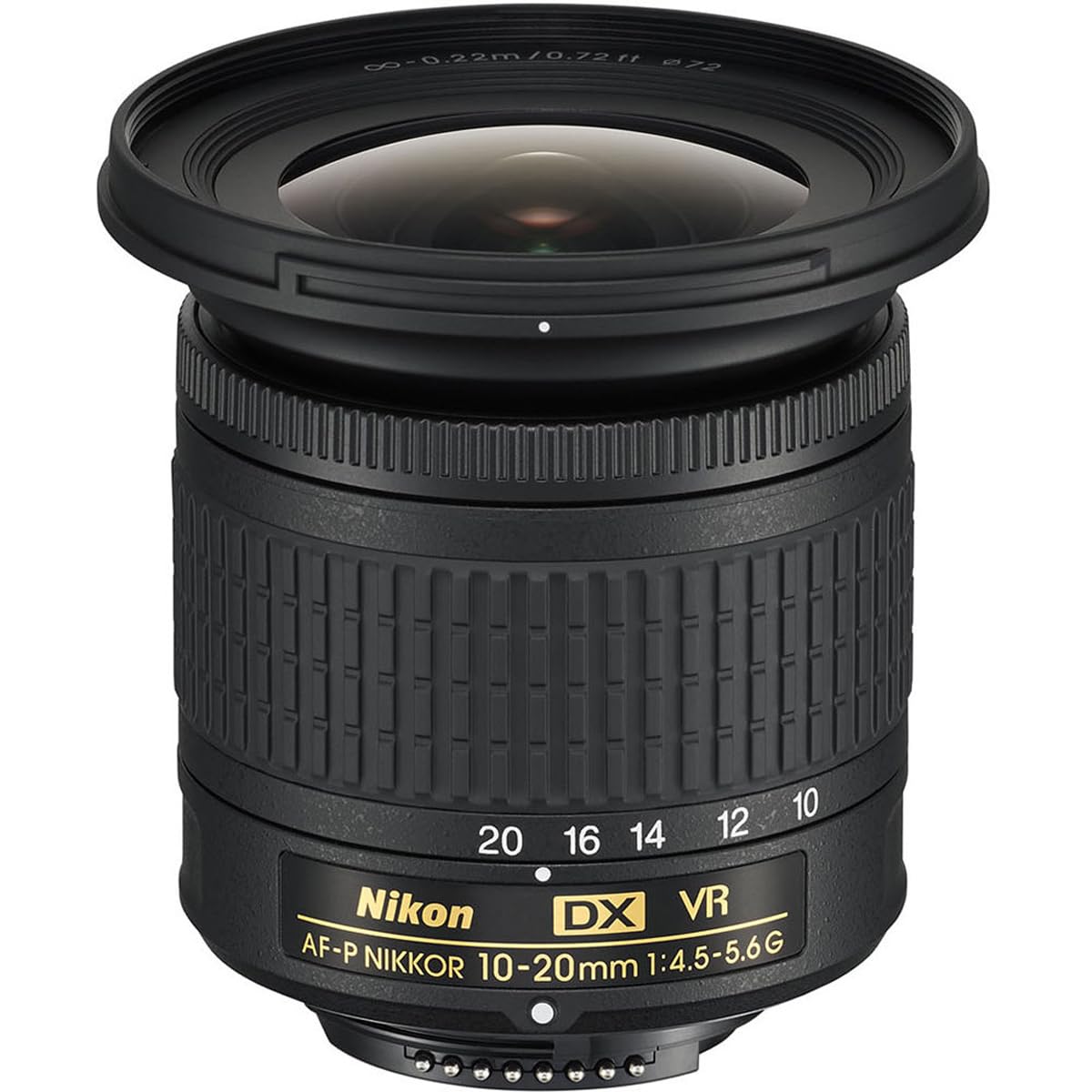
Nikon AF-P DX 10-20mm VR

92 /100
Studio Score High Confidence

Key details

Focal Length
10-20mm zoom
Max Aperture
f/4.5-5.6
Mount / Sensor
Nikon F DX
Type And Weight
Zoom, 230g
Check Price on Amazon

Affordably priced, the Nikon 10-20mm VR gives DX landscape shooters a true ultra-wide view in a body small enough for a daypack. It covers a field the 50mm f/1.8 prime cannot, so it fills a different role at a similar budget. Landscape and travel shooters get the wide coverage they need. Variable f/4.5-5.6 aperture limits light collection after sunset, though a tripod reduces that impact. AF speed can vary on some bodies. This is a genuine ultrawide without stepping up to heavier glass. Full-frame Nikon users should stick with FX lenses.

💡 Confirm your Nikon body supports AF-P before purchase.

Pros

  • Landscape-focused sharpness holds up across the frame on a DX body.
  • VR optical stabilization steadies handheld wide-angle shots.

Cons

  • Compatibility with some Nikon camera bodies can be unclear before purchase, especially for AF support.
Our verdict

The Nikon 10-20mm VR is the practical wide-angle partner for a DX landscape kit.

Check Latest Price
4

Best Sony APS-C All-In-One Landscape Zoom

Tamron 17-70mm f/2.8

95 /100
Studio Score High Confidence

Key details

Focal Length
17-70mm zoom
Max Aperture
f/2.8
Mount / Sensor
Sony E APS-C
Type And Weight
Zoom, 525g
Check Price on Amazon

The Tamron 17-70mm f/2.8 covers a practical landscape-to-short-tele range with a constant f/2.8 and optical stabilization, so it can replace a kit zoom and a faster prime on a Sony APS-C body. The wide end is 17mm rather than dramatic ultrawide; framed this way, it suits a single-lens travel kit better than a dedicated wide prime.

This lens fits landscape shooters who want one setup from forest openings to mountain compressions, plus hybrid creators who need stabilized handheld video. It is heavier than a prime or kit zoom, and some ultra-wide compositions will be out of reach; those scenes belong to a dedicated ultra-wide prime.

💡 For long hiking days, pair the Tamron with a comfortable camera strap — the weight is noticeable but manageable.

Pros

  • Sharp across the frame from 17mm through 70mm, preserving landscape detail in the corners.
  • Autofocus locks quickly and accurately for stills and video in normal conditions.
  • Constant f/2.8 and optical stabilization keep handheld shots steady in fading light.

Cons

  • Carrying it on long hikes adds noticeable weight over a prime or kit zoom.
Our verdict

Sony APS-C landscape and travel photographers who want one lens from wide to short tele get constant f/2.8 and stabilization in the Tamron 17-70mm.

Check Latest Price
5

Best Canon APS-C Fast Wide Zoom

Sigma 18-35mm F1.8 Art

94 /100
Studio Score High Confidence

Key details

Focal Length
18-35mm zoom
Max Aperture
f/1.8
Mount / Sensor
Canon EF-S APS-C
Type And Weight
Zoom, 810g
Check Price on Amazon

Sigma’s 18-35mm f/1.8 Art is the only wide-angle zoom for Canon APS-C that holds f/1.8 across the range, and its sharpness is close to prime-lens quality. The all-metal body feels solid and durable.

It suits available-light landscape and event photographers who want zoom flexibility without a bag of primes. The 18mm end reaches wide rather than ultra-wide; the true 10mm view belongs to the Canon EF-S 10-18mm. Hikers counting grams should pass, and low-light autofocus can need manual override.

💡 Keep a tripod handy for slow-shutter landscape work.

Pros

  • Constant f/1.8 across the zoom range keeps exposure and depth of field consistent while framing.
  • Crop-sensor zoom sharpness that challenges primes at similar focal lengths.
  • All-metal construction feels durable enough for demanding location work.

Cons

  • Autofocus can hunt in low light, so night landscapes may need manual focus.
  • On long hikes with a full pack, the weight and bulk become hard to ignore.
Our verdict

For landscape shooters who need f/1.8 zoom flexibility more than a true 10mm view, the Sigma is the Canon APS-C lens to reach for.

Check Latest Price
6

Best Full-Frame Travel Superzoom

Tamron 28-200mm F/2.8-5.6

90 /100
Studio Score High Confidence

Key details

Focal Length
28-200mm zoom
Max Aperture
f/2.8-5.6
Mount / Sensor
Sony E full-frame
Type And Weight
Zoom, 575g
Check Price on Amazon

The 28-200mm zoom starts at f/2.8 and reaches a compressed telephoto, so landscape shooters can frame a wide scene and then pull in distant ridges without changing lenses. It stays light enough for a full-day carry, and image quality holds together across the range, making this a practical landscape-to-telephoto travel zoom.

Sony full-frame travelers who want one lens for wide-to-tele landscapes will accept the variable aperture, no built-in stabilization, and occasional AF hunting in flat light — all minor on a tripod or with Sony IBIS. The 28mm start won't replace a true ultrawide, so field-of-view expectations matter.

💡 Switch to manual focus or back-button AF for low-contrast landscape scenes.

Pros

  • 28-200mm reaches from wide landscapes to compressed telephoto details without swapping lenses.
  • Light enough for a full-day carry
  • All-in-one image quality holds up well for a superzoom across the focal range.

Cons

  • Autofocus can hunt in low-contrast scenes, slowing hand-held landscape focus.
Our verdict

For Sony full-frame travelers who want landscape width plus telephoto reach in a single carry, this is the most practical all-in-one — the 28mm start is the main concession.

Check Latest Price
7

Compact Walk-Around

Canon EF-S 24mm f/2.8 STM

94 /100
Studio Score High Confidence

Key details

Focal Length
24mm prime
Max Aperture
f/2.8
Mount / Sensor
Canon EF-S APS-C
Type And Weight
Prime, 125g
Check Price on Amazon

This 125g pancake brings a 24mm field and 0.16m close focus to Canon APS-C bodies, making it a handy second lens for street, travel, and tabletop detail. It is not ultrawide, and edge vignetting or chromatic aberration can appear on crop sensors; those limits matter if this is your only landscape lens.

Pros

  • Slips into a bag and stays light on the camera for day-long walks.
  • 24mm field with 0.16m close focus covers environmental scenes and tabletop detail without a macro lens.

Cons

  • Fixed 24mm prime means no zoom range for quick composition changes.
Our verdict

If your landscape kit already includes an ultrawide, this 24mm pancake is a lightweight second lens for travel and close-up work.

Check Latest Price
8

Professional Standard Zoom

Sony FE 24-70mm F2.8 GM

90 /100
Studio Score High Confidence

Key details

Focal Length
24-70mm zoom
Max Aperture
f/2.8
Mount / Sensor
Sony E full-frame
Type And Weight
Zoom, 886g
Check Price on Amazon

The Sony FE 24-70mm F2.8 GM is a pro-grade standard zoom with sharp optics, fast autofocus, and a rugged constant-f/2.8 build. The premium price and front-heavy balance are real boundaries for landscape-first buyers, and durability under tough conditions has varied. Event and wedding work is the natural fit.

Pros

  • Delivers sharp detail and strong contrast across the full 24-70mm range.
  • Fast autofocus and a weather-sealed barrel handle event work without hesitation.

Cons

  • The 24mm wide end is only modestly wide, so sweeping landscape scenes need a separate wider lens.
Our verdict

This GM fits a Sony full-frame event kit, not a landscape-first backpack.

Check Latest Price
9

APS-C Video

Sony PZ 18-105mm f/4 G

92 /100
Studio Score High Confidence

Key details

Focal Length
18-105mm zoom
Max Aperture
f/4
Mount / Sensor
Sony E APS-C
Type And Weight
Zoom, 427g
Check Price on Amazon

The 18-105mm f/4 G pairs smooth power zoom, constant f/4, and OSS for practical landscape travel. Distortion and digital noise can appear at some settings, and autofocus may lag in dim light, so manual focus or a tripod fits twilight work.

Pros

  • Smooth power zoom and OSS support handheld landscape video without extra rigging.
  • Constant f/4 and 18-105mm reach cover daylight landscapes and tele detail shots.

Cons

  • 18mm wide end equals a 27mm equivalent, so sweeping landscape vistas need a separate ultra-wide lens.
Our verdict

This is the right call when one lens needs to handle daylight landscapes and handheld video without frequent swaps.

Check Latest Price

How to Choose

Focal Length

Focal length controls how much of the scene fits in the frame. A 10-18mm zoom on APS-C gives a wide view; a 50mm prime on the same body gives a narrow, normal view closer to what one eye sees. 'Landscape' in product titles often includes lenses that are not wide enough for sweeping vistas.

Wider lenses shrink distant mountains and enlarge nearby foreground, so compositions need a strong foreground element. If you shoot classic alpine panoramas, look for 10-20mm on APS-C or 16-24mm on full-frame.

Maximum Aperture

Aperture determines how much light the lens lets through. An f/1.4 prime gathers roughly ten times more light than an f/4.5 ultrawide zoom, which matters for handheld dusk shots and night-sky landscapes.

The trade-off appears when you stop down. Landscapes usually need f/8 to f/11 for front-to-back sharpness, which cancels the speed advantage. A fast aperture should be chosen for astro, low-light handheld, or subject separation, not as a general landscape sharpness booster.

Image Stabilization

Stabilization shifts lens elements to counter hand shake, letting you shoot at slower shutter speeds without a tripod in daylight and twilight. Long-exposure waterfall shots still need a tripod, and IS does nothing for stars moving across the sky.

If your camera body has in-body stabilization, a non-stabilized lens can still work well. On older DSLRs without IBIS, lens stabilization matters more for handheld hiking photos.

Mount and Sensor Format

The mount must match your camera, and the sensor format determines whether the image circle covers the frame. Canon EF-S, Nikon DX, and Sigma DC DN lenses are APS-C-only; on a full-frame body they force crop mode or produce heavy vignetting.

Check the lens designation before buying. A 10mm APS-C lens is not equivalent to 10mm on full-frame; its field of view is roughly 16mm. This is the most common spec mismatch in landscape lens shopping.

Zoom vs Prime and Weight

Zooms cover multiple compositions without changing lenses, which is why ultrawide zooms dominate landscape kits. Primes are smaller, lighter, and often one to two stops faster, but they lock you into one field of view.

The hidden cost of fast zooms is weight. A constant f/2.8 wide zoom can weigh 800g or more, while a compact f/2.8 pancake prime can weigh 125g; that difference is obvious after a few miles of hiking.

Frequently Asked Questions