4 Best Used Cameras in 2026: 24MP DSLRs That Still Hold Up

Find the best used camera for your budget and skill level — from beginner-friendly Canon Rebels to 24MP Nikon DSLRs with proven performance.

Shopping for a used DSLR usually means balancing age against price. A camera can have a 24MP sensor and still lack built-in Wi-Fi, while a cheaper model from the same era might make phone transfer effortless. The differences that matter show up in daily use, not on the spec sheet.

Condition is the other variable that decides whether a used camera feels like a steal or a hassle. Cosmetic scratches and mismatched chargers are common in renewed listings, so the practical question is which kit gives you the most reliable entry into a good lens system. This guide focuses on APS-C Canon and Nikon DSLRs that keep modern usability within reach.

Megapixels alone do not make a camera easy to learn on or fun to carry. The best used camera for you balances sensor resolution, autofocus points, and wireless sharing against the trade-off of buying renewed versus new-old-stock. That balance is what the picks below are built around.

1

Best Overall

Canon EOS Rebel T6 DSLR Kit

89 /100
Studio Score Strong Evidence

Key details

Burst
3 fps
Video
1080p
Sensor
18MP APS-C CMOS
Wireless
Wi-Fi + NFC
Check Price on Amazon

The T6's built-in Wi-Fi/NFC is the kind of feature that matters more than sensor specs for a new DSLR owner: photos move to a phone quickly, and NFC tap-to-connect skips the usual pairing-menu fumble. The 18-55mm IS II lens covers typical walkaround focal lengths, and the 9-point AF system is predictable in ordinary light. The APS-C sensor turns out clean JPEGs for prints and social media without demanding a raw workflow.

The shooting process follows the classic DSLR rhythm: an optical viewfinder, a mode dial, and dedicated buttons for common settings. That layout keeps adjustments visible while your eye is at the finder, which helps a learning shooter connect the controls to the result. The kit lens's image stabilization adds a tangible safety margin indoors, and the 1080p recording mode handles short family clips without fuss. The optical viewfinder also stays visible in bright sunlight, an advantage over budget mirrorless bodies in the same used price range.

First-time DSLR buyers and gift-givers are the core audience: the learning curve is gentle, the Wi-Fi keeps phone sharing hassle-free, and the Canon EF/EF-S mount leaves room to grow into better lenses later. Parents shopping for a teenager get a body that encourages deliberate shooting away from a phone, while still making phone transfer easy when needed. Refurbished units can show cosmetic scratches or an occasional function issue, so inspect the camera when it arrives and use the return window if something seems off.

The higher-resolution Canon in this set costs more, while the T6 keeps the same lens mount and Wi-Fi at a lower price. For buyers who print at standard sizes or share mostly on phones, the price gap is better spent on a spare battery or an extra memory card than on extra megapixels. The EF/EF-S system also means cheap used lenses for portraits, telephoto, or macro are widely available, and the body can later work as a backup once a more advanced camera arrives.

The T6 is best understood as a learning tool. Its control layout and Canon menu system teach aperture, shutter speed, and ISO without overwhelming a newcomer, and those skills carry over to other Canon bodies. The camera's job is to make the fundamentals visible, and it does that without burying settings in menus. Spending less on the body leaves budget for the accessories that actually improve a first DSLR experience: a memory card, a second battery, or a simple tripod.

The kit is a real DSLR, so it will not slip into a pocket. It lives comfortably in a small shoulder bag or a camera insert in a backpack, and that is a reasonable trade for the tactile controls and lens options.

Pros

  • Built-in Wi-Fi/NFC lets you send photos to a phone without a card reader or cable.
  • Entry-level image quality is clean and well-suited to first-time DSLR users.
  • Complete kit includes a stabilized 18-55mm lens, so it shoots right out of the box.
  • A low entry price leaves room for extras like a spare battery or memory card.

Cons

  • No external mic jack, so serious video projects will need a different camera body.
  • For fast-moving sports or heavy cropping, 18MP and 3fps burst run out of room compared with 24MP rivals.
Our verdict

For a first DSLR, this kit balances Wi-Fi, a stabilized lens, and a budget price without chasing spec-sheet numbers.

Check Latest Price
2

Higher-Resolution Canon Alternative

Canon EOS Rebel T7 DSLR Kit

89 /100
Studio Score Strong Evidence

Key details

Burst
3 fps
Video
1080p
Sensor
24MP APS-C CMOS
Wireless
Wi-Fi + NFC
Check Price on Amazon

The 24.1MP APS-C sensor is the main reason to choose this Canon Rebel over the top pick. You get the same familiar DSLR layout and 18-55mm kit lens, but with more cropping room for travel, event, or wildlife shots. Wi-Fi and NFC are built in, so transferring photos to a phone is a practical extra.

Image quality is the headline: crisp stills from the 24MP sensor, and the EF/EF-S lens mount keeps older Canon glass useful. The 9-point AF and 1080p video are dated, but stills shooters will rarely notice. This is a camera for people who want a Canon system without paying for a current-generation body.

Renewed units may arrive with screen scratches or a rare functional freeze; verify the return policy before purchase. Cosmetic wear alone does not undermine the imaging core, but renewed stock should be treated as a condition caveat rather than a guaranteed flawless unit.

Best for first-time DSLR buyers who want a 24MP Canon body with Wi-Fi and a real upgrade path through EF-S and EF lenses. It is not the budget pick in this set, and videographers who need an external mic jack should look elsewhere.

Pros

  • A 24.1MP sensor delivers crisp stills with noticeably more cropping freedom than the top pick.
  • Works with the full Canon EF and EF-S lens lineup, so the body can grow with a lens collection.
  • Built-in Wi-Fi and NFC make photo transfer to a phone a practical extra over older Nikon options.

Cons

  • No external mic jack limits audio for video projects.
  • Functional issues can interrupt early use, so the return policy is the backup.
Our verdict

Stills-first Canon shooters who value crop room over the lowest price get a genuinely more flexible body here, provided they treat renewed status as a condition caveat.

Check Latest Price
3

Best for Enthusiast Beginners

Nikon D3300 DSLR Kit

91 /100
Studio Score High Confidence

Key details

Burst
5 fps
Video
1080p60
Sensor
24MP APS-C CMOS
Wireless
None built-in
Check Price on Amazon

The D3300 kit delivers the strongest continuous-shooting spec in this entry-level DSLR set: 5fps burst, a 24.2MP APS-C sensor, and 11-point AF. The 18-55mm VR II lens adds image stabilization for handheld work, and 1080p60 video extends the camera beyond stills without requiring a separate video camera.

Image quality stays competitive with current entry-level models, producing sharp, accurate files from the 24.2MP sensor. Nikon F-mount users get familiar ergonomics and a lens catalog that reaches well beyond the kit zoom. The guide mode walks new owners through exposure and focus decisions without the manual, giving a photography student a clear path from auto mode to manual control.

This is the pick for Nikon F-mount enthusiasts who want a slightly faster learning body and prefer new-old-stock over a renewed unit. The premium is easier to justify for buyers who value a never-owned camera and the 5fps drive; budget-focused used-camera shoppers can get a lower-cost route from the certified-refurbished Nikon here. If you plan around a cable or card reader for photo transfers, the D3300 covers the enthusiast side of the entry-level tier.

💡 Keep a USB cable or card reader in the bag for photo transfers.

Pros

  • Established entry-level DSLR with strong customer consensus.
  • Strong image quality for an entry-level sensor.
  • Value holds for new-old-stock buyers who want a fresh body.
  • Beginner guide mode simplifies exposure and focus choices.

Cons

  • Premium-priced next to certified-refurbished Nikon bodies in the same lineup.
  • No built-in Wi-Fi means phone photo transfer requires extra steps.
Our verdict

For Nikon F-mount shooters who insist on a fresh body and want a faster drive, this D3300 kit beats the budget refurbished route.

Check Latest Price
4

Best Budget 24MP

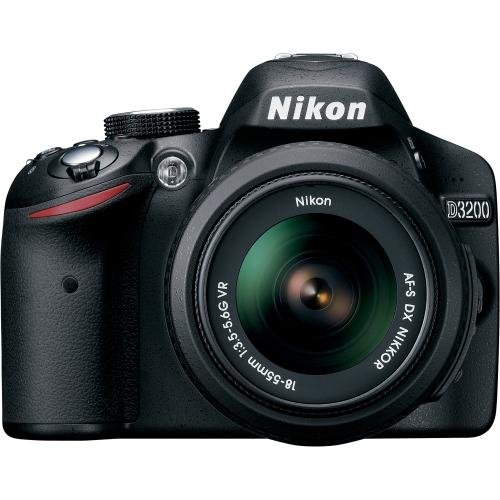
Nikon D3200 DSLR Kit

88 /100
Studio Score Strong Evidence

Key details

Burst
4 fps
Video
1080p
Sensor
24MP APS-C CMOS
Wireless
None built-in
Check Price on Amazon

The D3200 is the lowest-priced 24MP DSLR in this group and still brings the essentials: an APS-C CMOS sensor, 11-point AF, and 1080p video. The certified-refurbished kit adds the 18-55mm AF-S DX zoom and a warranty, making it the value entry point for anyone moving up from a phone or compact camera.

Image quality carries the kit. 24MP files hold up in daylight and leave room to crop, while the kit lens spans wide-angle to short telephoto. The 4fps burst works for portraits and static subjects, but fast action is outside its comfort zone. Video is capped at 1080p, so treat it as a bonus rather than a hybrid feature.

This is a good match for a budget-first student who expects a learning process and will check the included battery and charger before relying on them. The D3200 rewards patience, so an absolute beginner should budget time for the manual and accept that the menu is not the most intuitive starting point.

Pros

  • 24MP sensor captures detail that still competes with newer budget cameras.
  • Certified refurbishment is backed by a warranty and targets like-new condition.
  • The 18-55mm kit lens and 1080p video cover a new shooter's first needs.

Cons

  • No built-in Wi-Fi; moving photos to a phone requires an SD card reader.
  • A refurbished kit can include a third-party battery or charger.
  • The menu is not the easiest to learn for a first-time DSLR buyer.
Our verdict

For a student on a tight budget, the D3200 is the practical way into Nikon's DSLR system without paying for features that won't get used.

Check Latest Price

How to Choose

Sensor Resolution and Generation

Sensor resolution sets the ceiling for cropping and print size. A 24MP APS-C sensor gives you roughly 34 percent more pixels than an 18MP sensor, which matters when you need to crop a distant subject or produce large prints. The sensor generation also affects high-ISO noise, dynamic range, and color depth, so a newer 24MP body like the Nikon D3200 or D3300 generally produces cleaner images than an older 18MP Rebel.

For most beginners, the jump from 18MP to 24MP is not the difference between good and bad photos. It is the difference between being able to crop a bird photo or print at 20 by 30 inches without visible softness. If you mostly share on social media or print at 8 by 10, the older 18MP sensor is still very capable.

Autofocus Points and Tracking

Autofocus points determine how precisely the camera locks onto your subject and how well it tracks movement. A 9-point AF system like the Canon Rebel T6 has a single cross-type center point with eight surrounding points, which works fine for static subjects but struggles with fast-moving children or pets. An 11-point AF system like the Nikon D3200 and D3300 adds slightly more coverage and better tracking for subjects that drift from center.

The real-world difference appears in low light and action. The center point is the only one sensitive enough to lock focus in dim conditions; the outer points consistently hunt. If your main subject is a toddler who never sits still, you want the 11-point Nikon system and a faster burst rate to improve your keeper rate.

Built-in Wi-Fi and Phone Transfer

Built-in Wi-Fi determines how easily photos move from the camera to your phone. Canon's implementation in the T6 and T7 uses a direct connection that lets you browse and transfer selected images through the Canon Camera Connect app without needing a computer or card reader. Nikon's older D3200 and D3300 lack Wi-Fi entirely, so phone transfer requires a separate wireless SD card or a USB-OTG reader.

The trade-off is convenience versus capability. The Canon approach is genuinely easier for a beginner who wants to share photos the same day. The Nikon approach forces you to think about your workflow before you shoot, but the bodies themselves offer better autofocus, burst speed, or video specs at similar price points. Decide which one you will actually use before buying.

Continuous Shooting Speed

Burst speed controls how many frames the camera can capture per second while tracking a moving subject. The Canon Rebel T6 and T7 shoot at 3fps, which is enough for a slow walk or a posed portrait but will miss the peak moment of a child's jump or a dog catching a ball. The Nikon D3200 shoots at 4fps, and the D3300 reaches 5fps because of its newer Expeed 4 processor and optimized mirror mechanism.

The practical impact of a single extra frame per second is small in isolation, but it compounds over a sequence. At 5fps, you can capture 10 frames in two seconds and pick the sharpest expression. At 3fps, the same sequence gives you only six frames, and the odds of catching the exact moment drop. If you plan to photograph anything that moves, prioritize burst speed over extra megapixels.

Refurbished Condition and Warranty

Renewed and refurbished DSLRs are graded by the seller, not by a universal standard. Amazon Renewed units are inspected and tested, but cosmetic wear like screen scratches or body scuffs is still possible. Certified refurbished Nikon units come with a warranty and usually include genuine accessories, though some D3200 kits ship with third-party batteries or chargers.

The lowest price is not automatically the best deal if the kit includes mismatched accessories or an unclear return policy. Check whether the listing states the warranty length and whether the battery and charger are original brand parts. A used DSLR is only a bargain if the essential components — sensor, shutter, lens contacts, and battery — are in good working order.

Frequently Asked Questions