8 Best SD Card for 4K Video in 2026: Cards That Keep Recording

Confused by advertised speeds and 4K labels? Find the SD card that keeps recording for photographers and videographers shooting real 4K video.

Memory card listings lead with peak read speeds and capacity, but those numbers describe fast transfers to a computer. 4K recording is determined by sustained write speed and whether your camera can actually use the card. A card that looks great on paper can still stop saving clips in the middle of a shoot.

The practical fix is to match the card format and speed class to your camera's slot and video bitrate. A V30 UHS-I card covers the large majority of 4K cameras. A UHS-II V60 card only earns its price in cameras with a UHS-II slot and high-bitrate modes. Buying capacity over compatibility creates larger problems than buying too little space.

The right card is the one that records without interruptions across the cameras and devices you actually own, not the one with the biggest number on the label.

1

Best Overall

SanDisk Extreme 128GB microSD

96 /100
Studio Score High Confidence

Key details

Capacity
128GB
Form Factor
microSD with adapter
Sustained Write
90MB/s
Video Speed Class
U3 / V30 / A2
Check Price on Amazon

SanDisk's 128GB Extreme microSD pairs V30/U3 sustained write speed with 160MB/s reads, giving action cams, drones, and phones the write headroom needed for smooth 4K UHD capture. The V30/U3 rating matters for video because it certifies sustained write performance rather than a short burst speed. The card's 90MB/s write speed stays steady through long clips, and the 128GB capacity is a practical middle ground between 64GB starter cards and the premium price range of 256GB and 512GB models.

A2 app performance keeps photo bursts and large mobile apps moving, and it matters particularly on Android phones that adopt the card as internal storage, where random read performance counts more than sequential speeds. Once paired with a phone or tablet, the card also handles high-resolution photo libraries without lag.

The bundled SD adapter extends the same storage to full-size camera slots, making one card work across a drone, a mirrorless body, and a phone without reformatting. That removes the need to buy separate cards for each device, which is the practical advantage of this microSD in multi-device kits. This is especially useful for travel, where packing one card instead of several keeps gear light.

This is the card for GoPro and DJI owners, phone users expanding storage, and photographers who want one card across several devices. It records standard 4K UHD comfortably, and the write speed holds up when you switch between gadgets rather than staying in a single optimized device. It is not for 8K or high-bitrate raw workflows that require V60/V90 cards, and shooters who prefer a native full-size SD card will get a better fit from a dedicated SD card. For the mainstream 4K recording this card targets, those limits sit outside the use case rather than hidden flaws.

The combination of 128GB capacity, V30 write speed, and a bundled adapter makes this a cost-effective option for mixed-device shooting. It is less expensive than maintaining separate microSD and full-size cards, and it covers the two main camera categories with a single purchase. This is the card to buy when you want one storage medium that follows you across phones, action cams, drones, and adapted full-size slots without forcing you into a higher-tier price bracket.

๐Ÿ’ก Keep the adapter seated in your camera to avoid handling the small microSD between formats.

Pros

  • V30/U3 sustained write speed keeps 4K UHD recording stable on action cams, drones, and phones.
  • The bundled SD adapter lets one card move between microSD devices and full-size camera slots.
  • 128GB capacity balances storage space with mid-range pricing for photo and video work.
  • Build quality holds up in compact cameras and drones where vibration and heat are routine.
  • Cost-effective price for the speed and capacity this card delivers to mainstream 4K shooters.

Cons

  • At 128GB, long recording sessions may require a spare card or a mid-shoot offload.
Our verdict

A mid-priced 128GB microSD with V30 write speed and adapter flexibility โ€” the most practical 4K card for shooters who move between phones, action cams, drones, and camera slots.

Check Latest Price
2

Best Full-Size SD for 4K

SanDisk Extreme 256GB SD

95 /100
Studio Score High Confidence

Key details

Capacity
256GB
Form Factor
Full-size SDXC
Sustained Write
130MB/s
Video Speed Class
U3 / V30
Check Price on Amazon

The 256GB Extreme pairs a full-size SDXC format with 180MB/s reads and 130MB/s writes, so offloads from long shoots don't drag on a USB 3.0 reader. That combination of capacity and read speed is what separates it from entry-level UHS-I cards for still-plus-video work.

It fits DSLR and mirrorless shooters who want a dedicated full-size 256GB card for standard 4K UHD and bursts. The UHS-I bus limits sustained writes in high-bitrate 4K/6K modes, so cameras that need UHS-II-level throughput should step up to a UHS-II card.

Compatibility with DSLRs and trail cameras that accept full-size SDXC is a practical plus. 256GB keeps card changes rare during long shoots, and 4K UHD recording stays smooth even when bursts are mixed in. That makes it a comfortable match for hybrid photo-video sessions where you don't want to stop and swap cards between modes.

Value is the other differentiator. The price per gigabyte lands mid-range for a 256GB UHS-I card, undercutting UHS-II options without sacrificing the write speed that 4K UHD recording needs.

๐Ÿ’ก Format the card in-camera before the first shoot so the allocation matches your camera's file system.

Pros

  • 256GB capacity keeps long shoots and burst sequences running without constant card swaps.
  • 180MB/s reads and 130MB/s writes move large files off the card quickly on a USB 3.0 reader.
  • Full-size SDXC compatibility covers DSLRs and trail cameras that use standard SD slots.
  • Mid-range pricing makes 256GB a cost-effective step up from smaller UHS-I cards.

Cons

  • MicroSD-only devices are outside this card's compatibility; it is full-size SDXC only.
  • Individual cards can arrive corrupted or become unreadable after a few uses, so backup habits matter.
Our verdict

For full-size DSLR and mirrorless shooters, this 256GB UHS-I card balances capacity, offload speed, and mid-range price for standard 4K UHD without the UHS-II premium.

Check Latest Price
3

Best UHS-II Upgrade

PNY EliteX-PRO 256GB UHS-II

93 /100
Studio Score High Confidence

Key details

Capacity
256GB
Form Factor
Full-size SDXC
Sustained Write
180MB/s
Video Speed Class
U3 / V60
Check Price on Amazon

The PNY EliteX-PRO60 is a full-size SDXC card that clears the V60 threshold with 180MB/s sustained writes and 280MB/s reads, putting high-bitrate 4K within reach without V90 pricing. It costs more than a typical UHS-I card, but the price stays below premium UHS-II offerings, and the 256GB capacity suits long recording sessions in mirrorless and DSLR bodies.

Write speed holds through continuous recording, which is what 4K capture depends on. The V60 rating guarantees a 60MB/s sustained floor, and this card's 180MB/s sustained spec clears it by a wide margin, so 4K 60/120 modes keep recording without buffer stalls.

With a UHS-II reader, offloads move quickly; a full day of mixed stills and video can be transferred without the usual UHS-I wait. The 256GB capacity also reduces card swaps, which matters when you're covering an event or a long shoot. The read speed matters in post as well, shortening export and backup time.

This is for mirrorless and DSLR owners with UHS-II slots who record 4K 60/120 and want faster transfers than UHS-I cards provide. It is not the card for 8K raw capture; the V60 ceiling sits below that workload's sustained write demands.

Pros

  • Dependable capture in UHS-II camera bodies
  • Build quality holds up under regular shooting
  • Sustained writes stay fast during long 4K clips
  • Strong value for a UHS-II card at this capacity

Cons

  • Needs a UHS-II camera slot and reader for full speed; in UHS-I bodies, it acts like a fast UHS-I card.
Our verdict

This is the card to step up to when 4K 60/120 is a regular part of your shooting workflow.

Check Latest Price
4

Best High-Capacity MicroSD

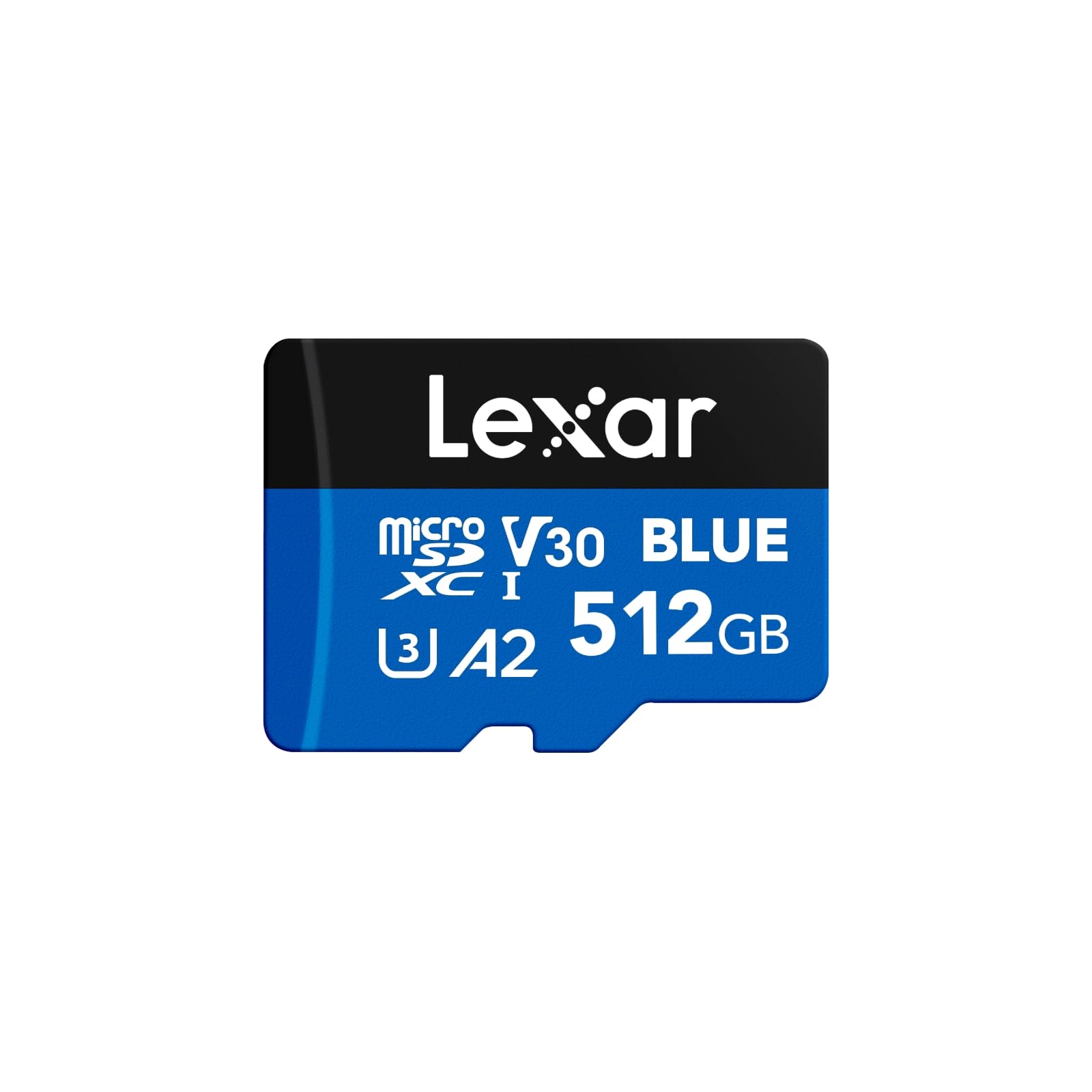
Lexar Blue 512GB microSD

94 /100
Studio Score High Confidence

Key details

Capacity
512GB
Form Factor
microSD with adapter
Sustained Write
30MB/s
Video Speed Class
V30 / A2
Check Price on Amazon

The 512GB Lexar Blue is the capacity-first pick in this comparison: one card holds a full travel shoot or a long weekend of drone flights. Read speeds reach 160MB/s for quick offloads, and the A2 rating keeps phone app behavior responsive when the card doubles as storage expansion.

With that much room, a 4K action cam can record far more footage before you need to offload, and the included SD adapter lets the same card move into a DSLR or mirrorless as a backup slot. This is not a native full-size card, but it removes the need to carry multiple microSDs on a long trip.

This card suits shooters who want maximum storage per slot and whose drone, action cam, or phone lists 512GB as supported. The capacity advantage only exists if the host device accepts that size, so a quick manual check comes before purchase. For long trips, a sensible backup habit is part of the workflow; this is a 4K-and-stills tool, not a high-bitrate raw card.

๐Ÿ’ก Format the card in the target device before first use to reduce device-specific hiccups.

Pros

  • One 512GB card covers a full travel shoot without mid-trip swaps.
  • V30/A2 speeds keep 4K recording and phone app performance smooth.
  • Build finish and overall behavior sit above budget microSD cards.
  • Consistent daily performance for drones, action cams, and phones.

Cons

  • Some drones and cameras cap below 512GB, so device support should be verified before ordering.
  • Repeated read/write cycles can lead to file corruption or formatting trouble in some units, so backups matter.
Our verdict

For travel-heavy shooters with a 512GB-compatible device, this card's capacity is the strongest argument. Keep a backup routine for footage that matters.

Check Latest Price
5

Fast UHS-I Full-Size Alternative

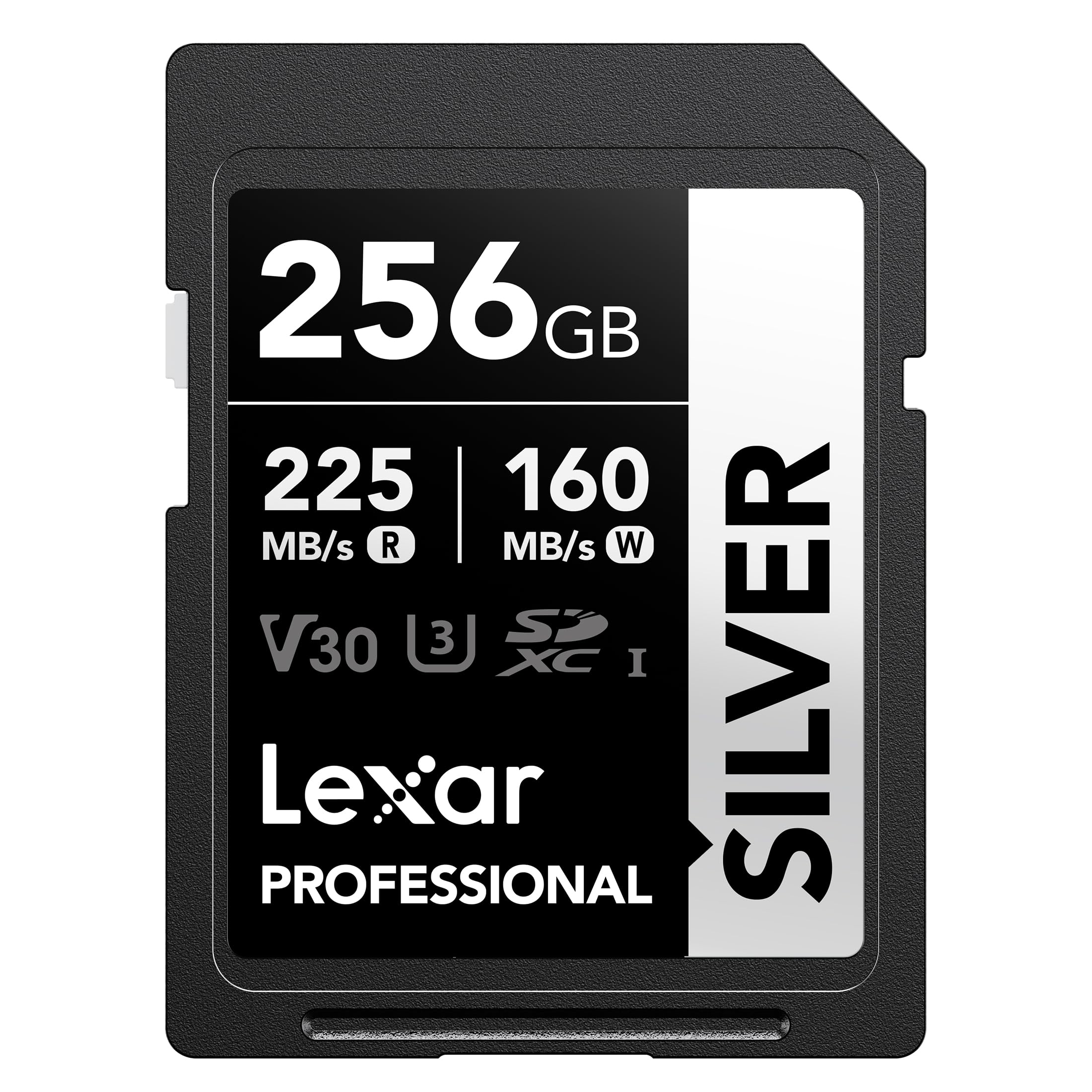
Lexar Silver 256GB SD

92 /100
Studio Score High Confidence

Key details

Capacity
256GB
Form Factor
Full-size SDXC
Sustained Write
160MB/s
Video Speed Class
U3 / V30
Check Price on Amazon

The Lexar Silver 256GB posts 225MB/s reads and 160MB/s writes, the fastest UHS-I figures in the full-size SD group. Those numbers put it ahead of typical UHS-I cards and give UHS-I cameras enough headroom for standard 4K UHD recording. The U3/V30 rating aligns with common 4K bitrates on compatible bodies, and the 256GB capacity supports long shooting sessions.

In supported cameras, 4K clips hold up well and playback stays clean. The bigger practical win is offload speed: 225MB/s reads cut transfer time after a full 256GB card, which makes backup and file review less of a bottleneck. Raw stills that stay within UHS-I write budgets also record without issue, which fits the card's V30 class.

The right buyer is a full-size SD photographer who wants fast UHS-I performance without UHS-II pricing. Sustained write tops out at UHS-I levels, so UHS-II cameras that require maximum sustained write and 8K or high-bitrate workflows should look at a V60 card. For hybrid shooting on a standard camera, 256GB gives room for both 4K clips and raw stills, while the read speed keeps import time short.

๐Ÿ’ก For long raw bursts, let the camera buffer clear between sequences.

Pros

  • Fastest UHS-I reads and writes in the full-size SD group, so offloads are quick.
  • Handles standard 4K UHD and raw stills within UHS-I write budgets.
  • Video quality holds up in compatible camera modes.

Cons

  • Full-size SDXC only; microSD-only action cams and phones need a different card.
  • Raw burst or high-bitrate modes can exceed the card's sustained write speed.
Our verdict

For full-size SD shooters, this is the UHS-I card with the fastest offload speeds and solid 4K headroom. If your camera demands UHS-II, look elsewhere.

Check Latest Price
6

Budget 4K

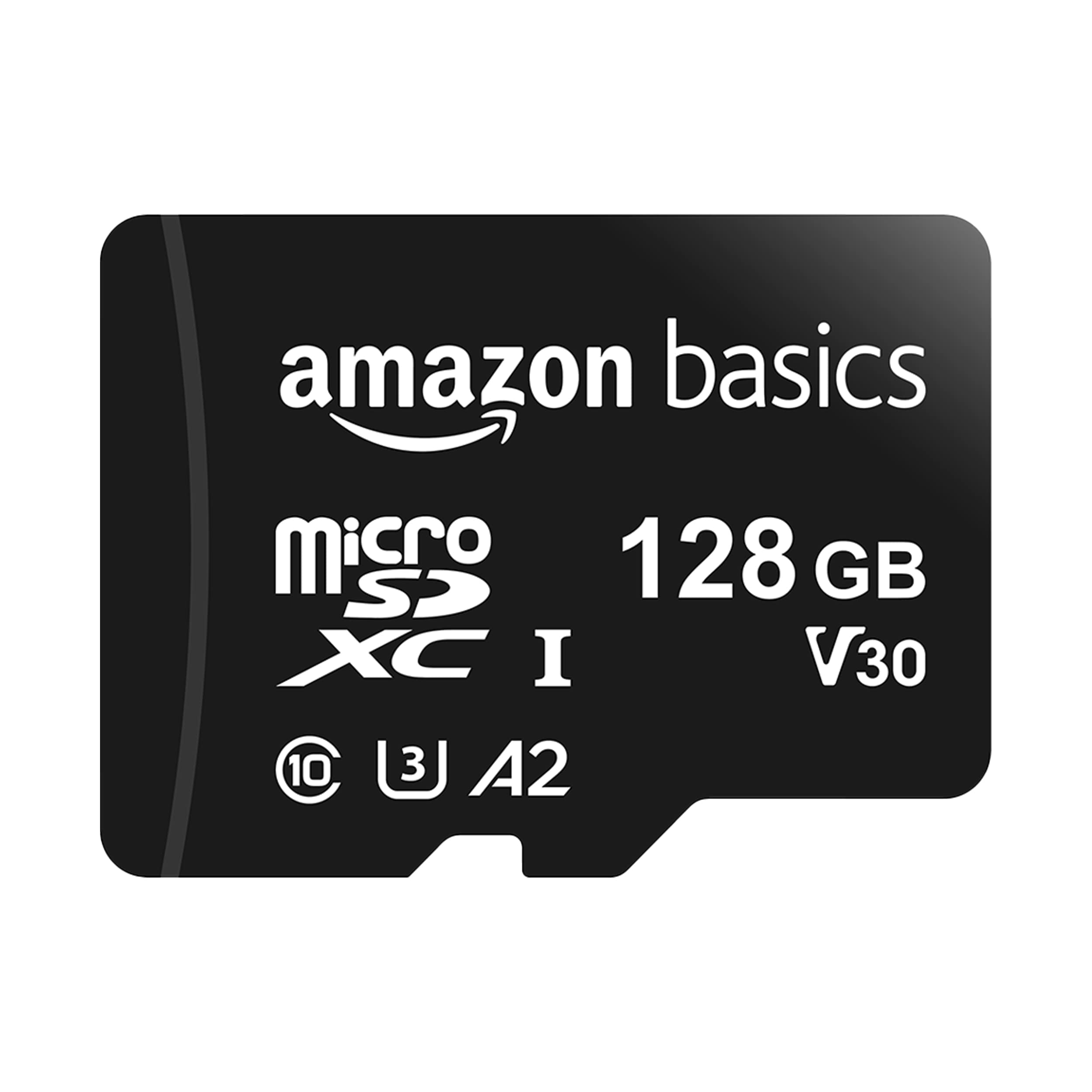
Amazon Basics 128GB microSD

95 /100
Studio Score High Confidence

Key details

Capacity
128GB
Form Factor
microSD with adapter
Sustained Write
60MB/s
Video Speed Class
U3 / V30 / A2
Check Price on Amazon

This 128GB microSDXC card with a full-size adapter is an entry-level V30 option with broad compatibility across GoPro, Switch, entry drones, and dash cams. U3/A2 ratings and 100MB/s reads cover standard 4K clips, while the bundled adapter lets the same card work in cameras that take full-size SD. The tradeoff that keeps it out of the top slot is predicting which individual cards hold up over time. Standard 4K on casual devices is well within its reach.

Pros

  • Entry-level price with V30 specs and an included full-size adapter for wide device use.
  • Handles standard 4K clips well on GoPro, Switch, entry drones, and dash cams.
  • 128GB capacity covers plenty of photos and HD video for secondary storage.

Cons

  • High-bitrate 4K modes on demanding cameras can outpace its sustained write speed.
  • Some units can become unreadable or require reformatting after extended use.
Our verdict

Fits casual 4K recording on a budget when footage is non-critical and the card is formatted and tested before heavy use.

Check Latest Price
7

Security Cameras

Gigastone 128GB microSD 2-Pack

93 /100
Studio Score High Confidence

Key details

Capacity
128GB x2
Form Factor
microSD with adapters
Sustained Write
40MB/s
Video Speed Class
V30 / A1
Check Price on Amazon

The Gigastone two-pack delivers two 128GB V30 microSD cards with SD adapters, giving 4K action cams, drones, and full-size camera slots a compatible storage pair at a lower per-card cost than typical single-card alternatives. Read speed tops out at 95MB/s, which is enough for quick transfers out of a card, and the 40MB/s write speed clears the U3/V30 threshold for standard 4K capture.

Unit variance is the reason this sits below the 4K top tier: a two-pack can include a card that will not format or becomes unreadable, so format and test both before first use. Security-cam redundancy and casual 4K recordings absorb that risk.

Pros

  • Steady performance for security cameras and casual recording
  • Good build quality and protective card packaging
  • Two-card bundle costs less per card than buying singles in this class

Cons

  • Professional 4K shoots with sustained high-bitrate output will want more write headroom than V30 offers.
  • The bundle is not a zero-maintenance option: first-time setup includes verifying both cards.
Our verdict

For security-cam or multi-cam 4K setups that can accept a quick arrival check, the two-pack is a cost-effective fit.

Check Latest Price
8

Phones, Tablets

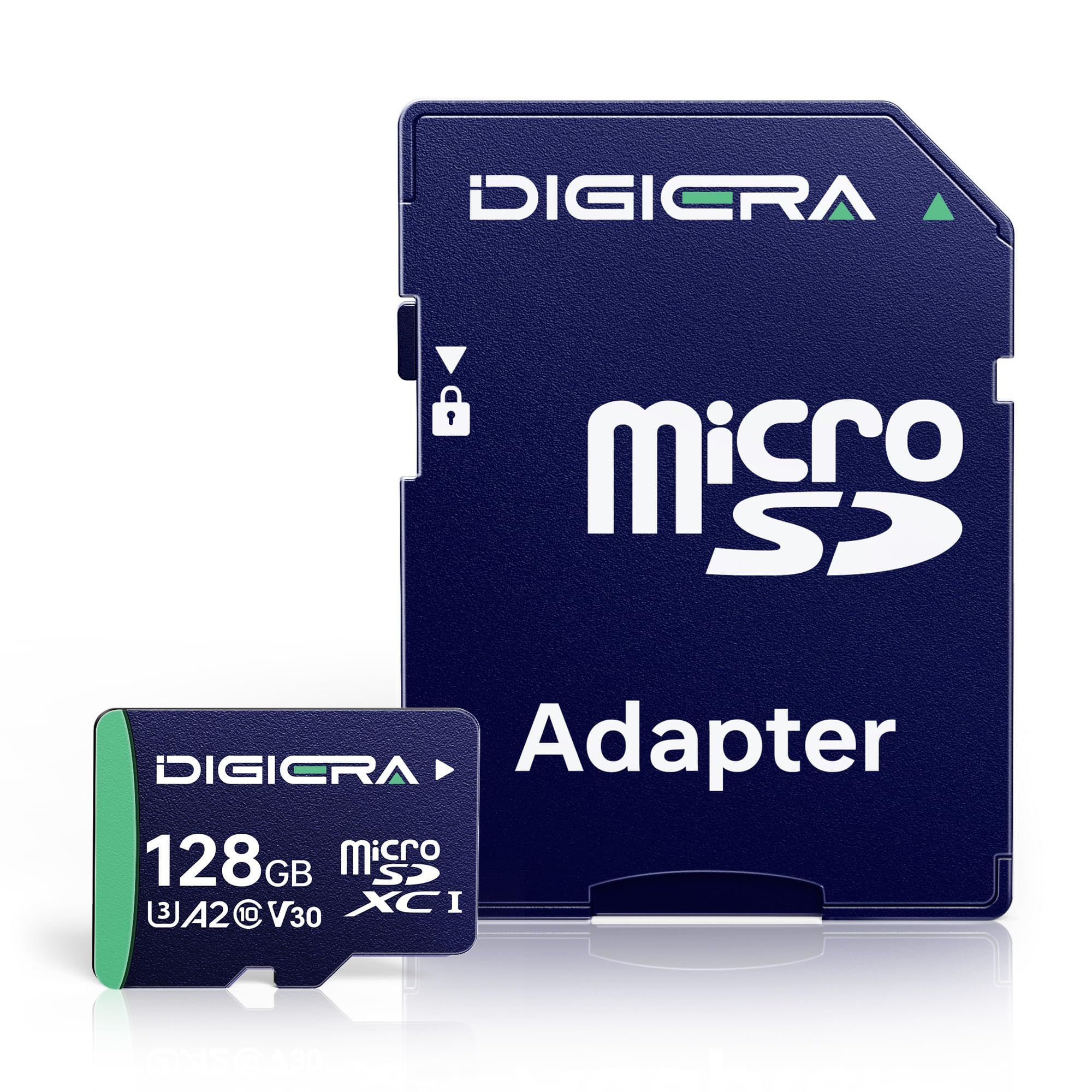
DIGIERA 128GB microSD

90 /100
Studio Score High Confidence

Key details

Capacity
128GB
Form Factor
microSD with adapter
Sustained Write
40MB/s
Video Speed Class
U3 / V30 / A2
Check Price on Amazon

The DIGIERA 128GB microSD pairs V30/U3 write speeds with A2 app performance and an SD adapter, which keeps the price entry-level while covering phones, tablets, and casual cameras. Standard UHD 4K clips sit within the card's capabilities, and the 100MB/s read speed handles ordinary transfers without complaint. High-bitrate 4K modes can exceed the sustained write headroom of a UHS-I card, so this is not a production workhorse. QC can vary between units, so an arrival format-and-test step matters; after that, it is a serviceable budget card for non-critical footage and everyday storage, but a secondary choice when footage cannot be re-recorded.

Pros

  • V30/U3 plus A2 ratings deliver usable 4K and app performance at an entry-level price.
  • 128GB capacity with an SD adapter fits phones, tablets, and casual cameras.
  • Cost-effective way to add 128GB of A2-rated storage.

Cons

  • High-bitrate 4K modes can exceed this UHS-I card's sustained write speed.
  • A card can arrive corrupt or refuse to format, so an arrival check matters.
Our verdict

Once it passes an arrival format-and-test, this is a serviceable low-cost option for casual 4K and everyday device storage, but not a primary production card.

Check Latest Price

How to Choose

Video Speed Class

Video Speed Class is the only label that directly addresses continuous recording. V30 guarantees a minimum sustained write of 30MB/s, which is the baseline for most 4K modes. V60 and V90 raise that floor for high-bitrate 4K, 6K, and 8K.

A camera recording low-bitrate 4K can run on V30, while the same camera shooting 4K60 in 10-bit may stop the clip or show a card error. Match the speed class to the most demanding mode you actually use, not the promotional footage on the box.

Sustained Write Speed

Peak read speed moves files to your computer quickly, but it says nothing about how fast a card absorbs incoming video. Sustained write speed determines whether the camera buffer can empty before the next burst or clip arrives.

A card with a 90MB/s write speed covers most UHS-I 4K cameras. A card that drops to 30MB/s under continuous load is a mismatch for a camera shooting 4K60 at a high bitrate, even when the label says U3.

Capacity and Camera Support

Capacity is not just a storage limit. Many cameras and drones have SDXC size caps, often at 128GB or 256GB, so a 512GB card can be rejected or behave unpredictably even when formatted correctly.

Check the manual's supported card list before moving up in capacity. When capacity works, bigger cards reduce swaps on long shoots; when it does not, the extra storage is worthless.

Form Factor

microSD cards with an SD adapter fit more devices, but the adapter adds a mechanical seam between the card and the camera. Native full-size SD cards avoid that seam, which matters in a dedicated camera slot exposed to daily insertion and heat.

For an action cam, phone, or drone, a microSD with adapter is the practical standard. For a primary camera, a native full-size SD card is the safer long-term fit.

Brand Reliability and Warranty

Budget cards can print the same V30 label as established brands, but support and lifespan differ. A cheap card can save money up front and turn into a larger cost when it stops saving footage.

Choose a card with a clear warranty and a brand that has a track record of honoring it. Card corruption is rare with name-brand cards and much less rare with the lowest-cost options.

Frequently Asked Questions