8 Best CFexpress Cards in 2026: Speeds That Survive Real Shooting

The best CFexpress cards for your camera, judged by sustained write speeds, heat behavior, and real workflow fit, not just the maximum read speed on the box.

CFexpress listings lead with enormous maximum read speeds, but those numbers only appear when the card, camera, and reader all support the same generation. The speed that actually matters is sustained write—how long the card holds high-bitrate video and rapid bursts before slowing down. Heat behavior matters too, since the same card can run cool in one body and trigger shutdowns in another.

The real trade-off is between proven track records and newer 4.0 specs. A card with years of field use costs more per gigabyte and transfers slower, while a newer card can match or beat it on paper for less money. For camera storage, where one corrupted file can cost a paid shoot, that difference is not just a benchmark number.

This guide matches cards to stressful real workflows: long 8K recording, continuous RAW bursts, and all-day event coverage. If a card cannot hold its speed when it counts, the headline read speed does not matter.

1

Best Overall

SanDisk 512GB Extreme PRO

96 /100
Studio Score High Confidence

Key details

Capacity
512GB
Warranty
Lifetime limited
Max Speeds
1700/1400 MB/s
Card Format
Type B
Check Price on Amazon

The Extreme PRO line has a long field history in Canon R5 and Nikon Z bodies, and this 512GB version follows that pattern: read speeds up to 1700 MB/s, write speeds up to 1400 MB/s, and enough room for all-day stills or extended 4K/8K clips. Those numbers hold through the sort of bursts these cameras produce. In a Z9 or R5, burst captures continue through long sequences without the buffer-induced pauses that mark slower cards. The 512GB size also means fewer card swaps during a long event, and the bundle adds RescuePRO Deluxe recovery software plus a lifetime limited warranty.

The card holds its write rate in the bodies it is built for. High-bitrate video recordings and continuous RAW bursts on Nikon Z8/Z9 and Canon R5 complete without an early stop, and offloads run at the rated 1700 MB/s ceiling, placing it at the high end of the CFexpress 2.0 generation. The physical build matches that performance: the card seats firmly in the slot, and the case assembly feels consistent across units. Firmware compatibility extends to select XQD cameras, so Nikon shooters moving from an older body can bring the card along via a firmware update.

This is the right Type B card for working Nikon Z6/Z7/Z8/Z9 and Canon R5 photographers who want a large-capacity card with extensive public field use behind it. The main boundary is generational: this is a PCIe 3.0/CFexpress 2.0 card, so it does not deliver CFexpress 4.0 transfer speeds. Very large offloads take longer than they would on a 4.0 card, and buyers who move a full card after every job will feel that difference. Sony shooters with Type A-only bodies need the smaller Type A format instead.

The 512GB capacity is set at a practical level for the cameras this card serves. Event photographers can cover a full day without swapping cards, and videographers can keep the same card in the body for multiple long clips. It sits between entry-level 128GB/256GB cards and the much more expensive 1TB/2TB options, which makes it a realistic choice for working pros. Memory cards are rarely the part of a kit that gets attention, but this one stays out of the way during a shoot.

The choice between this card and a speed-first CFexpress 4.0 alternative comes down to how you weigh recorded history against peak numbers. This card's advantage is that its behavior in the cameras this card targets is already mapped out. Newer cards may show higher numbers in benchmarks, but they have not built the same level of field documentation. For a working photographer, that documentation is the feature.

Pros

  • Field-tested behavior in Canon R5 and Nikon Z bodies keeps bursts rolling during paid shoots.
  • Dense construction and clean manufacturing give the card a dependable feel in the hand and in the slot.
  • Fast writes and transfers move a 512GB card through backups without stalling.
  • 512GB capacity covers all-day stills and longer 4K/8K sessions in one slot.

Cons

  • Premium price sits above comparable 512GB Type B cards, including some with faster 4.0 transfers.
  • When offloading a full 512GB card, transfer times sit below CFexpress 4.0 rivals.
Our verdict

This is the card to keep in the primary slot for paid Nikon Z or Canon R5 work; its long field record and 512GB capacity make it a low-risk choice for shooters who need the recording itself to behave.
Check Latest Price
2

Best Sony Type A Overall

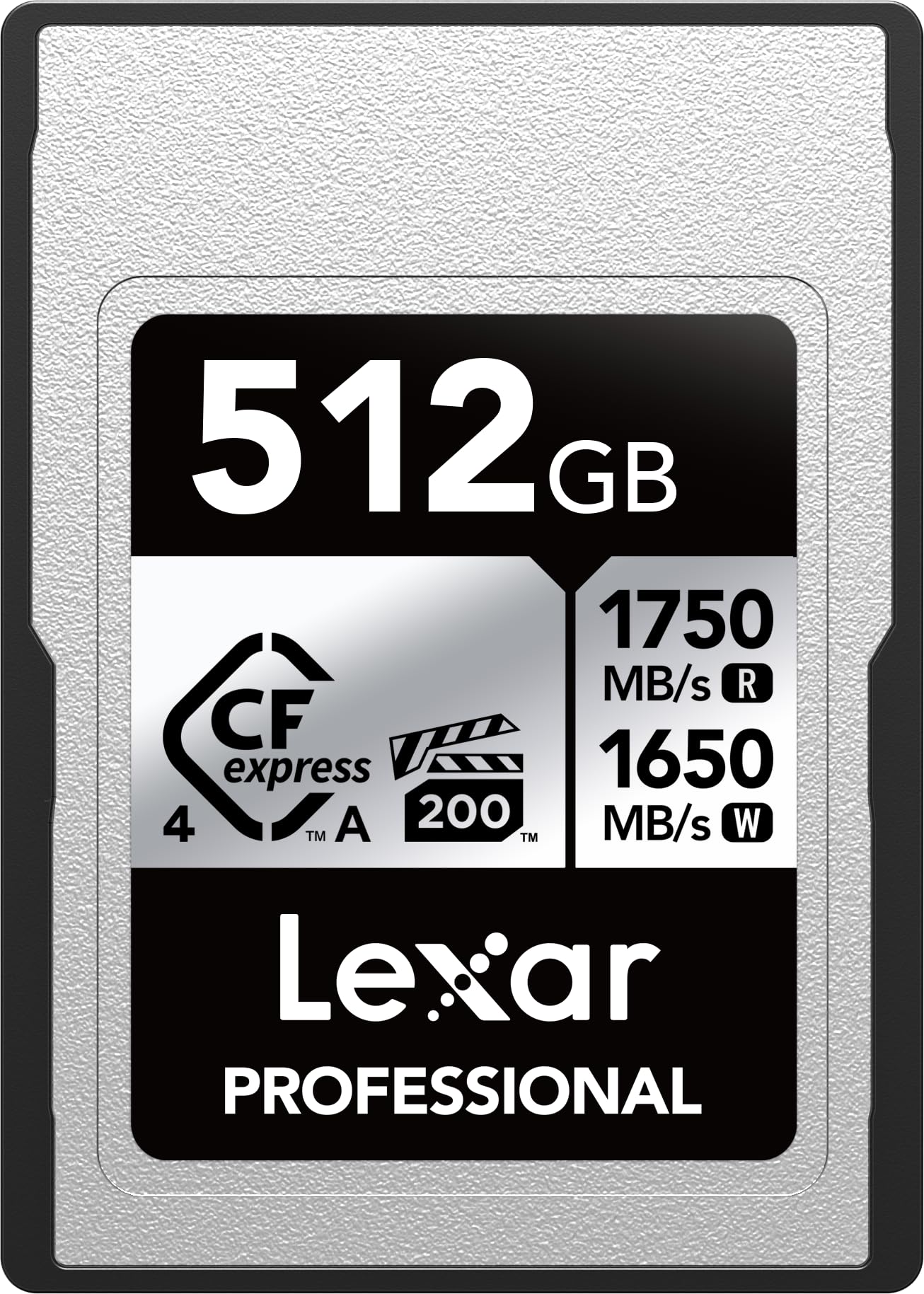
Lexar 512GB Type A Silver 4.0

92 /100
Studio Score High Confidence

Key details

Capacity
512GB
Warranty
Max Speeds
1750/1650 MB/s
Card Format
Type A
Check Price on Amazon

The 512GB Lexar Silver 4.0 is the Type A card that pairs CFexpress 4.0-class read and write speeds with Sony Alpha/FX compatibility at a price below Sony Tough alternatives. Its 1750 MB/s read speed and 1650 MB/s burst write speed clear buffers quickly during high-speed stills and keep card writes moving in A7 IV, FX3, and A1 bodies. The Type A form factor is what Sony Alpha and FX bodies take, and 512GB is enough for long event days or extended video sessions without swapping cards.

The sustained 1300 MB/s write stays ahead of 4K120 and 8K recording, and the 512GB capacity covers all-day shoots. VPG200 certification is relevant because it sets a minimum write floor; that floor is what keeps high-bitrate modes from dropping frames when the buffer fills. During high-speed bursts, the write path clears quickly, so the buffer is not what ends a run; card capacity or the camera's own frame-rate limits come first.

This card fits Sony Alpha/FX shooters who want one high-capacity card for bursts and high-bitrate video without paying the Sony Tough premium. It only fits CFexpress Type A slots, and full-speed offloads require a Type A reader. For this group, the card removes the need to carry multiple 128GB cards and gives the speed for demanding video modes in one slot.

Pros

  • Fast daily handling in Sony A7 IV, FX3, and A1 bodies keeps burst and video writes moving.
  • No buffer stall during high-speed bursts, so continuous shooting keeps going without a pause.
  • Lower-cost alternative to Sony Tough cards, making 512GB Type A capacity easier to afford.
  • Handles high-bitrate 4K120 and 8K video without dropped frames in demanding modes.

Cons

  • Premium-tier price for 512GB means budget shooters pay for capacity and 4.0-class speed they may not need.
  • VPG200 certification suits common Sony recording modes, but top-bitrate uncompressed RAW work can exceed its guaranteed write window.
Our verdict

Sony Alpha/FX shooters who need one 512GB card for bursts and 8K or 4K120 get Type A 4.0 speed below Sony Tough pricing.

Check Latest Price
3

Best Value CFexpress 4.0 Type B

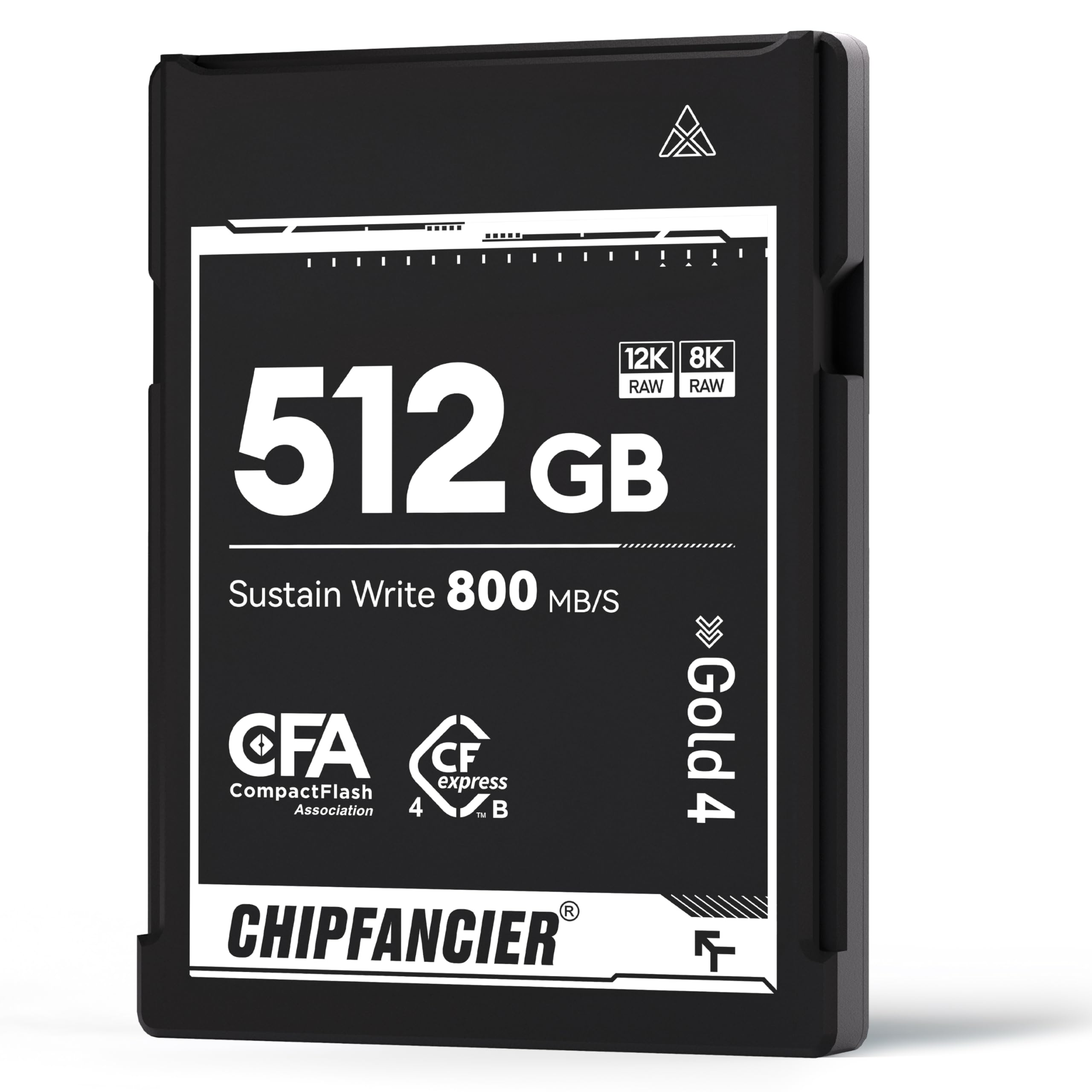
CHIPFANCIER 512GB Type B 4.0

91 /100
Studio Score High Confidence

Key details

Capacity
512GB
Warranty
5-year
Max Speeds
3550/1550 MB/s
Card Format
Type B
Check Price on Amazon

The CHIPFANCIER 512GB CFexpress 4.0 Type B card brings 3550 MB/s reads, 1550 MB/s writes, and VPG400 certification to a budget-friendly price point. The SanDisk top pick counters with a longer field history; this card answers with faster 4.0 transfers and a lower price for the same 512GB class. On paper it sits close to flagship Type B cards while undercutting them significantly.

In Nikon Z8/Z9 and Canon R5/R3 bodies, the card holds its write speed through long bursts and 8K RAW clips, with no overheating or data loss in normal operation. Buffer clearing stays quick, and transferring large projects does not drag. The card body seats firmly in Type B slots, which removes the 'did it click?' hesitation that comes with looser designs.

This is the right fit for value-focused hybrid shooters who need a 512GB Type B card with VPG400 performance in Nikon or Canon bodies. Sony Type A owners will need a different format, and anyone requiring the absolute highest sustained write for 8K60 RAW should look toward faster alternatives. Buyers who prefer a brand with a longer field history may feel more comfortable with the SanDisk top pick.

💡 Pair the card with a CFexpress 4.0 reader to get the full 3550 MB/s read speed; older readers and camera slots will cap transfers lower.

Pros

  • Records long 8K RAW clips without overheating or data loss in compatible bodies.
  • Card body fits securely in Type B slots and handles repeated swapping in Nikon Z8/Z9 bodies.
  • Offloads 512GB of footage quickly and clears buffer fast enough to avoid stalled bursts.
  • Pricing undercuts most 512GB CFexpress 4.0 cards, making it a cost-effective large-capacity option.

Cons

  • For all-day 8K RAW sessions, the 512GB capacity means carrying a spare card; 1TB options swap less often.
  • The 1550 MB/s sustained write sits below the fastest Type B 4.0 cards, so the highest-bitrate 8K60 RAW modes may exceed it.
Our verdict

For Type B shooters who want 512GB, VPG400, and 4.0 transfer speeds without the premium price, this is the value pick.

Check Latest Price
5

Best CFexpress 4.0 Type B for Pros

ProGrade Gold 512GB Type B

92 /100
Studio Score High Confidence

Key details

Capacity
512GB
Warranty
3-year limited
Max Speeds
3400/3000 MB/s
Card Format
Type B
Check Price on Amazon

The ProGrade Gold pairs a 3400 MB/s read speed with a sustained write rate that keeps high-bitrate hybrid work moving. The laser-etched serial number and included recovery software add a layer of accountability after a shoot, while the three-year warranty supports the investment. This is a premium Type B option aimed at Nikon Z8/Z9 owners who want the newest 4.0 transfer speeds and prefer a card with built-in recoverability.

In Nikon Z8/Z9 bodies, the card sustains long bursts without buffer stalls and runs cooler than several competitors during 4K/6K/8K recording. Offloads from a full 512GB card move quickly, so the 4.0 interface is a practical upgrade for shooters who transfer large clips between jobs. The sustained write rate stays steady enough for demanding modes, which is the part of the spec sheet that actually matters on set.

This is a Type B card, so Sony Alpha shooters using Type A slots need a different format. It suits Nikon Z8/Z9 owners and hybrid shooters who already use premium storage and want the newest Type B speeds. Fit can be snug in some camera bodies, so a quick ejection check in your specific body before the card enters a regular rotation is worth the few minutes.

Pros

  • Fast CFexpress 4.0 transfers keep large 512GB offloads from becoming a bottleneck.
  • Laser-etched serial number and recovery software protect working professionals after a shoot.
  • Holds high burst rates without write-stall issues in Nikon Z8/Z9 bodies.
  • Runs cooler than several competitors during sustained recording.

Cons

  • Premium price places it above budget-focused CFexpress 4.0 alternatives.
  • Ejection can be snug in some camera bodies.
Our verdict

The Gold's premium sits in the recovery software, serialized card, and three-year warranty — support that matters when footage is on the line.

Check Latest Price
6

Best 2TB High-Capacity Type B

Sabrent Rocket CFX PRO 2TB

88 /100
Studio Score Strong Evidence

Key details

Capacity
2TB
Warranty
2-year limited
Max Speeds
1800/1700 MB/s
Card Format
Type B
Check Price on Amazon

The Sabrent Rocket CFX PRO 2TB puts two terabytes of Type B storage in a single slot, with 1800/1700 MB/s maximum speeds and a 1300 MB/s sustained write. That combination supports long recording sessions on Nikon Z8, D850, and Canon R5C bodies without a card change.

Sustained throughput holds up in high-bitrate modes, so the full capacity stays usable instead of becoming a storage figure that only works in bursts. Stills shooters and event photographers get clean recording without lag during long takes.

This card suits event and wedding photographers who want one card for the entire day, plus hybrid shooters who need long recording times. Thermal behavior varies by camera body, and extended video on some bodies has produced overheating shutdowns, so video-heavy users should verify long-take performance in their own camera before relying on it.

At 2TB, the value case is simple: the cost per gigabyte lands low enough to replace several smaller spares. It is a premium-priced card, but for anyone who would otherwise carry a handful of 512GB cards, the capacity economics are hard to ignore.

💡 If you record long video, run a full-length clip in your own camera body before using this card for paid work.

Pros

  • 2TB capacity in one slot lets event shooters run a full day without swapping cards.
  • Sustained write speed handles high-bitrate recording without lag.
  • Cost per gigabyte is competitive for a 2TB Type B card.

Cons

  • Moving a full 2TB card takes longer than with CFexpress 4.0 because this is a PCIe 3.0 card.
  • Extended video on some camera bodies can trigger overheating shutdowns.
Our verdict

A capacity-first Type B card for shooters who would rather carry one 2TB card than a stack of smaller spares.

Check Latest Price
7

Budget Type B

Lexar 256GB Type B Silver

91 /100
Studio Score High Confidence

Key details

Capacity
256GB
Warranty
10-year limited
Max Speeds
1750/1300 MB/s
Card Format
Type B
Check Price on Amazon

The card sustains 1750 MB/s reads and 1300 MB/s writes in the Type B format, backed by a 10-year limited warranty — enough throughput for high-resolution bursts and 8K video on Nikon and Canon mirrorless bodies. XQD cameras that gained CFexpress via firmware can run it as a drop-in upgrade. The boundary is PCIe 3.0: offloading a full card takes longer than with newer 4.0 designs, and for similar money the 4.0 value leader doubles capacity to 512GB. Nikon and Canon shooters who want a 256GB Type B with a long warranty fit the profile; Sony Type A users and buyers chasing 4.0 rates should look elsewhere.

Pros

  • Sustained 1750/1300 MB/s throughput handles high-resolution bursts and 8K video on Nikon and Canon bodies.
  • Well-built card that operates consistently for daily shooting.
  • XQD camera owners with updated firmware gain a Type B CFexpress slot without buying a new camera.

Cons

  • Offloading a full 256GB card tops out at PCIe 3.0 speeds
  • You get 256GB where the 4.0 value leader offers 512GB for similar money.
Our verdict

The right fit when you need a 256GB Type B card for a Nikon or Canon body and CFexpress 4.0 offload speed isn't required.

Check Latest Price
8

CFexpress 4.0 Value

Delkin 512GB Type B 4.0

88 /100
Studio Score Strong Evidence

Key details

Capacity
512GB
Warranty
Lifetime, 48-hour replacement
Max Speeds
3650/3240 MB/s
Card Format
Type B
Check Price on Amazon

At 3650 MB/s read and 3240 MB/s burst write, this 512GB Type B 4.0 card brings near-flagship speed to a mid-range price, with a lifetime replacement program that includes 48-hour turnaround. Nikon and Canon mirrorless shooters get fast RAW bursts and smooth 4K/6K/8K video in a shockproof, waterproof package. The catch for video purists: it lacks VPG400 certification, so it cannot guarantee the minimum write speed some 8K RAW bodies require. That places it behind premium video-certified cards for demanding RAW video, but for hybrid stills/video work it covers the essentials at a lower cost.

Pros

  • CFexpress 4.0 burst speeds come at a mid-range price.
  • Smooth 4K/6K/8K video and fast RAW bursts in hybrid bodies.
  • Lifetime replacement with 48-hour turnaround protects long-term ownership.

Cons

  • Sustained write speed is 820 MB/s, below the burst figure; continuous high-bitrate recording has less headroom.
  • Extended 8K RAW sessions can fill a single 512GB card, so spares are part of the kit.
Our verdict

For Nikon/Canon shooters who want CFexpress 4.0 speed and lifetime replacement without a video-certified premium, this 512GB card fits.

Check Latest Price
9

Sony Budget Shooters

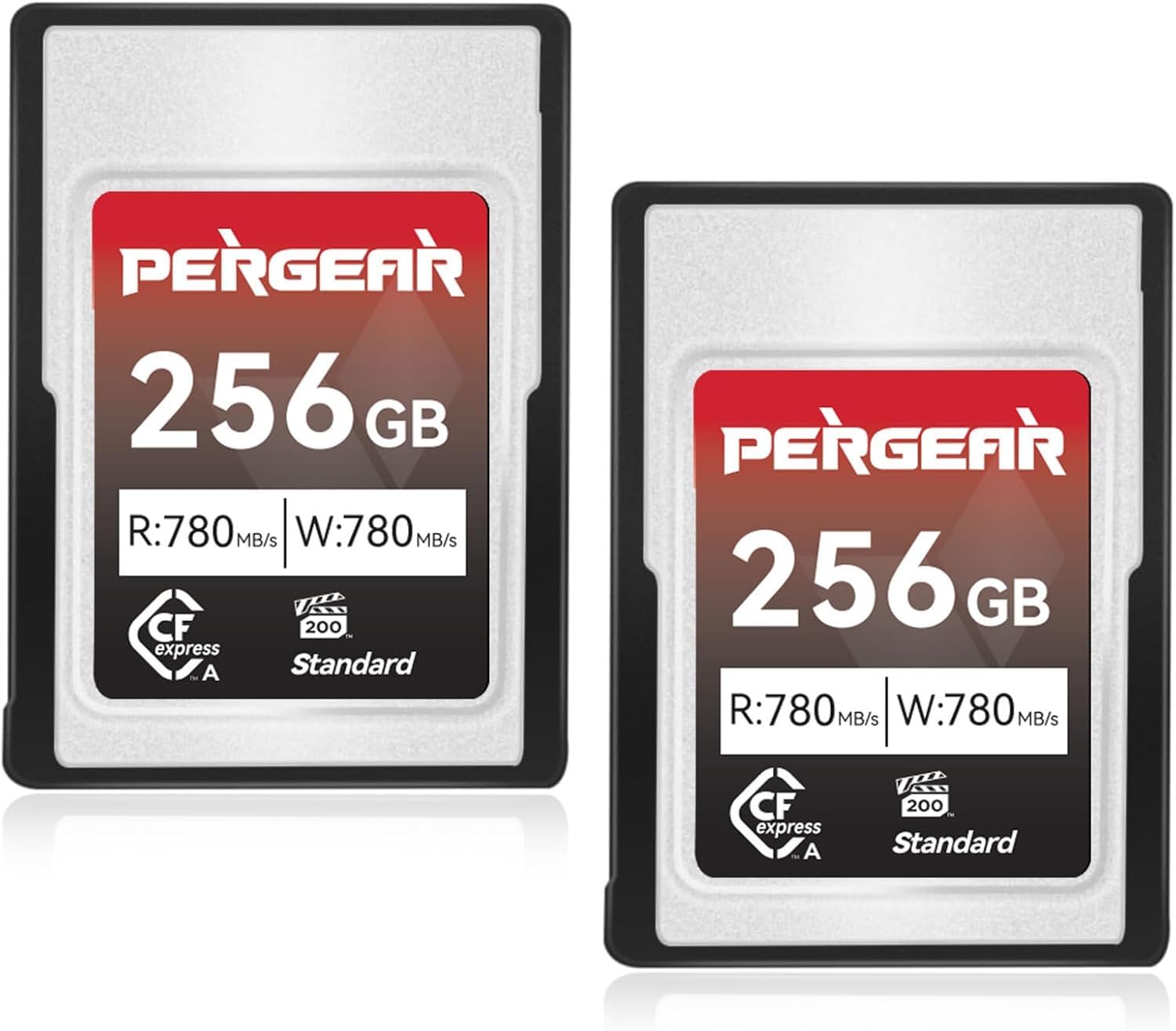
Pergear 256GB Type A 2-Pack

89 /100
Studio Score Strong Evidence

Key details

Capacity
2x256GB
Warranty
5-year replacement
Max Speeds
780/780 MB/s
Card Format
Type A
Check Price on Amazon

Two 256GB cards undercut the price of single premium Type A cards, which makes this the cheapest way to keep a second slot ready on a Sony body. The cards clear buffers quickly on A7S III and A7 IV bodies for stills bursts and 4K video, and the metal housing holds up through repeated swap sessions.

VPG200 certification covers stills and common video workloads, but not high-bitrate 8K RAW modes that require VPG400; sustained write sits at 380 MB/s. Event photographers and mixed photo/video shooters get a cost-effective second-card workflow without premium-card pricing.

Pros

  • Two 256GB cards in one kit undercut the price of a single premium Type A card.
  • Clears stills bursts and 4K video buffers quickly on A7S III and A7 IV bodies.
  • All-metal construction holds up to repeated card swaps in the field.

Cons

  • Max read speed of 780 MB/s trails newer CFexpress 4.0 Type A cards on large offloads.
  • At 256GB per card, all-day 4K video sessions can require additional cards beyond the two in this kit.
Our verdict

Best for stills-first Sony shooters and event photographers who want two-card backup without premium-card pricing.

Check Latest Price

How to Choose

Match the Card Format to Your Camera

Card format is decided by the camera body, not by preference. Type A fits Sony Alpha/FX bodies; Type B fits Nikon Z, Canon R, and most other mirrorless cameras. The two are physically different and cannot be adapted.

Using the wrong format risks damaging the slot connector. Check the manual before shopping.

Size Capacity for Real Shooting Days

Capacity should match your longest uninterrupted shooting session. A wedding shooter filling 8K or RAW bursts can burn through 128GB in under an hour; a street photographer might use 80GB in a week.

Larger cards concentrate risk: if a 2TB card goes bad, you lose an entire event. Many working photographers prefer two medium cards over one huge card.

Sustained Write and VPG Rating

Sustained write speed is what the card maintains during long recording, not the burst speed on the box. The camera buffer fills, and if sustained write cannot keep up, recording stops.

VPG ratings set a minimum: VPG200 guarantees 200 MB/s, VPG400 guarantees 400 MB/s, VPG800 guarantees 800 MB/s. Match the rating to your camera's bitrate; 8K RAW often needs VPG400.

Read/Write Speeds for Your Offload Workflow

Maximum read speed only affects offloads, and only when the reader and port support it. A 4.0 card in an older reader transfers at lower speeds.

In-camera write speed drops under heat, so the same card can run differently across camera bodies. Test the exact pair before a paid shoot.

Warranty and Data Recovery

Warranties differ in what they cover. In-house data recovery can retrieve files from a corrupted card; a basic replacement warranty cannot.

For paid work, a recovery program is worth a higher price. Casual users can rely on a standard limited warranty.

Frequently Asked Questions