7 Best Graphics Cards for Video Editing 2026: Match VRAM to the Job

Find the best graphics cards for video editing by matching VRAM, encoder support, and CUDA or RDNA compatibility to your actual timeline.

Most graphics card listings lead with gaming frame rates, not the specs that matter when cutting video. That leaves editors choosing between too little VRAM for 4K timelines or paying for raw gaming power that never speeds up an export. The practical difference comes down to memory capacity, hardware encoders, and whether your editing software accelerates NVIDIA or AMD GPUs.

8GB is a workable floor for 1080p and light 4K, but high-bitrate camera footage and effects-heavy timelines push that memory to its limit. 16GB is the safer point for serious editing, and encoder support determines how fast your final videos render. NVIDIA's CUDA ecosystem remains the default in Premiere, while AMD cards offer more VRAM per dollar for editors who work in Resolve or other OpenCL-friendly software.

Match the memory to your timelines, confirm the encoder generation, and you won't overpay for gaming performance you never need.

1

Best Overall

ASUS Dual RTX 5060 Ti 16GB

91 /100
Studio Score High Confidence

Key details

Memory Bus
128-bit
VRAM Capacity
16GB GDDR7
Cooling & Noise
Dual-fan, quiet
Encoder Support
Blackwell NVENC
Check Price on Amazon

The ASUS Dual GeForce RTX 5060 Ti 16GB is the balanced NVIDIA editing card in this roundup, putting 16GB GDDR7 and Blackwell NVENC in a dual-fan body that fits typical mid-tower builds. Premiere and Avid editors get CUDA acceleration plus current-gen hardware encoding, which keeps export times and timeline scrubbing where they need to be for 4K work. The 448 GB/s memory bandwidth is strong for this class, and GDDR7 gives it headroom over older 16GB cards that relied on slower GDDR6.

Fan behavior and build quality hold up under sustained loads. The Dual cooler keeps noise low during long exports, and the card stays within a comfortable temperature range without requiring a triple-fan shroud. The temperature curve favors quiet operation over aggressive fan spin-up, so the card does not sound like a small turbine during an overnight export. The compact length also leaves room for front radiators or storage in smaller cases, which matters in mid-tower builds where space is tight. The 2632 MHz boost clock holds close to rated speeds in editing workloads, so you are not trading sustained performance for a smaller cooler.

This card targets Premiere/Avid editors who want 16GB of VRAM without moving to a flagship. The 128-bit memory bus can feel bandwidth-limited on very heavy 4K multicam timelines, so those timelines are better served by a pricier 256-bit card. For single-stream 4K and typical effects work, the memory size and encoder generation are the right match. This is also a sensible upgrade for editors currently running 8GB cards who hit VRAM limits on color-heavy timelines.

The 16GB frame buffer is the decisive spec for effects-heavy 4K: it lets you keep adjustment layers, color nodes, and multiple 4K clips in memory without forcing proxies. That is the practical difference between this card and the 8GB NVIDIA cards lower in the lineup. Editors who bounce between Premiere, After Effects, and DaVinci Resolve will find the same memory pool available across apps, which avoids the habit of flattening layers to save VRAM. This becomes more important with 10-bit footage or high-bitrate clips, where memory pressure climbs quickly.

The PCIe 5.0 x16 interface gives this card room to run on current and next-gen platforms, though it will work without issue on a PCIe 4.0 board. The dual-slot profile keeps compatibility simple for compact-to-mid tower builds, and the shorter PCB leaves cable routing room in cases where a triple-fan card would crowd the drive cage.

Pros

  • 16GB GDDR7 handles 4K timelines and effects-heavy work without hitting memory ceilings.
  • Blackwell NVENC and CUDA acceleration are a direct fit for Premiere and Avid workflows.
  • 448 GB/s GDDR7 memory bandwidth is strong for its class.
  • Quiet dual-fan cooling holds up under long exports and fits compact builds.

Cons

  • For editors who don't use NVIDIA-accelerated apps, the premium price is hard to justify against 16GB Radeon alternatives.
  • Black-screen or stability glitches have been noted on some systems, so driver checks matter.
Our verdict

The Dual 5060 Ti 16GB is the practical center of this lineup: enough VRAM for 4K effects work and current NVIDIA encoding in a case-friendly body.
Check Latest Price
2

Best Value 16GB

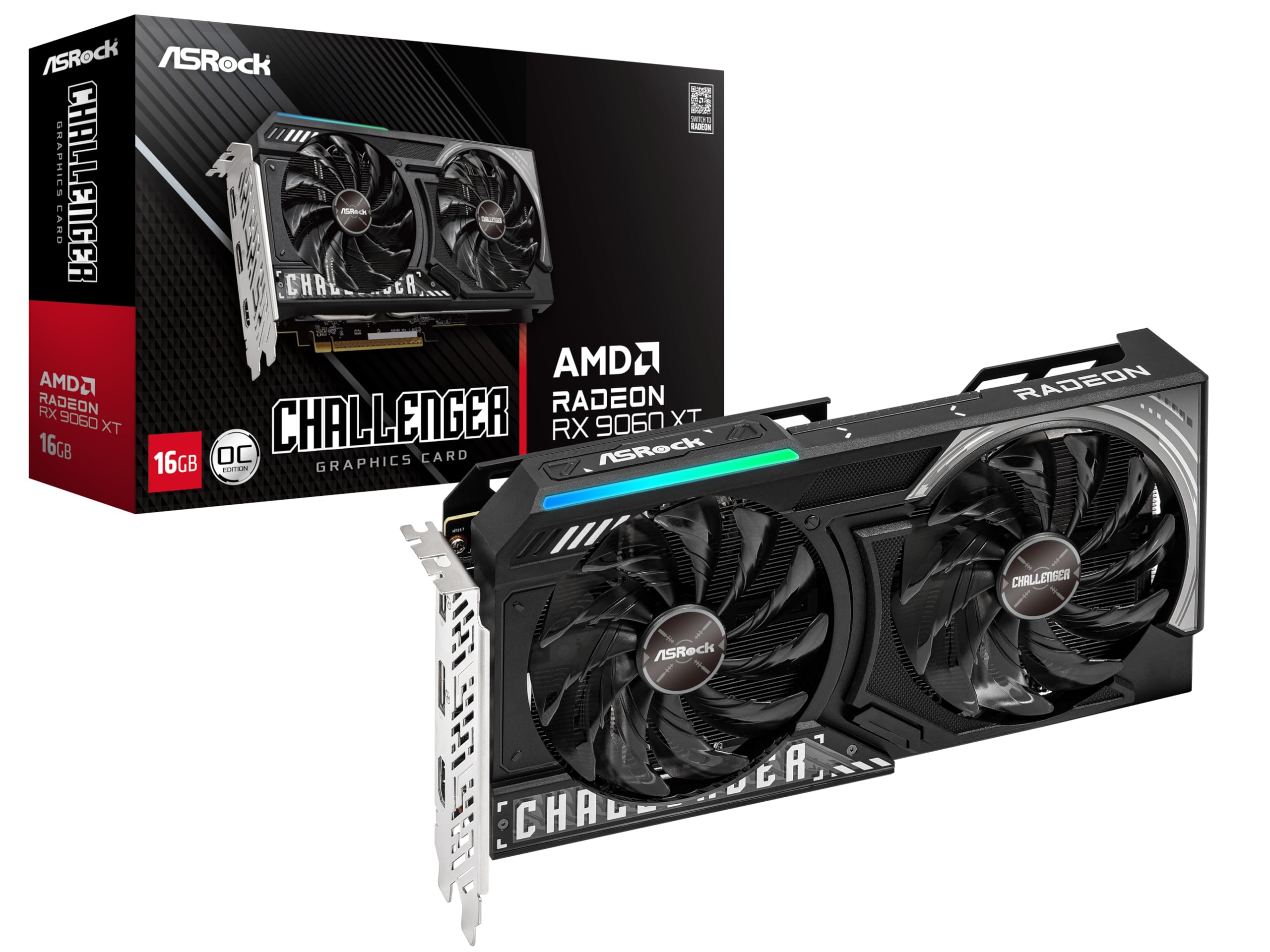
ASRock RX 9060 XT Challenger

92 /100
Studio Score High Confidence

Key details

Memory Bus
128-bit
VRAM Capacity
16GB GDDR6
Cooling & Noise
Compact dual-fan, quiet
Encoder Support
RDNA4 AV1
Check Price on Amazon

The ASRock RX 9060 XT Challenger is the value-led 16GB option in this roundup, pairing RDNA4 AV1 encoding with a compact dual-fan cooler at a mid-range price. The 16GB GDDR6 frame buffer gives editors meaningful headroom over 8GB entry cards, while the small footprint opens up SFF cases that larger triple-fan models can't fit.

Resolve, CapCut, and other AV1-friendly NLEs are where this card fits. It suits value-focused 1440p editors and budget-conscious 4K-lite workflows where timeline previews and color grading benefit from extra VRAM. AMD software support in some NLEs is less universal than NVIDIA's CUDA ecosystem, so Premiere-first editors should check their plugin list before switching.

Playback on 1440p timelines stays fluid with layered adjustments, and exports don't stall from memory pressure on typical projects. The dual-fan cooler runs quietly enough for a desk-side setup, and the single 8-pin connector keeps installation straightforward in modest builds. It also handles occasional 4K-lite output without forcing proxy files, which is more than typical mid-range cards can claim. Compared with the NVIDIA top pick, this card trades some ecosystem compatibility for the same 16GB capacity at a lower price.

Pros

  • 16GB VRAM at a mid-range price provides real headroom for 1440p timelines and effects-heavy previews.
  • 1440p performance is strong for the price, with smooth playback and responsive previews.
  • Compact dual-fan design fits SFF cases and stays quiet in desk-side builds.

Cons

  • For GPU-effect-heavy timelines, the higher-raster 12GB card in this set offers more throughput.
  • Heavy 4K multicam sequences can hit bandwidth limits from the 128-bit bus.
Our verdict

For Resolve and AV1-friendly editors, this is the value pick: 16GB VRAM and current RDNA4 encoding without the NVIDIA premium. If CUDA isn't a requirement, it belongs near the top of your shortlist.

Check Latest Price
3

Best Budget 1080P

GIGABYTE RTX 5060 WF OC 8G

91 /100
Studio Score High Confidence

Key details

Memory Bus
128-bit
VRAM Capacity
8GB GDDR7
Cooling & Noise
Dual-fan, quiet
Encoder Support
Blackwell NVENC
Check Price on Amazon

This GIGABYTE delivers the current Blackwell NVENC encoder at a mid-range price, making it the budget path into NVIDIA's newest editing features. The 16GB top pick in this roundup adds memory headroom for larger projects, but this card carries the same modern encoder at a lower entry cost. DLSS 4 is present as well, which supports real-time frame generation for game capture and preview workflows.

On 1080p timelines, scrubbing and previews stay fluid, and the Windforce cooler keeps fan noise low enough for small workstations. The compact body mounts easily into standard ATX and most mATX cases. Streamers can offload encode to the Blackwell NVENC block, freeing CPU capacity for gameplay or compositing. The 2512 MHz boost clock keeps exports moving, and the PCIe 5.0 interface leaves bandwidth headroom on current motherboards.

This card fits editors and streamers whose main workload stays in 1080p, with the occasional short 4K clip. 8GB VRAM is the practical floor; high-bitrate 4K multicam and effects-heavy overlays belong on the 16GB top pick instead.

Pros

  • Strong 1080p performance with modern NVIDIA features like DLSS 4.
  • Budget-friendly entry into current-gen NVIDIA encoding for streamers and editors.
  • Compact, quiet Windforce cooler simplifies installation in smaller cases.

Cons

No notable drawbacks to flag.

Our verdict

The right choice for a budget 1080p editing and streaming build that still wants current-gen NVIDIA encoding.

Check Latest Price
4

High-End Workhorse

GIGABYTE RTX 5070 Ti Gaming OC

88 /100
Studio Score Strong Evidence

Key details

Memory Bus
256-bit
VRAM Capacity
16GB GDDR7
Cooling & Noise
Efficient large-fan cooling
Encoder Support
Blackwell NVENC
Check Price on Amazon

The GIGABYTE RTX 5070 Ti Gaming OC pairs 16GB GDDR7 with a 256-bit memory bus, which gives 4K timelines the bandwidth to run effects and multicam clips without dropping to proxies. Its heatsink and triple-fan layout keep GPU temperatures stable during long exports, so the card holds its boost clock in sustained Adobe or Resolve sessions. That puts it a step ahead of the slimmer 16GB option in this set for editors who routinely work with high-bitrate footage.

CUDA acceleration and the current Blackwell NVENC handle H.264, H.265, and AV1 encoding from the same timeline, which matters when delivery formats vary by client. The card also stays quiet under load; coil whine is minimal at typical fan speeds, so it will not distract in a home studio. Sharp 4K output is a consistent strength, and the driver experience stays steady across GPU-accelerated effects.

This is a high-end NVIDIA card for editors who need the 16GB frame buffer and 256-bit bandwidth to work in 4K without proxy files, and who already have a roomy mid-tower or full-tower case. The premium price and large footprint require a serious PSU budget and case clearance; if either of those is tight, the slimmer 16GB option in this set covers more cases with less power demand.

💡 Remove drive cages that block the front interior; the card fits standard mid-tower layouts once clearance is confirmed.

Pros

  • 4K/1440p high-refresh timelines stay fluid with headroom for layered effects.
  • Large heatsink and triple-fan layout keep GPU temperatures under control during long exports.
  • Noise stays low enough for a shared editing room, with minimal coil whine.
  • Sharp 4K output and driver behavior that stays steady across NVIDIA-accelerated NLEs.

Cons

  • The triple-fan body extends 13.5 inches, so compact towers need a clearance check.
  • Premium pricing sits above the slimmer 16GB option, so budget-first editors may not see the value.
Our verdict

Editors working in 4K with CUDA-heavy effects should step up to this model; anyone constrained by case size or power budget should take the slimmer 16GB option.

Check Latest Price
5

High-End AMD Alternative

ASUS Prime RX 9070 XT 16GB

89 /100
Studio Score Strong Evidence

Key details

Memory Bus
256-bit
VRAM Capacity
16GB GDDR6
Cooling & Noise
Triple-fan, quiet
Encoder Support
RDNA4 AV1
Check Price on Amazon

With 16GB of GDDR6, RDNA4 silicon, and a 4,000 MHz boost clock, the ASUS Prime RX 9070 XT 16GB OC delivers high-end 4K raster performance at a more accessible price than NVIDIA's premium tier. It also brings current-generation AV1 encoding, so Resolve editors get both the frame buffer and the modern encode tools needed for serious timelines. The PCIe 5.0 x16 interface and three DisplayPort 2.1a outputs keep it compatible with current high-refresh monitors and future build upgrades.

During long exports, the card stays quiet and cool under load, which is exactly what you want from a GPU that will sit near full utilization for extended periods. The 16GB frame buffer lets multi-layer 4K projects breathe without spilling into system memory, and the high boost clock gives effects-heavy renders room to move. For editors working in AMD-friendly software, this combination makes the Prime a strong compute partner rather than just a gaming card.

This is aimed at 4K editors who are comfortable on the AMD side of the GPU aisle — DaVinci Resolve, AV1-heavy workflows, or anyone who wants 16GB without paying the NVIDIA premium. Premiere editors who depend on CUDA acceleration should look to the top pick instead. A current PSU and occasional driver maintenance are part of owning this card.

💡 Keep the card on a current PSU and update AMD's driver branch before the first 4K render.

Pros

  • Strong 4K raster performance with 16GB of VRAM keeps high-resolution timelines fluid.
  • Cost-effective high-end performance among AMD Radeon options.
  • Quiet and cool operation under sustained load suits long video exports.

Cons

  • High power draw can require a PSU upgrade in older or low-wattage builds.
  • Stability can vary between systems, with occasional crashes requiring driver troubleshooting.
Our verdict

For Resolve editors with a modern PSU, the Prime RX 9070 XT 16GB is the AMD-side answer to the top pick, trading CUDA compatibility for strong 4K performance and a lower price.

Check Latest Price
6

1440P Gaming Editing

ASRock RX 7700 XT Challenger

88 /100
Studio Score Strong Evidence

Key details

Memory Bus
192-bit
VRAM Capacity
12GB GDDR6
Cooling & Noise
Dual-fan cooling
Encoder Support
RDNA3 AV1
Check Price on Amazon

The ASRock RX 7700 XT Challenger gives 1440p editors a 12GB GDDR6 card with a 192-bit memory bus and stronger raster performance than the 16GB Radeon alternative in this set, backed by a well-built dual-fan cooler. Hardware encode/decode support covers modern editing workflows, and the card handles compute-heavy effects in shorter timelines without leaving the mid-range price bracket.

Against the top 16GB picks, the smaller VRAM pool and a bit more reliability variance make this less futureproof for heavy 4K editing. For 1440p-first editors or gamers doing light video work who don't depend on CUDA acceleration, the tradeoff is acceptable.

Pros

  • Strong 1440p raster performance from a 12GB card with a 192-bit bus for editing and gaming.
  • Well-built dual-fan design stays stable under normal workloads.
  • Cost-effective mid-range pick for editors who want more GPU performance per dollar.

Cons

  • Fan noise can be audible in quiet rooms during sustained rendering or gaming sessions.
  • Black-screen events can occur, a meaningful concern for deadline-driven 4K editing.
Our verdict

This card suits a 1440p-first editing build where CUDA isn't part of the pipeline; heavier timelines belong on a larger-VRAM option.

Check Latest Price
7

1440P 16GB Editing

XFX Swift RX 9060 XT 16GB

87 /100
Studio Score Strong Evidence

Key details

Memory Bus
128-bit
VRAM Capacity
16GB GDDR6
Cooling & Noise
Triple-fan, quiet
Encoder Support
RDNA4 AV1
Check Price on Amazon

With 16GB of GDDR6, RDNA4 AV1 encoding, and a large triple-fan cooler, this XFX Radeon handles 1440p editing timelines comfortably and runs cool under sustained loads. Its price is the sticking point: it costs more than the dual-fan RX 9060 XT in this roundup without adding performance, so the value case rests on XFX's cooling and brand availability rather than raw specs. Editors who want the lowest price for 16GB should take the dual-fan card; the XFX makes sense when thermals matter more.

Pros

  • 16GB VRAM plus RDNA4 AV1 encoding gives editors modern headroom for 4K and AV1 delivery.
  • Triple-fan cooling keeps long render sessions quiet.
  • Strong 1440p performance handles gaming between exports.

Cons

  • Large triple-fan shroud can make tight case clearances a problem.
  • CUDA-accelerated Premiere effects are unavailable, so NVIDIA-dependent editors should skip it.
Our verdict

Choose it when DaVinci Resolve or AV1-heavy editing is the main job and the triple-fan cooler is the reason you prefer this XFX.

Check Latest Price

How to Choose

VRAM Capacity

VRAM holds the frames, effects, and color data your editor accesses instantly. 8GB works for 1080p and light 4K, but high-bitrate camera footage, 10-bit color, and layered effects fill it fast. When VRAM fills, the editor swaps to system RAM and scrubbing stutters. 16GB keeps entire 4K sequences and effect caches on the card, making it the safer point for serious editing.

Encoder Support

A hardware encoder is a dedicated GPU block that handles H.264, H.265, or AV1 during export, leaving compute cores free for effects. Generation matters: NVIDIA added AV1 with RTX 40-series and Blackwell, and AMD added it with RDNA3 and RDNA4. If your delivery target is AV1, a card without AV1 encode forces slow software encoding or a format change.

Memory Bus

The memory bus controls how much data moves per second. A 128-bit bus handles 1080p and many 4K single-track edits, but 4K multicam and effects-heavy compound clips benefit from a 256-bit bus. Two 16GB cards can feel different on the same timeline because narrower buses can drop frames while VRAM still has room.

Cooling and Noise

GPUs hold their rated boost clocks only when temperatures stay in check; a weaker cooler can throttle a 30-minute export. Noise is the part buyers notice after the first long session. Dual-fan cards are fine for short edits, while triple-fan designs generally run quieter for sustained 4K work.

PSU and Case Clearance

Every GPU has a recommended PSU wattage and physical length. A high-end card can require 800W of PSU headroom and a 3.5-slot footprint, so measure case clearance before buying. A 550W PSU is fine for many mid-range cards; high-end models often need 750W or more.

Frequently Asked Questions