7 Best Fujifilm X-Mount Lens of 2026: Match It to Your Habits

Find the Fujifilm X-mount lens that matches your shooting style, from pocketable street primes to telephoto zooms, without overpaying for features you won't use.

Most Fujifilm shooters do not need a bag full of lenses. They need one that fits how they actually shoot: a fast prime for low light, a compact pancake for the street, or a telephoto zoom for daylight wildlife. The hard part is that the lens that looks best on paper is not always the one you will carry.

The trade-offs show up after a few weeks of use. A wide-range zoom covers everything but softens at the long end. A compact prime disappears on the camera but hunts for focus in dim light. Third-party lenses deliver much of the optical quality of Fujifilm glass at a lower price, while weather sealing and consistent autofocus still matter to many owners.

The right choice balances focal length, aperture, size, and control feel, because the cost of a wrong fit is a lens that stays home.

1

Best Overall

Fuji XF35mm f/2

94 /100
Studio Score High Confidence

Key details

Autofocus
0.08s inner focus
Focal Length
35mm (53mm equiv.)
Max Aperture
f/2
Size & Weight
โ€”
Check Price on Amazon

The XF35mm f/2 R WR is a weather-sealed 53mm-equivalent prime with fast inner-focus AF and a 9-blade aperture. The lens resolves fine detail well at f/2, and stopped down it stays sharp across the frame. For street scenes, travel snaps, and casual portraits, the focal length and aperture produce a natural look without the bulk of a faster normal prime. On APS-C, 53mm frames with enough context to keep a scene readable while still isolating a subject.

Autofocus acquisition is quick enough to keep pace with a walking city; the inner-focus system locks onto subjects smoothly. The 9-blade aperture gives out-of-focus areas a gentle falloff, and the compact barrel keeps a small Fuji body balanced. This lens disappears in a bag or on a strap, which matters more for daily carry than having an extra stop of light.

The intended buyer is the Fujifilm X-mount owner who wants one normal prime for daily carry: street, travel, family, walkaround. It is also the sensible first Fuji prime because it demonstrates the system's strengths without the premium price of an f/1.4 normal lens. The f/2 aperture and no built-in OIS mean very low light, handheld shots need higher ISO or faster glass; if that describes your regular work, the larger f/1.4 prime is the better fit.

Build quality matches the WR label: the barrel seals against light rain and trail dust, and the aperture ring feels solid without being stiff. Weather sealing is a meaningful advantage over cheaper X-mount primes, and the mid-range price keeps it a cost-effective entry into the system. The lens is easy to grab and set without looking because the controls sit where Fuji shooters expect them.

The value case is simple: a weather-sealed prime with strong optics and fast AF at a mid-range price. Fuji's f/1.4 normal prime is pricier and noticeably larger, while third-party X-mount primes are cheaper but may give up weather sealing or aperture-ring feel. This lens sits in the middle and covers the ground a daily carry kit needs.

Against the faster f/1.4 normal prime, this lens is the lighter and more affordable carry option. The speed difference shows only in dim indoor venues or when you need maximum background separation. For daytime street and travel, the trade is easy to live with.

๐Ÿ’ก For very low light, raise ISO or use a camera body with stabilization; this lens has no built-in OIS.

Pros

  • Sharpness at f/2 is strong across the frame, holding detail for everyday street and travel images.
  • Autofocus responds quickly and quietly, suited to street and travel pacing.
  • Compact and lightweight build keeps the camera balanced and easy to carry through a full day.
  • Weather-sealed construction adds all-weather confidence at a cost-effective price.
  • Solid build quality with a firm aperture ring and no wobble in the barrel.

Cons

  • The f/2 maximum aperture trades away some background isolation compared with f/1.4 normal primes.
  • Without built-in stabilization, handheld very low light shots rely on higher ISO or a camera body with IBIS.
Our verdict

A compact weather-sealed normal prime that puts everyday sharpness and fast AF ahead of maximum aperture. For X-mount owners who don't need f/1.4, this is the lens to build a carry kit around.
Check Latest Price
2

Best Telephoto / Wildlife

Fuji XF70-300mm f/4-5.6

89 /100
Studio Score Strong Evidence

Key details

Autofocus
Linear motor
Focal Length
70-300mm (107-457mm equiv.)
Max Aperture
f/4-5.6
Size & Weight
580g
Check Price on Amazon

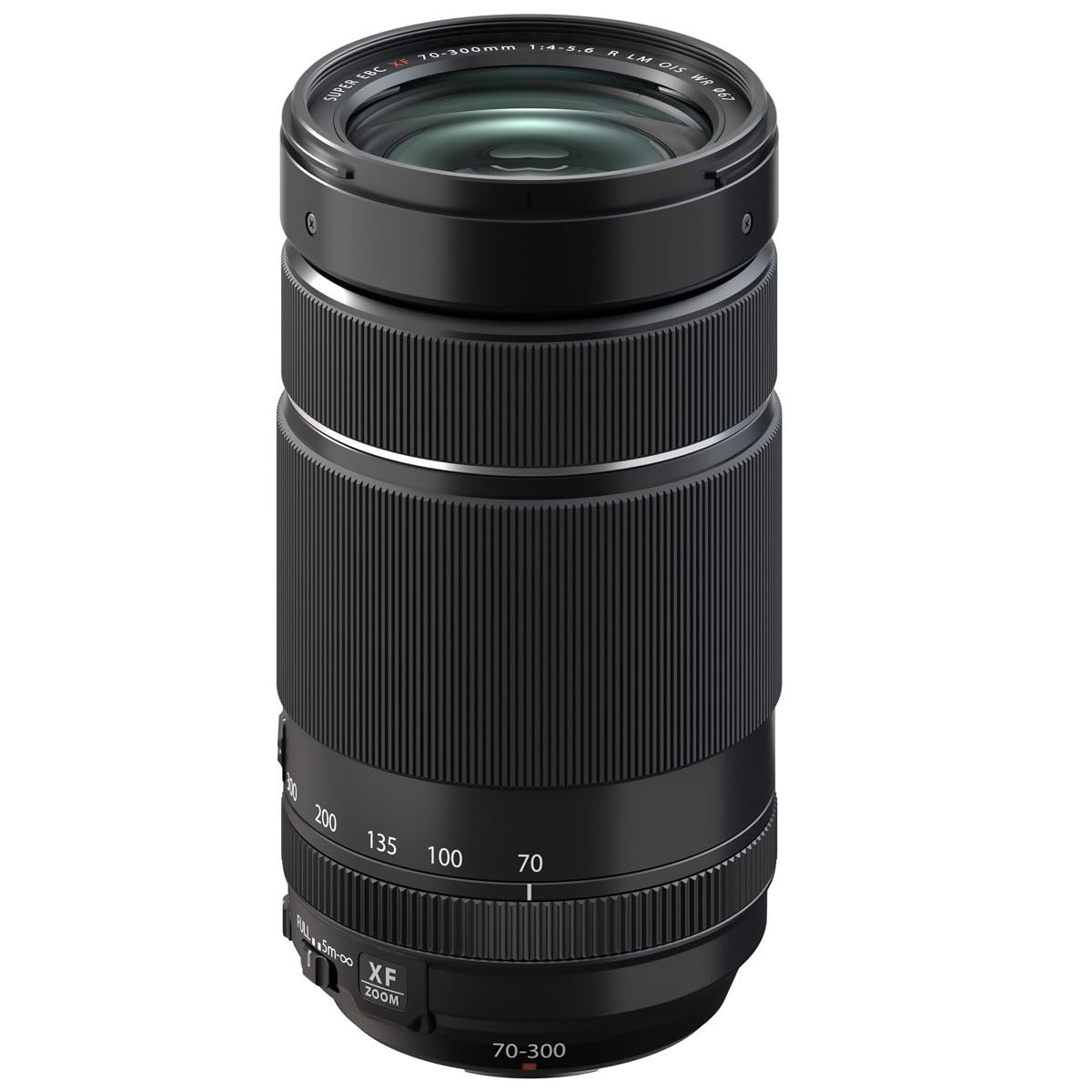
The XF70-300mm f/4-5.6 covers 70-300mm with 5.5-stop optical stabilization, weather sealing, and teleconverter compatibility in a 580g body. That combination makes it the telephoto specialist in this X-mount lineup, not an all-purpose walkaround.

Hand-held shooting at 300mm stays sharp, and the close-focus range opens up flower and small-subject work between telephoto shots. The 5.5-stop stabilization is what makes this practical on a hike: you can leave the tripod behind and still bring back usable wildlife frames. Image quality at the long end holds up well, which is why birders and outdoor sports shooters favor it over the wider-range superzoom in this group.

This lens is for Fujifilm X shooters who want serious telephoto reach for daylight wildlife, birding, and outdoor sports without jumping to a heavier 100-400mm class zoom. For stills work, it is a strong daylight companion; the variable f/4-5.6 aperture simply means indoor events in dim light and shooters needing f/2.8 speed should look at primes or standard zooms. Video users should also account for focus wobble when zooming during recording, so the lens suits a stills-first outdoor workflow.

๐Ÿ’ก Keep the zoom ring still while recording video; fixed-focal-length shots avoid focus wobble.

Pros

  • Strong telephoto image quality from 70mm through 300mm.
  • OIS keeps hand-held shots sharp at the 300mm end.
  • 580g weight makes long telephoto carry practical for hikes.
  • Close-focus range and teleconverter compatibility extend framing choices.

Cons

  • Focus wobble can occur while zooming during video recording.
  • Variable f/4-5.6 aperture needs decent light at the long end.
Our verdict

The XF70-300mm pairs long reach with stabilization and weather sealing in a body light enough for day hikes. For daylight wildlife and outdoor sports, it is a premium-priced but focused telephoto choice; low-light event work belongs to faster glass.

Check Latest Price
3

Best All-In-One Travel Zoom

Tamron 18-300mm f/3.5-6.3

84 /100
Studio Score Strong Evidence

Key details

Autofocus
VXD linear motor
Focal Length
18-300mm (27-450mm equiv.)
Max Aperture
f/3.5-6.3
Size & Weight
21.9 oz
Check Price on Amazon

One lens spans from 18mm group shots to 300mm reach, and the close-focus feature adds a macro-style mode that a typical standard zoom skips. The barrel is solid, the VC stabilization covers the long end, and the 21.9-ounce weight still balances on a Fujifilm body without feeling like a binocular attachment. That focal span removes the moment when the shot slips away because the needed lens is back in the bag.

At a family outing or trail stop, the Tamron behaves like the only lens you brought: wide scenes, compressed backgrounds, and close-up details all fall within the twist of the zoom ring. The close focus is the part that surprises: small flowers and food shots fill the frame without an adapter or a dedicated macro lens. The VC keeps handheld framing steady across the zoom range, which makes the long end more usable on uneven trail ground.

The right buyer is a traveler, hiker, or family photographer who prefers one lens over a bag of swaps. At 300mm the lens trades some fine detail and autofocus decisiveness for reach, so pixel-peeping landscape shooters and low-light wildlife work belong to the dedicated 70-300mm telephoto in this comparison. In exchange, you get a single lens that starts at a true wide angle and ends at a useful telephoto, which is the convenience this search category is really about.

๐Ÿ’ก At 300mm, keep shutter speed high enough to stop subject motion; VC steadies camera shake, not movement.

Pros

  • Covers 18mm wide shots through 300mm reach, so one lens handles most walking-around subjects.
  • Close focus gets into macro-style detail without an extra macro lens or adapter.
  • Solid barrel holds up through trail use and balances well on Fujifilm bodies.
  • For the focal span it provides, the price undercuts assembling two dedicated zooms.

Cons

  • At 300mm, the f/6.3 maximum aperture makes low-light action shots harder than with a faster telephoto.
  • Autofocus can lag at full zoom, especially when the subject is moving toward the camera.
Our verdict

This is the lens for a Fujifilm X shooter who would rather carry one body and one optic; the long-end compromises are real but stay out of view for daylight travel and family photos.

Check Latest Price
4

Best Compact Standard Zoom

Sigma 18-50mm f/2.8

84 /100
Studio Score Strong Evidence

Key details

Autofocus
Auto focus
Focal Length
18-50mm (27-75mm equiv.)
Max Aperture
f/2.8 constant
Size & Weight
285g
Check Price on Amazon

The Sigma 18-50mm f/2.8 is one of the lightest constant-aperture zooms for Fuji X, at 285g, and it is smaller than Fuji's own f/2.8 zooms. Constant f/2.8 keeps exposure stable while zooming, which matters for video, and the quiet focus motor does not intrude in close-in shots. The 18-50mm range covers standard walkaround angles in a barrel that disappears into a small bag. This is the compact alternative for shooters who want zoom flexibility without carrying a full-size f/2.8 zoom.

On an X-T body, the lens balances like a compact prime rather than a heavy zoom. The zoom ring is smooth and damped, and center sharpness holds up for daily stills work. The short barrel keeps the camera easy to pack and avoids the front-heavy feel of larger f/2.8 zooms. Hybrid shooters can move between photo and video modes without changing lenses, which keeps the workflow simple.

This lens is for travel and hybrid shooters who want one optic that moves easily from stills to video. Fuji shooters who insist on lens-ring aperture control and edge-to-edge sharpness will need to adapt: aperture is set from the body, and corner detail trails the center. For the intended travel and hybrid group, the compact barrel and constant f/2.8 outweigh the control layout.

๐Ÿ’ก Assign the camera's front dial to aperture before a shoot so exposure changes stay within thumb reach.

Pros

  • A 285g constant-f/2.8 zoom keeps a travel kit light without losing exposure flexibility.
  • Center sharpness is strong at typical stills apertures, so walkaround shots hold detail.
  • Quiet focus motor suits video work and close-in shots without noisy AF sounds.

Cons

  • No weather sealing, so sustained rain and heavy spray need to be avoided.
  • The standard zoom range ends at 75mm equivalent, so telephoto work needs a second lens.
Our verdict

The Sigma 18-50mm f/2.8 fits the travel kit that would otherwise rely on primes, adding zoom flexibility without the bulk of larger f/2.8 zooms.

Check Latest Price
6

Street, Travel, Carry

Viltrox 28mm f/4.5

85 /100
Studio Score Strong Evidence

Key details

Autofocus
Autofocus
Focal Length
28mm (42mm equiv.)
Max Aperture
f/4.5
Size & Weight
60g
Check Price on Amazon

For Fujifilm X-mount owners who want a jacket-pocket prime, this 60g pancake is the lightest way to add a 42mm-equivalent autofocus view. Street and travel frames come out sharp with lively color at an entry-level price, and the slim profile keeps a camera bag minimal.

The daylight-first character is why it sits below the faster normal primes: f/4.5 is slow and low-light AF can struggle, but for street and travel shooters who accept that boundary, this remains a compact, budget-friendly alternative to bulkier zoom kits.

Pros

  • Featherweight 60g pancake body keeps a Fujifilm kit easy to slip into a pocket or small bag.
  • Daytime images come out sharp with lively colors from a lens that costs well below typical X-mount primes.
  • Native X-mount autofocus at a budget price makes it a low-cost travel companion.

Cons

  • Autofocus can hunt in low-contrast scenes, so dim interiors are not its home turf.
  • f/4.5 max aperture pushes indoor shots toward higher ISO and limits background separation.
Our verdict

Pack this pancake when the Fujifilm kit needs to stay light and shooting stays outdoors; it is the portability-first option in this group.

Check Latest Price
7

Street, Travel, Budget

TTArtisan AF 27mm f/2.8

82 /100
Studio Score Strong Evidence

Key details

Autofocus
STM
Focal Length
27mm (41mm equiv.)
Max Aperture
f/2.8
Size & Weight
93g
Check Price on Amazon

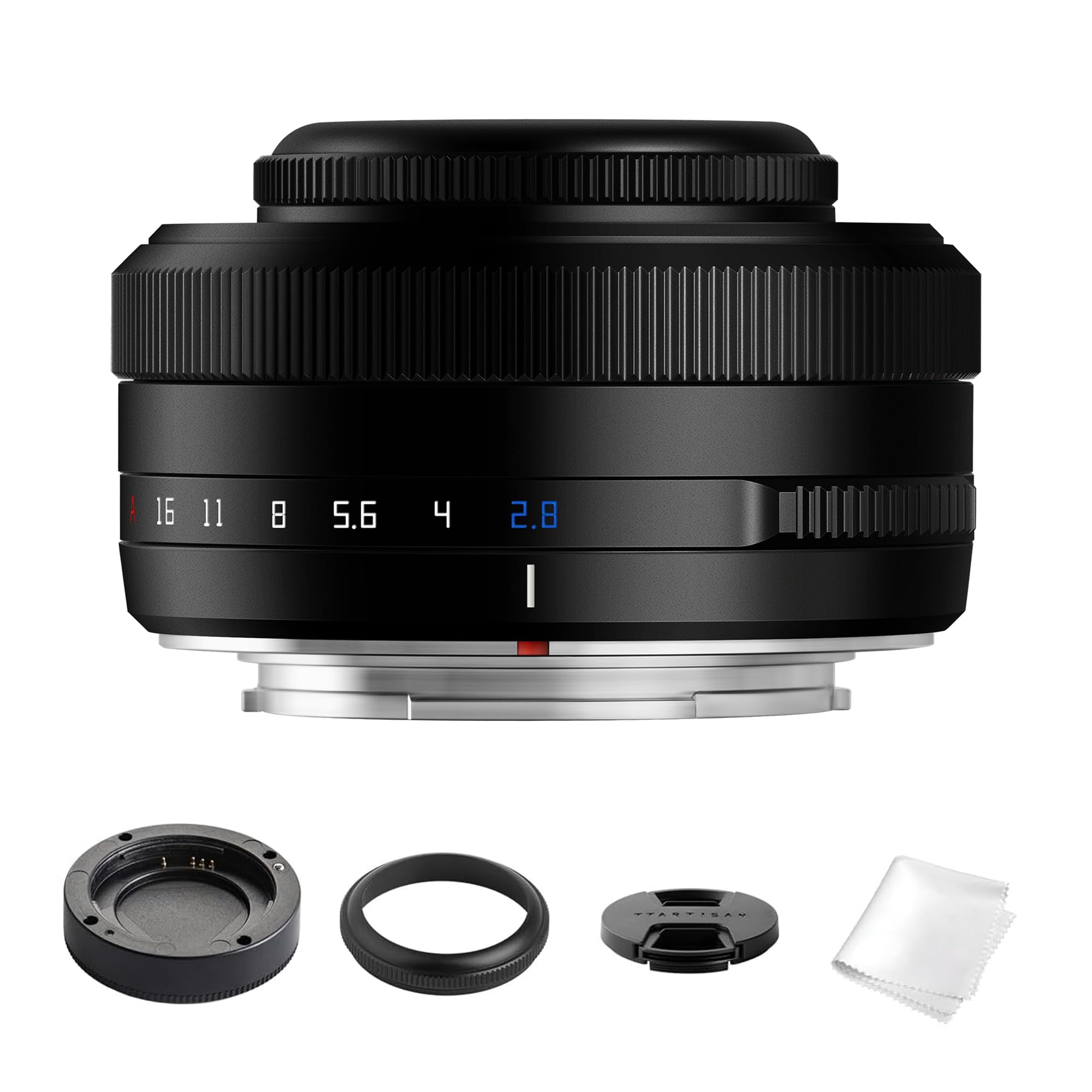
The TTArtisan AF 27mm f/2.8 is a 93g autofocus pancake for Fujifilm X with a 41mm-equivalent field of view, an aperture ring, and USB firmware updates. The optics outperform the entry-level price, delivering crisp daylight images without weighing down a body. That value is real. The compact profile and tactile aperture ring reinforce a street-shooting mindset. Focus consistency is the boundary: autofocus can miss or lose communication in low-light scenes, which is why the lens sits below the top tier. For daytime street and casual travel, the size, price, and optics make it a compelling alternative to a manual budget prime; for event coverage, a faster normal prime is the better call.

Pros

  • Sharp rendering for the price in daylight scenes
  • 93g pancake profile keeps an X-mount kit easy to carry
  • Aperture ring and USB firmware updates add real control for the cost

Cons

  • Autofocus can miss or lose communication in low-light scenes
Our verdict

Daytime street and travel walks are the right home for this budget AF pancake; critical low-light events belong to a faster prime.

Check Latest Price
8

Street, Video, Manual

TTArtisan 25mm f/2

83 /100
Studio Score Strong Evidence

Key details

Autofocus
Manual focus
Focal Length
25mm (37.5mm equiv.)
Max Aperture
f/2
Size & Weight
โ€”
Check Price on Amazon

An all-metal manual 25mm f/2 prime at a budget price is a compact tool for deliberate street and video follow-focus work. The 0.25m close focus and 37.5mm-equivalent view cover everyday framing, and central sharpness is fair for the money. The all-metal barrel and focus ring have a mechanical feel that other budget lenses skip. Wide-open f/2 gives enough light for shaded streets and indoor corners. Manual-only operation sets the pace: it suits patient shooters, not autofocus-dependent general walkaround. For a Fujifilm X buyer weighing primes and zooms, this one fills a specific low-cost manual niche rather than the all-round role.

Pros

  • Budget-friendly all-metal build with f/2 speed.
  • Compact size suits everyday carry.
  • Good optical quality for the price.

Cons

  • Edge sharpness is modest at f/2; stopping down improves it.
  • At the infinity stop, focus can land off; peaking or magnification is needed to confirm.
Our verdict

For deliberate street photography and manual follow-focus video, this compact all-metal prime is a sensible budget pick; general walkaround users should choose the autofocus pancake instead.

Check Latest Price

How to Choose

Focal Length & Field of View

Focal length changes more than magnification: wide angles exaggerate depth, while telephoto lenses compress space. A 35mm-equivalent street prime and a 50mm-equivalent portrait prime are not interchangeable even when both are compact. Zooms trade this character for convenience, but at the long end they magnify camera shake and haze. If most of your shots stay at one focal length, a prime usually delivers more consistent optical quality.

Maximum Aperture & Light

Maximum aperture controls light and background blur. An f/1.7 prime lets in more than a full stop of light over an f/2.8 zoom, which can turn a dim indoor scene into a clean hand-held shot. The trade-off is size: fast glass needs larger elements and heavier barrels. Aperture also affects autofocus; a brighter view gives the camera an easier edge to lock onto.

Size, Weight & Everyday Carry

Size and weight decide whether a lens stays on the camera or at home. A 60g pancake disappears on the body, but its small front element limits aperture and low-light focus. A heavier telephoto gives more reach, but front-heavy balance makes long walks tiring. A 580g lens in a bag is still too heavy if you leave the bag in the car. Choose the kit you will actually take with you.

Autofocus Speed, Noise & Consistency

Autofocus depends on the motor and focus group. Linear motors move quickly and quietly; budget stepping motors can click, hum, or hunt in low light. Single-shot AF can be fast even when continuous tracking is unreliable, so if you shoot moving subjects, test tracking before you commit.

Weather Resistance & Stabilization

Weather sealing keeps dust and light rain out; stabilization reduces blur from hand shake. They solve different problems: a stabilized lens cannot freeze a moving subject, and a sealed lens is not waterproof. A sealed body also needs its own gaskets, so match both to the weather you actually shoot in.

Frequently Asked Questions