6 Best Flashgun of 2026: Match TTL or Manual to Your Work

Which flashgun fits your camera and shooting style — manual radio value for off-camera builds, TTL for fast events, pocket fill for travel.

Flashgun listings push TTL and HSS compatibility hard, but the strongest value in the category usually comes from manual radio flashes. The choice is simpler than the spec sheets suggest: do you need the camera to set exposure automatically, or are you comfortable dialing in power yourself? That choice separates a budget manual workhorse from a premium TTL event gun more than any guide number.

Manual radio units cost less, keep controls simple, and group into multi-light setups that fire reliably outdoors. TTL models add automatic exposure, but the premium buys convenience rather than raw power. Pocket-sized manual flashes fill a third niche: close-range fill that fits in a jacket pocket.

Guide numbers, battery chemistry, and wireless systems all matter, but they only make sense after that TTL-versus-manual call. Get it wrong and every other spec is a footnote. Get it right and the flash becomes a tool you stop thinking about.

1

Best Overall

Godox TT600

92 /100
Studio Score High Confidence

Key details

Zoom & HSS
HSS via trigger
Guide Number
GN60
Power Source
4 AA
Exposure Mode
Manual, S1/S2
Check Price on Amazon

The Godox TT600 pairs a GN60 guide number (ISO 100, m) with a built-in Godox 2.4G radio receiver at a budget price, fitting standard hot shoes on Canon, Nikon, Fuji, Pentax, and Olympus bodies. The housing carries the heft of speedlights that cost two to three times as much, and the output is bright enough for outdoor fill and action-stopping work. On the camera, it runs in manual, S1, and S2 modes; add a Godox trigger and the same flash becomes a radio slave with access to 32 channels and 5 groups. The same body can serve on-camera or be pulled off for group work, which is the flexibility that keeps it relevant as a kit grows.

The 2.4G receiver keeps the flash locked to a Godox trigger without extra receivers, and the S1/S2 optical slave modes provide a simple fallback when a radio transmitter isn't attached, so the TT600 remains useful even as a single on-camera unit. Full-power recycle time lands between 0.1s and 2.6s depending on output level, which keeps pace for typical handheld shooting.

This is a manual-only flash for photographers who set power themselves and want a budget path into the Godox ecosystem. It is not for event shooters who rely on TTL auto exposure, nor for on-camera HSS use; HSS appears only with a compatible Godox trigger off-camera. Four AAs are the power source, with roughly 230 full-power bursts per set, so rechargeables or an external pack are part of the plan for serious sessions. If you treat the TT600 as a system tool rather than a standalone auto-exposure accessory, the manual control becomes a clear tradeoff, not a surprise.

For a first hot-shoe flash, the TT600 is a low-risk entry point. The budget price, GN60 output, and the size of the Godox system mean a later move to multiple lights doesn't make this unit obsolete; it just takes on a supporting role. The radio slave function alone makes it an easy second or third light for off-camera portraits. That combination of price, output, and ecosystem reach is hard to match for a first hot-shoe flash.

💡 High-capacity rechargeable AAs make sustained shooting less of a chore.

Pros

  • Heavy, solid housing feels more expensive than the price suggests.
  • Built-in Godox 2.4G receiver makes it an off-camera slave without extra triggers.
  • Budget price plus GN60 output handles outdoor fill and action-stopping work.
  • Compact AA-powered design still delivers bright full-power output for fill.

Cons

  • Sony MI hot-shoe bodies require an adapter before the flash will mount.
  • No li-ion pack
Our verdict

A GN60 manual speedlight that drops into any standard hot shoe and joins the Godox 2.4G system for a fraction of the price of single-brand equivalents.
Check Latest Price
2

Best Sony TTL Speedlite

Godox V860II-S

88 /100
Studio Score Strong Evidence

Key details

Zoom & HSS
1/8000s HSS
Guide Number
GN60
Power Source
Li-ion battery
Exposure Mode
TTL, manual, multi
Check Price on Amazon

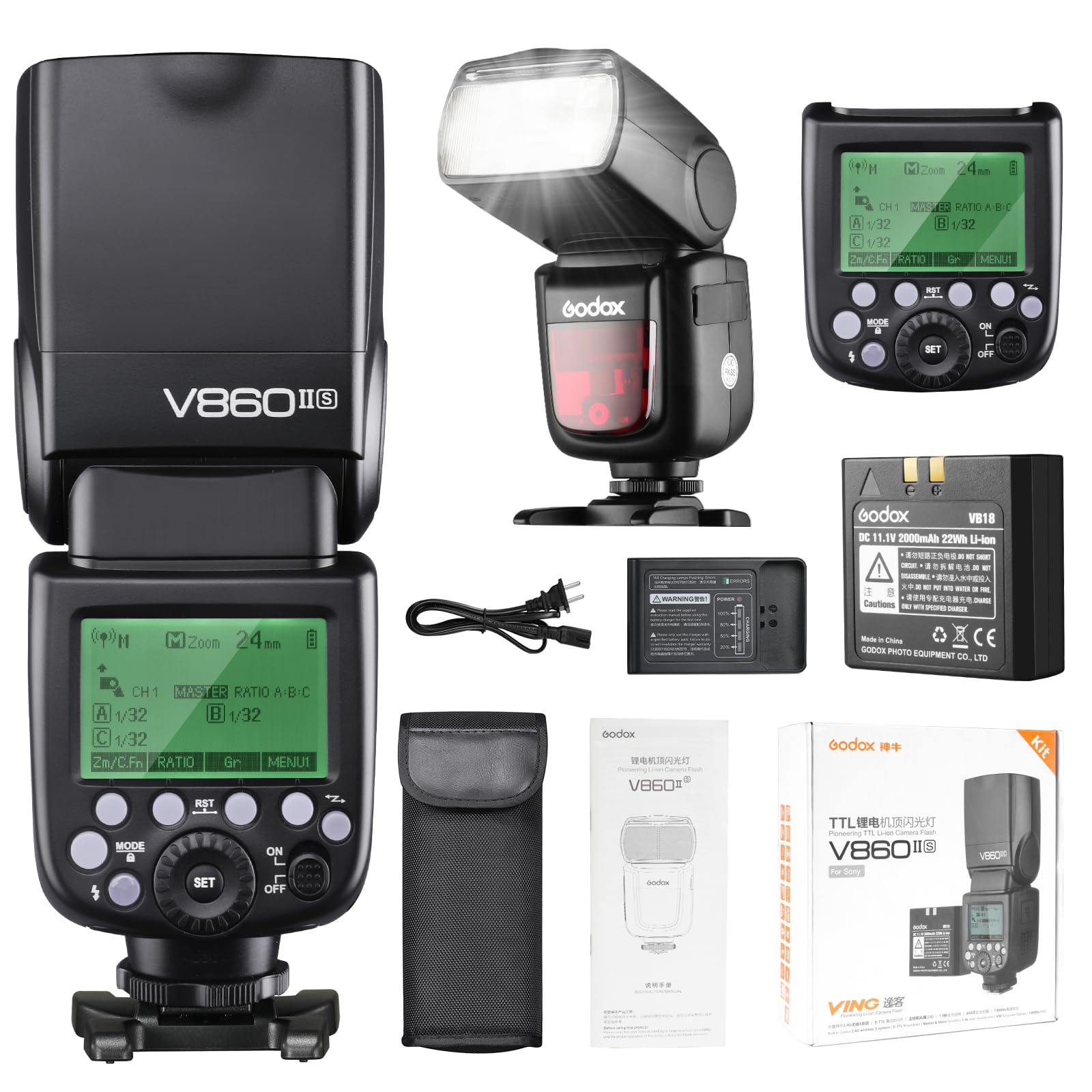
The Godox V860II-S is the Sony-specific speedlite that combines TTL, 1/8000s HSS, a 2000mAh li-ion cell, and a built-in Godox 2.4G radio in one head. That puts it ahead of a manual-only radio flash for Sony shooters who want automatic exposure from the hot shoe, and it undercuts Sony OEM pricing while matching TTL/HSS behavior on a job.

Recycle time sits near 1.5s at full power, and the li-ion battery covers roughly 650 full-power pops, so event work doesn't stall between shots. GN60 output handles dark reception rooms, and TTL exposure stays consistent on A7RIII-class Sony bodies across low-light and event scenes. Switching between TTL, manual, and slave modes takes little time.

Sony Alpha event and wedding photographers are the right fit; li-ion endurance removes the need to rotate AA packs during a long shoot. The plastic hot-shoe mount is the main physical compromise, and occasional E1 errors or sync drops may interrupt a session; a bracket and a backup trigger plan manage both. Hard-usage shooters who need a metal mount should look elsewhere.

💡 Keep the locking ring snug before each session to reduce mount stress.

Pros

  • Sony TTL and 1/8000s HSS put automatic exposure control on the hot shoe for Alpha bodies.
  • Li-ion battery lasts through around 650 full-power pops with a 1.5s recycle.
  • Built-in Godox 2.4G radio pairs with other X-system flashes for off-camera work.
  • Setup and mode switching are simple enough for event work.

Cons

  • Occasional E1 errors or sync drops can interrupt event coverage.
  • Plastic hot-shoe mount is the first stress point under heavy on-camera use.
Our verdict

Sony shooters who want TTL/HSS on the hot shoe get an event-ready flash: auto exposure, long li-ion endurance, and Godox radio in one Sony-specific body.

Check Latest Price
3

Best Canon TTL Value

Canon 430EX

89 /100
Studio Score Strong Evidence

Key details

Zoom & HSS
24-105mm zoom
Guide Number
GN43
Power Source
4 AA
Exposure Mode
Canon E-TTL II
Check Price on Amazon

The 430EX delivers consistent E-TTL II exposure from a compact Canon-native body, with a bounce head that rotates vertically and horizontally for ceiling or wall fill. That puts it on the opposite side of the top pick in this guide: a system-specific on-camera flash rather than a universal manual radio unit.

The 24-105mm zoom range reaches 14mm when the pull-out diffuser is used, and the GN43 output is enough to light a pitch-dark room for close-to-mid-range indoor shots. Controls run through a small set of labeled buttons and a clear LCD, so adjusting flash exposure compensation or zoom is fast without menu digging.

This suits a Canon EOS owner who wants automatic TTL flash on the hot shoe for events, parties, and indoor people photos. It is not built for 2.4G radio off-camera triggering, wireless mode is optical-only and line-of-sight, and heavy use runs through four AA cells quickly, so rechargeable batteries are part of the workflow.

💡 Keep one set of rechargeable AAs charging while the other is in use for sessions with frequent full-power bursts.

Pros

  • Consistent E-TTL II exposure makes indoor people shots look natural without manual guesswork.
  • Bounce head angles cover ceiling, wall, and portrait-orientation bounces.
  • GN43 output is enough for full dark-room fills in typical indoor settings.
  • Controls are simple enough for a beginner while keeping flash exposure compensation accessible.

Cons

  • Off-camera triggering is optical-only and line-of-sight, with no built-in 2.4G radio receiver.
  • Four AA cells can drain quickly in sustained high-power bursts, so spares are necessary.
Our verdict

For a Canon EOS owner who keeps the flash on the hot shoe, this is the sensible middle-ground choice: automatic TTL exposure, solid output, and controls that don't get in the way.

Check Latest Price
4

Budget Radio Master

Yongnuo YN560 IV

88 /100
Studio Score Strong Evidence

Key details

Zoom & HSS
Guide Number
GN58
Power Source
4 AA
Exposure Mode
Manual, multi
Check Price on Amazon

The YN560 IV is a budget manual speedlite that combines GN58 output with a built-in 2.4G radio master. From the hot shoe it adjusts power and groups on YN560 III/IV slave units without an external trigger, and the 3-group/16-channel support makes it a practical command center for a Yongnuo-based multi-light kit.

Manual-mode compatibility spans Canon, Nikon, Sony, and Samsung bodies, and the light output keeps pace with more expensive speedlights. The controls are dedicated and logical for manual work, but there is no TTL automation; exposure is set by hand on the flash and camera. That suits shooters who already work in manual and clearly rules out anyone expecting point-and-shoot auto exposure.

This is for budget manual shooters with YN560 III/IV units who want hot-shoe command over the whole group. It also suits hobbyists who treat the flash as a backup unit rather than the sole light on a paid job. The price makes it easy to add a second unit, but the value only shows if you accept manual operation and radio-only group control within the YN560 family. TTL-dependent photographers should look elsewhere in this set.

💡 Set each YN560 III/IV slave to the same channel before shooting; the master then adjusts power and groups remotely.

Pros

  • Built-in 2.4G master controls YN560 III/IV flash units directly from the hot shoe.
  • GN58 output provides enough light for most manual on-camera and off-camera work.
  • Manual-mode compatibility spans Canon, Nikon, Sony, and Samsung camera bodies.
  • Overall quality is rated highly for the price by a large owner base.

Cons

  • The plastic body and locking parts feel less solid than name-brand manual speedlights.
  • Full-power shooting drains AA batteries quickly, so a set of spares is a practical addition.
  • The hot-shoe foot and head angle can feel fragile, and some tubes have burned out after limited use.
Our verdict

The YN560 IV is the budget manual radio master for Yongnuo-based multi-light kits, delivering enough output and group control to replace separate triggers. Keep it in a manual-only workflow and treat it as a backup when the job allows.

Check Latest Price
5

Best Pocket Fill Flash

NEEWER Z150

87 /100
Studio Score Strong Evidence

Key details

Zoom & HSS
Guide Number
GN15
Power Source
Internal battery
Exposure Mode
Manual
Check Price on Amazon

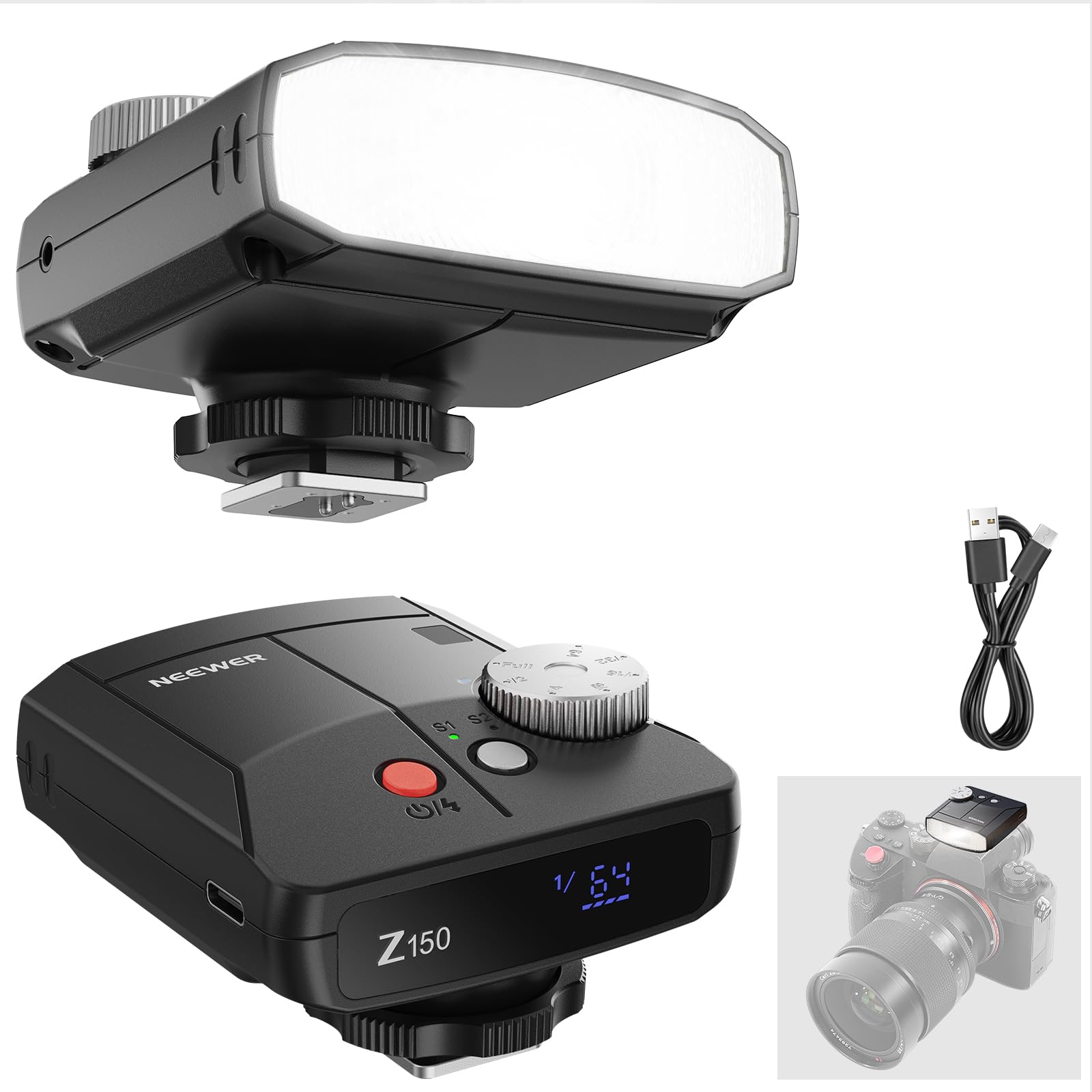
A full-size manual flash earns its place in a bag, but the NEEWER Z150 earns its place in a pocket. Its 1200mAh internal battery and compact shell still deliver usable fill light, and the simple power dial makes it a grab-and-go option for small cameras. The body feels denser and better finished than the price suggests, which removes the usual worry about cheap mini flashes.

This is for mirrorless or film shooters with a standard center-contact hot shoe who want close-range fill without carrying a full speedlite. GN15 output and a 1/200s sync limit define the boundaries: it handles subjects a few meters away, not large rooms or HSS work. The single-contact shoe also means some mirrorless bodies require mechanical shutter mode to trigger the flash, which is a non-issue for photographers already shooting in that mode.

Manual exposure is the whole system, so you set power directly rather than relying on TTL. The 1/64 to 1/1 range covers casual indoor fill, and the optical S1/S2 slave mode turns it into a low-cost off-camera light when the trigger flash is within line of sight.

Recycle runs about three seconds at full power, which suits patient shooting rather than rapid bursts. The internal cell is good for a few hundred pops, so it handles a day of casual shots before charging.

Pros

  • True pocket size with a built-in battery makes it an easy grab-and-go fill flash.
  • Manual mode fires across Canon, Nikon, Sony, Fuji, and Panasonic bodies with a center-contact hot shoe.
  • One dial handles power adjustment, so exposure control stays quick and clear.

Cons

  • At 1/64 power, close subjects can still overexpose unless you stop down or bounce.
  • The twist lock may feel light-duty; handle it gently when seating the flash.
Our verdict

The Z150 is the answer when the flash has to fit in a pocket and the shot list is close-range fill.

Check Latest Price
6

Compact Sony TTL

Nissin i60A

80 /100
Studio Score Strong Evidence

Key details

Zoom & HSS
24-200mm zoom
Guide Number
GN60
Power Source
4 AA
Exposure Mode
Sony TTL
Check Price on Amazon

The Nissin i60A delivers GN60 output and a 24-200mm zoom range in a body that keeps bulk low on the Sony hot shoe. Sony TTL exposure operates automatically, and four AA batteries keep power simple to replace. Its premium price and optical-only wireless triggering place it behind the Sony TTL runner-up in this set, which adds 2.4G radio and li-ion endurance. That makes the i60A a fit for on-camera Sony shooters who want a compact AA-powered flash with reach out to 200mm.

Pros

  • Compact AA-powered body delivers GN60 output without li-ion battery dependency.
  • 24-200mm zoom covers telephoto framing that compact flashes with shorter reach cannot match.
  • Sony TTL automation sets exposure from the hot shoe with no manual output guesswork.

Cons

  • At maximum output, the recycle pause can stretch to 5.5 seconds between bursts.
  • At full power, four AAs deliver roughly 220 pops per set, so extended shooting calls for spare cells.
Our verdict

The i60A serves a narrow lane: compact AA-powered Sony TTL flash with 200mm telephoto reach for on-camera use.

Check Latest Price

How to Choose

Guide Number and Output

Guide number (GN) is the flash's reach at ISO 100. A GN60 flash lights 60 meters at full power and telephoto zoom; real-world output drops as you zoom wider.

In practical terms, GN43 covers a living room with bounce; GN58-GN60 carries outdoor fill and larger groups.

TTL vs Manual Control

TTL reads a preflash through the lens and sets output automatically; manual asks you to dial power yourself. TTL saves time when subjects move between bright and dark spaces, but a misread preflash can shift exposure between frames.

Manual is predictable for multi-light setups, because each flash stays where you set it. The trade-off is the learning curve: distance, aperture, and ISO must become second nature before manual feels fast.

Wireless System

2.4G radio fires through walls and works in direct sun. Optical slave modes detect another flash's burst, which works indoors but struggles outdoors in bright light.

Radio systems are brand-specific — Godox triggers talk to Godox flashes, Yongnuo to Yongnuo. Choose the ecosystem before you buy the second flash.

Power Source

AA-powered flashes run on four cells, refill anywhere, and usually deliver 150-650 pops. Lithium-ion models pack more full-power flashes and recycle faster, but use a proprietary battery that needs its charger.

The difference shows in volume: an event shooter firing several hundred times gets more from li-ion; a hobbyist is fine with rechargeable AAs.

Recycle and Flash Count

Recycle time is the wait between full-power pops. A 1.5-second flash keeps up with event bursts; a 5.5-second unit can make you miss the frame.

Flash count works the same way: 230 pops cover a selective evening, 650 a full day. The spec matters only relative to how many frames you actually fire.

Zoom and High-Speed Sync

A zoom head matches the lens focal length, concentrating output for distance. A 24-105mm head covers normal range; a 24-200mm head pushes light further for compressed portraits.

HSS fires rapid pulses to work above the camera's normal sync speed, needed for wide-aperture outdoor portraits. Not every flash supports it, and some require a compatible trigger.

Frequently Asked Questions