9 Best Ring Flash of 2026: Match TTL to Your Camera Mount

A practical guide to matching a macro ring flash to your camera mount, exposure needs, and lens size—without overpaying for features you won't use.

A macro ring flash is a lens-mounted strobe, not a continuous LED light. It freezes motion and wraps close-up subjects in even light, but the first buying filter should be your camera's hot-shoe compatibility. A flash that fires on one photographer's Canon may stay silent on a newer body or a different mount entirely.

The biggest cost driver is TTL auto exposure. Brand-specific TTL gives the camera and flash a communication channel to meter automatically, while multi-brand manual flashes only need a trigger signal and cost less. That difference explains why 'compatible with many cameras' almost always means manual-only.

Once you know whether you need TTL, the remaining choices come down to output, adapter rings, and power source. Match those to your camera mount first, then decide how much automatic exposure is worth paying for.

1

Best Overall

Yongnuo YN14EX II

87 /100
Studio Score Strong Evidence

Key details

Flash Modes
TTL, Manual
Guide Number
GN18
Power Source
4x AA
Adapter Rings
52, 58, 67, 72mm
Check Price on Amazon

Canon E-TTL auto exposure is the centerpiece of the YN14EX II: mount it on a Canon EOS DSLR and automatic flash metering handles exposure changes as you move closer to or farther from the subject. The GN18 guide number covers flower close-ups, insects, and small product photography at typical working distances, and the adapter kit — 52mm, 58mm, 67mm, and 72mm — fits the usual Canon macro lens filter threads. Those are standard filter sizes, so matching one to a lens takes seconds. The large LCD keeps exposure compensation, flash bracketing, rear-curtain sync, and A/B ratio adjustments readable in the field, and manual mode is there when you want a fixed output independent of metering. Switching between TTL and manual is immediate, so you can lock a ratio and then return to automatic metering when the subject changes position.

The A/B flash-ratio control lets you shift output between the two ring halves, so a translucent petal can carry a lighter side and a darker side, or a portrait catchlight can carry more weight on one side. The AF assist lamp helps the lens acquire focus in dim close-up conditions, and the external power socket supports long studio-style sessions without swapping AA sets mid-shoot. TTL metering, flash bracketing, and rear-curtain sync run through the camera, while the flash body handles mode, ratio, and output adjustments.

This is the pick for Canon DSLR macro shooters who want automatic TTL exposure without the OEM price premium. It also serves portrait shooters who want a ring catchlight with adjustable A/B weighting. The boundary is mount compatibility: the YN14EX II speaks only Canon E-TTL/E-TTL II, so Nikon, Sony, and Fuji shooters need a mount-specific alternative. Shooters who require wireless TTL control or high-speed sync should look elsewhere; this ring is built for lens-mounted, camera-controlled macro flash. Macro photographers who work at small apertures for depth of field will appreciate TTL automation rather than calculating manual flash ratios on the fly.

The mid-range price places the YN14EX II between the entry-level Canon TTL ring and the twin-light model in this set. The core E-TTL feature set and clear control layout justify that mid-position comfortably. For Canon DSLR macro shooters, this is the strongest balance of output, control, and cost in the set.

💡 Load fresh AAs and shoot partial output when your subject won't wait; the flash recycles faster at lower power.

Pros

  • Canon E-TTL/E-TTL II auto exposure handles close-up metering changes automatically as you adjust distance.
  • GN18 output plus the 52/58/67/72mm adapter kit covers common Canon macro lenses at typical distances.
  • Large LCD, AF assist lamp, external power socket, and PC sync support low-light and extended sessions.
  • TTL and manual modes with A/B ratio, exposure compensation, FEB, and rear-curtain sync in one unit.
  • High owner confidence in a mid-range Canon TTL ring flash.

Cons

  • Full-power recycle stretches to about three seconds with fresh batteries, pacing rapid macro sequences.
  • Fixed ring geometry does not offer the directional shadow control of the twin-light Canon model.
Our verdict

For Canon DSLR macro shooters, the YN14EX II delivers consistent E-TTL automation, GN18 output, and a mature feature set at a mid-range price.

Check Latest Price
2

Best Advanced Canon Twin-Light

Yongnuo YN24EX

89 /100
Studio Score Strong Evidence

Key details

Flash Modes
E-TTL II, Manual
Guide Number
GN18
Power Source
4x AA
Adapter Rings
52, 58, 67, 72mm
Check Price on Amazon

Independent twin flash heads on a rotating ring give the YN24EX shadow and contrast control that a one-piece ring cannot match. Each head can be adjusted independently, so dental work, product details, and small subjects take on directional modeling instead of flat, circular illumination. The system is built for Canon EOS DSLR bodies and includes adapter rings for 52, 58, 67, and 72mm threads.

E-TTL II and full manual modes are both on board, with flash exposure compensation, rear-curtain sync, a modeling light, and a PC sync socket for off-camera setups. Build is solid for a non-OEM unit; full-output recycle sits around 3 seconds, extending to about 4-5 seconds with older AA cells. The control unit and flash head mount cleanly, which matters when the lens is already close to the subject.

This is the mid-range pick for Canon EOS DSLR shooters who want more light-shaping control than the top pick's single tube provides. There is no positive locking mechanism on the rotating ring, so it can move out of position during handling; a quick check before a series is part of the workflow. Shooters who simply want aim-and-fire macro flash will find the twin-head setup more than they need.

💡 Treat the ring position like part of the shot checklist; a quick glance before firing saves re-alignment.

Pros

  • Solid construction and quick attachment make it a dependable unit for regular macro work.
  • Twin-head output is strong enough for macro at f/10-f/11 and covers a range of exposure needs.
  • Included 52/58/67/72mm adapters cover common macro lenses, and the swivel head arrangement fits focus stacking tubes.

Cons

  • The rotating ring can shift during handling and has no positive lock, so a planned series may need re-alignment.
Our verdict

Canon macro shooters who need independent A/B head control get directional twin-light output here without stepping up to OEM twin-flash pricing.

Check Latest Price
3

Best Premium Nikon

Nissin MF18

79 /100
Studio Score Established

Key details

Flash Modes
TTL, HSS, wireless TTL
Guide Number
GN16
Power Source
4x AA
Adapter Rings
Check Price on Amazon

The Nissin MF18 is the only Nikon ring flash in this set with wireless TTL master and high-speed sync up to 1/8000s. That combination puts it ahead of single-purpose manual rings: it can trigger off-camera Speedlights while the lens-mounted tube keeps TTL exposure on the subject.

The hardware follows the same intent. The auto-rotating color display stays readable when the ring is turned for low-angle shots, the modeling LED helps judge shadow falloff before firing, and the quick-load battery magazine makes AA swaps faster than a conventional door. GN16 suits working distances typical of macro photography.

High-speed sync is the feature that opens up daylight close-ups. Rather than stopping down to hold ambient light, you can work at a wider aperture and let the ring fill the subject at 1/8000s. The wireless TTL master pulls the ring into the same flash language as an off-camera Nikon setup, so the ring becomes part of a larger lighting kit rather than an isolated accessory.

This is a premium, Nikon-only tool for enthusiasts and pros who already use TTL and HSS. The price premium and overkill risk for manual-only or amateur macro work are real boundaries; without that workflow, the wireless master and sync speed are idle capability. Canon and Sony shooters do not have a mount option with this model. For its intended Nikon buyer, the MF18 delivers a feature set no other ring flash in this group matches.

💡 Turn the modeling LED off between setups; the four AA cells feed both the LED and the flash tube.

Pros

  • Wireless TTL master and HSS up to 1/8000s provide the most advanced Nikon ring flash control in the set.
  • Auto-rotating color display and modeling LED make close-up setups readable and shadow placement easier.
  • Quick-load battery magazine reduces downtime when swapping four AA cells in the field.

Cons

  • GN16 output is modest, so usable range stays in true macro distances rather than general flash work.
  • The four AA cells add weight forward of the lens; smaller Nikon bodies feel more front-heavy as a result.
Our verdict

Nikon shooters already working with off-camera TTL get a ring flash that behaves like part of that system, not a separate manual tool.

Check Latest Price
4

Best Multi-Brand Manual

Godox MF-R76

79 /100
Studio Score Established

Key details

Flash Modes
Manual only
Guide Number
GN14
Power Source
Rechargeable lithium
Adapter Rings
49-77mm
Check Price on Amazon

The MF-R76 combines a rechargeable lithium battery, a 49-77mm adapter kit, and hot-shoe support for Canon, Nikon, Sony, Fuji, Olympus, and Panasonic bodies. That combination makes it the multi-brand option in this set: one ring flash can rotate across camera systems instead of adding a mount-specific flash for each. The lithium cell removes the AA-carrier habit from a manual ring flash, and the adapters cover compact macro lenses through 77mm filter threads.

Dual flash tubes deliver 1/128 through 1/1 output in 1/3-stop increments, with ten power levels for shaping close-range light. The guide number is GN14 at ISO 100, enough for macro subjects and tight portraits. The lithium cell is rated at roughly 660 full-power flashes, so an afternoon in the field does not revolve around AA swaps.

This is the right unit for manual-flash shooters who own more than one camera brand and want one ring flash on the shelf. TTL shooters should look elsewhere; every exposure is set by hand. Canon users with newer STM lens or body combinations should bench-test the hot-shoe trigger before a working session; that pairing is where trigger behavior is not guaranteed.

Pros

  • One ring flash covers Canon, Nikon, Sony, Fuji, Olympus, and Panasonic hot shoes.
  • Rechargeable lithium battery provides about 660 full-power flashes per charge.
  • Included 49-77mm adapter rings fit compact macro lenses and larger portrait glass.
  • Dual flash tubes with a 1/128-1/1 power range give close-range lighting control.

Cons

  • Manual-only exposure control means no automatic TTL for shooters who want set-and-forget flash.
  • Some newer Canon bodies or STM-lens combinations may not fire on the hot shoe; test yours before a shoot.
Our verdict

For manual-flash shooters with mixed camera systems, this is the single ring flash to keep in the bag.

Check Latest Price
5

Best Budget Sony TTL

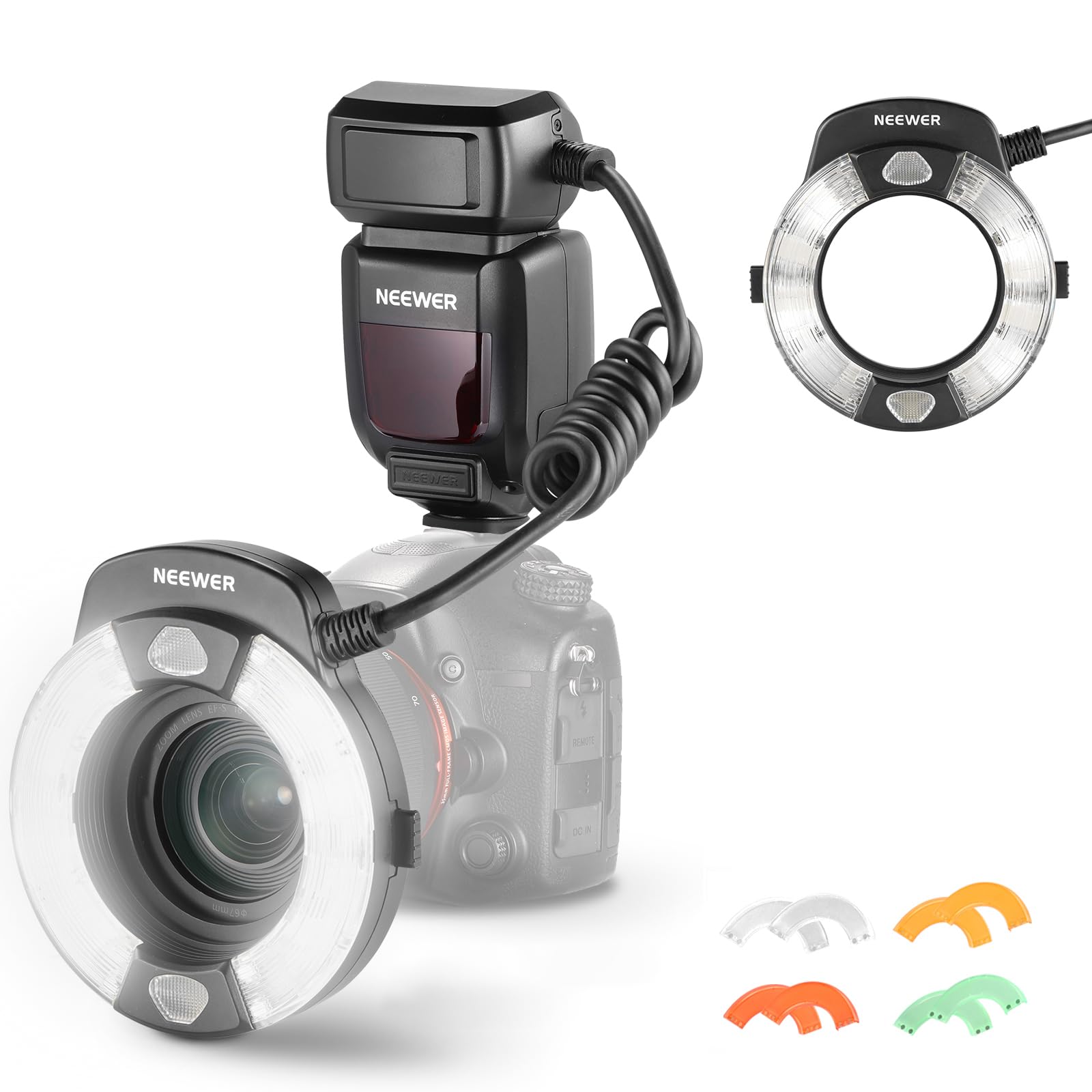
Neewer RF1-S

81 /100
Studio Score Strong Evidence

Key details

Flash Modes
TTL, Manual, Multi
Guide Number
GN15
Power Source
4x AA
Adapter Rings
49-77mm
Check Price on Amazon

The RF1-S brings Sony TTL auto exposure to a budget ring flash, with TTL, Manual, and Multi modes plus front and rear curtain sync. On bodies like the a6000, hot-shoe communication is direct, so macro shooters get automatic power leveling before they take over for creative control. That puts it ahead of manual-only ring flashes in the same price tier.

The A/B ratio from 8:1 to 1:8 adds directional control, and the included color gels cover creative white-balance work. The 49-77mm adapter set makes the flash easy to move across lenses, while the PC sync jack supports studio triggers. Output spans full power down to 1/128, with recycle times from 0.1 to 2.7 seconds, which suits both tripod tabletop shots and handheld macro once the flash has recycled.

This is the right fit for Sony Alpha/E-mount shooters who want TTL macro flash without paying for an OEM unit. Macro beginners get automatic exposure and enough modes to learn manual control; studio or product photographers can use the gels and A/B ratio for tabletop setups. Close-range shots can require a quick exposure check, so the ideal buyer is someone comfortable with that step during setup. The budget housing and sparse manual are a boundary, not a dealbreaker: this is an occasional studio companion, not a rugged daily carry for professionals.

Pros

  • TTL auto exposure on Sony bodies like the a6000 responds without manual guesswork.
  • Strong budget value for the feature set, with multiple flash modes and included accessories.
  • A/B ratio control, color gels, and a PC sync jack support creative studio and product lighting.

Cons

  • Budget construction and a basic manual are acceptable for occasional studio work but not for daily professional handling.
  • Close-range auto metering can overexpose at minimum focus distance, so manual exposure compensation may be part of the workflow.
Our verdict

For Sony E-mount shooters who want TTL and multi-mode control without a premium price, the RF1-S covers the essentials; the compensation quirk is manageable in a controlled macro setup.

Check Latest Price
6

Best Budget Nikon TTL

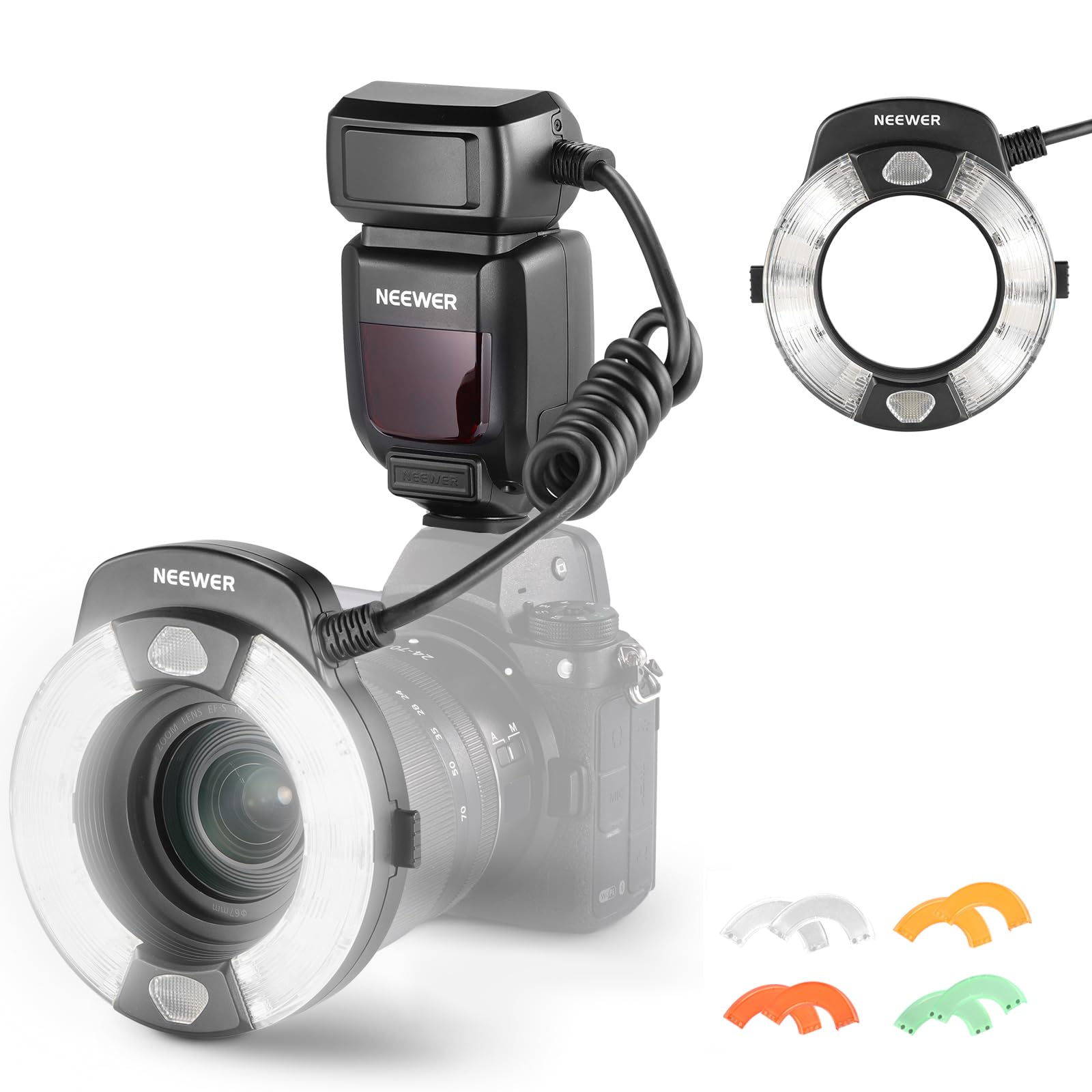
Neewer RF1-N

81 /100
Studio Score Strong Evidence

Key details

Flash Modes
TTL, Manual, Multi
Guide Number
GN15
Power Source
4x AA
Adapter Rings
49-77mm
Check Price on Amazon

The RF1-N bundles Nikon TTL, Manual, and Multi modes, a 49-77mm adapter kit, and color gels into a budget-friendly ring flash. It is the Nikon hot-shoe version of NEEWER's shared RF1 platform, so the control layout and gel system carry over without losing Nikon auto exposure.

This is for Nikon macro shooters on a budget — beginners, tabletop product photographers, and plant, insect, or small-object shooters who want TTL plus creative extras. The Nikon-only hot shoe rules out Canon, Sony, and Fuji bodies. Close-range auto exposure may require manual compensation, and the plastic body is not built for rough professional use; that tradeoff is fine for controlled desk or garden work.

With a dedicated macro lens, the 76Ws output and 1/1-1/128 power range cover most close-up distances, while front/rear curtain sync, a PC sync jack, and two AF assist lights add off-camera and dim-light flexibility. The 8:1 to 1:8 A/B ratio provides shadow control that a one-piece budget ring flash often lacks.

The four-AA battery system delivers 100-1500 flashes per set and recycles in 0.1-2.7 seconds, so a long macro session can continue without waiting on flash recovery.

💡 Shoot a test frame at minimum focus distance and dial in negative exposure compensation before starting a TTL batch.

Pros

  • Well-built body for the price range keeps the budget kit from feeling disposable on a macro lens.
  • TTL, Manual, and Multi modes give automatic and creative exposure options without a separate controller.
  • 49-77mm adapter rings cover common macro lens filter threads straight out of the box.
  • Color gels and an 8:1 to 1:8 A/B ratio provide quick shadow and color control on close-up subjects.

Cons

  • Plastic housing suits controlled tabletop and garden setups better than heavy pro field use.
  • TTL auto exposure can overexpose at minimum focus distance, so test frames or compensation are part of the workflow.
Our verdict

Nikon macro shooters who want TTL, gels, and a 49-77mm adapter kit without the OEM premium will find the RF1-N a practical fit; plan a compensation check at minimum focus distance.

Check Latest Price
7

Budget Manual Godox

Godox ML150II

82 /100
Studio Score Strong Evidence

Key details

Flash Modes
Manual only
Guide Number
GN12
Power Source
4x AA
Adapter Rings
49-77mm
Check Price on Amazon

The Godox ML150II is the lowest-cost path to a lens-mounted ring flash and shares the same 49-77mm adapter coverage as its larger Godox sibling. Output is manual from 1/32 to 1/1 in half-stop steps, giving close-up shooters direct control, but there is no TTL and no built-in rechargeable pack; four AA batteries run it. That manual workflow suits beginners who want an inexpensive way to learn ring lighting for insects, flowers, or macro portraits. The single-contact hot shoe works with a range of camera systems, but the manufacturer's exclusion list covers some Canon, Sony, and Fuji bodies, so confirm compatibility with your camera model before ordering.

Pros

  • Lowest-cost route to a lens-mounted ring flash for macro work.
  • Adapter rings from 49 to 77mm cover common macro lens filter sizes in one kit.

Cons

  • Manual-only operation has no TTL automatic exposure, and four AA batteries are required.
  • Single-contact hot shoe excludes certain Canon, Sony, and Fuji bodies, so compatibility must be checked before purchase.
Our verdict

This fits when the goal is an inexpensive manual ring flash for a camera already confirmed compatible.

Check Latest Price
8

Budget Nikon I-TTL

Meike MK-14EXT-N

82 /100
Studio Score Strong Evidence

Key details

Flash Modes
i-TTL, Manual
Guide Number
GN14
Power Source
4x AA
Adapter Rings
Check Price on Amazon

The Meike MK-14EXT-N brings Nikon i-TTL to a ring flash priced for entry-level macro work, and its circular tube does a solid job of lifting shadows in close-up flower and jewelry shots. It costs a little more than the Neewer budget pick, and durability can vary: individual units may lose a flash tube within months. A/B lamp controls give practical direction control from a one-piece ring, and the compact body fits the Nikon DSLR range this targets. For a Nikon DSLR shooter who wants i-TTL without moving to mid-range pricing, this is a reasonable entry point.

Pros

  • Nikon i-TTL auto exposure at an entry-level price
  • Circular ring design lifts shadows in flower, jewelry, and portrait macro work
  • A/B lamp controls allow basic direction control from a one-piece ring

Cons

  • Ring can rotate on certain lenses; a rubber-band shim keeps it positioned.
  • Battery set can run short during extended macro sessions.
Our verdict

The Meike is a budget-friendly i-TTL ring flash for Nikon owners focused on close-up shadow control.

Check Latest Price
9

Budget Canon E-TTL

Meike MK-14EXT-C

76 /100
Studio Score Established

Key details

Flash Modes
E-TTL only
Guide Number
GN14
Power Source
Adapter Rings
Check Price on Amazon

The Meike MK-14EXT-C packs Canon E-TTL into a small ring flash body at a budget price. Close-range subjects get even illumination around the lens axis, which is what casual flower, insect, and small-product photographers need. Its role in the Canon lineup is entry-level, not a feature-heavy alternative.

This is for Canon EOS DSLR beginners who want automatic macro flash without manual power juggling. Advanced users who expect dual-tube control or HSS should move up the lineup; those features are outside this model's scope. For simple E-TTL macro work, it does the job at a friendly price point.

Pros

  • Canon E-TTL auto exposure at a budget entry price.
  • Ring-style output spreads light evenly around the lens for close-up subjects.

Cons

  • GN14 output is modest, so working distances stay close for proper exposure.
  • Compatibility is limited to Canon EOS DSLR models; other systems need a different flash.
Our verdict

For casual flower and insect shots on a Canon DSLR, this Meike is an affordable entry point into E-TTL macro flash.

Check Latest Price

How to Choose

Camera Mount and TTL

TTL exposure depends on communication between the flash and the camera body. A manual-only flash only needs a trigger signal, so it is more likely to fire on different brands. Brand-specific TTL locks you to one mount, and some manufacturers list bodies that do not support their flash — check that list before buying.

Compatibility is not guaranteed by hot-shoe shape alone; newer cameras can change flash protocols.

Manual vs Automatic Flash Modes

TTL mode adjusts flash power automatically, which matters for close-up work because magnification changes exposure dramatically. Manual mode keeps control in your hands but forces you to adjust power as you move closer or farther.

Multi mode is a third option on some budget flashes, firing in rapid pulses for repeating flash effects. Most macro shooters use TTL or manual, so treat Multi as a bonus rather than the reason to buy.

Guide Number and Power

Guide number measures flash output at ISO 100 in meters, so a higher GN means more reach or the ability to use a smaller aperture for deeper depth of field. Most macro ring flashes land between GN12 and GN18, which is enough for close-up work but not for lighting a room.

The real difference appears at the working distances you use. A GN14 flash may struggle at f/16, while a GN18 unit gives one more stop before diffraction becomes a problem.

Lens Adapter Coverage

The flash mounts over the lens with adapter rings that match your lens filter thread. Kits commonly cover 49 to 77mm, but some only include 52, 58, 67, and 72mm, which leaves smaller lenses without a secure fit.

Measure the actual filter thread on your macro lens before ordering. An adapter that is too large will rock, and one that is too small will not mount at all.

Battery and Recycle Time

AA-powered ring flashes recycle faster with fresh batteries, but recycle time stretches as batteries drain. A rechargeable lithium model delivers more consistent power over a longer shoot.

Battery drain is common on budget TTL units because the flash tube and control electronics draw heavily from four AA cells. Choose a model with a known rechargeable battery or budget for high-capacity rechargeable AAs.

Frequently Asked Questions