9 Best Camera for Beginners in 2026: Pick a Real Learning Camera

The best camera for beginners fits how you'll shoot: real interchangeable-lens learning tools vs budget creator compacts with inflated specs.

A beginner camera budget now spans pocket compacts with big megapixel claims and interchangeable-lens cameras built to teach exposure. Headline specs like 4K/8K and 48MP often come from small sensors and digital-only zoom, so they don't deliver the image control newcomers expect.

The real trade-off is practical: a compact creator camera suits selfies, casual travel clips, and easy sharing, while an interchangeable-lens model with a larger sensor gives room to grow into aperture, shutter speed, and composition. Choosing between those two jobs matters more than any number printed on the box.

The first camera that matches how you actually shoot will do more for your photography than the one with the largest marketing number. Decide before you buy whether you want a camera to learn on or a camera to carry everywhere.

1

Best Overall

Canon EOS Rebel T7 DSLR

93 /100
Studio Score High Confidence

Key details

Zoom
3x optical zoom
Sensor
24.1MP APS-C CMOS
Autofocus
9-point phase-detect AF
Lens Mount
Canon EF-S mount
Check Price on Amazon

The Canon T7's optical viewfinder is the first thing a beginner notices: it shows the scene without electronic lag, while the top mode dial places Program, Aperture Priority, Shutter Priority, and Manual exposure a single turn away. The viewfinder stays bright in sunlight, and framing with your eye up naturally steadies the camera. That direct view of how shutter speed and aperture affect the image makes the T7 a teaching tool rather than another assisted compact.

The 24.1MP APS-C sensor produces high-resolution stills with good daylight color, and the bundled 18-55mm IS II covers common beginner subjects: family gatherings, travel landmarks, and casual portraits. Image quality is pleasing enough that a first-time shooter can focus on composition rather than second-guessing the gear. The kit lens includes image stabilization, which helps in shade and overcast conditions where a slower shutter speed might otherwise blur a handheld shot.

The deeper strength of the T7 is the EF-S mount. Canon's large EF/EF-S lens lineup includes fast primes, telephoto zooms, and macro options, so a learner can keep the same body through several lens additions. That upgrade path is the practical reason to pick this DSLR over a fixed-lens compact. Instead of buying a new camera when the kit zoom no longer fits the job, you add the lens the job calls for.

The right home for the T7 is a first-time buyer who wants to learn exposure on a true interchangeable-lens camera. It is not the right body for 4K vlogging, rapid subject tracking, or a pocket-size travel kit; those needs point toward a compact mirrorless option in this comparison. The dated autofocus is the main compromise, and phone transfer can be fussy, so this is a deliberate learning tool rather than an action or sharing-first body.

The bundle itself is easy to recommend: the 18-55mm kit lens covers common early photography assignments, and auto plus creative preset modes pull off casual shots without menu deep-dives. The body keeps manual controls visible, so a learner can see how aperture and shutter speed change the image while still having a safety net. For a mid-range price, that combination of teaching value and lens-system growth makes the T7 the default starter DSLR for first-time buyers who are serious about learning.

💡 For steady subjects, use single-shot AF through the optical viewfinder; live-view focus is slower.

Pros

  • A solid entry-level DSLR body that feels substantial without weighing down first-time owners.
  • The 24.1MP sensor delivers high-resolution stills, and the kit lens covers everyday shooting well.
  • Kit-bundle pricing puts a real interchangeable-lens system within reach of new buyers.
  • Auto and preset modes help new users get results while the physical dials teach manual exposure.
  • Recommended as a starter DSLR for students and hobbyists who want to learn photography.

Cons

  • WiFi transfer can be inconsistent, so phone sharing may take extra attempts.
  • Movie mode does not track moving subjects, and the nine-point AF array is dated by modern mirrorless standards.
Our verdict

For a novice who wants to build photography skills on a large-sensor DSLR with an optical finder and room to grow in Canon's EF-S catalog, this is the entry-level model to buy.

Check Latest Price
2

Best Beginner Mirrorless

Canon EOS R100 Mirrorless

88 /100
Studio Score Strong Evidence

Key details

Zoom
2.5x optical zoom
Sensor
24.1MP APS-C CMOS
Autofocus
143-zone Dual Pixel AF
Lens Mount
Canon RF-S mount
Check Price on Amazon

The R100 is Canon's modern mirrorless starting point: a 24.1MP APS-C sensor paired with Dual Pixel CMOS AF, 4K 24p video, and the RF-S 18-45mm stabilized kit lens in a compact body. It weighs less than the entry-level DSLR with an optical finder, and the RF mount keeps the lens path aligned with Canon's current mirrorless direction. The electronic viewfinder is a useful guide for learning framing, especially when the rear screen is not the best tool for the shot.

Image output is what a new photographer should expect from an interchangeable-lens camera: sharp frames, natural color, and autofocus that tracks a moving subject without hunting. The 18-45mm lens covers everyday scenes, though its f/4.5-6.3 aperture means indoor evenings can call for a higher ISO or a faster prime later. 4K records at 24p, while Full HD steps up to 60p for smoother motion.

This suits a beginner who wants a lightweight interchangeable-lens camera and a growth path into Canon's RF system, and it is not the cheapest way into ILCs. The fixed rear screen means vloggers who need to watch themselves while recording should choose a flip-screen body; the R100 is better used with the eye to the EVF, where the viewfinder does most of the work.

💡 Set up the quick menu before your first outing; the button-based navigation gets faster once AF area and picture style are one click away.

Pros

  • The camera body feels solid and Button layout suits a first-time mirrorless owner.
  • 24.1MP APS-C photos come out sharp and well-balanced from the kit lens.
  • Beginner-friendly controls get new photographers into manual exposure without a steep climb.
  • The RF mount and 4K video deliver modern features at a mid-range price.

Cons

  • The 18-45mm kit lens is short for distant subjects and dim at the long end.
  • 4K video records only at 24p; smooth-motion clips require dropping to Full HD 60p.
Our verdict

The R100 is a fit for beginners who want mirrorless autofocus and a compact RF body without locking into an older DSLR platform.

Check Latest Price
3

Best Budget Vlogging

AUREAPIX 8K Digital Camera

86 /100
Studio Score Strong Evidence

Key details

Zoom
20x digital zoom
Sensor
96MP 1/2.3-inch CMOS
Autofocus
Contrast-detect AF
Lens Mount
Fixed lens
Check Price on Amazon

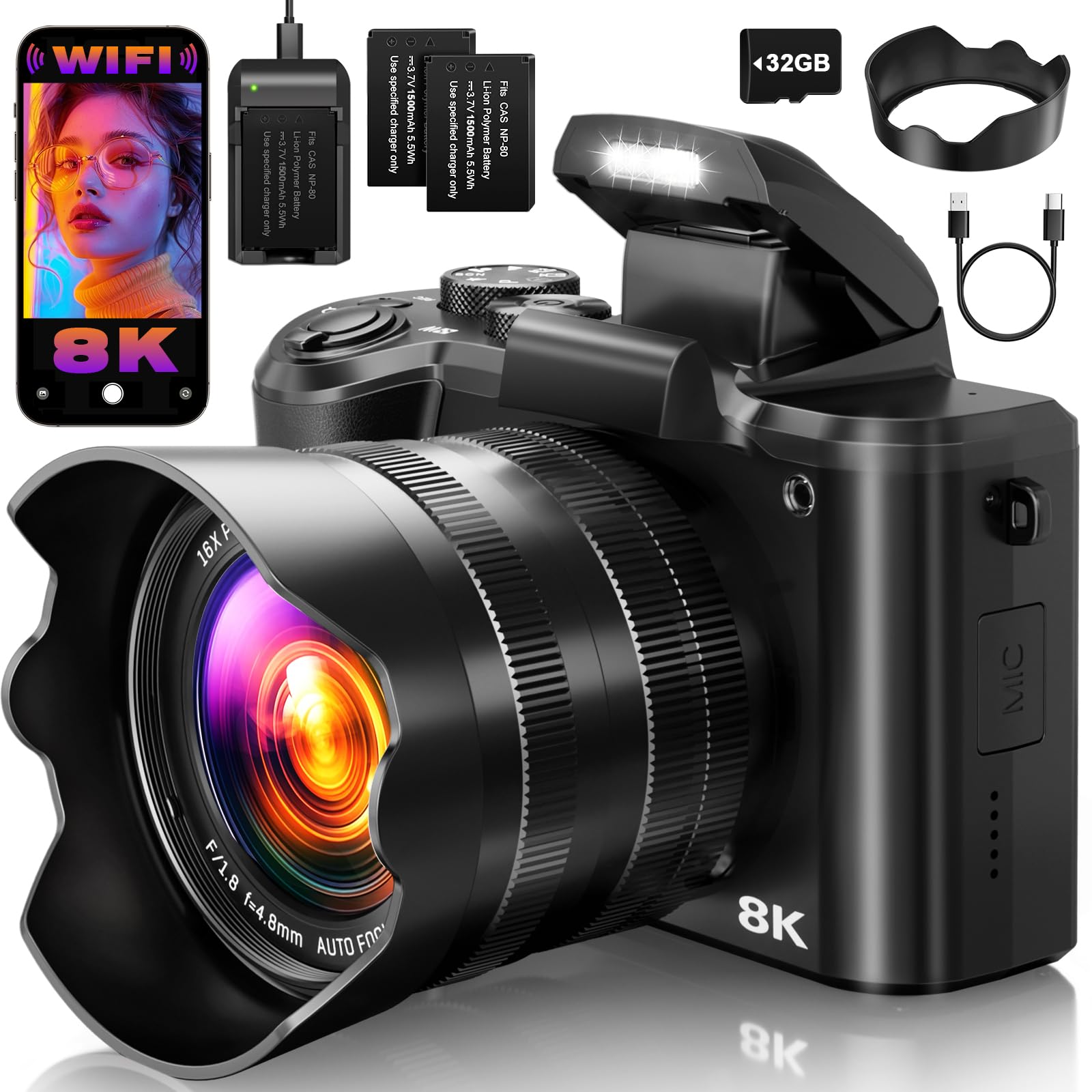
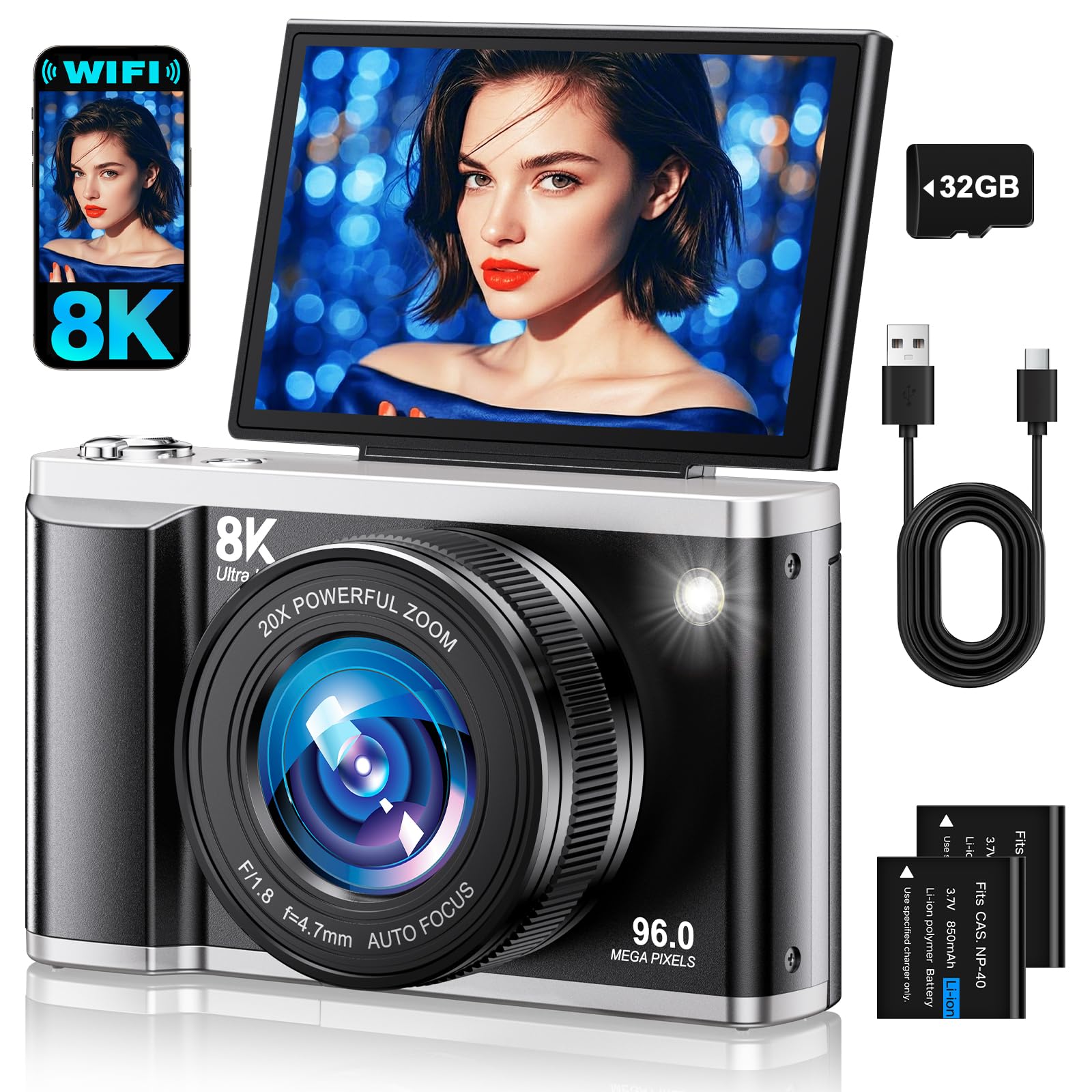
The 3.5-inch 180° flip screen gives a roomy view for framing selfies and vlog clips. WiFi transfer sends photos and clips to a phone without interrupting the shooting flow, and the two-battery bundle means you can record through a busy day without hunting for a wall outlet. Controls stay simple enough for a first-time owner to feel at ease within a few minutes.

In good light, images come out clear and the autofocus locks on quickly for a budget compact. The body is small enough to slide into a day bag, and the flip screen makes low-angle self-shooting easy. Video quality holds up for online sharing, which is the main job here. Autofocus keeps up with typical vlog movements in bright scenes. It is not a low-light specialist, but in bright scenes it behaves well.

This is a fit for selfie/vlogging beginners, travelers who want a compact flip-screen camera, and content creators who rely on WiFi sharing. The small sensor and digital-only zoom are the tradeoff for the low price, and the 8K/96MP labels are best read as marketing specs rather than optical performance. Beginners who expect DSLR-level flexibility will want an interchangeable-lens camera instead.

Pros

  • 3.5-inch 180° flip screen makes front-facing framing easy.
  • Clear image quality in good light and sharp video for casual uploads.
  • Two-battery kit and accessories deliver strong budget value.
  • WiFi transfer moves photos and clips to a phone quickly.

Cons

  • The 8K and 96MP specs are marketing labels, not a genuine optical promise.
  • At the 20x digital zoom setting, fine detail fades noticeably.
Our verdict

A vlogging beginner who wants a large flip screen, simple controls, and WiFi transfer without a system-camera budget will get strong value here.

Check Latest Price
4

Best Optical-Zoom Compact

KODAK PIXPRO FZ55

89 /100
Studio Score Strong Evidence

Key details

Zoom
5x optical zoom
Sensor
16MP 1/2.3-inch CMOS
Autofocus
Contrast-detect AF
Lens Mount
Fixed lens
Check Price on Amazon

The Kodak PIXPRO FZ55 puts a true 5x optical zoom in a body small enough for a jacket pocket, so casual shooters can pull distant subjects closer instead of cropping on their phone. The 28mm wide-angle end handles room shots and landscapes, and the zoom range gives it a functional advantage over the digital-only zoom found on other budget compacts. For this price tier, daylight photos are sharp, and the built-in flash produces pleasant indoor portraits and selfies without harsh overexposure.

Where the FZ55 earns its keep is daytime travel and family gatherings. Controls are simple enough for a first-time camera owner, and the vintage-looking body adds a tactile, film-era charm. Low-light action is not this camera's strength; moving subjects in an indoor room can come out soft, so it belongs in a day bag rather than at an evening event.

This is a beginner-friendly travel camera for casual users who want optical zoom without committing to an interchangeable-lens system. It slips easily into a purse or daypack, and the price undercuts typical ILC starter kits. It is not the camera to rely on as your only piece of gear if you need identical power behavior every time — some units have reliability or battery/charging issues. Treat it as a capable budget companion for outings, not as a primary workhorse.

💡 A spare battery is cheap insurance for full-day outings.

Pros

  • True 5x optical zoom in a pocketable body frames distant subjects without cropping.
  • Sharp results in a compact body that is easy to carry and handle.
  • Strong value for the price in the budget camera class.
  • Simple controls and clear menus are friendly for first-time owners.

Cons

  • Indoor shots with moving subjects can come out soft, so this is a daytime-first compact.
  • Shutter or small components can develop issues in the first months of ownership.
Our verdict

For daytime travel and family snapshots, the FZ55 delivers real optical zoom in a budget-friendly pocket camera. Keep it as a companion camera and the value is easy to appreciate.

Check Latest Price
5

Best Ultra-Budget Starter Kit

Duluvulu 4K Digital Camera

85 /100
Studio Score Strong Evidence

Key details

Zoom
16x digital zoom
Sensor
48MP 1/3-inch CMOS
Autofocus
Contrast-detect AF
Lens Mount
Fixed lens
Check Price on Amazon

The Duluvulu 4K Digital Camera arrives as a true out-of-box kit: 32GB card, two batteries, a 180-degree flip screen, and a compact body that slips into a day bag. It skips the webcam and WiFi-sharing extras of the social-first starter in this roundup, aiming instead at teens and gift-givers who want a simple point-and-shoot experience. For a young user moving up from a phone, this is a meaningful step without a steep learning curve.

In good daylight, stills come out sharp with natural colors, and the flip screen makes selfie framing effortless. The 4K UHD and 48MP labels read as starter marketing rather than performance guarantees; the camera captures usable clips for social sharing rather than cinema files.

This is the right first camera for a teen, a budget travel vlogger, or a gift-giver who wants every accessory included. The small sensor and digital-only zoom are the main boundaries; occasional quality-control variance is part of the ultra-budget reality. Anyone expecting DSLR-level prints or optical reach should move to a different class entirely. That fits a young creator testing whether photography is a hobby worth pursuing, or a family wanting a simple travel camera without relying on a phone.

Pros

  • Complete starter kit: 32GB card, two batteries, and a flip screen
  • Image quality is sharp and clear in good light, suitable for social posts and starter albums.
  • 180-degree flip screen makes selfies and vlog-style framing simple for first-time users.
  • Two included batteries extend casual shooting sessions without an extra charger purchase.

Cons

  • Longer recordings split into roughly 10-minute files, so editing a full session means stitching segments together.
  • The fixed lens cannot be swapped, so the camera remains a point-and-shoot rather than a growing system.
Our verdict

For a teen or gift recipient exploring photography for the first time, this kit is the most forgiving way in — provided you accept its starter-level limits.

Check Latest Price
6

Best for Young YouTubers

VJIANGER 4K Vlogging Camera

88 /100
Studio Score Strong Evidence

Key details

Zoom
16x digital zoom
Sensor
64MP 1/2.5-inch CMOS
Autofocus
Contrast-detect AF
Lens Mount
Fixed lens
Check Price on Amazon

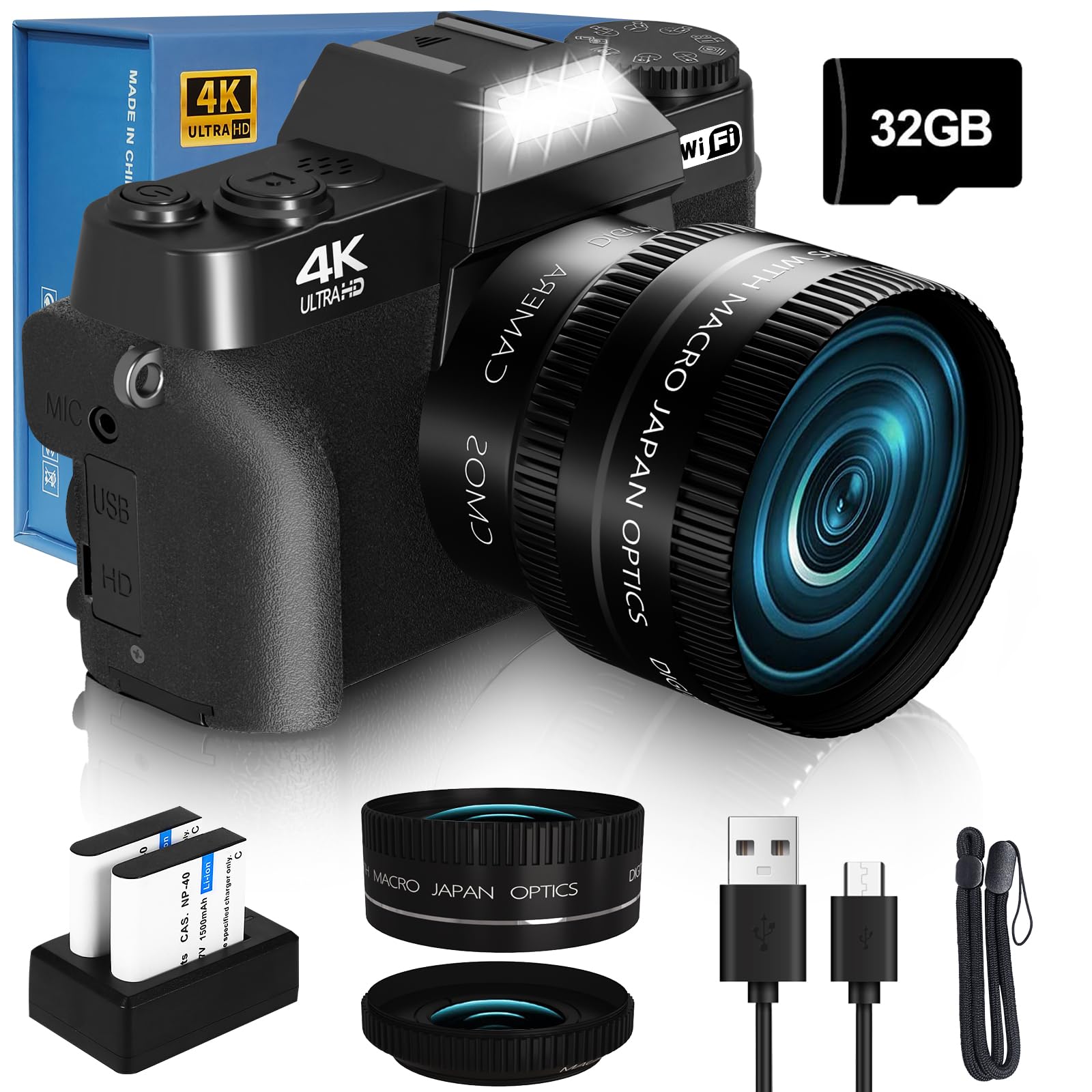
The VJIANGER comes as a complete first content kit: the flip screen faces forward for self-recording, bundled wide and macro lenses add creative range, and webcam mode turns it into a simple USB capture device for a first live stream or online class. WiFi transfer puts photos on a phone within a few taps, which makes sharing to social feeds faster than waiting for a computer.

Image quality is good for the price tier: daylight stills are crisp and colorful, and the menu layout invites a beginner to explore without a manual. The 64MP sensor and 4K label are best read as marketing ceilings, not professional guarantees. Two included batteries keep recording sessions moving, so a young user can shoot for longer stretches before hunting for a charger.

The natural home for this camera is a young content creator starting a YouTube channel who wants WiFi sharing, webcam mode, and a flip screen without buying into an interchangeable-lens system. The right owner will budget for a lapel mic and treat the first WiFi pairing as a minor setup step. Anyone whose goal is learning manual exposure on a traditional DSLR body should look at the roundup's top pick instead. This is a first camera for making content, not a long-term investment in a lens ecosystem.

Pros

  • Beginner-friendly controls and a clear menu let a new user start shooting quickly.
  • Two included batteries keep long video sessions going without frequent charging stops.
  • Bundled wide and macro attachments extend the fixed lens for close-up and wide-angle work.
  • Retro-styled flip-screen body makes it a fun first camera for kids and teens.

Cons

  • Fixed lens uses digital-only zoom, so magnifying a distant subject reduces image detail.
  • WiFi app pairing can take multiple attempts before the camera appears.
  • Built-in microphone captures sound at low volume, so voice clarity depends on an external mic.
Our verdict

A complete starter kit for a young creator who wants to post from day one without committing to a lens system.

Check Latest Price
7

Budget Selfie/vlog

FACLAM 4K Digital Camera

87 /100
Studio Score Strong Evidence

Key details

Zoom
16x digital zoom
Sensor
64MP 1/3.2-inch CMOS
Autofocus
Contrast-detect AF
Lens Mount
Fixed lens
Check Price on Amazon

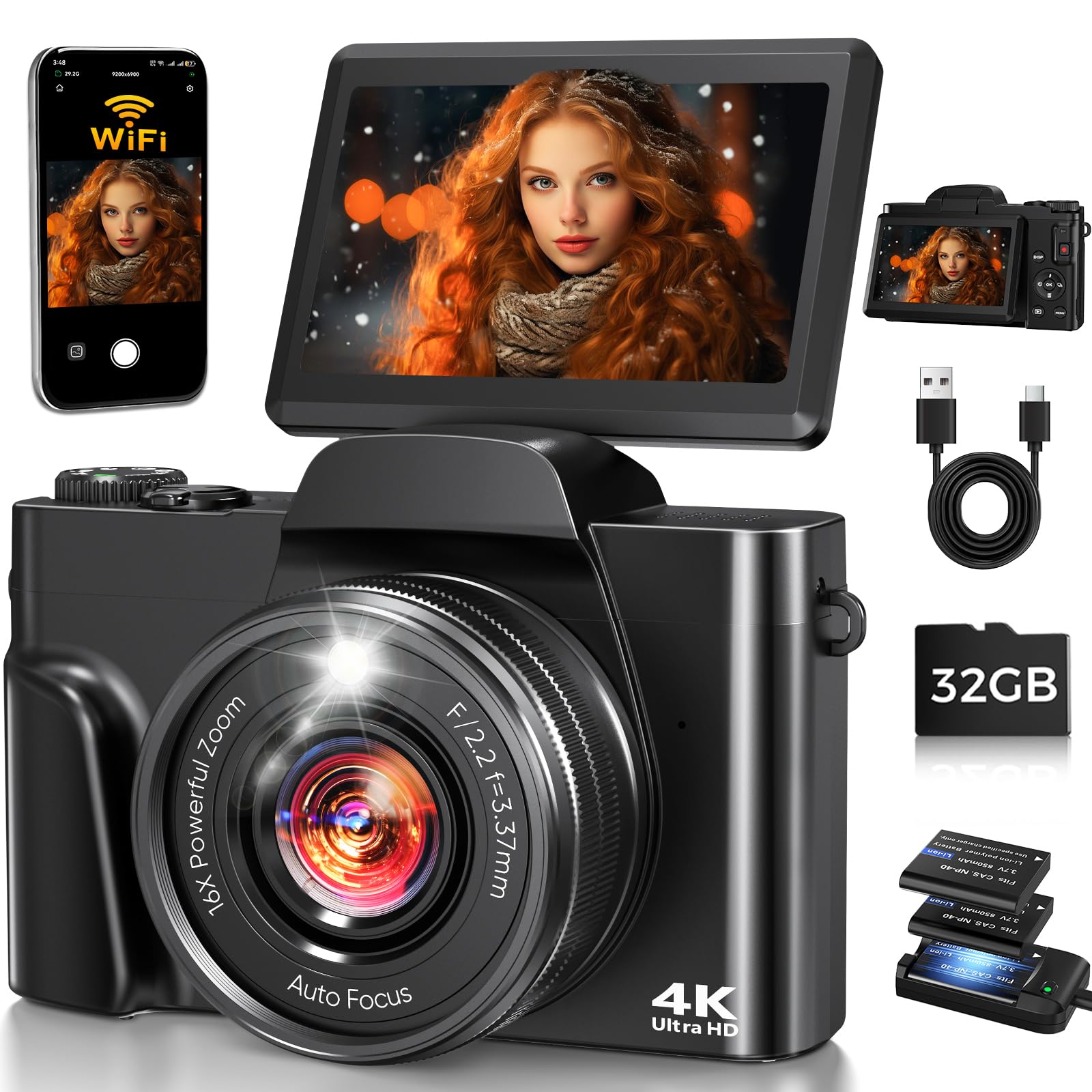
With a 180-degree flip screen, WiFi remote app, and two batteries in the box, this is a polished ultra-budget selfie/vlog kit. The 3-inch screen is smaller than the leading 3.5-inch flip-screen kit in this roundup, and the digital-only zoom crops into the frame rather than magnifying optically. The small sensor also limits low-light shots, so image quality holds up best in bright scenes. It falls just short of the broader vlogging pick here for that smaller screen, but first-time selfie and travel shooters who stay within daylight will find a complete, bag-friendly package.

Pros

  • 180° flip screen makes self-framing easy for selfie and vlog shots.
  • Two batteries in the box support longer outings before a recharge.
  • WiFi remote app simplifies transferring photos to a phone.

Cons

  • Digital zoom crops into the scene, so long-range close-ups lose detail.
  • In dim interiors or evening street scenes, the small sensor can produce soft, noisy images.
Our verdict

Keep it to brightly lit selfie and vlog use, and this budget kit delivers a coherent, bag-friendly starting point.

Check Latest Price
8

Budget Travelers

JGIPL 4K Digital Camera

87 /100
Studio Score Strong Evidence

Key details

Zoom
16x digital zoom
Sensor
64MP 1/3-inch CMOS
Autofocus
Contrast-detect AF
Lens Mount
Fixed lens
Check Price on Amazon

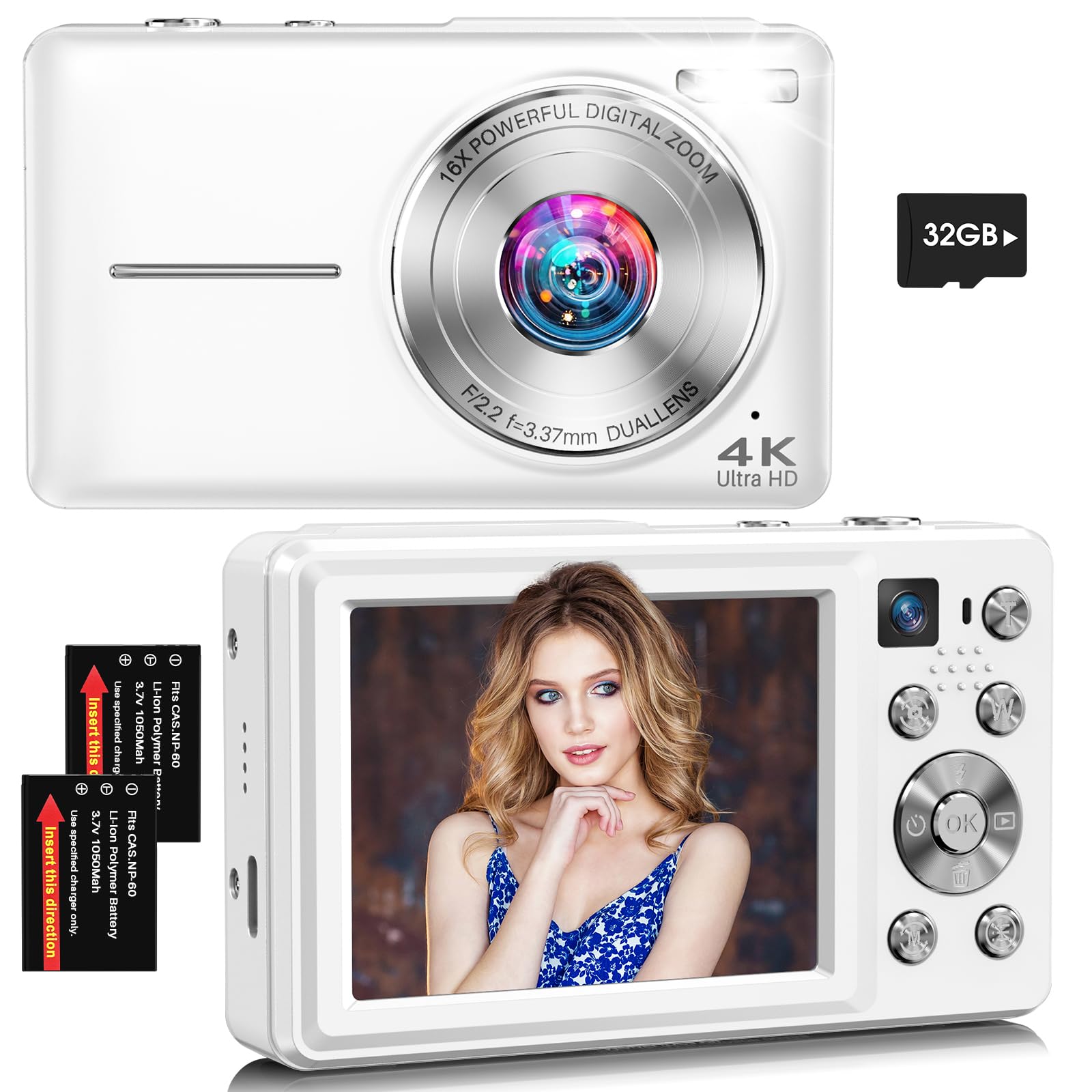
The JGIPL 4K Digital Camera is a lightweight, no-frills travel starter that bundles a dual-lens body, 32GB card, and two batteries. Beginner owners get sharp, detailed daytime shots and find the controls easy to learn, making it a simple gateway for first-time users. The 4K video and 64MP stills are marketing labels rather than optical performance, so this is best treated as a casual travel camera. It suits kids, seniors, and teens grabbing everyday shots, and the light body is a plus on travel days. Selfie-style vlogging and serious photography are outside its reach.

Pros

  • Simple controls make this one of the easier starter cameras for a first-time buyer to just pick up and shoot.
  • Daytime images come out sharp and detailed enough for casual sharing and small prints.
  • Bundle includes a 32GB card and two batteries, so no extra purchases are needed to start traveling.

Cons

  • The 2.8-inch screen is small and fixed, making image review less comfortable than on larger-screen rivals.
  • The 16x zoom is digital only, so distant subjects lose detail as you zoom in.
Our verdict

For a family seeking an inexpensive first camera for casual travel snapshots, this is a reasonable buy. Treat it as a beginner tool and it will do the job without overcomplicating things.

Check Latest Price
9

Touchscreen Vloggers

Tecglem 8K Digital Camera

86 /100
Studio Score Strong Evidence

Key details

Zoom
16x digital zoom
Sensor
88MP 1/4-inch CMOS
Autofocus
Contrast-detect AF
Lens Mount
Fixed lens
Check Price on Amazon

The Tecglem 8K Digital Camera pairs a bright 3.2-inch touchscreen with a dual-lens front and a kit that includes a 32GB card, two batteries, and a charging stand. Selfie framing is easy, controls are approachable, and the whole package is light enough to toss in a day bag.

The 8K/88MP headline is marketing-heavy, and the lens has no optical zoom — distant subjects rely on digital cropping, so detail drops quickly. That keeps it below the strongest budget vlogging kits for the same use case; bright daylight scenes and slow-paced selfie/vlog work are where it belongs.

Pros

  • Daylight photos come out sharp with vivid color, a pleasant surprise at this budget level.
  • The touchscreen and clean menus make first-time setup painless; the camera is ready to shoot shortly after opening the box.
  • The included 32GB card, two batteries, and charging stand remove the usual 'buy more before you can use it' step.

Cons

  • Dim interior lighting produces soft, noisy images, so evening indoor shoots are a real limitation.
  • Fast-moving subjects can blur, making action-heavy scenes a stretch for this compact sensor.
Our verdict

For a selfie-first beginner who wants a touchscreen and a complete starter kit, this fits — provided you stay within its compact-sensor limits.

Check Latest Price

How to Choose

Sensor Size and Type

Entry-level DSLRs and mirrorless cameras use APS-C sensors that capture more light than the small 1/2.3-type sensors found in budget compacts. That extra light means cleaner evening shots, better indoor color, and the ability to blur the background in portraits.

Small sensors exist to keep cameras cheap and pocketable, not to produce the same image quality. The gap shows when you push into low light or try to isolate a subject, exactly where novice photographers start noticing real progress.

Optical vs Digital Zoom

Optical zoom moves glass to magnify the scene before light reaches the sensor. Digital zoom crops the image and enlarges pixels, so detail disappears as you zoom deeper.

A 16x digital zoom spec sounds bigger than a 5x optical zoom, but the digital version degrades sharpness from the first step. On a compact camera, optical zoom is the only zoom that keeps your photos crisp.

Autofocus System

Budget compacts typically use contrast-detect autofocus, which searches for edges in the frame. It is fine for still subjects in good light, but it slows down when children, pets, or moving people enter the shot.

Interchangeable-lens cameras add phase-detect autofocus points that measure distance directly. That is why even an entry-level DSLR locks onto a moving subject faster than many tiny-sensor compacts.

Video & Flip Screen

High-resolution video labels like 4K and 8K describe file size, not the sensor's ability to capture usable detail. On a small sensor, a 4K clip can look soft indoors despite the big number.

A flip screen is the real usability test for self-recording. If you plan to vlog, a 180° screen lets you frame without a phone app; if you don't, a fixed screen saves cost and keeps the body simpler.

Lens Mount & Upgradability

A lens mount determines which lenses you can add later. An interchangeable-lens camera opens a path to fast primes, telephoto zooms, and macro glass; a fixed-lens compact closes that path on day one.

The real trade-off is system cost: a versatile mount invites more lenses over time. Buyers who just want a simple travel camera should not pay for that flexibility; beginners who want to learn should.

Frequently Asked Questions