8 Best 35Mm Lens of 2026: Match Mount, Speed, and Stabilization

Find the right 35mm lens for your camera mount, sensor size, and shooting style — with fast primes that focus where you need them.

A 35mm prime should be the lens that stays on the camera, so the choice comes down to practical compatibility: sensor coverage, focus speed, stabilization, and how close you can get. The fastest aperture on the spec sheet matters less than whether the lens actually lands focus in the scenes you shoot.

The category has shifted toward compact f/1.8 lenses that add macro close-focus or optical stabilization instead of chasing f/1.4 bokeh. That shift makes sense: a lens that steadies a handheld clip and focuses close enough for tabletop shots will earn its place in a bag more often than one that is simply faster on paper.

A camera body with good in-body stabilization changes the calculus, and a 35mm made for an APS-C sensor cannot simply replace a full-frame 35mm. Match the lens to your mount, sensor format, and the kind of shots you actually expect to take.

1

Best Overall

Canon RF 35mm f/1.8 Macro

93 /100
Studio Score High Confidence

Key details

Mount
Canon RF
Max Aperture
f/1.8
Stabilization
Optical IS
Check Price on Amazon

The RF 35mm f/1.8 Macro IS STM combines close-focus range, built-in optical stabilization, and f/1.8 speed in a 308g body that balances on Canon EOS R-series cameras. Image quality holds up at f/1.8, with sharp detail and smooth background falloff that works for portraits, food, and street scenes without stopping down.

Street, food, travel, and portrait work all fall inside its natural shooting range, and the 5-stop optical IS steadies handheld video on bodies without in-body stabilization. The macro reach lets you fill the frame with small objects, which makes the lens a practical option for tabletop and detail shots.

This is a Canon RF-mount lens, so Sony and Nikon shooters need to look at their own system options. It fits EOS R and RP owners who want one compact 35mm for mixed photo-video days, travel, and close-up work. Buyers whose main goal is f/1.4 low-light separation should turn to faster primes; the f/1.8 aperture trades that extra stop for macro reach and built-in stabilization.

Against an f/1.4 specialist prime, this lens gives up some background separation in dim venues, but it gains close-focus and optical stabilization that make it the more practical everyday carry. The mid-range price puts the emphasis on scene coverage rather than maximum bokeh, and that trade matches the way most mixed shooting days actually go.

Pros

  • Delivers sharp detail with soft background bokeh at f/1.8 across normal focusing distances.
  • Well-built compact prime that holds up for street photography at a mid-range price.
  • Macro close-focus, optical IS, and f/1.8 speed make the cost easy to justify.
  • STM autofocus responds quickly across standard shooting distances on R5 and R6 bodies.
  • Light 308g build balances well and is easy to carry through a full day of shooting.

Cons

  • Focusing extends the barrel, so the front of the lens can brush against a hand or bag.
  • Autofocus may hunt on close-macro subjects or group scenes with more than two people.
Our verdict

For Canon RF owners who want one compact 35mm that handles close-ups, handheld video, and everyday street shots without swapping lenses, this is the most complete single-lens option.

Check Latest Price
2

Best Premium Full-Frame

Sony 35mm f/1.4 GM

93 /100
Studio Score High Confidence

Key details

Mount
Sony FE
Max Aperture
f/1.4
Stabilization
None
Check Price on Amazon

The Sony FE 35mm f/1.4 GM is the only lens in this set that pairs full-frame f/1.4 speed with G Master optical design. It delivers sharp wide-aperture rendering and autofocus that keeps up with moving subjects, which is why paid event and portrait work is its natural home. It skips the close-focus macro and optical stabilization of the top pick, but those features matter less when the priority is pure f/1.4 image quality.

At f/1.4 the GM resolves fine detail across the frame while the 11-blade aperture keeps background highlights round and smooth. The dust- and moisture-resistant barrel takes weather in stride, and the lens stays compact enough for a full-frame prime at this speed.

The autofocus behavior is what separates it from slower 35mm lenses: it locks onto subjects quickly during receptions and event work. At f/1.4 the rendering has a visible depth and smoothness that f/1.8 primes can't match in low light.

That makes it a tool for Sony full-frame shooters who want top-tier 35mm f/1.4 rendering and use that speed in low light or for subject isolation. The premium price is the main boundary; budget-conscious buyers should weigh it against the lighter f/1.8 primes in this comparison.

Pros

  • G Master build with dust- and moisture-resistant housing holds up through event and outdoor work.
  • f/1.4 rendering stays sharp across the frame while the 11-blade aperture makes background highlights smooth.
  • Autofocus locks onto subjects quickly enough for weddings and fast-changing scenes.
  • Compact for a full-frame f/1.4 prime, so the optical quality doesn't demand a huge lens bag.

Cons

  • The f/1.4 speed and full-frame build are more than casual travel really needs.
  • On APS-C bodies, the focal length becomes 52mm-equivalent and the full-frame optical advantage is wasted.
Our verdict

The full-frame 35mm that answers the image-quality question first: maximum aperture, sharp optics, and autofocus that keeps up with event work.

Check Latest Price
3

Best Budget Nikon APS-C

Nikon 35mm f/1.8G DX

96 /100
Studio Score High Confidence

Key details

Mount
Nikon F DX
Max Aperture
f/1.8
Stabilization
None
Check Price on Amazon

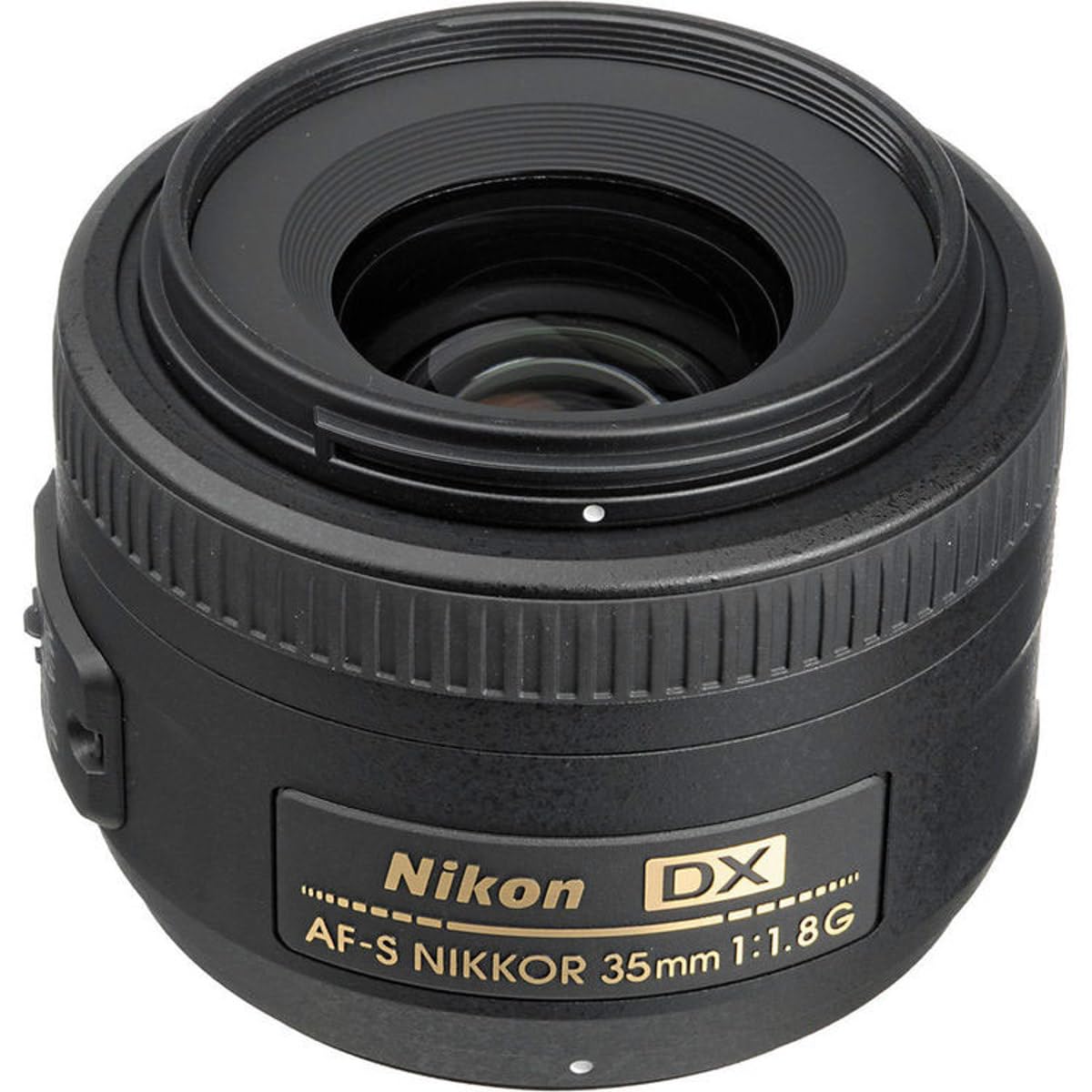
The Nikon AF-S DX 35mm f/1.8G is the natural first prime for Nikon APS-C DSLR owners: f/1.8 aperture, silent-wave AF-S motor, and just 200g. It steps up from the budget Nikkor 35mm with quieter autofocus and a compact DX design. The 52.5mm equivalent framing suits portraits, street scenes, and walk-around photography.

Wide open, the f/1.8 aperture pulls in enough light for indoor and evening shots without flash, and depth of field can separate subjects from busy backgrounds. Stopped down, the lens stays crisp for landscape and street work. Autofocus noise is low, though low-contrast targets can cause hesitation and occasional back-focus has been noted on some bodies. The optical character is what keeps it mounted on the camera.

This is a stills-first lens for Nikon DX DSLR owners who want a sharp, fast normal prime without moving to full-frame. It does not cover FX sensors, so full-frame Nikon shooters need a different 35mm. The plastic barrel and smaller focus ring are the tradeoff for 200g; the lack of lens-based stabilization matters mainly for handheld video, not stills. Autofocus can be hesitant in dim contrast, but the f/1.8 light-gathering, compact size, and price make it a practical pick for portrait and street work on a DX body.

💡 For dim scenes, set single-point AF on a high-contrast edge for steadier focus.

Pros

  • Sharpness for the price sets the bar in the Nikon DX prime lineup.
  • f/1.8 aperture makes indoor and evening shots possible without flash.
  • Background blur at portrait distance has a creamy, flattering character.
  • 52.5mm equivalent framing on DX makes it a natural everyday and portrait lens.

Cons

  • Entry-level plastic body and smaller focus ring; fine for careful handling, less reassuring in hard use.
  • No optical stabilization; handheld video can look shaky on Nikon bodies without in-body IS.
  • Autofocus speed and precision can be inconsistent in low-contrast scenes, with occasional back-focus.
Our verdict

For Nikon DX stills shooters, this 35mm is the easy answer: sharp, light, and bright enough to leave the flash home.

Check Latest Price
4

Best Value Full-Frame Sony

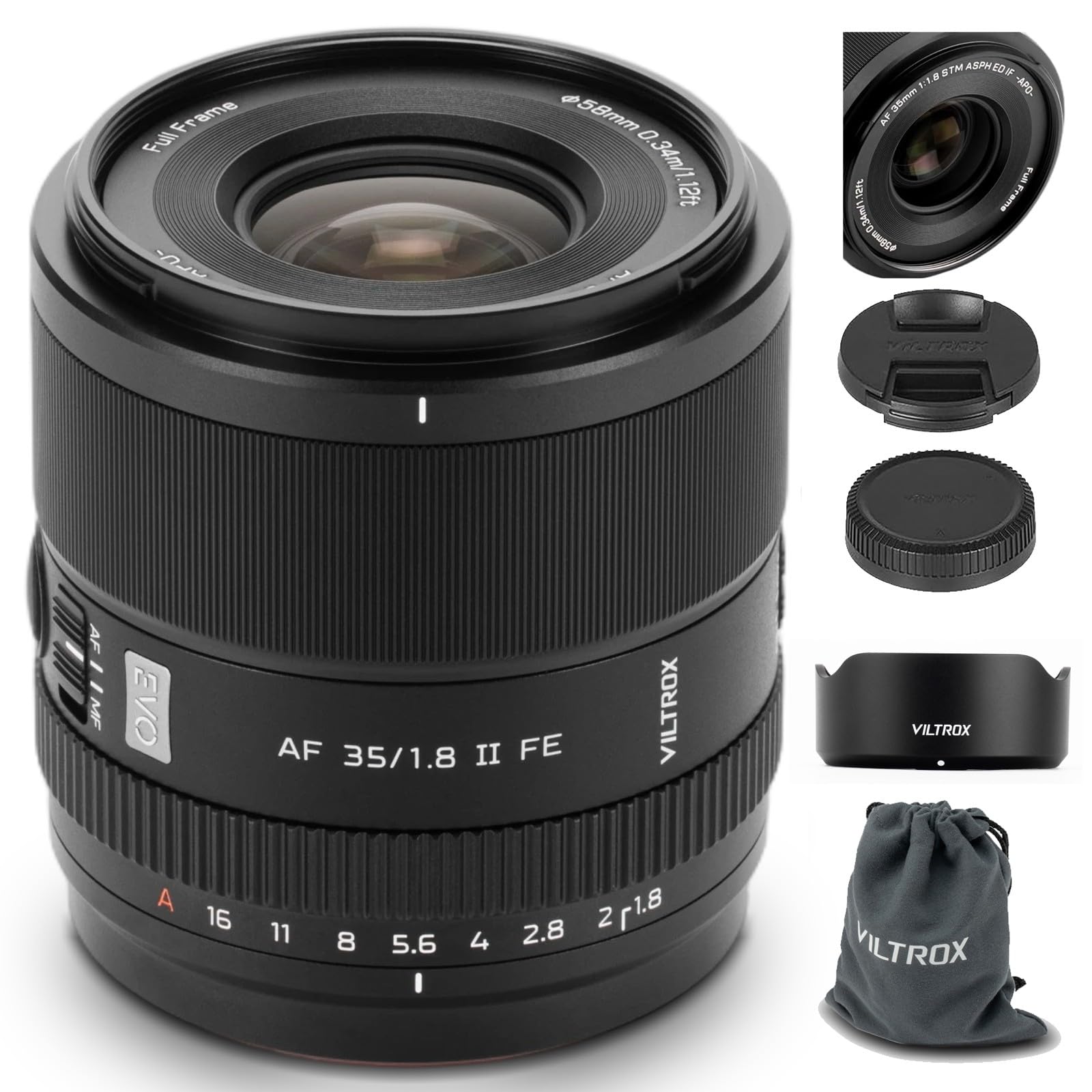
Viltrox 35mm f/1.8 II FE

90 /100
Studio Score High Confidence

Key details

Mount
Sony FE
Max Aperture
f/1.8
Stabilization
None
Check Price on Amazon

Viltrox's 35mm f/1.8 II EVO combines a 13-element APO optical design with a 0.34m close-focus limit, giving Sony full-frame shooters a sharp prime at a mid-range price. That layout lifts it above budget 35mm options and close to flagship-level resolution, while the body stays light enough for a long street day. The f/1.8 aperture handles standard low-light scenes, but it does not chase the shallow depth of field of f/1.4 primes.

Autofocus pulls quickly and quietly for routine photo work, and the AF/MF switch, Fn button, and click switch let you adjust on the fly without menu diving. The 0.34m minimum focus covers close details as well as full-frame street perspectives, so it can serve as a single-lens daytime travel setup. The click switch also lets you silence the aperture ring when you want to shoot in quiet settings.

This is the Sony FE lens for photographers who want 35mm f/1.8 coverage without moving into G Master territory. It suits full-frame travel and street shooters; APS-C users should pass. The tradeoff is a body that carries the stabilization load for handheld video, and Sony shooters with IBIS get the most from that arrangement. For full-frame owners, the sharpness-per-dollar keeps it ahead of the APS-C-only alternative in this roundup.

💡 Pair it with a Sony body that has IBIS for handheld video.

Pros

  • APO 13-element design keeps images sharp and controlled on full-frame.
  • Fast f/1.8 speed at a mid-range price undercuts flagship Sony primes.
  • AF is quick and quiet for street and travel photography.
  • Light construction and 0.34m close focus make it an easy everyday carry.

Cons

  • Bokeh can look plain in busy backgrounds, and vignetting or distortion may show in certain scenes.
  • No lens-based stabilization; handheld video relies on Sony body IBIS.
Our verdict

At a mid-range price, the Viltrox 35mm f/1.8 II EVO is the value-focused full-frame Sony prime: APO sharpness and quick f/1.8 speed in a light body, with body IBIS covering the stabilization duty.

Check Latest Price
5

Best Stabilized APS-C Prime

Sony 35mm f/1.8 OSS E

92 /100
Studio Score High Confidence

Key details

Mount
Sony E APS-C
Max Aperture
f/1.8
Stabilization
Optical SteadyShot
Check Price on Amazon

For Sony A6000-series shooters, the 35mm f/1.8 OSS E is the compact prime that puts handheld stills and video on equal footing: a 155g barrel with built-in Optical SteadyShot and f/1.8 speed. It splits the difference between a lightweight budget prime and a heavier full-frame option, covering the scenes most travel and vlog work requires without making the camera a burden.

Image quality is a clear strength: crisp center sharpness, smooth bokeh at f/1.8, and clean behavior in dim interiors. The optical stabilizer makes handheld clips noticeably steadier, which matters more for hybrid shooters than for tripod users. Portraits, street scenes, and casual indoor events all fit within one small lens, so there is no need to swap glass mid-session.

This lens suits A6000-series owners who want a single everyday prime for travel and video. It is premium-priced for an APS-C lens, and the video autofocus can lose confidence in low contrast; backlit edges may show fringing before stopping down. Full-frame Sony shooters should look elsewhere, and buyers on a tight budget can compare the lighter f/1.7 option.

💡 In video, prefocus before the shot and use the small body for steady handheld movements.

Pros

  • Built-in Optical SteadyShot steadies handheld stills and video without adding bulk.
  • Renders crisp, clear images with solid sharpness across everyday shooting.
  • Smooth, attractive bokeh at f/1.8.
  • Handles dim interiors and low-light scenes with clean output.

Cons

  • Backlit, high-contrast edges can show fringing before stopping down.
  • Video autofocus can lose confidence in low contrast, and the manual focus ring does not allow precise pulls.
  • Premium-priced for an APS-C prime, so budget buyers should compare the f/1.7 alternative.
Our verdict

Sony APS-C shooters who prioritize a compact, stabilized 35mm for handheld work get the right all-rounder here; tight budgets point toward the slimmer f/1.7 instead.

Check Latest Price
6

Sony APS-C Shooters

Viltrox 35mm f/1.7 E

89 /100
Studio Score Strong Evidence

Key details

Mount
Sony E APS-C
Max Aperture
f/1.7
Stabilization
None
Check Price on Amazon

The Viltrox AF 35mm F1.7 E packs a 170g barrel, a bright f/1.7 aperture, and quiet STM autofocus into an entry-level price, making it a natural first prime for Sony APS-C owners. Sharpness holds up at wide-open apertures, and the little lens feels more capable than a kit zoom. The boundaries show up quickly: there is no optical stabilization, so handheld video and low-light shooting on bodies without IBIS depend on a steady hand, and the APS-C image circle leaves full-frame Sony users out. That combination keeps it below the full-frame Viltrox sibling with APO-grade optics, but for APS-C shooters on a budget it covers street and travel needs without weighing down a bag.

Pros

  • At just 170g, the lens rides along comfortably for all-day street or travel shooting.
  • The f/1.7 aperture delivers sharp images wide open and a solid step up from kit-lens quality.
  • Quiet STM autofocus locks on quickly enough for casual everyday framing.

Cons

  • In-lens stabilization is absent, so handheld video or low-light shooting on bodies without IBIS requires a deliberate technique.
  • Full-frame Sony bodies don't get usable coverage from this APS-C image circle.
Our verdict

Sony APS-C owners get a sharp, compact 35mm prime at a budget price; those needing full-frame coverage or in-lens stabilization should pass.

Check Latest Price
7

Compact Macro Shooters

Tamron 35mm f/2.8 E

89 /100
Studio Score Strong Evidence

Key details

Mount
Sony FE
Max Aperture
f/2.8
Stabilization
None
Check Price on Amazon

The Tamron 35mm f/2.8 E is a compact, moisture-resistant Sony FE prime with crisp rendering, smooth bokeh, and a genuine 1:2 close-focus mode. At 7.4 oz it slides easily into a travel kit, and landscape, street, and product-close-up shooters get sharp results without a heavy bag. The f/2.8 aperture limits low-light work, and the AF motor is slow and audible, which is why this lens sits below the faster f/1.8 and f/1.4 primes in the 35mm category. It suits Sony E owners looking for a lighter general-purpose prime with macro reach over speed.

Pros

  • True 1:2 close-focus magnification turns the lens into a capable product and food detail lens.
  • Crisp rendering and smooth bokeh deliver sharp wide-open results for landscape and street work.
  • Only 7.4 oz with moisture-resistant construction, so it rides along in a small travel bag.

Cons

  • Autofocus can be slow and may click or hum while hunting, noticeable in quiet video.
  • f/2.8 max aperture demands higher ISO in dim scenes and limits background separation.
Our verdict

If your 35mm search centers on Sony E and weight plus 1:2 close focus matter more than speed, this Tamron covers that lane.

Check Latest Price
8

Nikon F Hobbyists

Yongnuo 35mm f/2N

87 /100
Studio Score Strong Evidence

Key details

Mount
Nikon F
Max Aperture
f/2.0
Stabilization
None
Check Price on Amazon

The YONGNUO YN35mm f/2N is a low-cost entry into 35mm on Nikon F, with multi-coated glass and close-focusing that suit street and landscape work. For a Nikon DSLR hobbyist on a tight budget, it is the cheaper alternative to the default Nikon DX 35mm prime, and it fits manual-focus street and landscape shooting. Wide-open sharpness is modest for a prime, so this is a casual-use lens rather than the strongest 35mm candidate overall. It remains a sensible budget pick for Nikon shooters who want the focal length without the usual price.

Pros

  • Very strong value for a Nikon F prime.
  • Works well for casual full-frame and APS-C use.
  • Useful for street and landscape photography with close focus.

Cons

  • Autofocus motor is loud in quiet settings.
  • Autofocus can slow and soften in dim conditions.
Our verdict

For a Nikon DSLR hobbyist on a strict budget who shoots street or landscape, this lens fits as a manual-focus-style budget prime. In a mount-agnostic search for the best 35mm, it is a value niche rather than the overall pick.

Check Latest Price

How to Choose

Mount and System Compatibility

A 35mm lens only works if its mounting flange and image circle match your camera. Full-frame lenses cover a 36×24mm sensor, while APS-C lenses project a smaller circle; put an APS-C 35mm on a full-frame body and the corners go dark or the camera forces a crop. Adapting across mounts usually costs autofocus speed and can surrender full-frame coverage. Buy for the mount you already own, not one you might switch to later.

Maximum Aperture

A faster aperture means a larger physical entrance pupil, so f/1.4 gathers roughly two-thirds of a stop more light than f/1.8 and separates a subject from a busy background. That extra speed comes with a bigger, heavier barrel and a shallower focus plane that punishes imprecise autofocus. For a travel prime, f/1.8 is often the practical balance between low-light capability and missed-shot rate.

Image Stabilization

Lens-based IS shifts floating elements to counter hand shake, which matters when the camera body has no IBIS. A stabilized 35mm lets you shoot at 1/15s handheld and keeps video smooth; an unstabilized lens on a non-stabilized body forces you to raise shutter speed and accept noisy frames or shaky clips. If the body has strong IBIS, the sensor can compensate at 35mm, so the lens's lack of IS is less critical.

Close-Focus and Macro Capability

Close-focusing determines how near the optical group can sit to the subject, and a shorter minimum focus distance gives you more magnification for food, product, and detail shots. A 1:2 macro lens fills the frame with a subject roughly the size of a credit card, while a standard prime often stops at a smaller reproduction ratio. That close-focus reach turns one prime into a de facto macro lens without adding a second bag.

Autofocus Motor and Real-World Reliability

Motor type determines how quickly and quietly the lens finds focus: stepping motors are quiet enough for video, ultrasonic ring motors react faster for stills, and budget DC motors can click or hunt in low light. The harder truth is that a cheap lens with a good spec sheet can still land focus inconsistently because the motor and firmware work together. A lens that is sharp on paper loses its value if it hunts through a ceremony or misses portraits at close range.

Frequently Asked Questions