12 Best Wireless Microphones in 2026: The Ones That Don't Drop Out

Find the right wireless mic for your camera, phone, or stage setup — without paying for features your workflow doesn't need.

Wireless microphone listings all promise long range and studio-clean audio. In practice, the difference between a frustrating shoot and a reliable recording usually comes down to device compatibility, charging-case build quality, and how the system handles a crowded RF environment.

The right wireless mic for a vlogger is not the same as the right wireless mic for a church stage or a karaoke party. Clip-on systems prioritize portability and phone pairing. Handheld UHF systems prioritize frequency flexibility and metal build. Matching the system to the use case matters more than chasing the highest bit depth or the longest range figure.

For most creators, a two-transmitter kit with a charging case and multiple receiver options covers the widest range of real-world scenarios. For live sound, tunable frequencies and dedicated XLR outputs will save you from interference that no amount of range can fix.

1

Best Overall

DJI Mic Mini 2-TX Kit

95 /100
Studio Score High Confidence

Key details

Battery
48 h with case
Transmitters
2 TX, 1 RX
Compatibility
DJI OsmoAudio, phones
Wireless Range
400 m
Check Price on Amazon

The DJI Mic Mini's 10g transmitters, 400m wireless range, and 48-hour charging case make it the least intrusive two-mic kit at this price tier. Voice comes through clean and crisp, and the two-level noise cancellation trims wind and hiss without hollowing out room tone. The direct OsmoAudio connection also makes it a natural fit for DJI handhelds and action cams. At a mid-range price, it undercuts heavier pro kits without skimping on the core vlogging workload.

Pairing is quick on supported phones and DJI gear, and the receiver works as a wired USB-C or 3.5mm device for cameras and computers. The charging case keeps both transmitters topped off between shots, so a day of back-to-back interviews doesn't require hunting for a USB port. The 3.5mm output keeps older cameras in play when Bluetooth isn't an option.

This is the kit for everyday vloggers, mobile creators, and interviewers who want a compact two-mic setup that travels well. It is not for professionals who need 32-bit float internal backup recording. Some iPhones, Insta360, and GoPro units can have wireless pairing quirks, and older iPhones need a Lightning adapter that isn't in the box; verify your device before relying on it.

Pros

  • Voice comes through clean and crisp with strong intelligibility.
  • 10g transmitters are comfortable and sit discreetly on a collar.
  • Charging case extends total runtime to 48 hours.

Cons

  • No Lightning adapter is included, so older iPhones need a separate dongle.
  • Certain iPhones, Insta360, and GoPro units can have wireless pairing quirks.
Our verdict

For vloggers and interviewers on a single USB-C or 3.5mm device, the Mic Mini is the compact two-mic kit to pack for travel-heavy shoots.

Check Latest Price
2

Best Cross-Device Creator Kit

Hollyland Lark M2

95 /100
Studio Score High Confidence

Key details

Battery
40 h with case
Transmitters
2 TX, 3 RX
Compatibility
Camera, USB-C, Lightning
Wireless Range
300 m
Check Price on Amazon

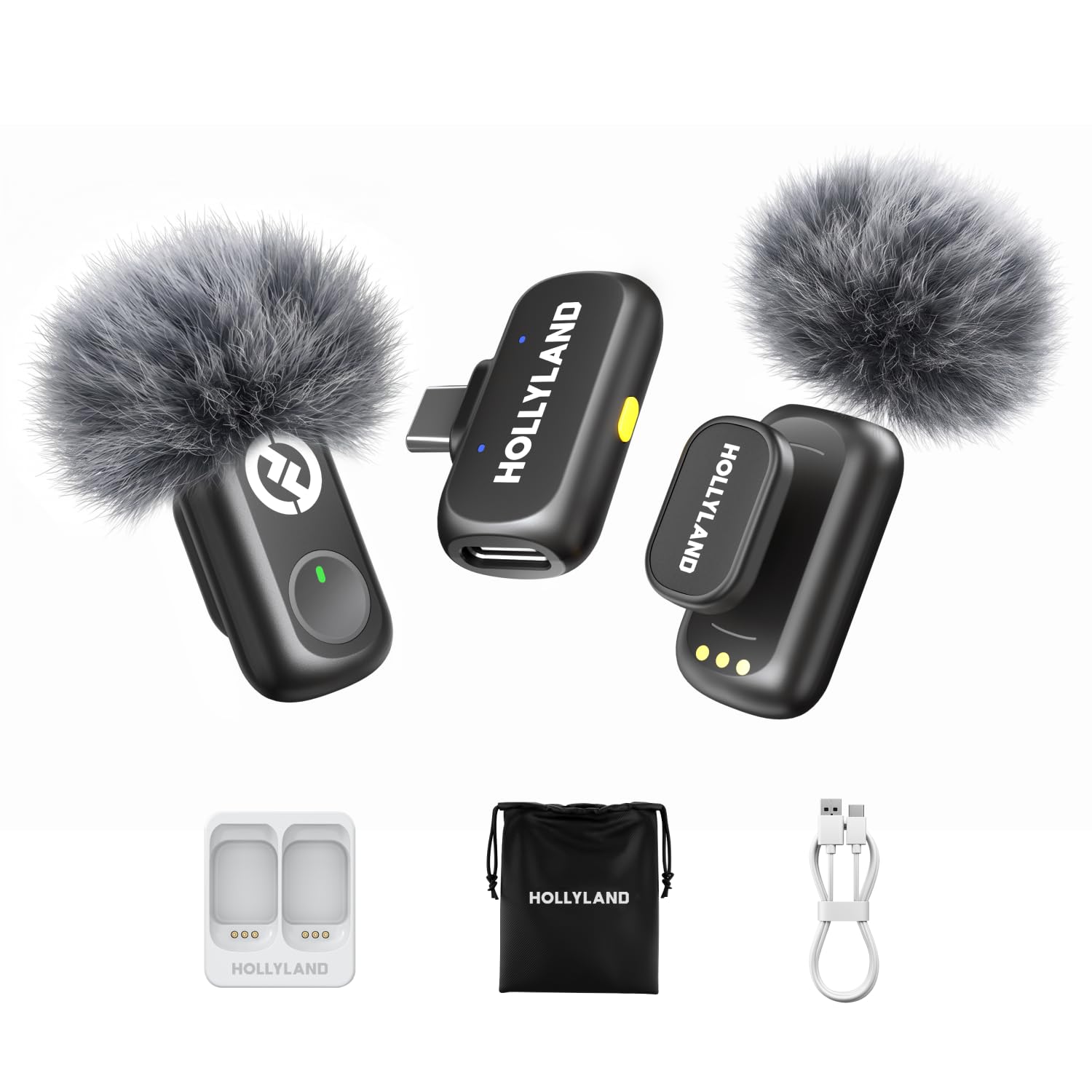
Three receivers in the box — camera, USB-C, Lightning — make the Lark M2 the one-kit answer for creators switching between iPhone, Android, camera, and PC. It records 48kHz/24-bit audio with a 40-hour charging case, and each 9g transmitter runs clear across a 300m wireless range. Noise cancellation isolates voice in normal interiors.

This kit fits podcasters, vloggers, and filmmakers who need one mic across every setup. The magnetic clips are convenient for seated interviews and desk recording; high-motion shoots will want the included clip for a secure hold. A single transmitter pair covers podcast recording, camera interviews, and phone clips without changing hardware.

💡 For active or fast-moving scenes, swap the magnetic clip for the included spring clip.

Pros

  • Professional-level audio quality with strong detail in voice recordings.
  • Three receivers in the box cover camera, iPhone, Android, and PC without extra adapters.
  • 40-hour charging case and 300m wireless range support long shoots.

Cons

  • Magnetic clip can slip during active shooting; the included spring clip is needed for vigorous scenes.
Our verdict

For multi-device creators, this is the kit to grab before a shoot. The slimmer travel option suits single-device users, while this one keeps the same transmitters working across every platform.

Check Latest Price
3

Best Pro Backup Recording

DJI Mic 2

93 /100
Studio Score High Confidence

Key details

Battery
18 h with case
Transmitters
2 TX, 1 RX
Compatibility
Camera, phones, DJI
Wireless Range
250 m
Check Price on Amazon

The DJI Mic 2 stands apart with 32-bit float backup recording on each transmitter and an OLED receiver that makes channel checks quick. Interviewers and documentary shooters get a safety track even when audio peaks unexpectedly, and intelligent noise cancellation trims outdoor rumble in everyday field settings.

This premium-priced kit is for creators who want a polished professional workflow instead of a featherweight travel rig; the slimmer alternative in this lineup is the lighter everyday option. Bluetooth pairing with some iPhones and DJI devices can be finicky, so a wired receiver connection is the more predictable path for time-sensitive shoots.

Pros

  • 32-bit float backup recording on each transmitter protects interviews from unexpected level spikes.
  • OLED receiver makes channel and gain checks quick without digging into menus.
  • Intelligent noise cancellation trims outdoor rumble in everyday field settings.

Cons

  • In extreme wind or dense crowd noise, the noise-cancellation effect can be barely noticeable.
Our verdict

For interview and documentary workflows, this is the wireless kit for shooters who treat backup audio as a requirement, not an afterthought.

Check Latest Price
4

Best 4-Mic Live Sound System

Phenyx Pro PTU-5000

92 /100
Studio Score High Confidence

Key details

Battery
AA batteries
Transmitters
4 handhelds
Compatibility
XLR mixers
Wireless Range
260 ft
Check Price on Amazon

The PTU-5000-4H puts four all-metal UHF handhelds into one receiver with individual XLR outputs, giving churches, schools, and small stages multi-mic coverage without separate wireless systems. Sound quality holds up across all four channels, and the metal bodies feel stage-ready. Setup is quick: plug in the receiver, set the channels, and check levels.

This is the right fit for venues and mobile DJs that routinely need several handhelds at once and don't face heavy RF competition. Frequencies are fixed, so in RF-crowded venues you have less flexibility to dodge interference than a tunable dual-mic system. For typical church, classroom, or karaoke use, that tradeoff is manageable.

Pros

  • Four UHF handhelds with individual XLR outputs deliver clean live vocal sound from one receiver.
  • Four-mic coverage for less than the investment in separate single-channel wireless systems.
  • All-metal receiver and handhelds handle regular setup, load-in, and load-out.

Cons

  • Antenna or receiver issues can surface on arrival.
  • Fixed frequencies leave less room to maneuver around interference in RF-crowded venues.
Our verdict

The PTU-5000-4H gives churches, schools, and mobile DJs four live microphones in a single metal receiver.

Check Latest Price
5

Best Tunable UHF Duo

Phenyx Pro PTU-71

92 /100
Studio Score High Confidence

Key details

Battery
AA batteries
Transmitters
2 handhelds
Compatibility
XLR and 6.35mm
Wireless Range
328 ft
Check Price on Amazon

The Phenyx Pro PTU-71 combines auto-scan dual UHF with 200 selectable frequencies and a range around 328 feet, giving live performers room to dodge interference in venues already loaded with wireless gear. The all-metal handhelds and XLR/6.35mm outputs make this the tunable alternative to fixed-frequency multi-mic sets.

Singers, DJs, and presenters working in RF-heavy rooms are the right fit. AA battery drain can run faster than expected with heavy use, so rechargeable AAs are the practical pairing; this is not the kit for users who dislike managing AA batteries or for rooms where a fixed-frequency budget set already gets the job done.

Pros

  • Vocal clarity holds up on stage, and the all-metal body feels built for steady work.
  • Auto-scan finds open frequencies quickly, reducing guesswork in RF-crowded venues.
  • The 328-foot range covers large stages and outdoor performance areas.

Cons

  • Handling noise or feedback can surface in quiet rooms when the mic is held close.
Our verdict

For live performers who need frequency agility without stepping up to multi-mic racks, this is the tunable dual handheld system to build around.

Check Latest Price
6

Best Value Karaoke Pair

TONOR TW820

91 /100
Studio Score High Confidence

Key details

Battery
AA batteries
Transmitters
2 handhelds
Compatibility
XLR and 6.35mm
Wireless Range
60 m
Check Price on Amazon

The TW820 is a dual UHF handheld system with all-metal construction, 15 selectable frequencies per mic, and both XLR and 6.35mm outputs. Vocals come through clearly with no lag, and the 60m range covers a classroom, small stage, or home karaoke setup. That puts it a clear step above newer 2.4GHz budget handhelds in build quality and tuning options.

For home karaoke hosts, classroom presenters, and small-venue DJs, this is a genuine live-sound tool rather than a wearable recording kit. Handling noise or occasional feedback can surface on cheaper sound systems, and battery life is average, so it fits shorter performance sets and presentations better than all-day wearable use.

Pros

  • All-metal bodies with XLR and 6.35mm outputs make this a serious live-sound set.
  • Clear, no-lag vocal pickup suits karaoke and spoken presentations.
  • 60m range and 15 selectable frequencies per mic cover typical small venues.

Cons

  • No built-in rechargeable batteries; longer sessions mean keeping external spares close by.
Our verdict

For karaoke hosts and small-venue sound, this dual UHF set brings the metal build and output flexibility that cheaper 2.4GHz handhelds skip.

Check Latest Price
7

Budget USB-C Creators

Hollyland Lark A1

88 /100
Studio Score Strong Evidence

Key details

Battery
54 h with case
Transmitters
2 TX, 1 RX
Compatibility
USB-C phones
Wireless Range
200 m
Check Price on Amazon

The Hollyland Lark A1 offers crisp 48kHz/24-bit audio, 3-level noise cancellation, and a 54-hour charging case at a budget price — a sensible first mic for USB-C phone creators. Its single USB-C receiver limits it to one device ecosystem, and pairing on some iPhones can be inconsistent. That keeps it behind the multi-receiver kits in this roundup.

Pros

  • High-fidelity 48kHz/24-bit audio with effective 3-level noise cancellation at a budget price.
  • Plug-and-play setup gets first-time USB-C creators recording fast without an app.

Cons

  • Battery runtime can fall short of the 54-hour case estimate, and a charging dock may not seat the transmitter securely.
Our verdict

For USB-C-only vloggers and podcasters who need long battery on a tight budget, this is the right entry point.

Check Latest Price
8

Budget Backup Recording

NEEWER CM28

91 /100
Studio Score High Confidence

Key details

Battery
9 h per TX
Transmitters
2 TX, 1 RX
Compatibility
Phone, camera, PC
Wireless Range
200 m
Check Price on Amazon

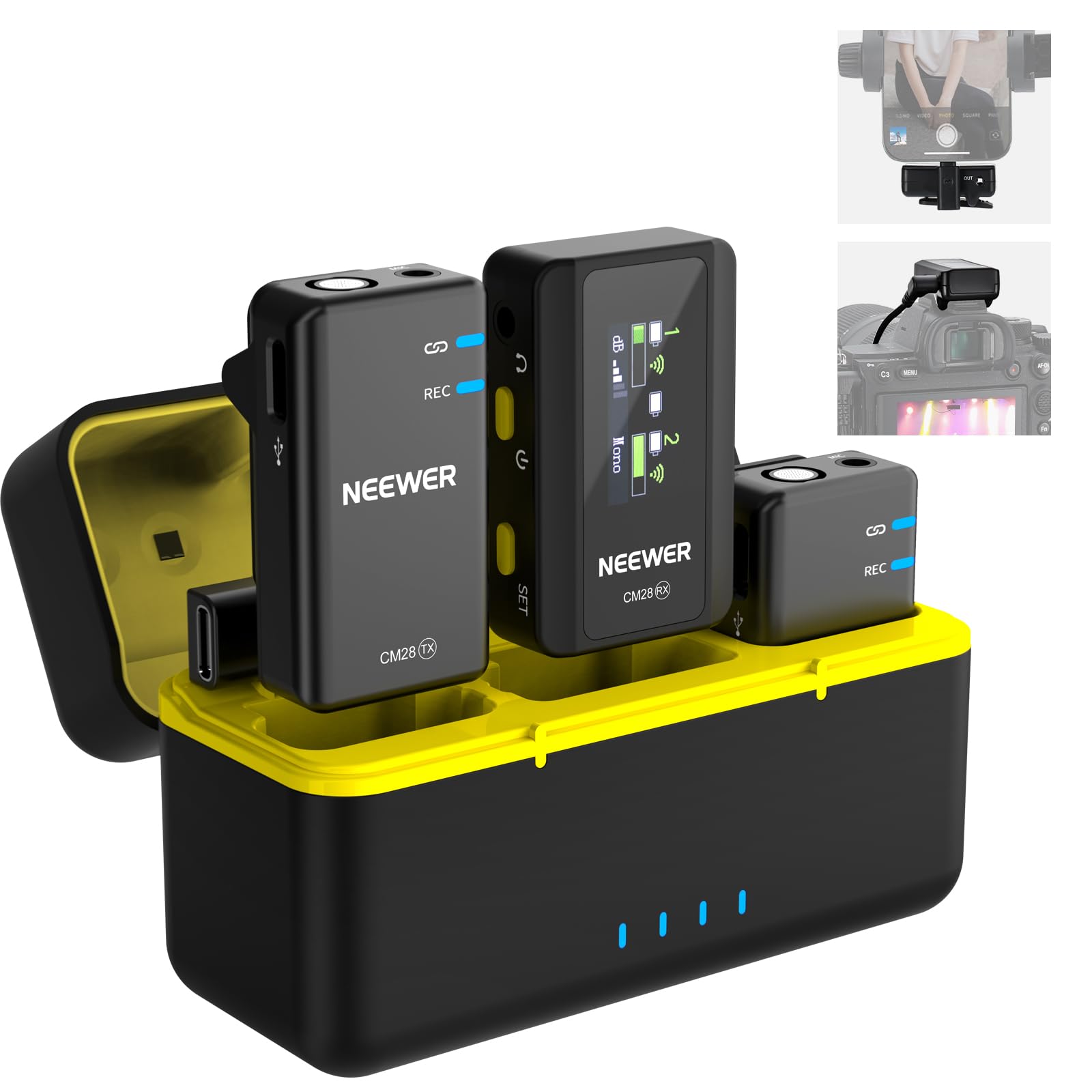
The NEEWER CM28 fits budget creators who want standalone backup recording: each transmitter stores its own 4GB WAV copy, and phone, camera, and PC hookups are simple. The charging case extends sessions, but receiver power-on/charging can vary between units, so this is a backup-capable kit, not a do-or-die daily driver.

Pros

  • Clear voice capture at a budget price.
  • Easy setup across phone, camera, and PC for multi-device creators.

Cons

  • For all-day shoots, receiver power-on/charging behavior can vary between units.
Our verdict

For budget creators who want a safety-net recording copy without paying for pro features, the CM28 is a reasonable backup kit — as long as you can tolerate occasional receiver power-on/charging quirks.

Check Latest Price
9

Casual Home Karaoke

TONOR TW220

88 /100
Studio Score Strong Evidence

Key details

Battery
30 h per mic
Transmitters
2 handhelds
Compatibility
6.35mm input
Wireless Range
50 ft
Check Price on Amazon

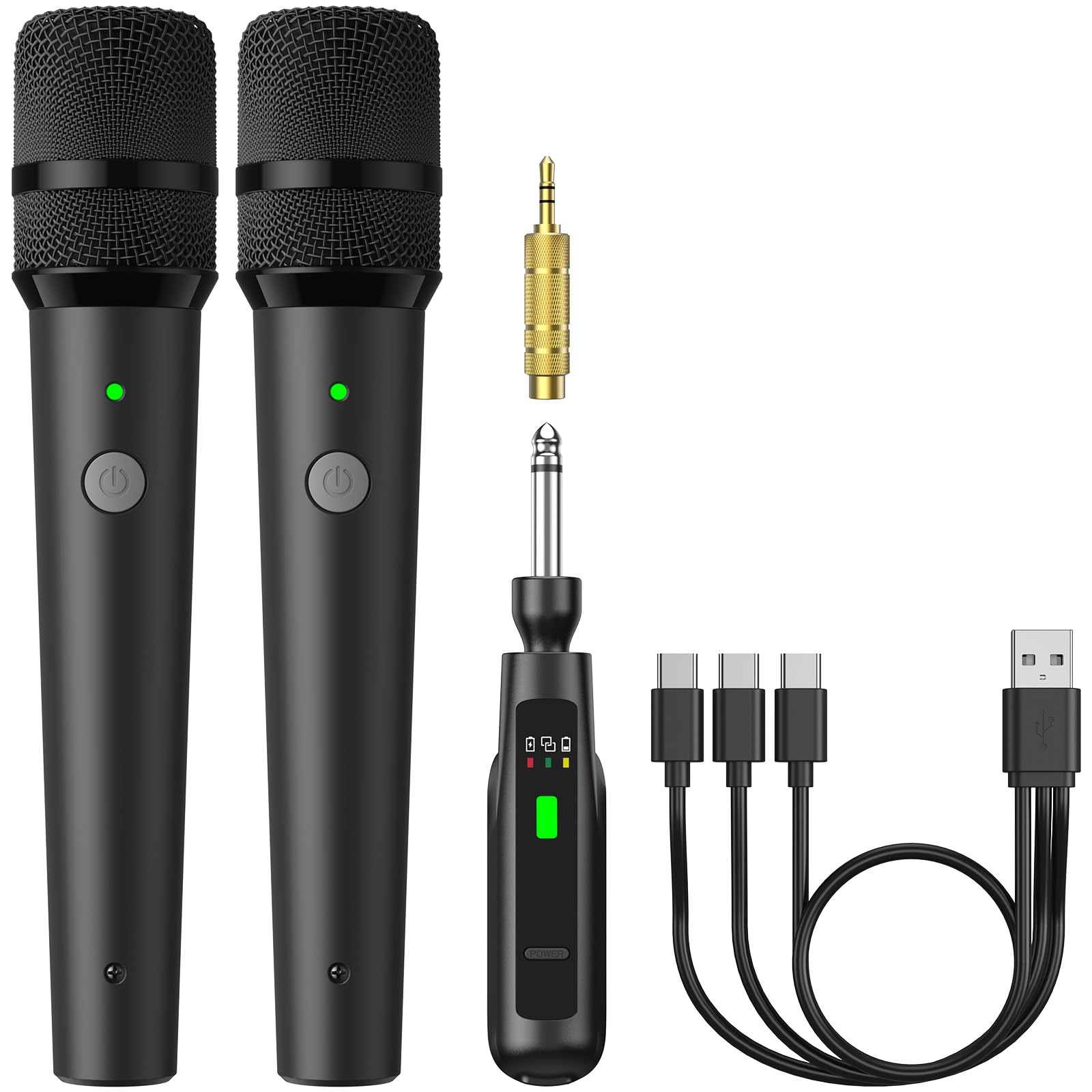
Two rechargeable handhelds plug into a powered speaker's 6.35mm input and deliver clear, loud vocals for living-room karaoke or small meetings. The 50ft range suits home use rather than a hall, receiver charging can be inconsistent, and occasional 2.4GHz dropouts are possible in crowded RF spaces. These limits keep it below UHF handheld sets for serious live sound.

Pros

  • Crisp and loud voice reproduction through a 6.35mm receiver at a budget-friendly price.
  • Two handhelds pair quickly and stay comfortable for casual home karaoke or small meetings.

Cons

  • The handheld connector can become intermittent with repeated plugging, so this system is best for occasional home use.
Our verdict

For hosts with a powered speaker and a 6.35mm input who stay in one room, this budget-friendly set is a viable two-mic karaoke pair.

Check Latest Price
10

iPhone Content Creators

Mini Mic Pro

88 /100
Studio Score Strong Evidence

Key details

Battery
6 h per charge
Transmitters
2 TX, 1 RX
Compatibility
iPhone, Android
Wireless Range
—
Check Price on Amazon

The Mini Mic Pro captures clean spoken word for iPhone TikTok or YouTube clips straight out of the box, with both sponge and deadcat wind protection included. Its low price is appealing, but treat this as an iPhone-first kit. Battery life can vary between units, so a full case charge before a long shoot is wise.

Pros

  • Plug-and-play setup with included sponge and deadcat wind protection covers outdoor recordings.
  • Noise cancellation trims wind and background noise for clear spoken word.

Cons

  • Android and camera compatibility can be inconsistent, and some phones may not recognize the receiver.
Our verdict

For iPhone creators who want a cheap, easy clip-on for short social clips, this fits — as long as Android and camera use are not on the plan.

Check Latest Price
11

USB-C Phone Vloggers

GoorDik J3 USB-C Mic

87 /100
Studio Score Strong Evidence

Key details

Battery
6–12 h per TX
Transmitters
2 TX, 1 RX
Compatibility
USB-C, Lightning adptr
Wireless Range
30 m
Check Price on Amazon

GoorDik's USB-C lavalier delivers clear, no-app audio with USB-C, USB-A, and Lightning adapters in one kit. Setup is easy for Type-C phones, tablets, and laptops. It is not a camera receiver kit, and battery life can run shorter than claimed; occasional pairing loss after extended use has been noted. Those caveats keep it below the more rounded options above.

Pros

  • Clear audio that suits vlogs, podcasts, and interviews on USB-C devices.
  • Plug-and-play setup with USB-C, USB-A, and Lightning adapters included.

Cons

  • Entry-level feature set compared with higher-tier wireless mic kits.
Our verdict

This fits USB-C phone, tablet, and laptop creators who prioritize no-app simplicity and a budget-friendly price.

Check Latest Price
12

JBL PartyBox Karaoke

JBL Wireless 2-Mic

91 /100
Studio Score High Confidence

Key details

Battery
6 h playback
Transmitters
2 handhelds
Compatibility
JBL PartyBox only
Wireless Range
—
Check Price on Amazon

JBL PartyBox owners get two UHF handhelds and a dual-channel receiver that brings karaoke-ready vocals without extra mixing gear. Vocal clarity and solid build fit home parties, and setup stays inside the PartyBox line. The receiver is tied to those speakers, so this is a speaker-specific accessory rather than a general-purpose wireless mic system.

Pros

  • Clear vocal reproduction suited to karaoke and home parties.
  • Solid feel and easy setup for JBL PartyBox owners.

Cons

  • Charging behavior can be inconsistent; individual units may not hold a full charge.
Our verdict

If you own a JBL PartyBox and want a karaoke mic set without extra gear, this fits; outside that ecosystem, a general-purpose system serves better.

Check Latest Price

How to Choose

Transmitters and Receivers

Count the inputs you actually need on a typical shoot. A two-transmitter kit covers interviews and dual-speaker podcasts, while a four-mic system serves panel discussions, church services, or karaoke bars without syncing multiple receivers.

The hidden trade-off is receiver design. Multi-receiver kits that include camera, USB-C, and Lightning outputs remove adapter friction but often cost more or force you to choose between a phone receiver and a camera receiver. If you only ever record on one device, a single-receiver kit is simpler and usually cheaper.

Wireless Range and Frequency

Range figures like 300m or 400m are measured in open air with zero interference. Inside a venue with Wi-Fi routers, Bluetooth devices, and other wireless mics, real-world range often drops to a fraction of that number.

For clip-on systems, 2.4GHz is standard and works fine for vlogging and interviews where the receiver is within a few meters. For live sound, UHF systems with auto-scan or selectable frequency groups let you move to a clear channel when interference appears. Fixed-frequency UHF systems are cheaper but leave you stuck if a competing signal occupies that channel.

Battery Life and Charging Case

Battery life claims usually separate transmitter runtime from charging-case capacity. A 6-hour transmitter with a 40-hour case can last all day if you return it to the case between takes, but the case only helps when it is actually with you.

The mechanism reviewers most often discover too late is charging-case QC. A case that fails to charge one transmitter, or a receiver that drains while idle, is far more disruptive than a slightly shorter rated run time. Prioritize systems with a proven review base and a case that charges both transmitters and the receiver simultaneously.

Device Compatibility and Adapters

Phone compatibility is the most common pain point in this category. USB-C receivers work with newer iPhones and Android devices, but older iPhones need Lightning, and many Android phones handle audio over USB-C differently. A kit that includes both receiver types is the safest bet for mixed-device creators.

Camera owners need to confirm whether the receiver outputs a clean enough signal for their specific camera model. Some receivers only work with phones, and others require a TRS-to-TRS cable that older cameras may not support. Check the included cables and receiver outputs before buying.

Noise Cancellation and Recording

Noise cancellation on wireless mics is not a universal performance feature. Some systems cut wind and HVAC hum convincingly; others muffle the voice or do nothing in real-world environments. It is a signal-processing feature, so its effect varies with the microphone placement and the background sound profile.

Internal recording is the more reliable safety net. If the wireless link drops or the noise cancellation fights your voice, a transmitter with built-in recording captures a clean file that you can sync in post. That feature matters most for interviews and documentary shoots where you cannot ask the subject to repeat themselves.

Frequently Asked Questions