9 Best Shotgun Microphone of 2026: Pick One That Matches Your Rig

Find the shotgun mic that actually matches your camera, phone, or XLR recorder — without paying for the wrong connector or powering setup.

Most shotgun microphones marketed as 'broadcast-quality' are fine capsules wrapped in confusing connector and power requirements. The first buying decision is matching the mic to your camera, phone, or recorder; brand and price tier matter less. A 3.5mm on-camera mic and an XLR boom mic are different tools, and the wrong connection cannot be fixed with an adapter.

The practical fork is compact 3.5mm convenience versus XLR broadcast flexibility. If you shoot solo with a DSLR or mirrorless camera, a small mic with plug-in power, wind protection, and basic controls solves more real problems than a pro XLR mic that demands a recorder. If you work on a boom pole, the XLR route is the actual tool.

Beyond the capsule, shock-mount durability and phone compatibility decide whether a mic lasts and works with your gear. Focus on those two boundaries, and a budget shotgun can sound close to a much more expensive one.

1

Best Overall On-Camera Shotgun

Sennheiser MKE 400

88 /100
Studio Score Strong Evidence

Key details

Controls
Low-cut, gain, monitor
Powering
1 AAA battery
Connection Type
3.5mm TRS, TRRS
Mount & Wind Kit
Integrated wind, suspension
Check Price on Amazon

The MKE 400 captures clearly better audio than a camera's built-in mic, using a supercardioid capsule to keep the subject's voice forward while trimming room tone. That directional pickup matters for interviews and voiceover-style segments, where the voice needs to stay present without the room dominating. The low-cut filter and three-step sensitivity switch adapt to changing locations without menu diving, and headphone monitoring confirms what the mic hears before you move on. An internal suspension and integrated wind protection suit a compact body made for DSLR and mirrorless rigs.

Interviews and vlogs come through with crisp dialogue in mixed environments such as sidewalks, expo halls, and event rooms. The 3.5mm TRS and TRRS outputs expand beyond cameras to phones and recorders, and a single included AAA battery delivers power without charging cables. Switching the low-cut filter or gain steps changes the sound immediately, so a shooter can respond to a noisy location on the spot. The supercardioid pattern is not as isolating as a long broadcast shotgun, but it behaves well when the camera is reasonably close to the subject.

This suits DSLR and mirrorless shooters, vloggers, and mobile creators who want a premium 3.5mm shotgun without moving up to XLR gear. XLR multi-cam and boom-pole workflows need a different microphone, and budget-only buyers should start lower in the price range. The main limits are a plastic cold-shoe lock ring that can snap and a noise floor that can become audible in very quiet rooms; consider whether either matters for your regular setups.

At a mid-range price, the MKE 400 sits clearly above budget 3.5mm shotguns in controls and build integration. For a shooter who already owns a camera and wants one compact mic for interviews, vlogs, and general run-and-gun, it avoids the extra cost and bulk of an XLR recorder setup. The monitoring jack alone can save a take that would otherwise be ruined by an unnoticed gain change or cable issue.

The internal shock mount keeps handling rumble lower than a rigid shoe-mounted mic, and the integrated wind protection handles moderate outdoor use. This is still a short shotgun, not a long broadcast-style boom, so keeping the camera within a few feet of the speaker gives the best dialogue-to-room ratio.

💡 Confirm your phone's 3.5mm jack accepts an external mic signal before relying on the TRRS cable.

Pros

  • Dialogue is clearly better than built-in camera mics, with a supercardioid pattern for forward presence.
  • Vlogging and interview sound stays clean in mixed ambient settings.
  • Compact body fits DSLR and mirrorless rigs while feeling sturdy.
  • Headphone monitoring lets you catch gain and placement problems before the take ends.
  • Low-cut filter and three-step sensitivity switch handle noisy or quiet locations without menu diving.

Cons

  • The plastic cold-shoe lock ring can snap when the mic is levered in the mount.
  • In very quiet rooms, the noise floor can be audible; active scenes reduce its impact.
Our verdict

The Sennheiser MKE 400 is the practical mid-range choice for camera and mobile creators who want clean dialogue, onboard controls, and monitoring in a compact 3.5mm shotgun.

Check Latest Price
2

Best Pro XLR / ENG Choice

Sennheiser MKE 600

92 /100
Studio Score High Confidence

Key details

Controls
Low-cut filter
Powering
Phantom or AA
Connection Type
XLR, 3.5mm adapter
Mount & Wind Kit
Foam, shock mount
Check Price on Amazon

The MKE 600 is the all-metal XLR shotgun in this comparison, with a longer interference tube, low self-noise, and strong rear rejection. It runs on recorder phantom power or one AA battery, so documentary and ENG crews can keep the same signal path when a camera or mixer lacks 48V.

On an interview or field-dialogue setup, the longer tube keeps the main voice separated from room chatter, and the capsule captures clean, full audio without the thin edge of shorter 3.5mm mics. The XLR output feeds recorders directly, while a 3.5mm adapter path lets hybrid cameras receive the signal with the right cable and power arrangement.

The all-metal body is built for bag-and-boom life, and the included foam windshield and shock mount cover basic location use. At a premium tier price, this sits below typical broadcast rental costs while giving shooters the interference-tube length and dual-power flexibility that shorter or battery-only shotguns do not offer.

This is for ENG/EFP crews, documentary teams, and indie filmmakers who already own XLR-capable cameras or recorders. The XLR/pro form factor is overkill for ultra-compact vlogging and mobile-only creators; the compact 3.5mm Sennheiser in this comparison fits that role better.

Pros

  • Broadcast-grade dialogue with tight rear rejection for interview and documentary work.
  • Phantom or AA power keeps field recording going when the recorder or camera lacks 48V.
  • All-metal aluminum body handles location work without the flex of plastic-bodied alternatives.
  • Longer interference tube provides tighter off-axis rejection than compact on-camera shotguns.

Cons

  • The included hot-shoe mount can bind in a camera shoe; a clamp-style third-party mount removes the annoyance.
Our verdict

For XLR-equipped ENG/EFP and documentary crews, the MKE 600 is the field shotgun to grab when the compact top pick cannot deliver the same rear rejection or dual-power flexibility. Mobile-only creators should stick with the 3.5mm Sennheiser.

Check Latest Price
3

Best Budget Compact

Rode VideoMicro II

84 /100
Studio Score Strong Evidence

Key details

Controls
None
Powering
Camera plug-in power
Connection Type
3.5mm TRS, TRRS
Mount & Wind Kit
Helix mount, no windscreen
Check Price on Amazon

The Rode VideoMicro II is a 39g battery-free shotgun that mounts in a camera shoe and runs off the camera's 3.5mm jack. Its Helix isolation mount and unidirectional pickup deliver clear directional voice without adding bulk or recorder batteries. Unlike Rode's XLR boom mics, this one is for the shoe, not the boom pole.

On a DSLR or mirrorless body, the VideoMicro II separates spoken word from room echo and camera motor noise compared with built-in mics. The fixed sound profile suits straight-to-edit vlogs more than controlled recording sessions, and the 80mm length keeps it unobtrusive in front of the lens.

This is for vloggers and travel creators who want a 39g battery-free shotgun that runs off camera plug-in power. There are no onboard gain controls or filters, and a unit can arrive with static or no output, so it is aimed at shooters who want a fast shoe-mount upgrade rather than a sound-design tool.

At an entry-level price, the included Helix mount and short TRS/TRRS patch cables cover the basics without a recorder or battery. That leaves the kit small enough for a day bag, which is the main appeal for travel creators.

💡 For mobile use, pair it with a TRRS adapter; the included patch cables cover TRS and TRRS.

Pros

  • Clear directional voice in a 39g body; an immediate upgrade over built-in camera mics.
  • Battery-free operation with Helix isolation mount keeps travel and vlogging kits minimal.
  • Entry-level price delivers a meaningful audio upgrade without extra cables or recorders.

Cons

  • No headphone monitoring means you can't verify audio while recording.
  • Requires a powered 3.5mm jack; cameras without plug-in power won't drive it.
Our verdict

The VideoMicro II is the compact, battery-free answer for travel creators who want a clear directional voice track without adding bulk or recorder batteries.

Check Latest Price
4

Best Compact XLR Value

Audio-Technica AT875R

90 /100
Studio Score High Confidence

Key details

Controls
None
Powering
Phantom power
Connection Type
XLR
Mount & Wind Kit
Shock mount, windscreen
Check Price on Amazon

The AT875R is a short XLR shotgun that pairs low self-noise with strong off-axis rejection, and its sub-7-inch body fits a documentary kit without the bulk of a long ENG barrel. That compact length also makes it easier to position close to talent without showing up in wide shots.

On a boom or fixed stand, the supercardioid pattern keeps background chatter and camera noise from crowding dialogue, while the tailored response cuts down handling rumble when the mic is shock-mounted. Narration and commercial voice sessions get the same even response at typical indoor distances.

The main boundary is live-space feedback: in an open auditorium or a room with loud floor monitors, the capsule can ring when it is aimed near a loudspeaker. That same directional control is exactly what keeps dialogue clean indoors, so the tradeoff is situational rather than constant. The mic also has no battery option, so phantom power has to come from the field recorder or mixer.

Documentarians, church/event recorders, and narration/commercial shooters who already run XLR mixers or field recorders are the natural fit. Anyone expecting a plug-and-play camera-shoe mic or direct phone connection should pick a 3.5mm model instead.

Pros

  • Off-axis sound stays damped, so dialogue remains clean in rooms with background chatter or HVAC.
  • Mid-range price for a professional XLR shotgun that competes with longer broadcast barrels.
  • Sub-7-inch body eases boom placement and keeps the mic out of wide frames.

Cons

  • No 3.5mm output, so a camera or phone needs an external interface before this mic can be used.
Our verdict

A documentarian with an XLR recorder gets a compact shotgun that controls direction well; shooters without XLR gear should start with the 3.5mm option in this guide.

Check Latest Price
5

Best Rechargeable Feature-Packed Budget/Mid

Comica VM20

90 /100
Studio Score High Confidence

Key details

Controls
Low-cut, gain
Powering
Built-in rechargeable
Connection Type
3.5mm TRS, TRRS
Mount & Wind Kit
Shock mount, windscreen
Check Price on Amazon

Full-metal build, an OLED battery display, two low-cut filters, stepless gain, and USB-C charging make the VM20 unusually capable for a budget-friendly 3.5mm shotgun. It moves past Comica's entry-level model without forcing an XLR rig on camera or mobile shooters. Dialogue pickup is clean for the price, and the built-in battery holds up through a full day of event work.

The controls matter in the field. The 75/150Hz low-cut filters tame air-conditioning rumble and handling thumps, while the stepless gain control lets you adjust levels as a subject moves closer or farther away. The OLED display removes the guesswork about remaining power, a practical advantage when you're shooting long interviews without easy access to a charger.

Best suited to event and documentary shooters, podcasters, and vloggers recording into a 3.5mm camera or recorder. The USB-C rechargeable cell removes the disposable-battery hassle. This is a compact supercardioid, and directional rejection is not as tight as claimed; in busy rooms the pattern behaves more like a forgiving cardioid than a broadcast isolator. XLR professionals should pass. Occasional connection quirks are part of the territory at this price tier. iPhone shooters need a TRRS-to-Lightning adapter for the 3.5mm output.

Pros

  • Clear voice pickup with a natural tone for the price.
  • Built-in rechargeable battery lasts through long shooting days and charges over USB-C.
  • Gain and low-cut filters add practical control without needing an XLR mixer.
  • Kit includes useful accessories, making the budget price even stronger.

Cons

  • Off-axis voices in crowded rooms can bleed into the main track.
  • Occasional units may drop audio or arrive without a working output.
Our verdict

The VM20 is the budget-friendly 3.5mm shotgun to choose when rechargeable power and on-board controls matter more than XLR infrastructure.

Check Latest Price
6

Best Analog/USB-C Hybrid

Movo X1-Mini

86 /100
Studio Score Strong Evidence

Key details

Controls
None
Powering
Plug-in/USB power
Connection Type
3.5mm, USB-C
Mount & Wind Kit
Rycote shockmount, windscreens
Check Price on Amazon

The X1-Mini carries both a 3.5mm analog output and a 24-bit USB-C output, which separates it from the entry-level 3.5mm-only shotguns in this lineup. One mic can move from a mirrorless body to a phone to a laptop without an adapter chain.

Dialogue capture is clean, and the supercardioid pattern keeps off-axis room tone from dominating. The 80dB SNR and battery-free operation keep the rig light: plug-in power runs the analog path, while USB bus power runs the digital path. The mic handles both connection types without added bulk.

This is the shotgun for hybrid creators who record to a camera, then move the same clips to a phone or computer for finishing. The bundled shockmount has a snug fit, so creators who prefer minimal handling effort should plan for a firm press when mounting.

The kit bundles a Rycote shockmount, foam and furry windscreens, and a hard case, which covers a broad range of location-recording needs without separate accessory purchases. That packaging, paired with the dual-output design, puts the X1-Mini between the cheapest 3.5mm mics and the premium compact shotguns in this group.

💡 Apply even pressure with both hands when seating the mic in the shockmount.

Pros

  • Clean, solid dialogue sound with good side rejection off-axis.
  • Strong value at a budget-friendly price, especially with USB-C digital output.
  • Plug-and-play setup across camera, phone, and computer via 3.5mm and USB-C.

Cons

  • In an XLR audio-interface workflow, this mic has no direct connection path.
  • When swapping between camera and phone setups, the tight bracket can make re-mounting slow.
Our verdict

Creators who split their week between camera, phone, and computer get one budget-friendly shotgun that covers all three without a dedicated audio interface.

Check Latest Price
7

Indie Film Boom

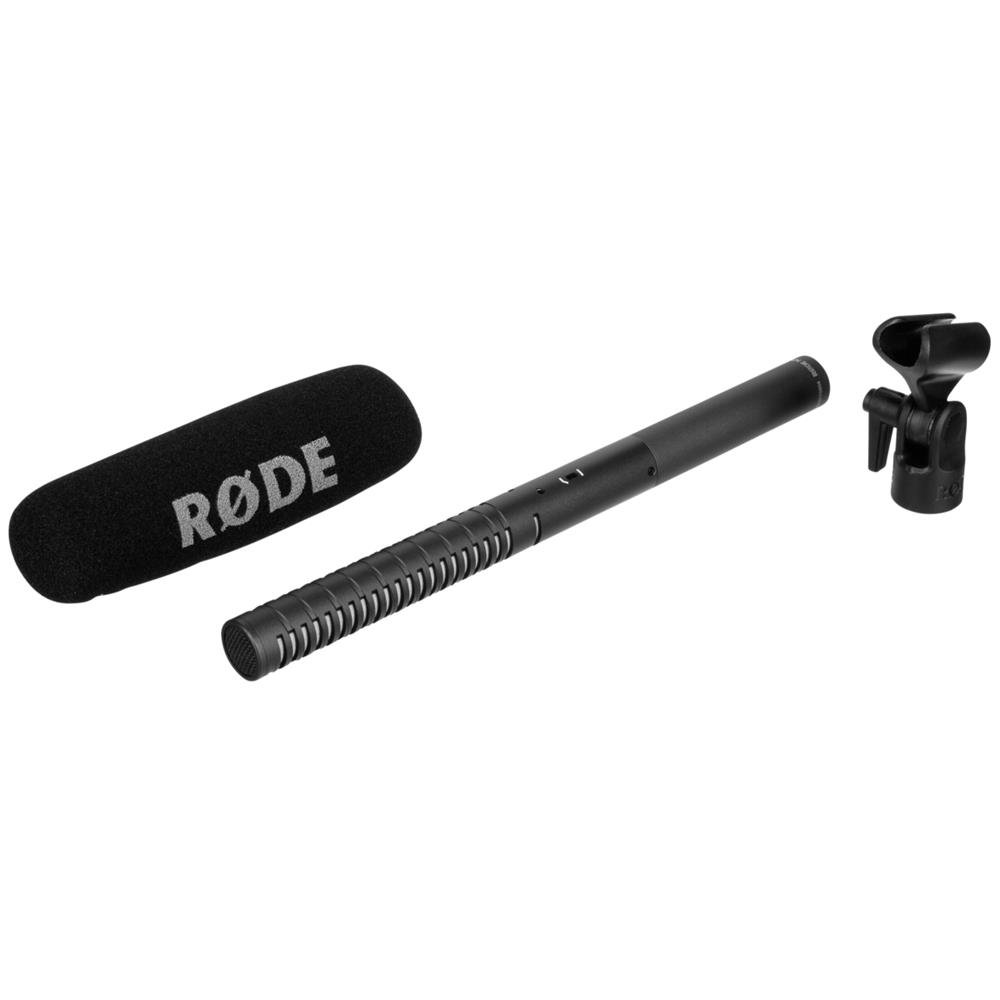
Rode NTG-2

90 /100
Studio Score High Confidence

Key details

Controls
None
Powering
Phantom or AA
Connection Type
XLR
Mount & Wind Kit
Stand clamp, windscreen
Check Price on Amazon

The NTG-2 is a long-body shotgun with natural 20Hz-20kHz response and dual phantom/AA power, backed by Rode's 10-year warranty. It pairs with a boom pole and field recorder for dialogue, interviews, and location-sound work, giving low-budget crews a proper broadcast-style capture path. The sensitive capsule can surface handling noise and room hiss unless the boom is handled carefully, so this is a mic for planned shooting rather than quick handheld grabs. Its long body and boom-pole orientation make it less convenient than compact 3.5mm on-camera mics for solo creators, which is why it sits below the top pick in this roundup.

Pros

  • Clean, natural shotgun sound with a wide frequency response for dialogue and interviews.
  • Phantom or AA power adds flexibility for field recorders and mixers.
  • Strong value for low-budget and independent film production.

Cons

  • No battery-free operation; a phantom source or AA battery is mandatory.
  • XLR-only output leaves 3.5mm cameras and smartphones needing an external recorder or interface.
Our verdict

If you already work with a field recorder and boom, this is a fitting mid-range investment; otherwise compact 3.5mm options serve solo shooting better.

Check Latest Price
8

Wireless Interviews

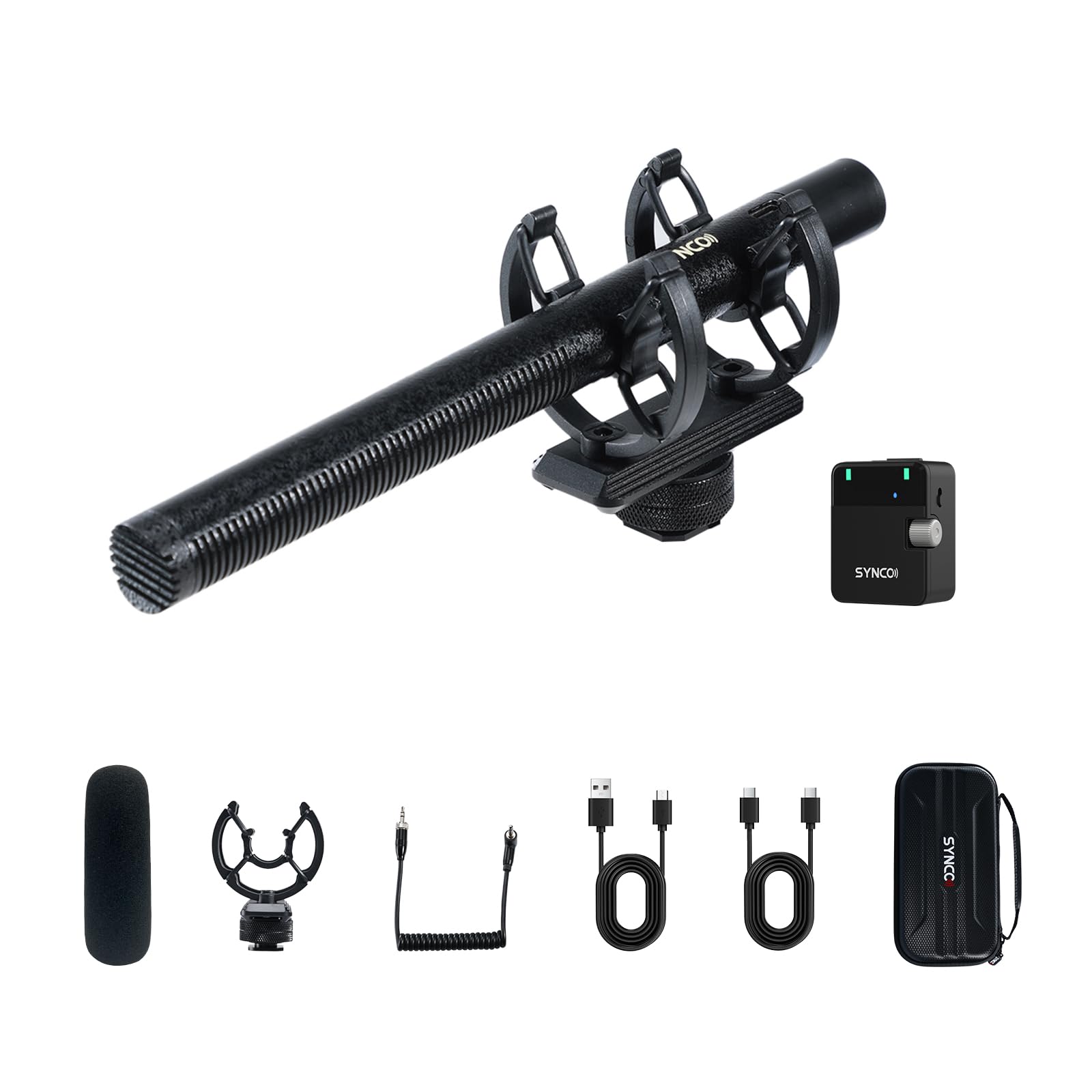
SYNCO D2 Wireless

83 /100
Studio Score Strong Evidence

Key details

Controls
None
Powering
Built-in rechargeable
Connection Type
2.4GHz wireless receiver
Mount & Wind Kit
Check Price on Amazon

The SYNCO D2 delivers 200m of wireless range and 11 hours of continuous battery from a single hypercardioid shotgun body, which makes it a practical fit for run-and-gun interviewers who want cable-free operation on set. Event audio stays clean over the 2.4GHz link, and the included receiver keeps the setup compact. The compatibility list excludes Sony A7M4/A7M5 bodies, so those shooters are not the intended audience. That sharp boundary, rather than audio behavior, is why it sits below the top pick instead of higher in this roundup. For creators on compatible mirrorless, DSLR, or camcorder bodies, it offers solid build quality and a cost-effective wireless shotgun package.

Pros

  • Solid build quality handles regular run-and-gun rig use.
  • Cost-effective way to get a wireless shotgun without a separate transmitter kit.
  • Clean event audio stays intact over a long wireless range with low-latency transmission.

Cons

  • Cameras outside the manufacturer's compatibility list have no supported path to use this wireless shotgun.
Our verdict

For creators on compatible bodies, the D2 is a mid-range wireless shotgun that makes cable-free interview sound easy to capture without a separate wireless kit.

Check Latest Price
9

Budget Vloggers

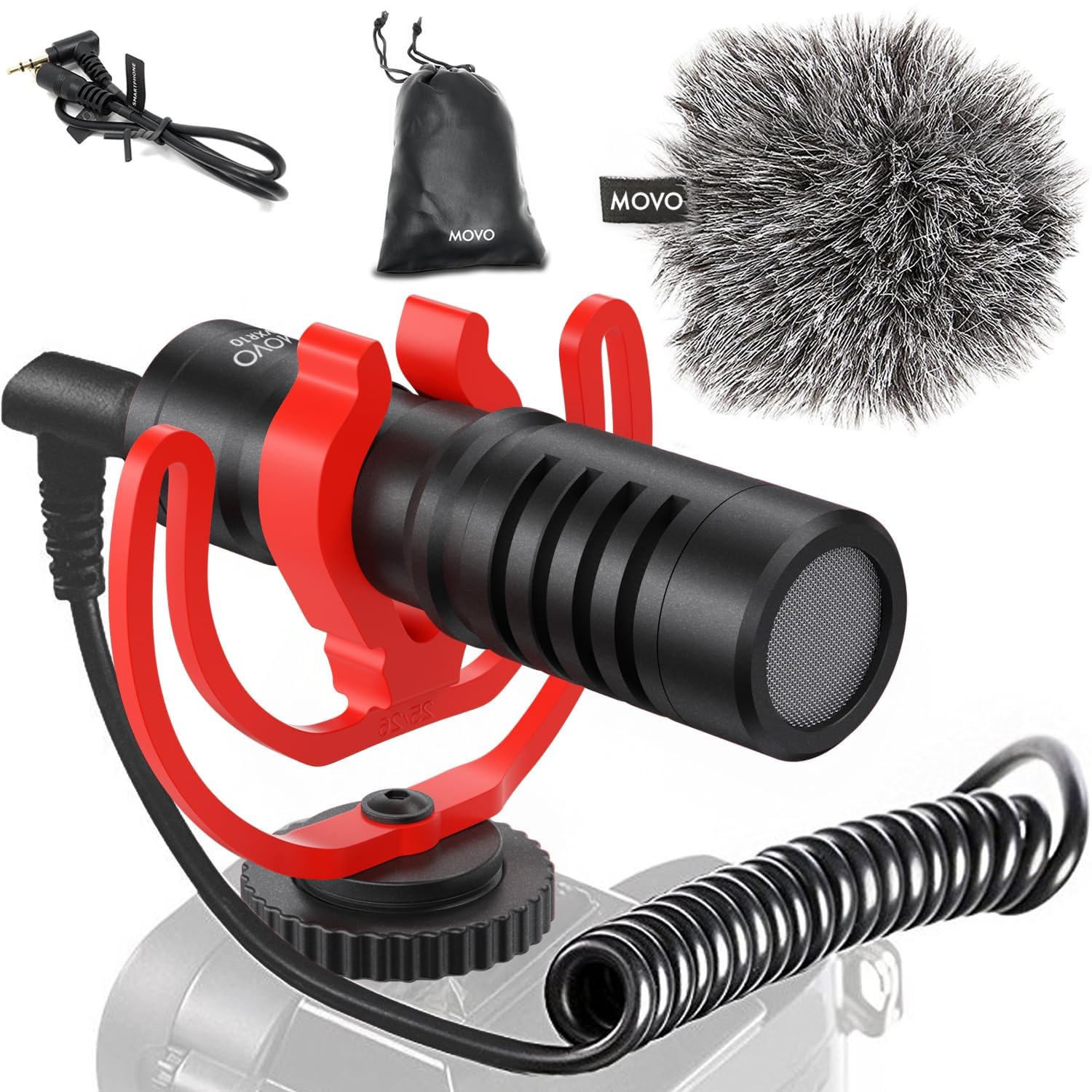
Movo VXR10

88 /100
Studio Score Strong Evidence

Key details

Controls
None
Powering
Plug-in power, no battery
Connection Type
3.5mm TRS, TRRS
Mount & Wind Kit
Two shock mounts, windscreen
Check Price on Amazon

The Movo VXR10 is a budget-friendly entry into 3.5mm shotgun audio. It delivers a unidirectional pickup in a small aluminum body, runs on plug-in power, and ships with two shock mounts, cables, and a case — enough to get a first-time DSLR or mirrorless vlogger recording immediately. The bundled kit covers the basics without a separate purchase. It also shows why the price is low: the shock mount can crack under uneven stress, newer phones may not recognize it without an adapter, and some units let a low hiss into quiet scenes. Those are the boundaries that keep it below the top tier.

Pros

  • Budget-friendly price for a compact unidirectional shotgun with two shock mounts, cables, and a case.
  • Plug-in power and a small body suit vlogging, DSLR, and small video projects.

Cons

  • On newer phones, a TRRS adapter may still not produce a signal in some cases.
  • The shock mount can crack when the mic is torqued in a tight shoe or cage.
Our verdict

For a first-time vlogger with a compatible camera, this is a low-cost way to get directional audio before moving up.

Check Latest Price

How to Choose

Connection Type

A 3.5mm TRS connector is the default for DSLR and mirrorless cameras; TRRS adds the extra ring needed for many phones. XLR is the broadcast standard that needs a camera with XLR inputs, a recorder, or an audio interface.

The practical catch is that a 'universal' mic with both TRS and TRRS cables can still be incompatible with a specific phone or camera because plug-in power voltage and TRRS pinouts vary. Check the exact model before you buy, not the package claims.

Powering

3.5mm shotgun mics typically draw plug-in power from the camera; some add a battery for a stronger preamp. XLR mics need phantom power, usually 48V, or an internal AA battery. Rechargeable USB-C mics remove battery swaps but need charging discipline on long shoots.

Power source also affects self-noise. A condenser mic at the edge of available voltage can sound thin or produce hiss, so the powering system helps set the audio floor in quiet scenes.

Directional Pickup

Supercardioid and hypercardioid patterns are standard for shotguns; they reject side pickup but still have rear lobes. Unidirectional microphones are less directional and may catch more room tone.

The consequence shows up in real rooms: a tight pattern lets you record dialogue from a few feet away in a crowd, but it becomes unforgiving when the mic drifts off-axis on a boom. Match the pattern to how close you can keep the mic to the subject.

Controls

A low-cut filter cuts rumble from HVAC or handling; a gain or sensitivity switch matches the mic's output to the camera preamp. Headphone monitoring matters if you need to hear what you're recording.

Controls consume space, battery, and budget. On a compact 3.5mm mic, each switch adds cost and another component that can wear out, so choose the controls you will actually use.

Mount and Wind Protection

Rubber or Rycote-style suspension bands isolate the capsule from handling noise, but they are the most common wear item on budget shotguns. The shock mount often goes first, not the capsule.

A foam windscreen removes some wind noise; a furry dead cat is needed outdoors for any serious moving air. If you shoot outside regularly, budget for a decent mount and wind protection.

Frequently Asked Questions