8 Best Monocular of 2026: Match Magnification to Your Real Use

The right monocular balances magnification, lens size, and one-hand focus. This guide helps you pick one that fits your hand, terrain, and light — not just the specs.

A monocular should be the easiest optic to carry, but the spec sheet often gets in the way. Extreme magnification numbers and tiny objective lenses create images that are dim or hard to hold, and a stiff focus ring can ruin a trailside moment. The real decision is less about raw magnification and more about how the lens size, weight, and focus mechanism work together in your hand.

That trade-off matters most in the field. A compact 10x25 slips into a pocket but loses light at dawn and dusk, while a larger 8x32 or 8x42 is brighter and easier to steady but adds bulk. This guide sorts out those boundaries so you know which design fits your use — hiking, birding, hunting, or travel — before you spend.

1

Best Overall

Vortex Solo 10x25

90 /100
Studio Score High Confidence

Key details

Magnification
10x
Objective Lens
25mm
Weatherproofing
Waterproof, fogproof
Focus & Handling
Two-hand focus
Check Price on Amazon

The Solo 10x25 packs a fully multi-coated 10x25 optical path into a 5.6-ounce body that fits a closed hand. Daylight views come through sharp and crisp, with enough 10x reach to separate birds, trail markers, or distant game from the background. The nitrogen-purged chassis is waterproof and fogproof, and the bare view stays free of reticle clutter. No premium ED glass, but the fully multi-coated lenses hold contrast well in open shade and overcast conditions.

Carry is where the Solo makes its case. Hunters tuck it into a vest pocket, hikers into a hip-belt pocket, and bow hunters into a chest pack without altering the balance of the load. The body holds up under regular outdoor use, and the 25mm objective keeps image contrast intact through varied daylight conditions. Because the monocular is light enough to forget about, it tends to be along when you actually need it — which is the whole point of a pocket optic.

This is a daylight optic for hikers, hunters, and birders who want 10x reach in a pocket package. The focus ring can be stiff enough that one-hand refocusing is not always effortless. That fits a set-and-forget style of use: get the target focused, lower the optic, and raise it again when you need it. Users who expect rapid follow-focus will handle the Solo best with two hands on the barrel.

Skipping the reticle also separates the Solo from the tactical monoculars in this set. No ranging hash marks means one less thing to process in the field; the trade-off is that hunters or shooters who need distance estimation will need one of the reticle-equipped options instead. The Solo keeps its job narrow: magnify the scene, keep the view clean, and stay out of your pocket.

At a mid-range price, the Solo includes Vortex's lifetime VIP warranty, which covers the optic for as long as you own it. There is no premium ED glass here, but the combination of a lightweight body, clear coatings, and a lifetime warranty is what gives the Solo the everyday pocket position in this roundup.

💡 Set focus at your target distance before raising the monocular; a two-hand brace helps when you need a quick change.

Pros

  • Build quality holds up during regular outdoor carry without adding noticeable bulk.
  • Daylight views are sharp and crisp, with enough reach to separate birds and trail markers from the background.
  • The 5.6-ounce body slips into a pocket or pack pocket and stays out of the way.
  • Backpackers and bow hunters can keep it on a lanyard or in a chest pack without changing the weight they feel.
  • Handles varied lighting and outdoor conditions without fogging or losing image contrast.

Cons

  • Focus ring can be stiff, so quick one-hand refocusing is not always effortless.
  • The 25mm objective is light-limited at dawn and dusk; expect dim images rather than usable detail.
Our verdict

For daylight hikers, hunters, and birders, the Solo delivers pocket-sized 10x reach with a clean view and a lifetime warranty.

Check Latest Price
2

Best for Birding & Everyday Carry

Nocs Zoom Tube 8x32

89 /100
Studio Score Strong Evidence

Key details

Magnification
8x
Objective Lens
32mm
Weatherproofing
IPX4 splash-proof
Focus & Handling
One-hand focus wheel
Check Price on Amazon

The 384-foot field of view at 1,000 yards is the Zoom Tube’s defining feature: it shows more treeline and trail in a single glance than comparably sized 8x optics. The multi-stop eyecup keeps that wide view usable with eyeglasses, and the focus ring sits where the thumb finds it naturally.

The image holds detail well across the field, with enough brightness for early-morning birding and enough clarity to pick out feather patterns. The fully multi-coated lenses help in shaded canopy, where the view stays lively rather than dimming out. The body feels solid in hand, and the controls allow one-hand operation while bracing against a tree or pack strap.

At this size, the Zoom Tube stays out of the way in a jacket pocket between lookouts, which is the main point for a backpacking monocular. The 8x magnification keeps the view steady without a rest, and the wide field makes scanning easier than a narrow 10x alternative. The eyecup adjustment is simple enough to change on the move.

This is the pick for birders and backpackers who want a bright, wide field in a compact body, and for eyeglass wearers who need the multi-stop eyecup. It is splash-rated at IPX4, so it handles rain and stream spray but not full submersion, and focus ring feel can vary between individual units, so checking the action on your sample before a long trip is worthwhile.

Pros

  • Crisp image with good detail across the field for a compact optic.
  • Build quality and ergonomics hold up during all-day outdoor use.
  • One-hand focus keeps adjustments quick while hiking or birding.
  • Small body fits a jacket pocket or daypack without adding bulk.

Cons

  • The 8x view tops out before 12x-plus reach for long-range field observation.
Our verdict

For birders and backpackers who want a wide, bright view without a full-size binocular, the Zoom Tube is the value-minded 8x32 here. Keep the fully weatherproof 10x32 in mind if you expect extended wet-weather trips.

Check Latest Price
3

Best Budget High-Power

Pankoo 16x52 Monocular

86 /100
Studio Score Strong Evidence

Key details

Magnification
16x
Objective Lens
52mm
Weatherproofing
Waterproof, fogproof
Focus & Handling
One-hand center focus
Check Price on Amazon

The Pankoo 16x52 puts real reach in a one-hand optic: 16x magnification through a BAK-4 prism and fully multi-coated glass, sealed against water and fog. The view holds up well for a budget monocular, with enough sharpness to read numbers on a jersey or pick out a hawk against tree cover. Focus is simple enough that a first-time user gets the hang of it within minutes, and the 52mm objective keeps daytime images bright.

Sports, birdwatching, and hiking are where the 16x reach earns its keep: a front-row look without hauling a spotting scope. The body is compact enough for a backpack side pocket and light enough to carry all day, while the included hand strap adds security during longer sessions. The high-power view brings details into range at distances where a 10x monocular starts to feel short, and the one-hand focus keeps operation comfortable enough for repeated use.

This is the budget choice for sports fans, concert goers, hunters, and beginners who want high reach without a big spend. At 16x, hand shake is noticeable, so brace against a tree or railing or accept a less stable view.

💡 Use the included hand strap to keep the 52mm body secure during longer carries.

Pros

  • Clear and sharp imaging for a budget monocular, with BAK-4 prisms pulling out useful detail.
  • Works well for sports, birdwatching, and outdoor observation.
  • Simple one-hand operation that beginners can pick up immediately.
  • Lightweight enough for all-day carry.

Cons

  • In low light, the 16x image dims compared with an 8x or 10x monocular.
  • The 52mm objective makes it bulkier than a true pocket optic; belt or daypack carry works.
Our verdict

If you are buying one high-magnification optic for sports, hunting, or beginner birding, the Pankoo 16x52 is the entry-level pick that makes sense.

Check Latest Price
4

Best Budget Low-Light / Wide Field

FEEMIC 8x42 Monocular

89 /100
Studio Score Strong Evidence

Key details

Magnification
8x
Objective Lens
42mm
Weatherproofing
Waterproof, fogproof
Focus & Handling
One-hand center focus
Check Price on Amazon

The FEEMIC 8x42 brings a 42mm objective to the budget monocular class, so the image holds its brightness in shaded woods and overcast weather rather than dimming like smaller pocket optics. The 8x magnification keeps the view steady while offering a wide field for following birds in flight.

BAK-4 prisms and fully multi-coated lenses produce a crisp, high-definition image. The focus ring turns smoothly with a single finger, and the rubber-armored body handles the bumps of trail use without slipping from your grip.

For archery and target shooters, the forgiving 8x view makes quick target-spotting easy without a tripod; for birders and hikers, it is a lighter, more compact alternative to full-size binoculars. The 42mm objective also keeps the scene usable in dim morning light.

This is a budget pick for people who want a bright, easy-to-focus monocular for day hikes, birding outings, and range days. The 8x view is modest for long-distance observation, and the included pouch fits snugly — plan to carry it on the hand strap or in a belt pouch instead of expecting a quick holster return.

Pros

  • Sharp, high-definition image from the BAK-4 prism and fully multi-coated lenses.
  • One-hand focus works smoothly enough to follow a moving bird.
  • Lighter and more compact than binoculars, so it rides well on a hike.
  • Good-quality build that undercuts cheap binoculars at a similar budget.

Cons

  • Focus ring is smooth but lacks the damped, premium feel of higher-priced optics.
  • The 42mm objective is too wide for pocket-only carry; it needs a strap, belt pouch, or pack.
Our verdict

For hikers, birders, and target shooters on a budget, this is the monocular to reach for when you want a bright image without paying for a premium name.

Check Latest Price
6

Travel, Casual Birding

Celestron Nature 10x25

84 /100
Studio Score Strong Evidence

Key details

Magnification
10x
Objective Lens
25mm
Weatherproofing
Waterproof, fogproof
Focus & Handling
Two-hand focus
Check Price on Amazon

The Celestron Nature 10x25 delivers a clear, crisp view for a compact body, and its waterproof build adds confidence on a wet hike. For budget travelers who want a light optic for casual birding and wildlife stops, the BaK-4 prisms and 10x reach do the job without dragging a camera bag down. The tradeoff is handling: the focus ring can be stiff enough to require two hands, and the field of view is narrower than an 8x32. That puts it a step behind the top pick for one-handed use and fast-moving birds, but those boundaries matter less when you are carrying it as a small travel companion rather than a primary birding tool.

Pros

  • Clear, crisp view for a compact body
  • Small and light enough to ride in a jacket pocket or pack strap on short hikes.
  • Budget-friendly pricing with BaK-4 prisms, waterproofing, and solid build from a known optics brand.

Cons

  • Fast-moving birds can slip out of the frame because the field is narrower than an 8x32.
  • One-handed refocusing may be difficult when the focus ring on a given unit feels tight.
Our verdict

For budget travelers who want a lightweight, waterproof 10x25 for casual hikes and backyard birding, this is a sensible entry-level monocular.

Check Latest Price
7

Wet-Weather Birding

Nocs Field Tube 10x32

88 /100
Studio Score Strong Evidence

Key details

Magnification
10x
Objective Lens
32mm
Weatherproofing
IPX7 waterproof
Focus & Handling
Precision focus wheel
Check Price on Amazon

The Field Tube 10x32 is built around a fully sealed optical path: IPX7 waterproofing, nitrogen purging, and a precision focus wheel make it a genuine wet-weather monocular. The 333-foot field of view at 1000 yards is moderate; tracking fast-moving birds in dense brush can require more scanning than an 8x32 would. For open-country birding, hiking in heavy rain, or travel where weather is a real factor, that tradeoff is easy to accept. The price, though, is a boundary: it costs materially more than the 8x32 Zoom Tube, so casual users who don't need submersible sealing should look to that wider-field option.

Pros

  • Solid build and a confident grip make it easy to handle in wet weather.
  • Crisp, sharp image quality for a compact 10x32.
  • IPX7 waterproofing and nitrogen sealing protect the optics in downpours.

Cons

  • Tracking quick birds in dense brush can require more scanning than a wider-angle 8x32 view.
  • Premium-priced; the 8x32 Zoom Tube is the budget-friendly alternative if full waterproofing isn't required.
Our verdict

This is the monocular to consider when full weatherproofing is non-negotiable; fair-weather users should steer toward the 8x32 Zoom Tube.

Check Latest Price
8

Tactical, Target Shooting

Bushnell Legend 10x42

87 /100
Studio Score Strong Evidence

Key details

Magnification
10x
Objective Lens
42mm
Weatherproofing
Nitrogen purged
Focus & Handling
Manual center focus
Check Price on Amazon

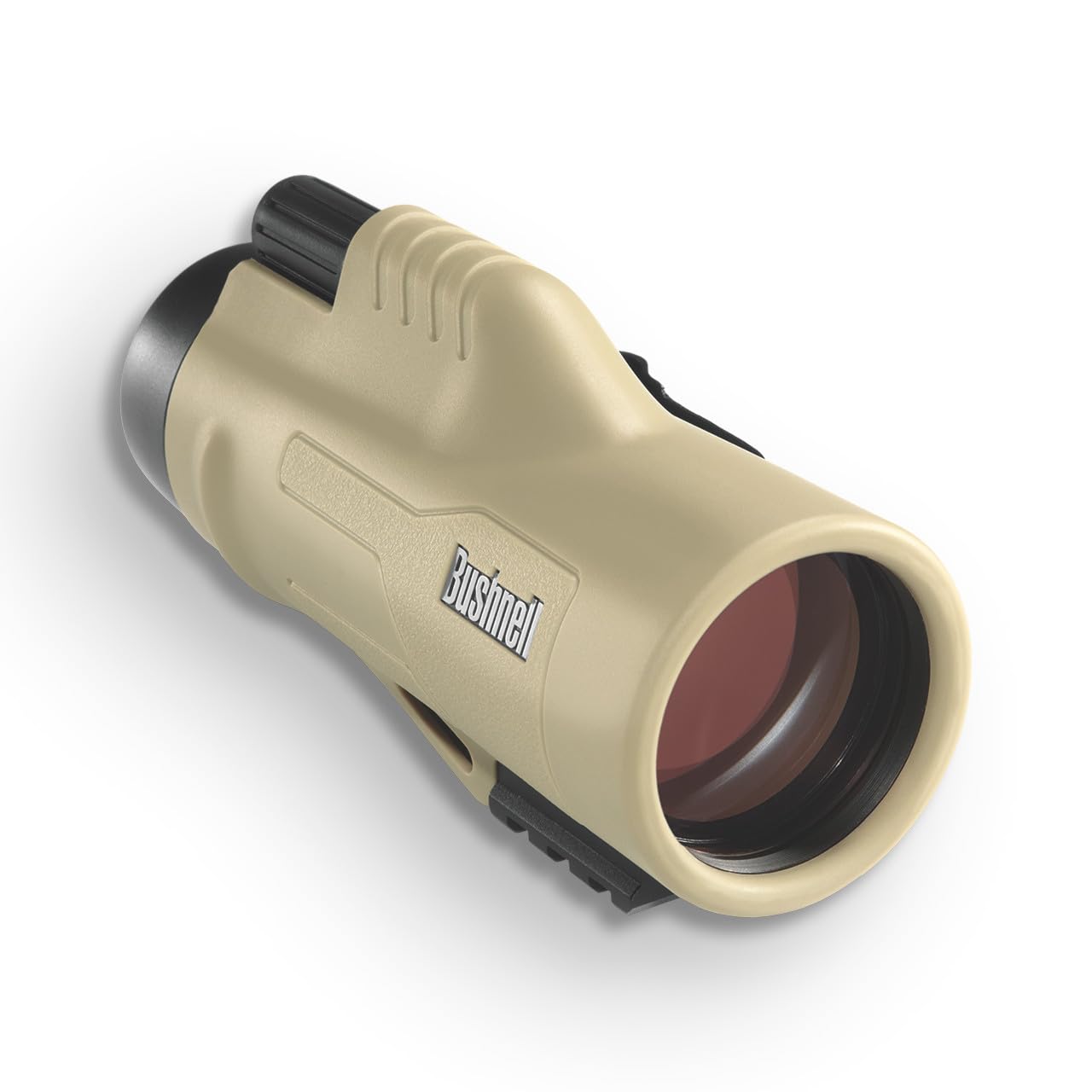
ED Prime glass and a 42mm objective give the Legend a bright, color-accurate image for reading targets at distance. For shooters and hunters who want range estimation without an electronic rangefinder, the mil-hash reticle is a useful reference. The Solo R/T remains the more accessible tactical pick in this roundup, while this model is a more specialized tool. Choose the Legend when the reticle is part of the plan; for clean observation, a plain monocular is a better match.

Pros

  • ED Prime glass delivers a bright, color-accurate image for target identification.
  • The image stays crisp and clear, helping with target detail at distance.

Cons

  • Premium price narrows the audience; casual users can get a clean-view monocular for less.
  • The mil-hash reticle can look busy in low light and may obscure game for anyone not using the ranging function.
Our verdict

This is the premium 10x42 option for shooters who will actually use the mil-hash reticle as part of their sight picture.

Check Latest Price
9

Digiscoping, Landscapes

Pankoo 12x60 HD

88 /100
Studio Score Strong Evidence

Key details

Magnification
12x
Objective Lens
60mm
Weatherproofing
Focus & Handling
Manual center focus
Check Price on Amazon

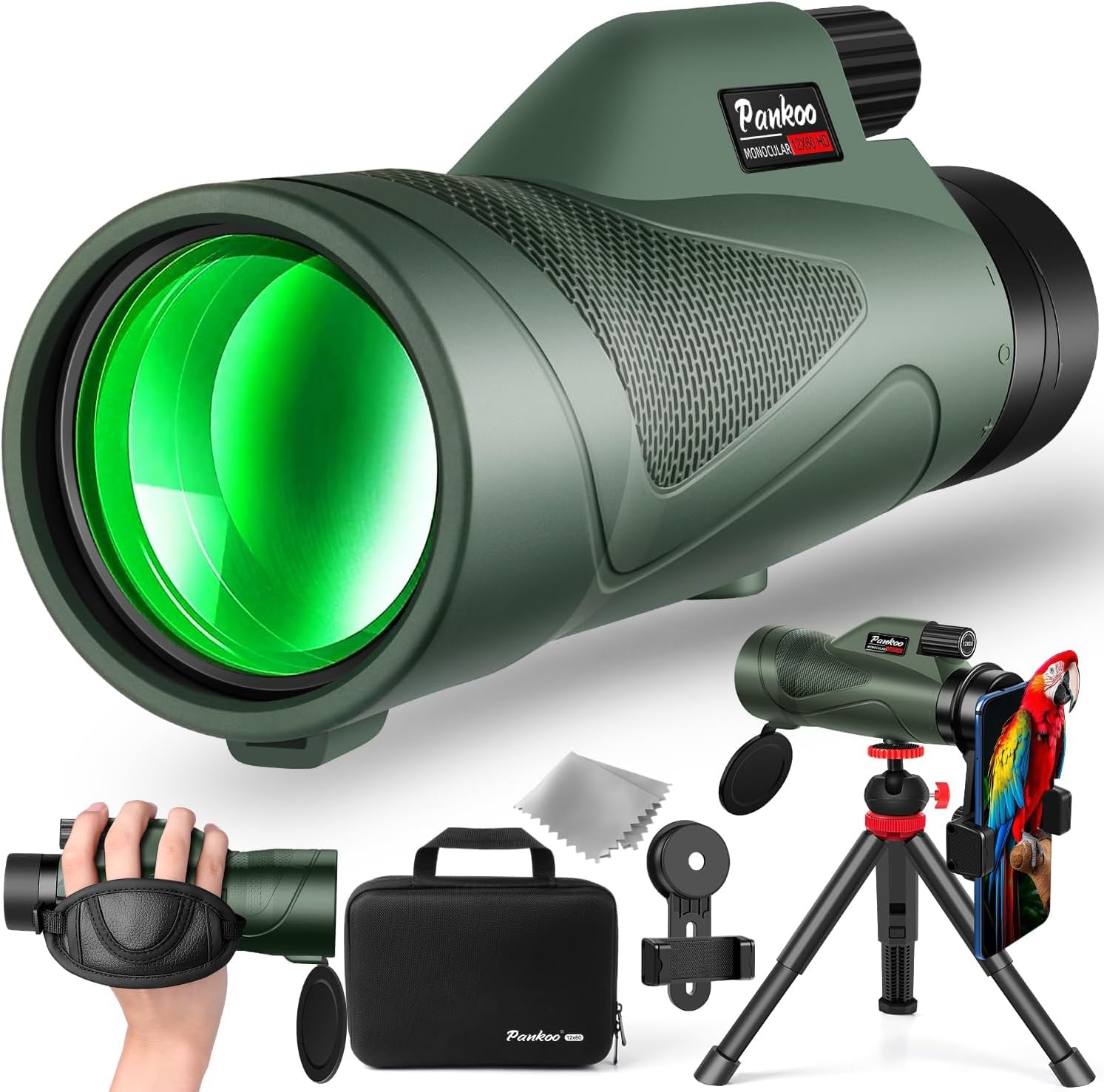
A complete smartphone digiscoping kit, the Pankoo 12x60 HD pairs a BAK-4 prism and fully multi-coated optics with a phone holder and tabletop tripod in the box. Build quality is good, distant views are clear, and the single eyepiece is easier to handle than binoculars. The 60mm objective is bulky and 12x benefits from a steady rest or tripod, so this suits day-bag travelers more than pocket-only users — that size keeps low-light views bright. The 12x reach suits landscapes and slow-moving wildlife rather than fast fliers across a wide field. It stops short of the top picks: the 16x52 Pankoo delivers high magnification for less money, and smaller monoculars handle the lightweight niche more easily.

Pros

  • Complete digiscoping kit — phone holder and tripod included
  • Distant wildlife and landscape details come through in a clear, bright 60mm view.
  • Priced fairly for a high-power monocular with the accessory kit.

Cons

  • For pocket-only carry, the 60mm objective is too large
  • Handheld viewing at 12x can show noticeable shake; the included tripod or a firm rest keeps detail sharp.
Our verdict

The right scenario is a day-bag trip where long-range landscape viewing and phone digiscoping both matter.

Check Latest Price

How to Choose

Magnification Range

An 8x to 10x monocular keeps the image steady enough for handheld use. Because the optic multiplies angular movement, a slight hand wobble at 8x becomes a large jump at 16x. At 12x, shake is noticeable; at 16x, plan on bracing or mounting.

Higher magnification also narrows the field of view, making fast-moving subjects harder to find. For most outdoor observation, 8x or 10x is the practical sweet spot.

Objective Lens Size

The objective lens determines how much light enters the tube, and the useful measure is exit pupil: objective diameter divided by magnification. A 10x25 gives a 2.5mm exit pupil; an 8x32 gives 4mm. Your eye's pupil can dilate to 5-7mm in low light, so the smaller optic delivers a dimmer image.

This matters at dusk, under forest canopy, or in cloudy conditions. A 42mm objective makes the tube bulkier but noticeably improves low-light brightness compared with a 25mm lens.

Prism and Coatings

BAK-4 prism glass has a higher refractive index than BK-7, which means a rounder, brighter exit pupil and less light loss at the edges. Multi-coatings reduce reflections at each glass-air surface; fully multi-coated means every surface is coated, which improves contrast and color.

At budget prices, BAK-4 and fully multi-coated lenses are the specs that separate a genuine optic from a decorative tube. They do not fix a small objective or a poor focus mechanism, so treat them as necessary but not sufficient.

Weatherproofing

Waterproofing comes from O-ring seals and nitrogen purging, not from the metal body. The nitrogen fill pushes moist air out so internal lenses do not fog when you move between cold and warm air.

For occasional splashes, IPX4 is enough. For steady rain, stream crossings, or salt spray, look for IPX7 or a nitrogen-purged body rated as waterproof and fogproof.

Focus Mechanism

A monocular needs frequent adjustment because object distances change constantly outdoors. A stiff focus ring forces two-handed operation and slows you down at the moment you need the view most.

Look for a smooth, damped focus wheel that turns with one finger, and check the eyecup. A multi-stop twist-up eyecup preserves eye relief for eyeglass wearers, which is part of the same handling equation.

Frequently Asked Questions