5 Best Nikon Binoculars of 2026: Match Your Viewing Style

Find the right Nikon binoculars for birding, hiking, and travel by matching field of view, eye relief, and low-light performance to how you actually watch.

Nikon's binocular lineup splits between affordable daylight models and premium ED-glass models. The premium glass earns its keep at dawn and dusk, when it reduces color fringing and keeps contrast high. In normal daytime birding, the cheaper 42mm models get closer to the premium image than the price gap suggests.

The other decision is 8x versus 10x. An 8x view is easier to hold steady and usually wider; 10x reaches further but amplifies hand shake. Eyeglass wearers also need to check eye relief, because short eye relief can turn a promising view into a black edge.

Match the binocular to the conditions you actually face. First-time birders get the most from a wide, steady 8x42; dawn/dusk watchers gain from ED glass; long-range viewers need 10x reach; travelers should trade aperture for pocketability. The right choice is about the light and distance around you, not the price badge.

1

Best Overall

Nikon Prostaff P3 8x42

92 /100
Studio Score High Confidence

Key details

Eye Relief
20.2mm
Field Of View
377 ft @ 1000 yds
Magnification
8x
Objective Lens
42mm
Check Price on Amazon

The Prostaff P3 8x42 delivers the widest 8x42 field of view in Nikon's general-purpose lineup: 377 feet at 1,000 yards, paired with 20.2mm of eye relief. The 377-foot width is not just a number; it translates to an obvious improvement when you are watching a flock move across a treeline. That spec mix does more for everyday use than a coating badge because it determines how easily you find and stay on a subject. Eyeglass wearers can see the full image without pressing hard into the cups, and a moving bird stays in frame longer between repositions. The roof-prism body uses multilayer and silver-alloy coatings, which support a clean, bright daytime view at a mid-range price below the Monarch line.

Focus and weight make the P3 a practical carry for a full day outdoors. The center focus wheel turns smoothly enough to track a bird moving through branches, and the body stays light enough that neck fatigue is not the reason you cut a hike short. On a full-day hike, the P3 carries lighter than its 42mm class suggests. The wide field also cuts the need to pan when scanning open water or a hillside, so you spend more time watching and less time hunting for the subject. For a 42mm full-size binocular, that practical mix of reach and comfort is what makes it a travel companion as well as a birding tool.

This is a daylight generalist with a clear boundary. It does not use ED glass, so serious low-light specialists who want the extra contrast and color-fringing control of the Monarch M5 should set their budget above this model. First-time birdwatchers, hikers, and budget-conscious full-size buyers, by contrast, get the field width, eye relief, and sealed waterproof build that carry standard daylight outings. If your primary use is backyard birding, trail hiking, or travel sightseeing, the P3 covers those well.

The 8x magnification also keeps images steadier in hand than a 10x model, which makes this an easier first full-size binocular for newcomers. The steadiness helps during travel too, when you are viewing from an overlook or after a long walk. It is not a pocket optic; the 42mm objective is the reason for the bigger view, and the tradeoff is a bulkier carry than a compact 8x25. That positioning is exactly where a general-purpose Nikon should sit: wide enough for birding, light enough for hiking, and priced to stay out of the premium tier.

Pros

  • Sharp, clean daylight views with dependable color and contrast for bird and wildlife watching.
  • Sits below the Monarch line in price while keeping a wide 42mm view and waterproof build.
  • Smooth focusing makes it easy to follow birds through branches and moving targets.
  • Light enough for a full-size 42mm to carry all day on hikes and travel walks.

Cons

  • Objective lens caps can feel flimsy or loosen during active hikes; aftermarket replacements are inexpensive.
Our verdict

The P3 8x42 is the natural entry point into Nikon's full-size binocular lineup for anyone who wants one wide-field pair for birding, hiking, and travel.
Check Latest Price
2

Premium 8X42 Upgrade

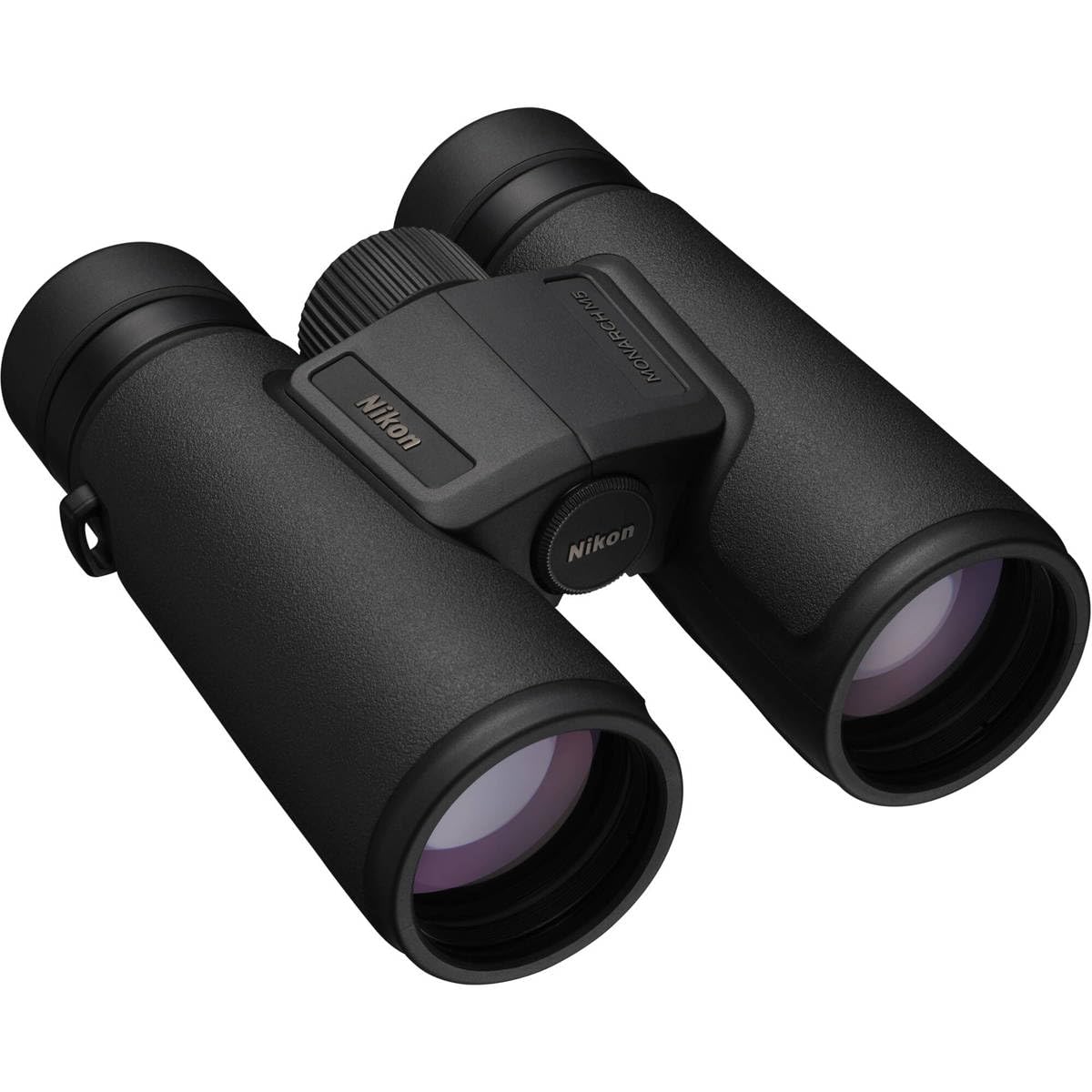
Nikon Monarch M5 8x42

91 /100
Studio Score High Confidence

Key details

Eye Relief
19.5mm
Field Of View
335 ft @ 1000 yds
Magnification
8x
Objective Lens
42mm
Check Price on Amazon

The Monarch M5 8x42 is the strongest low-light 8x42 in Nikon's lineup, pairing ED glass with dielectric prism coatings for deep contrast and accurate color at dawn and dusk. It sits above the Prostaff P3 as the optical upgrade for birders who want more than a bright, wide entry-level image, with coatings that keep color fringing in check when branches cross the light.

The 19.5mm eye relief gives eyeglass wearers a full view, while the 8x magnification holds steady during handheld hikes. The image stays bright in low light, and the 42mm objective gathers enough light that foreground shadows do not obscure feather detail. This is the model to choose when first and last light are part of the day.

This is the right 8x42 for birders and wildlife viewers who work early and late in the day and want true-to-life colors when light is thin. It costs noticeably more than the top-pick Prostaff P3, so the premium only makes sense if twilight performance matters more than the P3's wider view. Budget-first buyers and anyone set on 10x reach should consider the wider-field P3 or a 10x Monarch instead.

Pros

  • ED glass and dielectric prisms deliver accurate color in dim conditions.
  • The wide, bright image keeps detail visible across the view.
  • Build quality feels substantial for a premium-priced binocular.
  • Low-light brightness holds up well for pre-dawn and dusk viewing.

Cons

  • Objective lens covers can slip off when the binocular is packed tightly.
  • Field of view is narrower than the Prostaff P3's, so tracking birds takes more re-centering.
Our verdict

Twilight birders get the low-light performance they pay for; daytime generalists can save money with the Prostaff P3.

Check Latest Price
3

Long-Range 10X Specialist

Nikon Monarch M7 10x42

89 /100
Studio Score Strong Evidence

Key details

Eye Relief
16.5mm
Field Of View
362 ft @ 1000 yds
Magnification
10x
Objective Lens
42mm
Check Price on Amazon

The Monarch M7 10x42 combines ED glass, dielectric prism coatings, and a 362-foot field at 1,000 yards. Compared with the entry-level 10x42 in this lineup, it adds noticeably more field width and a cleaner high-power image.

The wide field changes how the binocular handles open-country viewing. Scanning ridgelines and tracking wildlife feels less restricted than on a typical 10x42, and the bright image keeps working as daylight fades. This is a dedicated long-range tool, not a compact travel companion.

This Nikon suits long-range wildlife viewers, hunters, and scenic landscape observers who already work at 10x. New users will feel the 10x image shake, and eyeglass wearers with limited eye-relief tolerance should check the 16.5mm eye relief before buying. If the plan is one general-purpose pair for birding, hiking, and travel, the 8x42 models below it cover more ground with less effort.

Pros

  • ED glass and dielectric prism coatings hold image clarity from center to edge.
  • A 362-foot field gives one of the widest high-power views in the Nikon lineup.
  • Build quality and durable handling make it suited to regular field work.
  • Value aligns with optical performance, especially for committed 10x users.

Cons

No notable drawbacks to flag.

Our verdict

For experienced 10x users who spend more time scanning ridgelines than walking trail loops, the Monarch M7 10x42 is the high-power model to choose in this Nikon lineup.

Check Latest Price
4

Best Value 10X

Nikon Prostaff P7 10x42

91 /100
Studio Score High Confidence

Key details

Eye Relief
15.7mm
Field Of View
367 ft @ 1000 yds
Magnification
10x
Objective Lens
42mm
Check Price on Amazon

The Prostaff P7 10x42 delivers true 10x reach at a mid-range price, with dielectric prisms and a locking diopter. It sits between the value-focused 8x top pick and the pricier 10x Monarch: more magnification for daylight travel and wildlife, less money for the long-range specialist. The 367-foot field stays wide enough for scanning fields and forest edges without feeling like a porthole.

This is the right fit for budget-minded 10x buyers who want 42mm light gathering without paying the Monarch premium. No ED glass is present, so low-light color fidelity is a step below the Monarch M5 and M7; dawn and dusk birders should weigh that before choosing. Eyeglass wearers should also verify the 15.7mm eye relief against their frames before committing. For those buying their first 10x42, the price makes it easier to test the format without committing to the Monarch line.

The dielectric prism coating keeps the image bright in ordinary daylight, and phase-corrected prisms hold edge detail. At this price, the P7 reads like a Monarch alternative rather than a bare entry-level Prostaff, without demanding the Monarch premium.

Pros

  • Solid build and clean image quality support everyday outdoor use.
  • Dielectric prisms plus phase correction keep the 42mm view bright.
  • Locking diopter holds right-eye focus during packing and shared use.
  • Mid-range price buys 10x reach with full-size light gathering.

Cons

  • The 367-foot field is narrower than the 8x top pick, so scanning wide terrain takes more movement.
  • A 10x view amplifies hand movement; new 10x users will need a steady stance.
Our verdict

This is the budget-friendly way to get Nikon 10x42 reach with dielectric prisms; step up to the Monarch M7 only if dawn and dusk color fidelity matters.

Check Latest Price
5

Ultra-Portable Travel Pick

Nikon Travelite 8x25

89 /100
Studio Score Strong Evidence

Key details

Eye Relief
11.1mm
Field Of View
Magnification
8x
Objective Lens
25mm
Check Price on Amazon

The Travelite 8x25 is the only true pocketable 8x25 in this Nikon set, and its Porro-prism view stays sharp in daylight. Unlike the full-size top pick, it slides into a jacket pocket or daypack without adding noticeable weight. The waterproof build also means an unexpected shower during a walk is not a reason to leave it at home.

This is a travel and event optic, not a primary birding tool. The 25mm objective is noticeably dimmer at dawn/dusk and the field is smaller than full-size 42mm models, so serious birding or wildlife observation at those hours belongs to the larger Nikons in this set. For commuters, concertgoers, and casual hikers who want a Nikon they will actually carry, the compact size is the point.

Budget-minded Nikon shoppers get a real Porro-prism optic in a package that trades bulk for portability without sacrificing daylight sharpness. Along with the waterproof housing, that makes the Travelite a low-fuss companion for daytime travel, stadium seats, and trailhead hikes. It is the model to keep in a commuter bag when the 42mm top pick stays at home.

Pros

  • Sharp daylight image for a compact binocular.
  • Light enough to feel like an afterthought in a daypack.
  • Pocket-size footprint fits travel bags without awkward bulk.
  • Budget-friendly price point for a Nikon compact.

Cons

  • The 11.1mm eye relief may crop the view for eyeglass wearers.
  • The small exit pupil requires steady eye placement, especially in shadow.
Our verdict

The Travelite is the Nikon to grab when a 42mm binocular would stay in the drawer. Travelers and event-goers get a clear daylight view without the bulk.

Check Latest Price

How to Choose

Objective Lens Size

A 42mm objective collects more light than a 25mm objective, and the difference shows as soon as shadows lengthen. The larger exit pupil keeps the image bright and comfortable in low light because it matches your eye's dilated pupil more easily.

A 25mm compact is fine for daytime events, but at dawn or dusk the view dims and your eye must align itself with a much smaller exit pupil. If you will ever bird in the morning or evening, choose a 42mm model.

Magnification

8x keeps the view steadier because small hand movements are magnified less; 10x reaches roughly 25 percent closer but turns every pulse into visible movement. Most first-time buyers underestimate how much arm fatigue and hand shake affect a 10x image by the end of a hike.

If you mostly watch birds in trees or near trails, choose 8x. If you scan open fields or shorelines, 10x is worth the extra bracing.

Prism and Lens Coatings

Roof prisms need phase correction to keep contrast sharp; without it, fine detail softens. Dielectric mirror coatings boost reflectivity, while ED glass reduces color fringing at high-contrast edges.

The catch is that these coating upgrades mostly matter in low light and against bright backdrops. In broad daylight, a well-made non-ED Prostaff can look very close to a Monarch, so paying for ED glass is really buying dawn and dusk performance.

Eye Relief

Eye relief is the distance from the eyepiece to where your eye sees the full image. If it is too short for glasses wearers, the view clips into a black ring.

Around 20mm is consistently comfortable for most eyeglass wearers; 16mm or shorter gets finicky. Since Nikon's 10x models tend to have shorter eye relief than their 8x equivalents, glasses wearers should verify fit before paying for extra reach.

Field of View

Field width determines how easily you can find and track a moving bird. A wider field feels more forgiving, especially when you raise the binoculars quickly or follow subjects through branches.

The trade-off is that the very widest field in this lineup belongs to the value-priced 8x42, not the premium ED-glass 8x42. Buyers who assume paying more buys a wider view may be surprised.

Frequently Asked Questions