5 Best Binoculars for Astronomy in 2026: Aperture That Pays

Match binoculars to your stargazing style with the right aperture, mounting, and optical build — without overspending or fighting double vision.

Astronomy binocular listings lean hard on magnification, but magnification alone does not make a night-sky tool. A 25x zoom number sounds impressive until the hand shake and narrow field make finding a target harder than seeing it.

Useful astronomy binoculars balance aperture, exit pupil, field of view, and mounting reality. Bigger objectives collect more light, but they also demand a stable platform and add weight that changes how you observe.

This guide sorts those trade-offs by use case: handheld scanning around 50mm, tripod deep-sky work at 70mm, and high-power Moon and planet viewing at 80mm and up. Pairing the right aperture to your observing style matters more than any single spec line.

1

Best Overall

Celestron SkyMaster 15x70

89 /100
Studio Score Strong Evidence

Key details

Mount
Tripod adapter included
Prism
BaK-4
Objective
70mm
Field Of View
~4.4°
Check Price on Amazon

Seventy millimeters of objective is what separates this binocular from a daytime field glass. The added light grasp makes star clusters, nebulae, and the Moon visibly brighter and more detailed than through 50mm alternatives, while the BaK-4 prisms keep the image clean across the field. At a budget price, this is a direct upgrade path for a stargazer who wants to chase faint objects without buying a telescope.

The included tripod adapter is a real part of the package, not an afterthought. It threads into the center post and locks onto a standard photo head, so mounting the binocular is a few minutes' work. Once the setup is stable, the 15x magnification gives a fixed, satisfying view: lunar craters come into focus, double stars separate cleanly, and the field stays steady enough for a long observing session. This is a binocular that rewards a deliberate setup rather than a quick glance.

The right buyer is a budget deep-sky observer who treats a tripod as part of the equipment list. Weight and 15x magnification make a solid tripod nearly mandatory; hand-held viewing gets shaky quickly. If the plan is grab-and-go scanning or a hiking pack, a smaller 10x50 pair is the better match. For observers who set up under a dark sky and work through a list of clusters and nebulae, the aperture is worth the extra effort.

Twilight and Moon viewing are strong zones for this glass. The 70mm objectives hold brightness well in fading light, and the moderate power keeps lunar observing calm enough to watch terminator shadows move. Earthshine on the Moon shows up readily. Under darker skies, the same aperture reveals star colors in dense regions and brings out the glow of emission nebulae.

Compared with the slimmer 10x50 options in this set, the SkyMaster trades hand-held convenience for a noticeably deeper view into the night sky. That trade-off is easy to accept when the binocular is mounted and the session is planned around specific targets. What remains is a 70mm deep-sky tool that asks for a stable platform and returns views far beyond what its price suggests.

💡 Practice focusing on a bright star before dark; the focus collar settles once you get a feel for its travel.

Pros

  • 70mm aperture and BaK-4 prisms reveal faint clusters and nebulae that escape smaller binoculars.
  • Included tripod adapter mounts quickly on a standard photo head, so setup takes minutes.
  • Twilight and Moon views are bright and detailed, a strong combination for evening sessions.
  • Budget-friendly build makes this a low-risk entry into serious deep-sky observing.

Cons

  • Focus collar can be stiff, and crisp focus takes a bit of practice.
  • A solid tripod must be supplied; the included adapter mounts the binocular but does not stabilize it.
Our verdict

For observers willing to mount it, the SkyMaster 15x70 is the value benchmark in 70mm astronomy binoculars. A steady tripod turns it into a deep-sky instrument that outperforms anything near its price.

Check Latest Price
2

Best for Beginners / Handheld Use

Celestron Cometron 7x50

91 /100
Studio Score High Confidence

Key details

Mount
Tripod-adaptable
Prism
Objective
50mm
Field Of View
~6.8°
Check Price on Amazon

The Cometron 7x50 covers a 6.8° swath of sky with the relaxed exit pupil and handheld stability that a first-time stargazer needs. Where the tripod-bound 15x70 in this lineup trades portability for light grasp, this 7x50 stays in your hands for quick scans of constellations and Milky Way star clouds.

Views of the Moon and bright clusters come through with strong contrast for a budget 7x50. The 7.1mm exit pupil matches a dark-adapted eye, the view sweeps through dense star fields, and the 7x magnification keeps the image calm enough that a tripod is optional for short sessions.

Handheld use is genuinely comfortable at first. The body is light enough for a quick scan across the constellation pattern, and the view holds steady as you pan. If a session stretches, arm fatigue can build, so plan for breaks.

This is the grab-and-go beginner optic for budget buyers and eyeglass wearers who want one binocular for daytime and night-sky use. It lacks the aperture for faint deep-sky objects, so its natural territory is the Moon, bright clusters, and Milky Way sweeping rather than galaxy hunting. For that specific starter role, it hits the balance between aperture and portability better than the heavier tripod models in this comparison.

💡 A tripod adapter will keep the view steady when you stay out longer than a quick scan.

Pros

  • Wide 6.8° field keeps constellations and Milky Way clouds in view while panning.
  • Clear, bright views of the Moon and bright clusters for a budget 7x50.
  • Very easy to use for first-time stargazers, including those who wear eyeglasses.
  • Light enough for short handheld sessions without requiring a mount.

Cons

  • Lunar and planetary detail stays modest compared with higher-power models in this lineup.
  • The splash-resistant body is not fully sealed, so humid summer nights can fog the internal optics.
Our verdict

For a first astronomy binocular, the Cometron fills the grab-and-go role without demanding a mount. Keep expectations on wide-field scanning, and it works as an easy starter optic.

Check Latest Price
3

Best Complete Digiscoping Kit

Sogries 18x70

84 /100
Studio Score Strong Evidence

Key details

Mount
Tripod-ready
Prism
BaK-4 roof
Objective
70mm
Field Of View
Check Price on Amazon

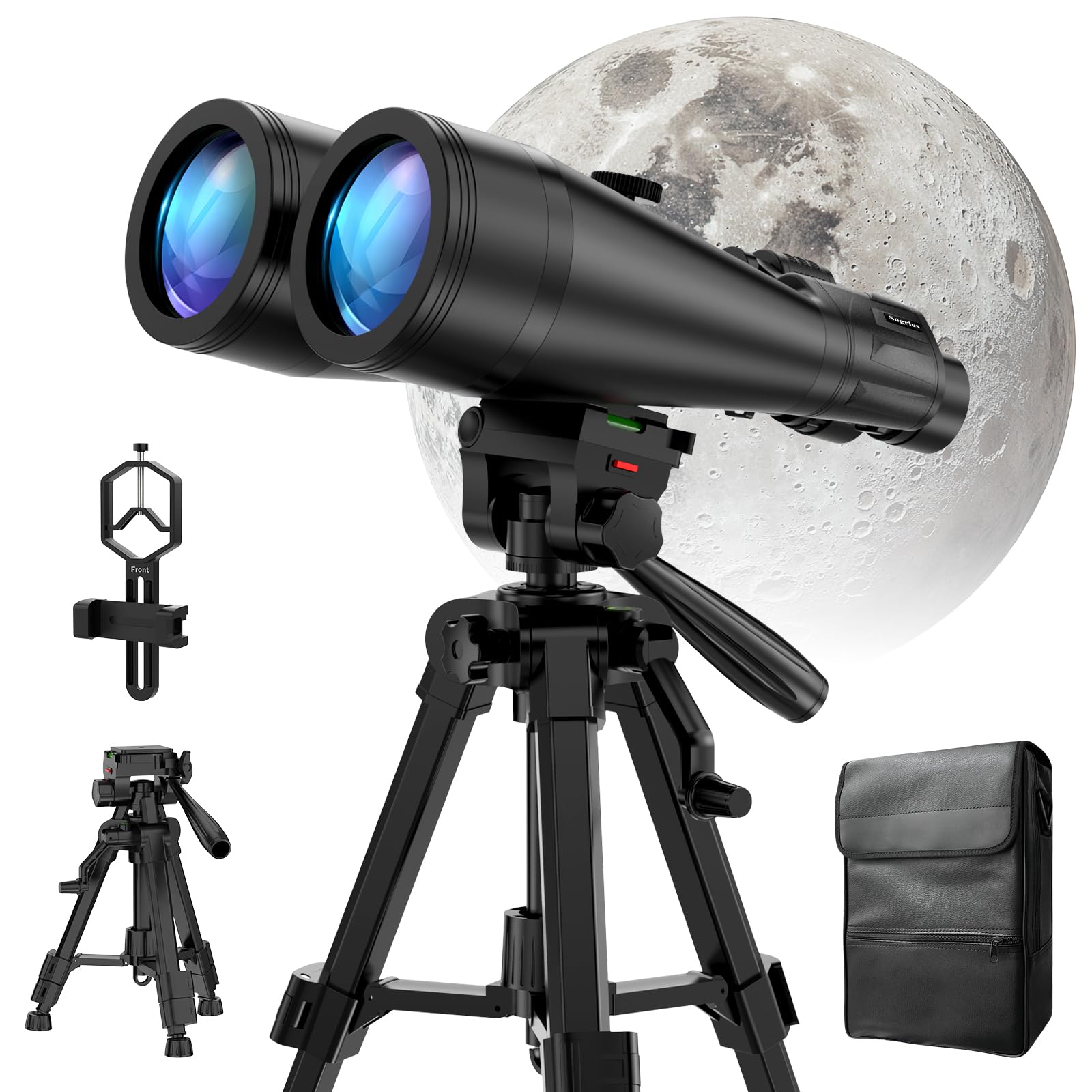
The Sogries 18x70 pairs 70mm aperture with a phone adapter that aligns cleanly, so capturing Moon shots and daytime detail is part of the same package. It is a more complete kit than the top pick for someone who wants to record what they see rather than just observe. The BaK-4 roof prisms and IPX7 sealing round out a package aimed squarely at first-time astronomy binocular owners. It is not competing on raw aperture; instead it targets the buyer who wants the view and the photo from the same session.

Best for a first 70mm astronomy binocular buyer who plans to observe from a tripod and wants one instrument that also covers daytime nature viewing. If you will not use a tripod, this is the wrong tool for the job.

The body is heavy and bulky, which is the tradeoff for 70mm aperture and a phone adapter. Mounted on a sturdy tripod, that weight becomes stability, and the view holds steady for long looks at the Moon and brighter deep-sky objects. Image quality remains sharp where budget 70mm binoculars can get soft, and the build feels substantial for the price. The included accessories cover the main uses without an immediate upgrade list.

Pros

  • Sharp, high-contrast views of the Moon and brighter deep-sky objects, with usable clarity through the phone adapter.
  • Solid build quality and durable feel that suits tripod-based stargazing and repeated dark-site trips.
  • Included smartphone adapter lines up cleanly, making phone astrophotography and daytime digiscoping practical.
  • Cost-effective complete kit with BaK-4 prisms, IPX7 waterproofing, and no immediate accessory upgrades required.

Cons

No notable drawbacks to flag.

Our verdict

Choose this kit when you want a tripod-mounted 70mm binocular that records Moon shots on your phone as well as it shows them.

Check Latest Price
4

Best Budget 80Mm Aperture

Sogries 20x80

81 /100
Studio Score Strong Evidence

Key details

Mount
Tripod-ready
Prism
BaK-4
Objective
80mm
Field Of View
Check Price on Amazon

The Sogries 20x80 delivers serious 80mm light grasp at a mid-range price, and the BaK-4 prisms hold up well when you push the magnification on the Moon and bright planets. That puts it ahead of the standard 70mm astronomy binoculars in this roundup for buyers who care more about target detail than wide-field sweeping, though the 70mm model's wider field makes it the easier all-rounder.

Centered views show distinct lunar craters and Jupiter's moons, and the extra 80mm aperture keeps those targets bright without pushing into premium-priced territory. The image is at its best on axis, which is where lunar and planetary observing happens. Focus adjustments are firm enough that small tweaks stay controlled.

This is for budget large-aperture buyers who already own a sturdy tripod and want a fixed-power lunar/planetary viewer. At 20x, hand-held use is too shaky to be worthwhile; a tripod is part of the intended setup. For its intended role, it is a focused tool rather than a general-purpose binocular.

The build makes a sturdy first impression: the body feels dense, the focus mechanism is firm, and the packaging suggests a more expensive instrument.

Pros

  • Bright Moon and planet views at 20x80 with 80mm light grasp.
  • Good optical quality for the price, especially on centered targets.
  • High-quality packaging and sturdy first impression.

Cons

  • The bundled tripod is undersized; a full-size tripod is required for steady 20x views.
Our verdict

Buyers with a full-size tripod already in place get the most 80mm aperture their money can buy in this group.

Check Latest Price
5

Zoom Flexibility

HIOPIACO 30-260x80

78 /100
Studio Score Established

Key details

Mount
Tripod included
Prism
BaK-4
Objective
80mm
Field Of View
Check Price on Amazon

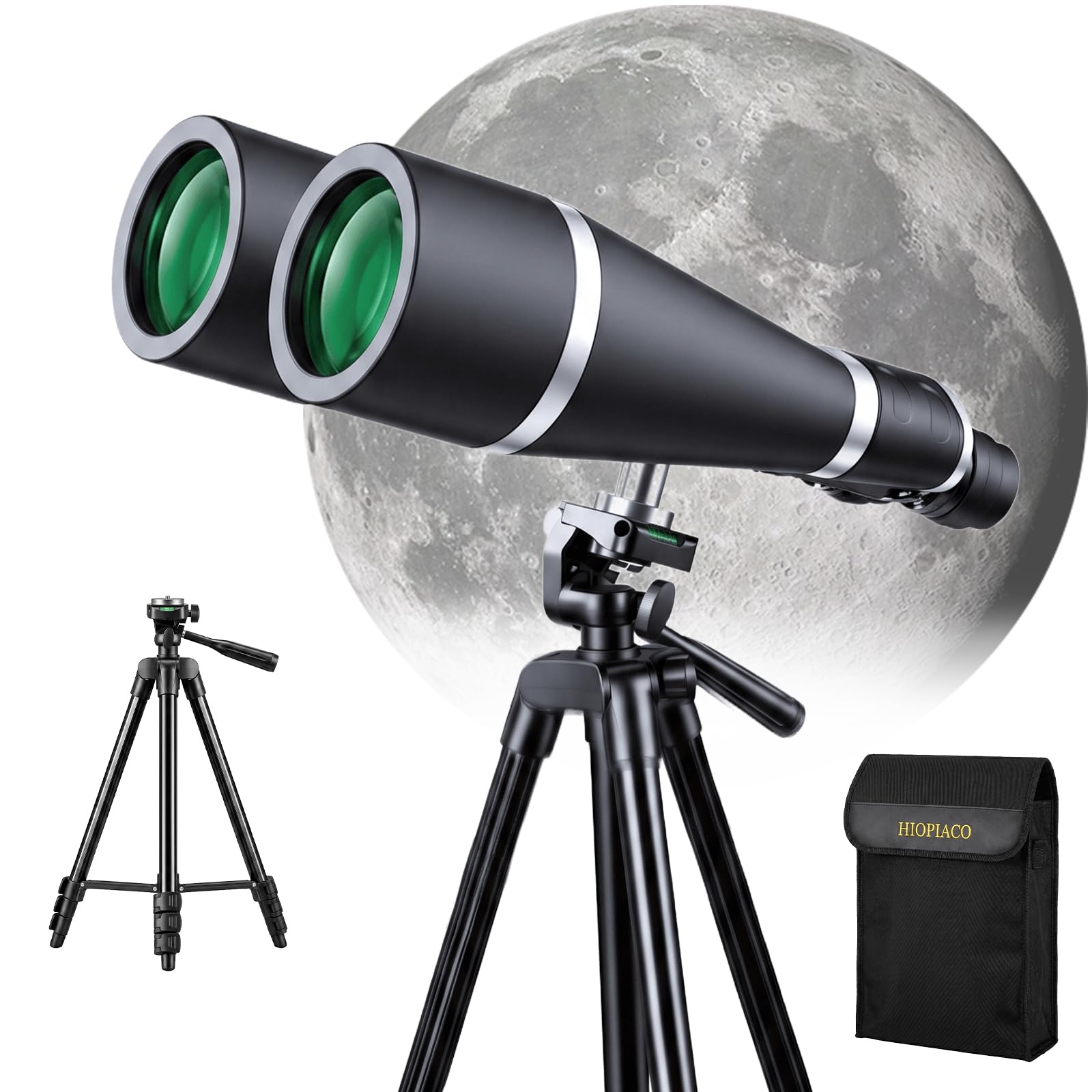
The 30-260x zoom range and included tripod kit give curious buyers maximum magnification on paper. On land, the zoom flexibility lets a single binocular sweep across harbors, skylines, and ridgelines from one viewpoint. For astronomy, the practical case is narrower: the advertised zoom range exceeds practical optical limits, with usable sharpness dropping off at high magnification and the included tripod too light for stable views. Night-sky observers who need steady high-power views will get more from a fixed-power 70mm or 80mm model.

Pros

  • Long zoom range covers far-off daytime targets without swapping optics.
  • Kit includes a tripod, keeping first-time buyers ready to mount it immediately.

Cons

  • The bundled tripod is light for the binocular's weight, so wobble can interrupt sustained viewing.
  • At high magnification, the image can soften and double, narrowing usable zoom.
Our verdict

Fits the curious zoom buyer who prioritizes daytime long-range observation and will pair it with a sturdier tripod.

Check Latest Price

How to Choose

Objective Lens Size

Objective diameter controls light collection. A 50mm objective gathers about 84% more light than a 35mm compact, which is the difference between seeing the Milky Way band and catching only a handful of bright stars.

Bigger objectives also make the binocular heavier and force a tripod. A 70mm is the practical deep-sky starting point for most buyers; 80mm and 100mm models add serious light grasp but require a sturdy mount and deliberate session planning.

Magnification

Magnification trades field of view and stability for image scale. At 7x, a wide 6.8° field lets you scan constellations easily; at 25x, the field narrows drastically and every hand tremor becomes obvious.

Above 15x, a tripod is no longer optional. The same 70mm binocular that feels immersive at 12x becomes difficult to aim at 20x, which is why the best high-power astronomy binoculars are almost always mounted.

Exit Pupil

Exit pupil is the objective size divided by magnification. A 7x50 gives a 7.1mm exit pupil, which matches a young observer's dilated pupil in dark skies and produces a bright, easy-to-align view.

A 15x70 produces a 4.7mm exit pupil, which still works well but is less forgiving if your eye is not perfectly centered. High-magnification models above 20x drop to 3-4mm, so you trade night-sky brightness for lunar and planetary detail.

Tripod Mounting

A tripod removes hand shake and lets you sustain a steady view for minutes instead of seconds. Many 70mm and larger models include a center bracket, but the bracket threads matter: standard 1/4-20 works with most photo tripods, while 3/8-16 needs an adapter.

The hidden trade-off is that a binocular on a tripod becomes a fixed telescope: you lose the ease of sweeping the sky. A parallelogram mount restores smooth movement but adds cost and setup time, so weigh how mobile you want your observing kit to be.

Prism Glass and Coatings

BaK-4 prisms and multi-coated air-to-glass surfaces improve light transmission and edge sharpness compared to basic BK-7 prisms. The difference shows up mainly in faint deep-sky objects and low-contrast detail.

Fully multi-coated optics reduce reflections that wash out dim targets. For astronomy, choose BaK-4 and fully multi-coated wording when the price difference is modest; coatings matter more than prism type in most modern designs.

Frequently Asked Questions