6 Best Lens for Sony ZV-E10 of 2026: Wide, Fast, Budget-Friendly

Find the best lens for Sony ZV-E10 that matches your shooting style: wide primes for vlogs, fast apertures for low light, OSS for handheld shots.

The ZV-E10 is a video-first camera with one practical catch: the body has no in-body stabilization, and the kit zoom's variable aperture struggles once the lights drop. Most new owners quickly discover that the lens choice matters more than any camera setting.

Third-party APS-C primes have closed the gap with first-party glass, delivering fast apertures, compact bodies, and quiet autofocus at a fraction of the cost. The real trade-off is between wide fields of view for selfie-style vlogs and longer focal lengths for portraits or reach. Wide lenses keep the ZV-E10 useful in tight spaces; longer lenses force a tripod or Active SteadyShot cropping.

Pick the field of view first, then let aperture and stabilization settle the rest. A wide fast prime fits the camera's handheld vlogging strength; a stabilized zoom fits a more traditional stills-and-video routine.

1

Best Overall for ZV-E10
Viltrox 15mm F1.7 E

90 /100
Studio Score High Confidence

Key details

Autofocus
STM, eye/face AF
Focal Length
15mm / 22.5mm eq
Max Aperture
f/1.7
Sensor Coverage
APS-C
Check Price on Amazon

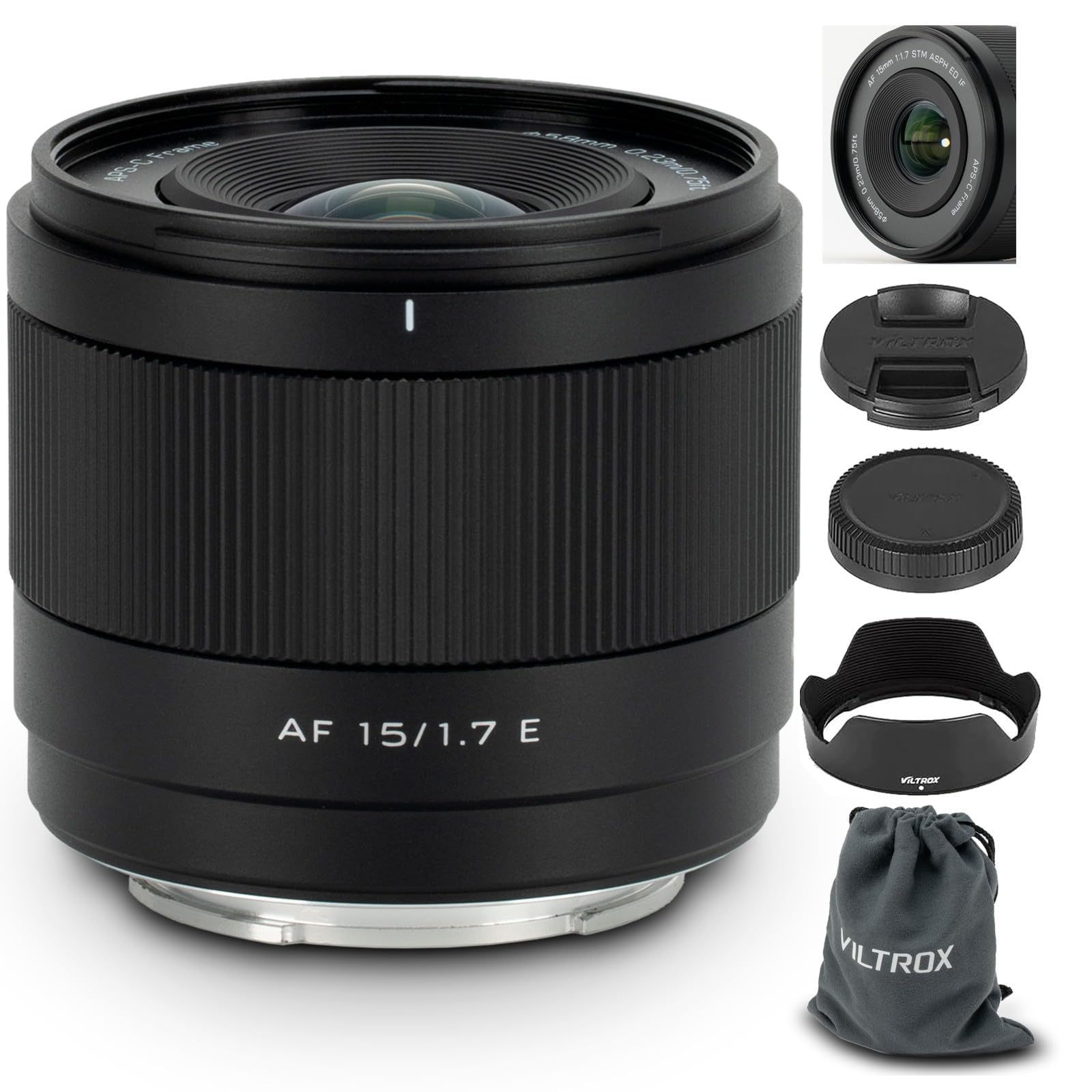
The 15mm F1.7 pairs a 22.5mm-equivalent field of view with F1.7 light-gathering in a 180g body. Mixed-light interiors and evening street scenes stay usable without pushing ISO to uncomfortable levels, and the 84.9-degree angle captures a selfie-friendly frame with room for context. The STM motor drives face/eye AF quietly during video, so focus adjustments stay out of the recorded audio track. On the ZV-E10, face tracking stays engaged as the subject moves across the frame, which makes solo shooting more forgiving.

On the ZV-E10, the lens behaves as a wide-normal rather than an extreme ultra-wide. It frames a seated interview with surrounding context, an interior establishing shot with enough depth, and a handheld vlog without exaggerated wide-angle perspective. The 180g weight keeps the front of the camera light on a gimbal and reduces fatigue during longer run-and-gun sessions. When you need a wider establishing view, there is room to step back and still keep the scene in frame.

Content creators and vloggers shooting in mixed light get clear value here: one compact prime covers travel, interiors, and selfie-style video without switching lenses. Smooth handheld footage is a setup question, with Active SteadyShot or a gimbal as the expected tool. The 22.5mm-equivalent focal length keeps the camera friendly for solo framing while still behaving like a true wide angle on the ZV-E10.

The price lands below first-party wide primes while keeping a fast aperture and autofocus. Image quality at open aperture is strong enough for video and travel stills, and the 180g body makes the lens an easy everyday carry on the ZV-E10. The F1.7 aperture also gives flexibility for indoor close-ups and food or product shots where you want some background separation without carrying a zoom. That same speed helps when the available light drops before you reach for a tripod. For hybrid shooters who want wide scenes from one compact lens rather than a zoom or a bag of primes, this focal length covers a wider range of everyday situations.

Hybrid shooters who switch between photo and video will appreciate that the APS-C lens matches the ZV-E10's sensor without adapter and without extra crop. The 22.5mm-equivalent field works for both vlog framing and travel landscapes, so the lens stays on the camera during a normal travel day. No lens covers every scenario, but this one keeps you from swapping glass when you are moving through a city or shooting inside.

๐Ÿ’ก Electronic stabilization crops the view on the ZV-E10, so leave a little headroom when framing handheld shots.

Pros

  • F1.7 aperture and 22.5mm-equivalent view handle low-light vlogs and indoor scenes without a flash.
  • 180g body keeps the ZV-E10 light on a gimbal and works well for long sessions.
  • STM autofocus with face/eye AF tracks subjects quietly while recording.
  • 84.9-degree angle frames selfie video and interiors with context and minimal distortion.
  • Budget-friendly price undercuts first-party wide primes while keeping fast aperture and AF.

Cons

  • The 22.5mm view does not reach the 9mm's 113.8-degree field; maximum ultra-wide framing needs that specialist lens.
  • No optical stabilization is built in, and the ZV-E10 body has no IBIS to compensate.
Our verdict

For a ZV-E10 owner who wants one compact prime for mixed-light video, travel, and everyday stills, this lens fits that need directly.
Check Latest Price
2

Ultra-Wide Vlogging Specialist

Viltrox 9mm F2.8 E

90 /100
Studio Score High Confidence

Key details

Autofocus
AF
Focal Length
9mm / 13.5mm eq
Max Aperture
f/2.8
Sensor Coverage
APS-C
Check Price on Amazon

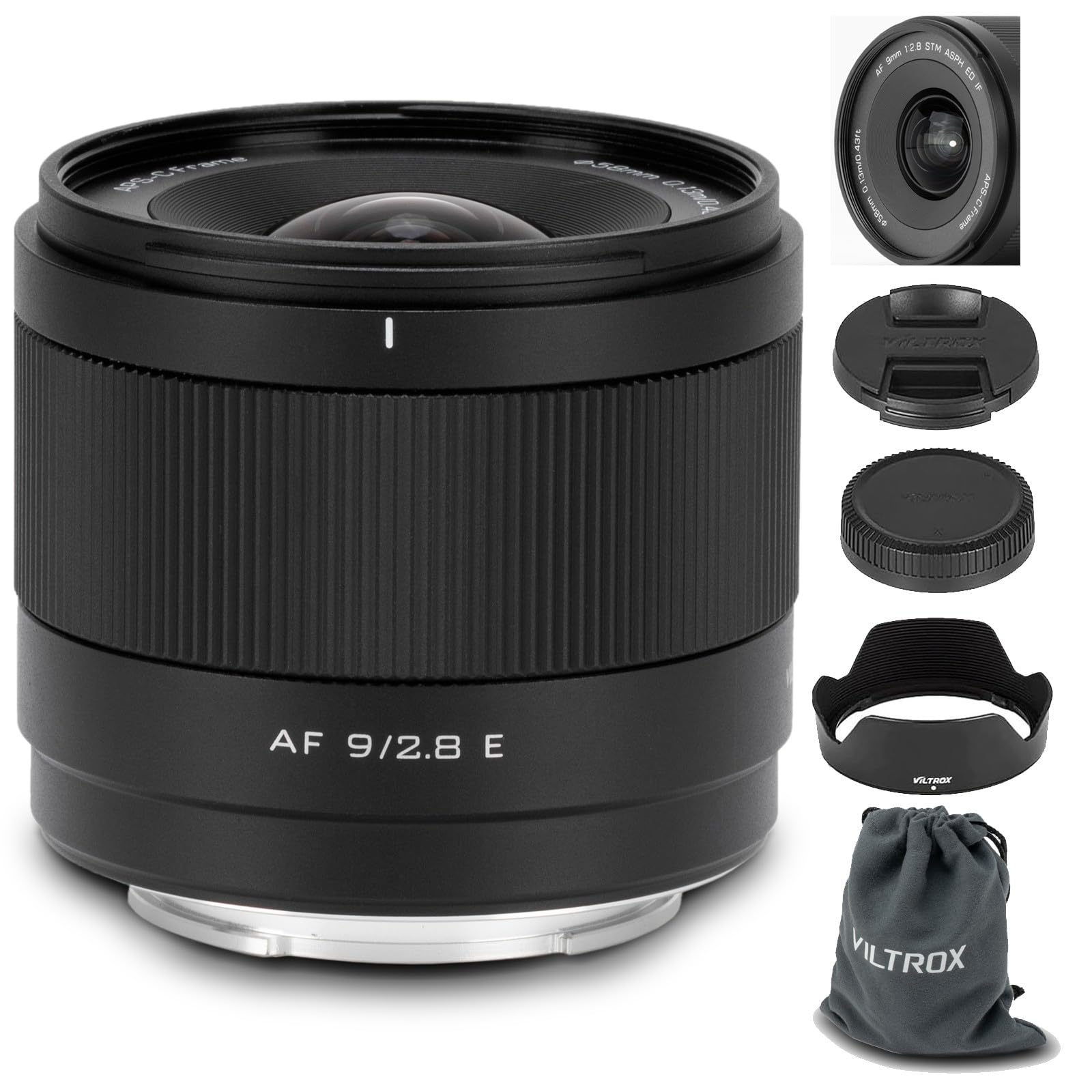
The 9mm F2.8 is the widest autofocus prime in this ZV-E10 set, with a 113.8-degree field of view that frames a selfie subject plus the room without backing up. Edge-to-edge sharpness at a budget price makes it a practical real-estate and travel lens, and the 175g body is easy to balance on a gimbal. For vloggers, the focal length keeps the face prominent while the surroundings stay visible.

Buyers who consistently hit the edges of a narrower lens fit the profile. The extreme FOV can show distortion and vignetting; F2.8 is also slower than the top pick's F1.7, meaning low-light handheld scenes depend on Active SteadyShot or a gimbal rather than aperture speed. For that group, the coverage outweighs both.

Real-estate shooters can capture full rooms from a hallway, and travel creators can hold the camera at arm's length while keeping both themselves and the location in frame. That coverage is the reason to choose it over the top pick when width is the limiting factor. At its price, no other autofocus option in this ZV-E10 set offers this much angle of view.

Pros

  • Delivers sharp images corner to corner without the usual ultra-wide AF price tag.
  • Frames a selfie subject plus the surrounding room without needing to step back.
  • 175g body keeps the ZV-E10 comfortable on a gimbal or in hand.

Cons

  • Autofocus can hunt in low-contrast scenes, so a manual focus nudge may be needed for corner cases.
  • The 113.8-degree FOV can curve straight lines and shade corners; post-processing is part of the workflow.
Our verdict

For ZV-E10 creators who need a whole room in the frame, the 9mm F2.8 is the ultra-wide specialist; the top pick remains the more balanced everyday option.

Check Latest Price
3

Telephoto Reach

Sony 55-210mm OSS

91 /100
Studio Score High Confidence

Key details

Autofocus
AF
Focal Length
55-210mm / 82-315mm eq
Max Aperture
f/4.5-6.3
Sensor Coverage
APS-C
Check Price on Amazon

The 55-210mm OSS is the only lens in this set built to close distance: 82-315mm equivalent reach on APS-C, supported by Optical SteadyShot and a 345g body. On a ZV-E10, it adds a working telephoto range that a wide prime simply cannot cover, which makes it a natural second lens for daytime action and travel.

The optical design keeps weight down without demanding a tripod; Optical SteadyShot and a compact barrel make it comfortable to shoot hand-held through the zoom range. At 345g, the 55-210mm is a sensible walk-around telephoto rather than a lens that requires a dedicated support system.

The right buyer is a ZV-E10 owner who already has a wide prime for indoor and vlogging shots and wants an affordable telephoto for outdoor sports, nature walks, or travel. Event shooters working in dim venues should look to fast primes instead; this lens answers sunny-side reach questions, not low-light ones.

Autofocus slows and sharpness softens at the long end, especially in dim light, so the 55-210mm is best treated as a daylight specialty lens rather than an all-conditions zoom.

๐Ÿ’ก At 210mm, favor a higher ISO over a slower shutter speed when the light is uneven.

Pros

  • 82-315mm equivalent reach delivers a real telephoto option for ZV-E10 shooters.
  • 345g weight and Optical SteadyShot make it easy to carry by hand for outdoor sessions.
  • Pairs well with a wide prime as a second lens for daytime reach.

Cons

  • Variable aperture changes exposure and depth of field as you zoom.
  • At 210mm, f/6.3 leaves little margin before shutter speeds drop.
Our verdict

For daylight outdoor reach, this is the cost-effective way to add a telephoto range and stabilization to a ZV-E10; keep the fast primes for evening work.

Check Latest Price
4

Compact Power-Zoom Kit

Sony SELP1650 16-50mm OSS

86 /100
Studio Score Strong Evidence

Key details

Autofocus
AF
Focal Length
16-50mm / 24-75mm eq
Max Aperture
f/3.5-5.6
Sensor Coverage
APS-C
Check Price on Amazon

The only power zoom with Optical SteadyShot in this group, the SELP1650 keeps the ZV-E10 compact while stretching from 16mm wide to a 50mm short tele. The retracting barrel balances well on a small body, and the motorized zoom works cleanly from a gimbal or remote setup. For handheld video on a body without IBIS, the built-in stabilization is the main reason to choose it over the faster primes here.

At 16mm, the frame is wide enough for arm's-length vlogs; at 50mm, you get a short tele for travel details. The starter bundle adds accessories around the same familiar Sony kit optic, so image quality lands where you'd expect for the price: good in daylight, with enough definition for online video and everyday photos.

This suits ZV-E10 owners who want one lightweight lens for daytime travel and gimbal work rather than a fast prime. The variable F3.5-5.6 aperture keeps it in daylight and well-lit indoor territory; low-light shooters will want a fast prime. White-box bundles can vary, so check for missing caps when the box arrives. If you already own the Sony 16-50mm kit lens, this package doesn't improve the optics; it just adds accessories.

๐Ÿ’ก Zoom at a steady, slower tempo; the electronic ring responds best to consistent input.

Pros

  • The only power zoom with OSS here; the compact retracting barrel is easy to keep mounted.
  • 24-75mm equivalent range covers vlogging-wide and short tele in one lightweight lens.
  • Budget-friendly walk-around zoom with built-in stabilization for handheld video.
  • Image quality is surprisingly good for a casual kit lens at this price.

Cons

  • The electronic power zoom ring has a distinct feel; some users will prefer a mechanical zoom.
  • Sharpness at the long end is modest next to modern primes; fine for online video, less for large prints.
Our verdict

For a single lens that handles travel and gimbal video in daylight, this is the practical ZV-E10 choice. A fast prime covers the dark stops.

Check Latest Price
5

Budget Everyday Prime

Yongnuo 35mm F1.8 E

85 /100
Studio Score Strong Evidence

Key details

Autofocus
STM AF
Focal Length
35mm / 52.5mm eq
Max Aperture
f/1.8
Sensor Coverage
APS-C
Check Price on Amazon

STM autofocus and an F1.8 aperture arrive at the lowest entry price in this group with the Yongnuo 35mm F1.8. On the ZV-E10 it frames a 52.5mm-equivalent normal view, which separates it from the wide-angle vlogging primes and makes it a photography-first option for budget stills.

The F1.8 aperture gives usable low-light headroom and enough depth-of-field control to separate a subject from a busy background. At 265g, the lens stays comfortable on the compact ZV-E10, and the STM motor keeps autofocus quiet and responsive during stills work.

This lens is for very budget-conscious stills shooters who want a normal prime and are already comfortable with Yongnuo's approach. It is not for vloggers or for buyers who want a long field-tested history; the more established primes in this comparison offer that, at a higher price. Long-term durability is less documented than those alternatives, so it suits shooters who weigh low cost more heavily than third-party validation.

On the ZV-E10, the 35mm F1.8 handles the stills work a compact APS-C camera is built for: walk-around shooting, portraits, and low-light scenes where the kit zoom would struggle.

Pros

  • Entry-level price undercuts other fast primes in this group while keeping autofocus.
  • F1.8 aperture adds low-light capability and background separation without adding bulk.
  • STM autofocus runs quietly, which suits unobtrusive stills work.
  • 265g weight balances cleanly on the ZV-E10 body.

Cons

  • No optical stabilization, so handheld video on the ZV-E10 may show shake; Active SteadyShot crops the frame.
  • 35mm APS-C framing is a normal view, not a selfie-friendly wide angle; self-shot video needs a wider lens.
Our verdict

The 35mm F1.8 delivers a normal-prime option for the ZV-E10 without pushing the budget.

Check Latest Price
6

Manual Portraits

Brightin Star 55mm F1.8

81 /100
Studio Score Strong Evidence

Key details

Autofocus
Manual only
Focal Length
55mm / 82.5mm eq
Max Aperture
f/1.8
Sensor Coverage
Full-frame
Check Price on Amazon

Metal-barreled and satisfying to rotate, the Brightin Star 55mm F1.8 gives ZV-E10 owners an affordable 82.5mm-equivalent portrait angle and a genuine chance to learn manual focus. The compact body suits handheld stills, and the focus ring has the kind of deliberate feel that rewards slow, careful composition. The tradeoff is manual focus only: the ZV-E10 records no EXIF or aperture readout, and its autofocus system is not part of this lens. Wide open, images are softer and can show chromatic aberration; stopping down to f/4 improves clarity. That keeps this in a niche role for posed portraits and creative experimentation rather than an everyday lens for vloggers or casual grab-and-go shooting.

Pros

  • Metal barrel and damped focus ring give a satisfying manual experience for portrait work.
  • Budget-friendly fast manual prime with an 82.5mm-equivalent portrait angle on the ZV-E10.

Cons

  • The ZV-E10 cannot autofocus or record aperture/EXIF data with this fully manual mount.
  • Wide-open shots can show chromatic aberration and softening in high-contrast edges.
Our verdict

This lens fits a ZV-E10 photographer who treats focusing as part of the craft and wants a compact 82.5mm-equivalent portrait look without spending much.

Check Latest Price

How to Choose

Focal Length and Field of View

Wide focal lengths keep the ZV-E10 useful for selfie-style video. At 15mm, a camera held at arm's length frames your face and enough background to feel like a scene; at 35mm or longer, the same setup cuts off the top of your head.

Choose the shortest focal length that still gives the framing you want, since you can crop in post but never widen a shot later.

Maximum Aperture

Maximum aperture controls how much light reaches the sensor and how much background blur you get. An F1.7 lens lets in roughly one and a half stops more light than F2.8 and more than three stops more than F6.3, which is the difference between a clean indoor vlog and a noisy one.

Faster apertures also improve autofocus in dim light, but the trade-off is size and price; modern APS-C primes have made F1.7 lightweight and affordable.

Autofocus and Eye AF

The ZV-E10's eye and face tracking only works with autofocus lenses. STM or stepping motors are quiet and precise for video, while older screw-drive or DC motors can hunt in low-contrast scenes.

If you shoot people, confirm the lens supports eye AF. A lens that hunts during an interview is more disruptive than a slightly softer image.

Stabilization and Weight

The ZV-E10 has no in-body stabilization, so lens OSS matters for handheld footage. Active SteadyShot on the body uses electronic cropping to smooth movement, but it reduces the field of view and works best on wide lenses.

Lenses without stabilization force you to accept micro-shake or use a gimbal; a 180g prime keeps the body balanced, while a 345g telephoto shifts weight forward.

APS-C vs Full-Frame

APS-C lenses are smaller and cheaper, and they cover the ZV-E10's sensor exactly. Full-frame FE lenses work on the ZV-E10 but bring their full-frame size, weight, and price without any reach advantage; a 14mm FE lens becomes a 21mm-equivalent on APS-C.

Buy full-frame glass only if you plan to move to a full-frame body later; for the ZV-E10, APS-C primes are the correct tool.

Frequently Asked Questions