4 Best Instant Print Camera of 2026: Pick One That Prints Keepers

Find the best instant print camera for your workflow: analog direct prints, phone-print flexibility, or a bundle that won't waste film.

Instant cameras promise a physical memory in seconds, but the reality often involves dark frames, soft focus, and film packs eaten by mistakes. The deeper split in this category is between direct analog shooting and hybrid models that let you preview, select, and even print from your phone.

That choice determines which camera fits you. Direct analog models are immediate and social, but they punish bad exposure because every shot costs money. Hybrid models add a screen and phone connectivity, which means fewer wasted prints at the expense of a less purely 'instant' feel.

The right pick comes down to how much control you want over the frame before it reaches paper, how much film you're willing to spend on the learning curve, and whether you want to print existing phone photos. Matching those three decisions is what separates a camera you use from one you shelve.

1

Best Overall

Fujifilm Instax Mini EVO

92 /100
Studio Score High Confidence

Key details

Battery
Rechargeable
Film Format
Instax Mini
Image Preview
Yes, 3-inch LCD
Bundled Extras
None
Check Price on Amazon

The EVO separates capture from print: preview the shot on the LCD, delete the misses, and print only the frames worth keeping, or send phone photos through the Instax app to the same Mini printer. That makes it the only model in this roundup where film consumption is a choice rather than a gamble. The hybrid approach still produces familiar Instax Mini prints, so the output fits the same albums, frames, and party walls as any other Mini camera. This is a print-first camera dressed in a retro body, not a standalone phone printer and not a simple point-and-shoot analog.

The two control dials layer ten lens effects and ten film effects, and each combination shows on the LCD before you commit it to film. At a party or event, that means you can hand the camera around, let people shoot freely, then review the captures on the LCD and print only the three or four frames that actually worked. The microSD slot stores digital copies for later, while the built-in selfie mirror and twin shutter buttons keep the handling close to a classic Instax. The EVO rewards slow, deliberate shooting more than rapid-fire snapshots.

This is for instant photographers who want control over wasted film and for event hosts who want the social ritual of handing around a camera but not the pile of unwanted prints. It also suits phone-first users who want a physical Mini print from images already saved on their phone. The digital capture is low-resolution, so on-screen and phone files appear soft even though small prints look fine; that is the boundary condition for anyone expecting a high-res hybrid.

The build is light and compact, with a plastic body that suits a camera meant to be carried around all day. The shell does not feel as dense as the price tag might suggest, yet the controls click positively and the print engine keeps Instax Mini's familiar saturated colors. Where a simple analog kit gets you a case and a stack of film at a lower entry cost, the EVO asks a higher upfront price but makes each sheet count.

For heavy event use, the preview workflow saves enough film to offset the price gap, and the phone-printing mode keeps the camera useful after a shoot. Gifting this model signals a recipient who wants to choose before printing rather than burn through a pack for two keepers. The analog kits in this roundup are easier to hand to a child; the EVO suits someone who wants a say in every frame.

๐Ÿ’ก Install a microSD card if you want to keep the digital captures; the slot is empty out of the box.

Pros

  • Preview before printing spends film only on chosen frames, and the same path prints phone images.
  • Ten lens and ten film effects combine on the camera for creative range without an editing app.
  • Retro body, dual shutters, and selfie mirror make it enjoyable to hand around.
  • Print engine delivers the classic saturated Instax Mini look; overall quality is well received.

Cons

  • Plastic body is light enough for a day bag, though the shell feels less dense than the premium price suggests.
  • Film packs are not included, so the premium entry price does not cover the consumable.
  • Digital captures are low-resolution, so phone and screen viewing looks pixelated even though small prints are acceptable.
Our verdict

For event hosts who hate wasted film and phone-first users who want a Mini printer with a camera body attached, the EVO is the pick. It shifts the instant-camera routine from shoot and hope to shoot, choose, then print.

Check Latest Price
2

Best Value Family Bundle

Fujifilm Instax Mini 12 Bundle

90 /100
Studio Score High Confidence

Key details

Battery
2 AA
Film Format
Instax Mini
Image Preview
No
Bundled Extras
50 sheets, case, album
Check Price on Amazon

Nothing else in this set is as ready to use: the box includes the Mini 12 camera, 50 sheets of Instax Mini film, a fitted case, a photo album, and a matching strap. That makes it a complete first-instant-camera experience for families who would rather start shooting than shop for extras. The process stays simple from box to print.

The right buyer is a family, a kid getting a first real instant camera, or a party host who values the physical print over pixel-peeping. In uneven light, prints carry the softness that comes with Instax film; in dim or backlit scenes, occasional blur is possible. In isolated cases, the shutter or flash can develop problems after limited use, so treating the warranty as part of the purchase is sensible.

Controls are minimal: auto exposure, a built-in flash, a selfie mirror, and a close-up mode handle the basics. The blossom-pink finish and compact body make it feel like a gift rather than a technical gadget. The flash works best for subjects within a few feet, which matches the camera's social-use intent.

๐Ÿ’ก Use the close-up mode for anything within arm's reach; the auto exposure handles the rest.

Pros

  • Ready-to-use gift kit with 50 sheets, case, album, and strap included.
  • Simple controls let kids and first-time shooters produce a print without technical setup.
  • Blossom-pink finish and compact body have broad visual appeal for younger users.

Cons

  • Auto exposure only, so manual shutter or aperture adjustments are not available.
  • No preview screen or phone printing means every shot is committed before you see it.
Our verdict

For a child or a party host, this bundle turns the first roll into a keepsake session rather than a technical project.

Check Latest Price
3

Best Pocket 2X3 Camera-Printer

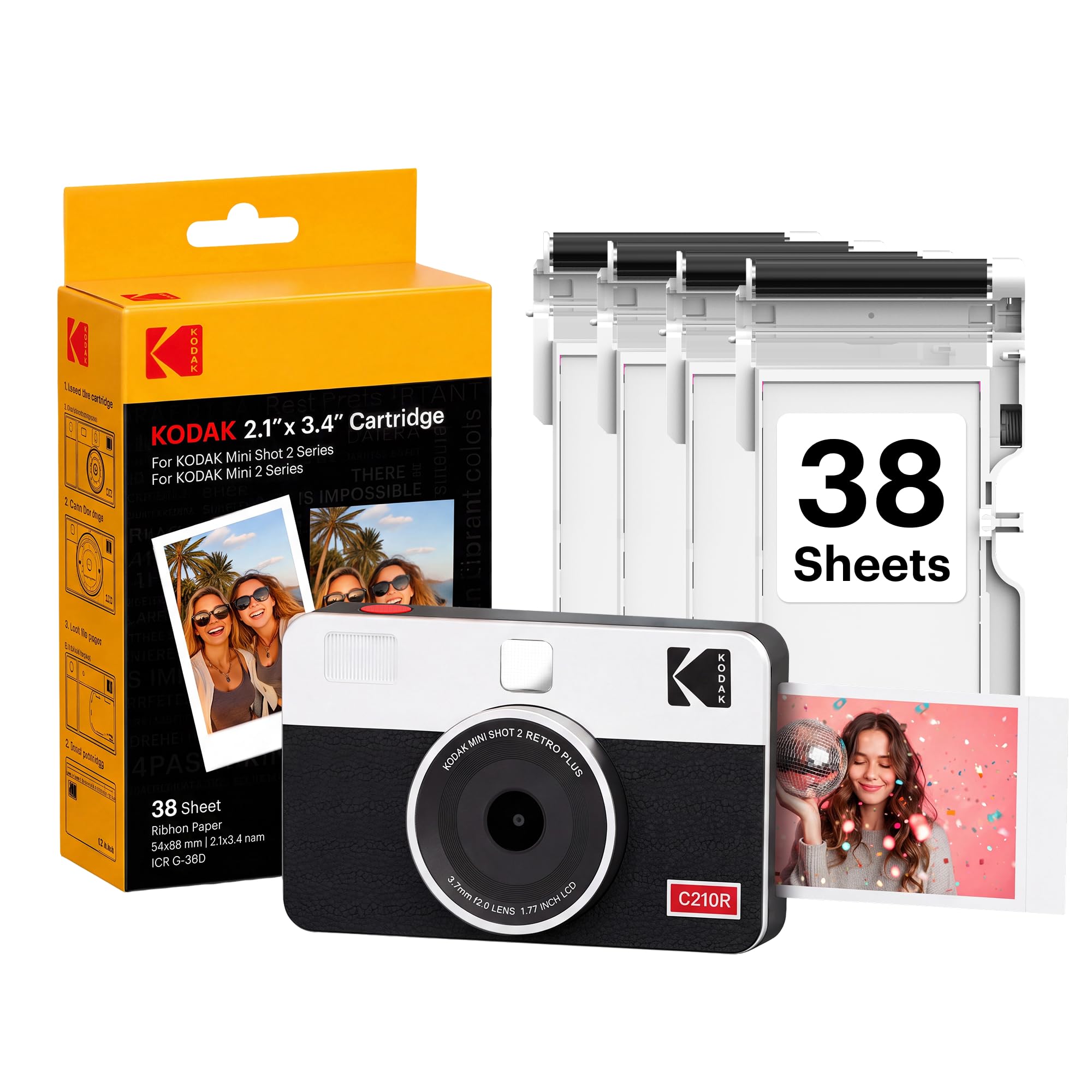
Kodak Mini Shot 2 Retro

87 /100
Studio Score Strong Evidence

Key details

Battery
Rechargeable
Film Format
Kodak 2x3
Image Preview
Yes, 1.7-inch LCD
Bundled Extras
38 sheets
Check Price on Amazon

The Mini Shot 2 Retro is a pocket 2x3 camera-printer that puts the phone-print path first. Bluetooth app pairing and 4PASS dye-sublimation output produce small prints with a protective layer, all in a compact body that fits a daypack. The built-in 10MP camera is a convenience, not the headline feature.

Printed sheets come out dry and smudge-resistant thanks to the 4PASS overcoat, so they are ready to drop into a scrapbook or pass around a table. The 2.1 x 3.4 sheets slot neatly into journals and mini albums, and the Kodak Photo Printer app is where the best results come from. The app also makes it easy to pick multiple photos before committing to paper.

The right buyer is a smartphone-first scrapbooker or party planner who wants 2x3 keepsakes on the go. Battery life is short, and camera-captured images are softer than phone-printed images, so the Bluetooth path is the reason to own it. Accept those boundaries and the small size makes sense.

Buyers who want a larger square print should consider the square-format 2-in-1 in this lineup; the Mini Shot 2 Retro stays light and pocketable.

๐Ÿ’ก Charge with the original cable and a firm connection; the port can be sensitive to cable angle.

Pros

  • Compact 2-in-1 design is easy to pack and makes phone printing plus camera snapshots a single carry.
  • 4PASS dye-sublimation prints arrive dry with a protective layer, ready for scrapbooks or tabletop sharing.
  • Bluetooth app printing turns your phone's camera roll into 2x3 keepsakes without a computer.

Cons

  • The small 1.7-inch LCD is fine for basic previews but not for detailed framing; the phone app is the better viewfinder.
  • Occasional paper jams can interrupt a batch printing session, so a flat surface and a little patience are part of the workflow.
Our verdict

For smartphone-first scrapbookers, the Mini Shot 2 Retro is a budget-friendly way to turn phone photos into small prints without dragging a separate printer along.

Check Latest Price
4

Best Square-Format Camera-Printer

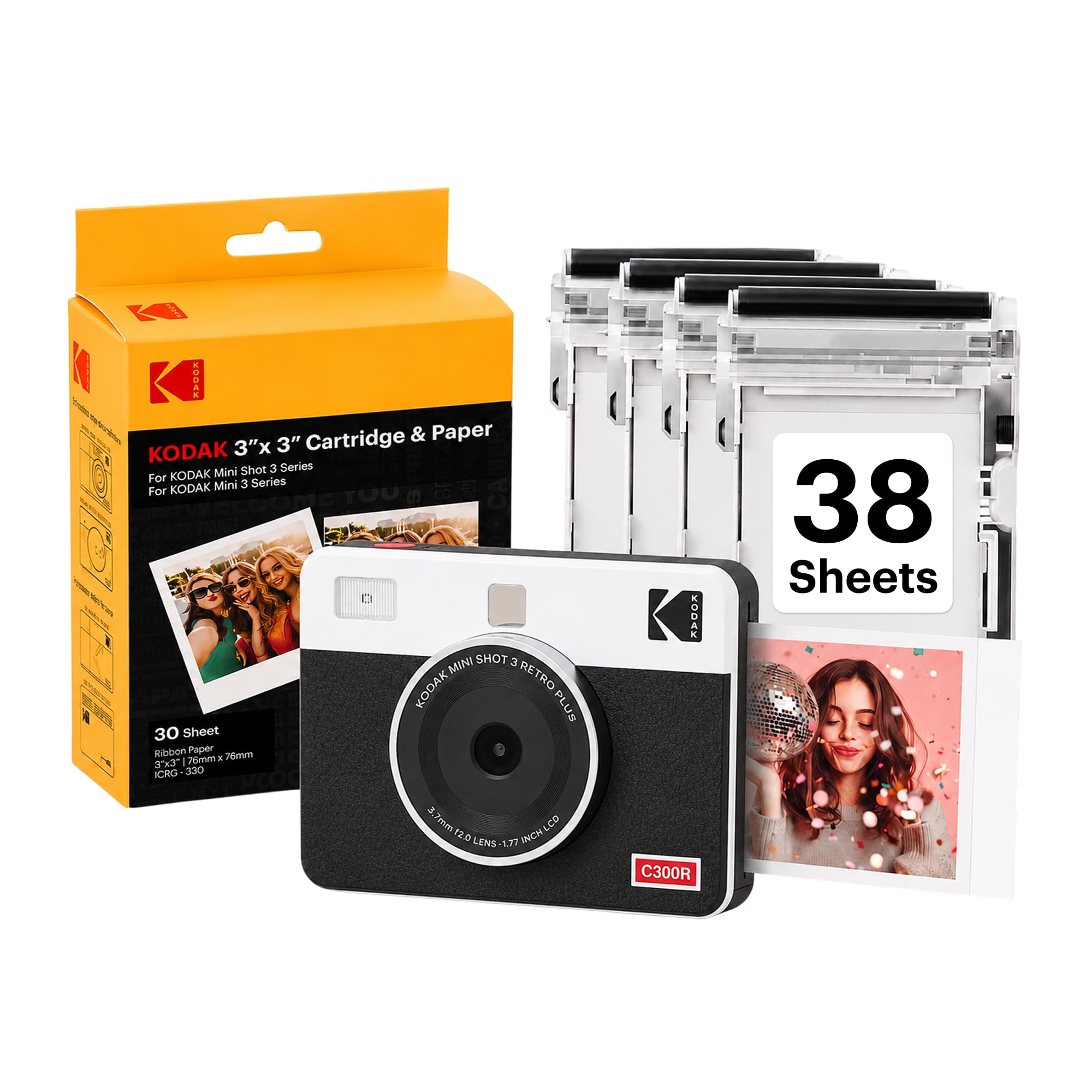
Kodak Mini Shot 3 Retro

84 /100
Studio Score Strong Evidence

Key details

Battery
Rechargeable
Film Format
Kodak 3x3
Image Preview
Yes, 3-inch LCD
Bundled Extras
38 sheets
Check Price on Amazon

The Mini Shot 3 Retro combines a 10MP camera, a 3-inch LCD, and a built-in square-format printer into a single device. It uses the same 4PASS dye-sublimation process as the slimmer 2x3 Mini Shot, so the print engine behaves the same way while the paper size moves to the larger square format.

The print path starts from either the camera's own captures or existing phone photos via Bluetooth and the Kodak Photo Printer app. The 3-inch LCD handles framing and playback, and the bundled 38 sheets provide enough output to judge whether square prints work for your album or wall-display setup before buying additional media.

Because the print engine is shared with the 2x3 body, the main difference is format rather than photo quality. Square prints fill a 3x3 frame edge to edge, so a clean square composition works without cropping. The 10MP camera output fits the small-print purpose of this category, meaning it is best treated as a finished print rather than a high-resolution source file for large edits.

This is for square-format fans who want a 2-in-1 for both capture and phone printing, and for mobile-first users who prefer 3x3 photos in albums and wall displays. The physical tradeoff is size: this body won't slide into a small pocket the way the 2x3 Mini Shot does, so it belongs in a bag or on a tabletop. If the smallest possible body is the priority, the slimmer 2x3 model is the better match.

Pros

  • Combines a 10MP camera and a 3x3 printer in one device, eliminating the need to carry a separate printer.
  • Bluetooth phone printing brings existing images into the same square-format workflow.
  • The 3-inch LCD handles framing and playback, reducing wasted sheets compared to analog-only instant cameras.

Cons

  • Phone printing depends on the Kodak Photo Printer app, so there is an extra step before a phone image becomes a print.
  • Square media carries a higher per-sheet cost than 2x3 formats, which adds up for high-volume event printing.
Our verdict

For square-format albums and wall grids, this Kodak delivers the most direct single-device path to a finished 3x3 photo.

Check Latest Price

How to Choose

Film Format and Print Size

Film format fixes print size, per-sheet cost, and how visible exposure errors are. Instax Mini prints are credit-card-size and easy to share or drop into mini albums; Kodak 2x3 and 3x3 dye-sublimation prints work for different storage styles; larger Polaroid frames feel classic but show blur and darkness more prominently. Pick the size that matches where the photo will live instead of choosing by camera body alone.

Preview Before Print

A screen lets you delete bad frames before film is spent, but it comes with a small digital sensor underneath. Hybrid models trade resolution for control. For event shooting, preview/select saves more money in wasted film than the sensor loses in sharpness; for direct analog fans, the lack of a screen is part of the experience, not a defect.

Bundled Film and Accessories

Instant film is chemically sensitive; packs age and heat accelerates color shifts. A 50-sheet bundle is only good value if you will shoot through it before the chemistry drifts. Bundled cases, straps, and albums also reduce the effective start-up cost and make a bare camera a ready-to-use gift.

Battery Type and Rechargeability

AA-powered analog cameras are easy to restart, but give little warning before the flash weakens. Rechargeable models need overnight charging and can be dead at an event if forgotten. Camera-printers draw more current than film-only cameras because every print feeds paper, lays color, and applies a protective layer, so expect to charge them between sessions.

Phone Printing

Bluetooth printing lets the camera act as a printer for photos already on your phone. In that workflow, app color handling and the paper engine matter more than the camera lens. If phone printing is your main use, choose a proven print method over a higher-megapixel capture spec.

Frequently Asked Questions