5 Best Geared Tripod Head of 2026: Pick One That Stays Precise

Which geared tripod head keeps 6 kg rigs stable and micro-adjustment precise — and which ones match your Arca or Manfrotto setup.

Geared tripod heads all promise precision. The difference shows up when you turn a knob: smooth micro-adjustment on one model, a sticky fight on another. The same is true for quick-release plates — Arca-Swiss labels can fit loosely, and proprietary plates add another adapter.

The real trade-off is weight and speed. A geared head is a precision tool, not a fast one; it replaces free movement with gear-reduced control. It only earns its place on a tripod when the load rating, plate standard, and knob action match the camera you carry.

This guide focuses on those deciding details: rated capacity for 6 kg-class rigs, plate compatibility, gear feel, and weight. Match those to your work, and a geared head becomes a dependable framing tool rather than a source of friction.

1

Best Overall

Benro GD3WH Geared Head

91 /100
Studio Score High Confidence

Key details

Weight
1.92 lb / 0.87 kg
Max Load
6 kg / 13.2 lb
Quick Release
Arca-Swiss PU70
Check Price on Amazon

The GD3WH combines a 6 kg load capacity with an Arca-Swiss compatible PU70 plate and a 0.87 kg body, which is light for a geared head. Three separate gear-driven axes allow small, repeatable framing shifts, and the graduated scales plus bubble level give you a clear reference for leveling and composition.

In architectural and landscape setups, the geared movements hold position after each turn, so a horizon stays put once you set it. The micro-knobs are the reason to buy this head; they make fine adjustments feel controlled, while the larger coarse knobs serve as quick positioning handles rather than precision controls.

This is a head for photographers upgrading from a ball head who work with 6 kg-class rigs and want calibrated framing rather than fast free movement. Real estate, architecture, landscape, and astro shooters will benefit, as will studio and macro users who nudge composition in small steps. The tradeoff is geared-head handling: large coarse-adjustment knobs can feel stiff, the quick-release plate can take extra effort to seat, and occasional minor gear play has been noted when reversing direction. For the photographer who needs calibrated framing, that handling is the price of precision. This is not a head for buyers who want lightweight, fast all-purpose support without gear friction or who are on strict entry-level budgets.

The body is built from metal with a solid locked feel, and the Arca-style receiver accepts PU70 plates directly. That makes it a practical upgrade for shooters already using Arca clamps, because the same plate standard carries over to their tripod system.

At 0.87 kg it undercuts heavier geared heads with comparable capacity, so it suits location work where weight matters. The mid-range price positions it below heavy-duty geared heads while keeping the 6 kg capacity and precision controls that the target buyer needs.

The pan base covers 360 degrees, and the bubble level sits beside the scales, so you can set a horizon and then rotate for a pano without losing the reference. The 6 kg capacity matches a standard camera-and-lens rig; photographers shooting medium format or long telephotos should look at heavier geared heads, but for the typical mirrorless or DSLR outfit, this is the correct load class.

💡 Use the bubble level and graduated scales during framing so reverse-direction corrections stay minimal.

Pros

  • Holds a 6 kg rig securely while keeping a sturdy locked feel
  • Fine adjustments are precise and stay where you set them
  • Works across real estate, landscape, studio, and astro work
  • Lightweight body for a geared head at 0.87 kg

Cons

  • Large coarse-adjustment knobs can feel stiff and the quick-release plate can take extra effort to seat
  • Minor gear play can appear when reversing direction
Our verdict

For a 6 kg-class rig and Arca-Swiss workflow, the GD3WH delivers micro-adjustment, precision scales, and a light body without the luxury premium.

Check Latest Price
2

Proven Workhorse for Architecture & Real Estate

Manfrotto 410 Geared Head

87 /100
Studio Score Strong Evidence

Key details

Weight
2.7 lb / 1.22 kg
Max Load
5 kg / 11 lb
Quick Release
Manfrotto QR plate
Check Price on Amazon

Three geared axes deliver the kind of repeatable framing that building interiors and night-time long exposures demand, with a sturdy 5 kg-rated platform that holds a locked composition in place.

Each axis is adjusted with a dedicated knob, so last-millimeter shifts can be made without unlocking the whole head. The geared movement holds its position when you let go of the knob, which makes horizon lines easier to set and reset than on a ball head. It also means a horizon line can be corrected after the lock is set, something a ball head cannot do without resetting the frame. This is a slower way to work, but the tradeoff is accuracy.

This is for photographers whose camera-and-lens combo stays under 5 kg and who need repeatable framing for building interiors or long exposures. Architecture and real-estate shooters working from a stationary position can return to a framing after checking the camera back by nudging the geared knobs. The 6 kg target sits above this head's rated load, so a heavier rig belongs on the top pick. Gear tightness, plate release, and long-term wear can vary between units, so a bench check before heavy use is a sensible step.

Pros

  • Three geared axes allow fine, repeatable framing for architecture and long-exposure work.
  • Stable platform at a 5 kg rating holds compositions steady for long shutter speeds.
  • Quick-release plate and control knobs are intuitive for photographers familiar with the Manfrotto system.
  • Long-term value: owners keep it in service for years after purchase.

Cons

  • At 1.22 kg, this is a heavy head for travel and hike-in field work.
  • Uses Manfrotto's proprietary plate system; Arca-Swiss users need an adapter or replacement plate.
Our verdict

Leave this one on a studio column or a tripod that stays close to the car; its precision earns its keep whenever composition has to stay locked for long exposures.

Check Latest Price
3

Great Value All-Metal Pick

K&F Concept Geared Head

82 /100
Studio Score Strong Evidence

Key details

Weight
1.8 lb / 0.81 kg
Max Load
6 kg / 13.2 lb
Quick Release
Removable QR plate
Check Price on Amazon

The K&F CONCEPT Geared Head pairs a CNC aluminum body with three-axis micrometric knobs and a 6 kg load rating, covering the standard landscape and astro kit at a mid-range price. The all-metal build skips the plastic parts found on entry-level heads.

At 0.81 kg, the head suits field work while the 6 kg load rating covers telephoto rigs. Each axis adjusts independently, so fine leveling stays separate from coarse positioning.

Micro-adjustment remains accurate for architecture and astrophotography: small knob turns level a DSLR with a 300mm lens without nudging the composition. The standard 1/4-inch quick-release plate and 3/8-inch base work with typical tripods.

This head suits value-focused photographers who want all-metal construction and micrometric control on a 6 kg kit, and who are comfortable with a firmer gear hand. Gear knobs can be very stiff, and some units may develop gear wear over time, so it fits buyers who prioritize initial cost over long-haul smoothness. If ultra-smooth coarse movement is a must, the top pick is the better match. That makes it a reasonable first geared head for someone unwilling to spend on a premium nameplate.

💡 Loosen axis locks before coarse repositioning to reduce force on the knobs and geared mechanism.

Pros

  • All-metal CNC aluminum construction with no plastic parts.
  • Accurate fine adjustments for leveling and framing in architecture and astro work.
  • Supports a DSLR with a 300mm lens without stability issues.

Cons

  • Coarse-adjustment knobs can require noticeable force for rapid repositioning.
  • Some units may develop gear binding or slop after weeks or months of use.
Our verdict

For precise leveling and framing on a 6 kg kit, this all-metal geared head delivers the essential control at a mid-range price.

Check Latest Price
4

Best Budget Entry Point

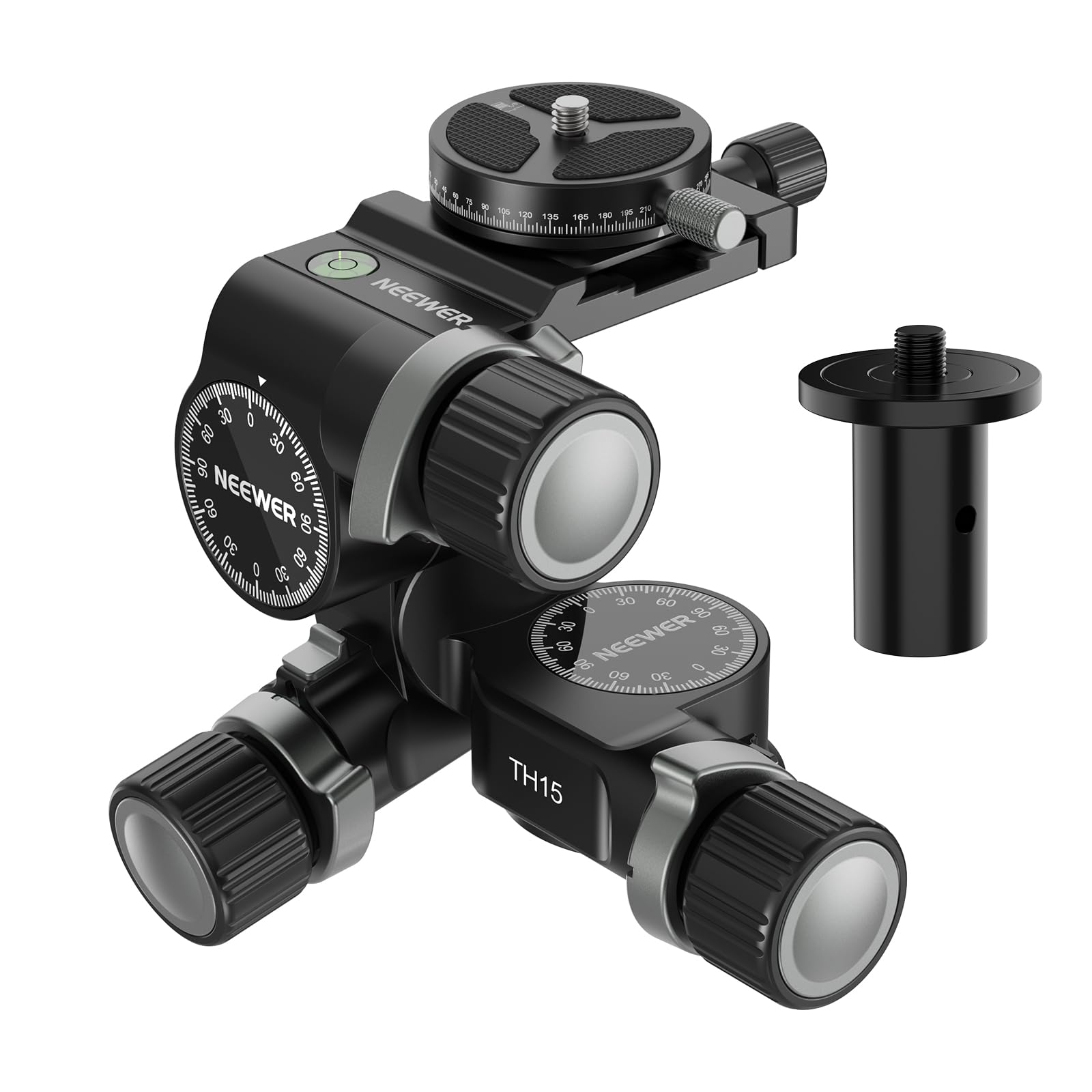
NEEWER TH15 Geared Head

80 /100
Studio Score Strong Evidence

Key details

Weight
2 lb / 0.91 kg
Max Load
6 kg / 13.2 lb
Quick Release
Arca-type plate
Check Price on Amazon

The NEEWER TH15 is the lowest-priced geared head in this set with a 6 kg capacity and an Arca-type plate. It brings three-way geared micro-adjustment to photographers who want to learn geared framing without paying for features they may not use, and it lands well below the mid-range options that add CNC machining and tighter tolerances.

This head suits beginners, budget-conscious macro and product shooters, and photographers who already use Arca-Swiss plates but want to try geared framing without a high buy-in. The tradeoff is entry-level consistency: some Arca plates seat loosely, and the fine knobs can feel sticky during small shifts, so confirm your plate fit and gear feel before relying on it for a full shoot.

Independent mode control switches isolate each axis, which is the core maneuver for macro and tabletop reframing. The round Arca plate carries a 360° pan scale for simple panorama alignment, and the 2 lb body stays light enough for location tripods. Typical mirrorless and DSLR kits with standard zooms sit comfortably within the 6 kg rating; heavy telephoto and medium-format setups are a different class.

💡 Lock the axes you are not adjusting so fine shifts stay isolated.

Pros

  • Budget-friendly entry into a 6 kg-class three-way geared head.
  • Arca-type quick-release plate with 360° pan scale for standard mounting.
  • Three-axis fine-tuning with independent mode switches for precise framing.

Cons

  • Fine-adjustment knobs can feel stiff or sticky during small corrections.
  • Some Arca-Swiss plates seat loosely or the quick-release can catch on mounting.
  • Gear components can come apart or wear unevenly between units over time.
Our verdict

If you are still deciding whether geared control fits your shooting, this is the cheapest way to find out.

Check Latest Price
5

Pro-Grade Precision for Heavy Rigs

Manfrotto 405 Geared Head

77 /100
Studio Score Established

Key details

Weight
3.5 lb / 1.59 kg
Max Load
7.5 kg / 16.5 lb
Quick Release
Manfrotto RC4 plate
Check Price on Amazon

The Manfrotto 405 is a 7.5 kg geared head that turns fine framing into a controlled, deliberate motion. The three micrometric knobs hold their position when released, move smoothly across the full tilt and pan range, and feel firm without becoming stiff.

The aluminum body and heavy gearing keep medium-format bodies and long telephoto lenses rigid. The knobs allow sub-millimeter nudges without overshoot, so a slightly off composition can be corrected without loosening a tension knob and starting over. That is the core need behind a precision 3-way geared head.

Macro and product photographers get an advantage from the independent axis locks: adjusting one axis does not knock the other two out of position, so focus stays put while the frame is fine-tuned. Composition changes stay small and predictable, which cuts down on re-framing after each adjustment.

This is a studio-bound tool. The premium price and weight are reasonable only for photographers who already shoot heavy kit; for a typical 6 kg rig, it is more head than the job needs. Seat the quick-release plate fully and lock the clamp before heavy use.

Pros

  • Three gear-driven knobs move smoothly and hold position without overshoot.
  • Rigid aluminum body handles medium-format bodies and long telephoto lenses without flex.
  • Micrometric knobs cover ±90° tilt and 360° pan with precise, independent control.

Cons

  • A quick-release plate that is not fully seated can allow subtle camera movement.
  • Sustained heavy use can introduce a small amount of gear train play over time.
Our verdict

Studio photographers who need a 7.5 kg head with tight micrometric control will find the 405 does the job without fuss. For a lighter all-round rig, the top pick in this set is a better fit.

Check Latest Price

How to Choose

Load Capacity

Manufacturers rate geared heads at maximum load, not working load. The gear train pushes the whole rig through small teeth, so at max load adjustment gets stiff and less predictable. A 6 kg head with a 5.5 kg rig leaves useful margin; a 6 kg rig leaves none.

For a 6 kg-class kit, choose 6 kg or higher. That covers camera, lens, battery grip, and accessories when the head is tilted off-axis.

Quick-Release Plate

Arca-Swiss compatibility is not a single standard: clamp width, bevel angle, and locking depth vary, so one Arca plate locks tight while another sits loose. Proprietary systems like Manfrotto's quick-release are consistent but require the matching plate or an adapter.

Check your existing plates before buying. If you already own Arca plates, an Arca-style clamp saves adapters; if your kit uses Manfrotto plates, staying in that system avoids fit issues.

Gear Smoothness and Knob Ergonomics

Geared heads use worm drives or rack-and-pinion mechanisms to turn knob rotation into tiny movements. More gear reduction means finer control but more friction, so budget heads can feel stiff; premium heads use tighter tolerances and better grease. If one axis is dramatically harder than the others, that is a unit issue, not a break-in problem.

Test coarse and fine knobs with the head unloaded. A stiff coarse knob makes rough composition annoying; a smooth fine knob decides whether precise framing feels natural.

Weight and Portability

Geared heads are heavier than ball heads because the gearing and housing add metal. That weight improves stability but becomes a burden on trail hikes or travel shoots. A 1.5 kg head suits studio work; a 0.75 kg head fits mirrorless walkaround kits.

Build Material

CNC aluminum holds tolerances better than plastic gears or housings under temperature swings and repeated load. Plastic parts can flex under load, introducing backlash when you reverse a knob direction. All-metal construction is not a durability guarantee, but it removes one common source of wear.

For all-day professional use, metal build matters; occasional macro setups may handle plastic.

Frequently Asked Questions