9 Best Fluid Head Tripod in 2026: Smooth Pans That Last

The best fluid head tripod for DSLR and mirrorless video, matched to your shooting style so you don't overpay for marketing claims.

A video tripod works when the head starts a pan smoothly and the legs hold the rig without creep. Many tripods in this range use the term 'fluid head' loosely, and the hardware that gives out first is usually the leg lock, not the pan assembly. That makes the buying decision about leg design and damping behavior, not brand promises.

The right match depends on the camera weight and shooting style. A fixed-drag head can feel smooth with a light mirrorless body but sticky with a heavy DSLR, while a tall event tripod needs different legs than a travel pod. Start by setting the load range and working height, then look at lock hardware and portability.

This guide sorts the field by payload, height, head behavior, leg locks, and portability, so you can match the tripod to the way you actually shoot. The payoff is a stable base and predictable pans without hauling more weight than your work requires.

1

Best Overall

Cayer BV30L 72in

93 /100
Studio Score High Confidence

Key details

Head Drag
K3 fixed-drag head
Leg Locks
Twin-tube legs
Max Payload
13.2 lb
Portability
8.8 lb
Check Price on Amazon

The K3 fluid head is the centerpiece of the BV30L: pan and tilt moves glide in a smooth, controlled arc instead of the coarse friction-feel you get on budget video heads. Twin-tube legs keep the frame steady when the camera is moving with a subject, and the mid-level spreader adds stability at the full 72.5-inch height. The 360-degree pan and the -70/+90-degree tilt range leave enough room for follow shots and low or high angle framing. That combination makes it easy to hold a clean horizon while following action.

The two quick-release plates are a practical addition on a job: mount the main camera on one plate and a backup body on the other, then switch in seconds. Tilt response stays smooth across the range, which matters for top-down tabletop shots and low-angle interview setups. The padded carrying bag keeps the kit organized between the car and the venue.

The mid-level spreader locks the legs at a consistent angle, and it folds up when you need to reposition between shots. On an event floor, dropping and resetting the footprint without loosening every leg lock saves real time.

There is a visible gap between this tripod and the photo-tripod-with-a-fluid-head compromises that populate the entry level. The legs stay rigid under a DSLR with a battery grip, the head does not droop when tilted on a long lens, and the metal hardware feels cut from a higher price class. The bundle also matches that standard: two quick-release plates, a mid-level spreader, and a padded bag are all genuinely usable rather than promotional filler. For the cost, you get a functional event kit rather than a starter piece you will replace in a season.

Event and wedding videographers using DSLR or mirrorless bodies are the natural audience: they need repeatable pan moves, a stable base, and quick plate changes between tripod and gimbal. The 13.2 lb load cap covers typical hybrid kits and small camcorders, and the 8.8 lb weight is manageable from car to venue but not across a trailhead. The fixed pan drag may take a practiced start; once adapted, it is easy to ignore. If you need more payload capacity or a packing-light travel pod, a different kit is a better fit.

💡 A light counter-force on the pan handle before starting a move helps the fixed-drag head start smoothly.

Pros

  • Smooth K3 fluid head lets you pull pan and tilt moves with a steady, controlled feel.
  • Build quality is higher than the mid-range price suggests; the head and legs feel like a premium kit.
  • Value is strong because the kit includes the essentials: two plates, spreader, and carrying bag.
  • The package performs consistently across a wide range of video uses, from events to studio work.

Cons

  • Quick-release button spring can feel worn on some units, so check the plate lock before a paid shoot.
  • At 8.8 lb, this is a car-to-venue tripod, not a hiking companion for long trail carries.
Our verdict

Event and wedding videographers who want smooth pan and tilt without a premium rental budget will find the BV30L ready for paid work; keep it near the car.

Check Latest Price
2

Best High-Capacity Workhorse

NEEWER TP74 74in

93 /100
Studio Score High Confidence

Key details

Head Drag
Fluid drag head
Leg Locks
3-section aluminum
Max Payload
17.6 lb
Portability
10.9 lb
Check Price on Amazon

The NEEWER TP74 pairs a 75mm fluid bowl with a 17.6 lb load rating, and its dual quick-release plates accept both DJI RS gimbal bases and Manfrotto 501PL/504PL plates. Pan and tilt motion stays controlled even when a full-frame body wears a long telephoto lens.

The 360° pan range and -75°/+90° tilt cover standard event and interview framing without repositioning the legs. The head's damping stays smooth through the pan sweep, and the bowl lets you level the base without adjusting each leg first.

This is a near-field workhorse for event and studio videographers who move between sticks and a gimbal. The 10.9 lb body and sensitive height/balance adjustments are the tradeoff for that load capacity: keep it near a vehicle or cart, and plan extra time when changing leg height or swapping lenses.

💡 Mount the camera and set balance before extending the legs; fine height changes go faster with a second hand.

Pros

  • Steady under load, with a build that holds full-frame bodies and long telephoto lenses without visible sway.
  • Load capacity reaches 17.6 lb, covering full-frame video rigs and heavy telephoto combinations.
  • Fluid head moves through pan and tilt with controlled drag, so video pans stay smooth.
  • Works across telescopes, full-frame cameras, and field video shoots without compromising stability.

Cons

  • At 10.9 lb, this is a vehicle-to-stand unit rather than a long-carry field pod.
  • Height and balance adjustments can be sensitive when swapping lenses or changing elevation.
Our verdict

The TP74 earns its place for shooters who need gimbal-ready plate compatibility and a 75mm bowl at a mid-range price; just keep it close to a vehicle and budget time for height changes.

Check Latest Price
3

Best Tall All-Rounder

NEEWER TP-M200 79in

91 /100
Studio Score High Confidence

Key details

Head Drag
Fluid drag head
Leg Locks
3-section aluminum
Max Payload
17.6 lb
Portability
12.4 lb
Check Price on Amazon

The NEEWER TP-M200 reaches 200 cm with a 70mm bowl, putting the camera at standing eye level for event work without resorting to a center column. The 17.6 lb capacity covers DSLR, mirrorless, and most camcorder builds, and the bowl-based leveling is faster than adjusting individual leg lengths. That combination makes it the tall all-rounder in this comparison.

Its fluid head pans and tilts with controlled damping for interview and ceremony coverage. The 70mm bowl makes leveling quick on uneven venue floors, and the overall behavior suits a shooter who needs smooth framing moves rather than quick repositions.

Wedding and event videographers who need standing height and a fluid head for smooth pan/tilt video are the core audience, especially budget-conscious semi-pros. It is not a backpacking tripod: the 12.4 lb weight and a head-to-leg joint that can loosen over time in some units are the tradeoffs to accept. Shooters who set up once and stay put get the most from this tripod.

Pros

  • Build quality exceeds what the price implies, with no obvious shortcuts in leg locks or bowl base.
  • Leg set stays planted for event and studio work, drawing comparisons to more expensive tripods.
  • Tall 200 cm reach plus 70mm bowl leveling removes the need for center-column workarounds.
  • Fluid head pans and tilts with enough damping for interview and ceremony coverage.

Cons

  • At 12.4 lb and a bulky folded size, it is a car-to-venue tripod rather than a hike-in pod.
  • The head-to-leg joint can loosen over time in some units, so periodic re-tightening is part of the routine.
Our verdict

Event shooters who want standing height and bowl-leveling speed without paying premium studio rates should put this tall all-rounder on the short list.

Check Latest Price
4

Best for Overhead / Boom Shots

K&F Concept 90in Boom

87 /100
Studio Score Strong Evidence

Key details

Head Drag
Fluid head
Leg Locks
Max Payload
11 lb
Portability
4.9 lb
Check Price on Amazon

The K&F Concept 90-inch boom is the overhead specialist in this set. Its 0-120° center axis swings from vertical to horizontal, and the integrated fluid head accepts DSLR, mirrorless, and camcorder bodies without a separate head purchase. That puts cooking, desk, and product shots directly over the tabletop at a height beyond what standard video tripods reach. Where the lighter 83-inch model in this set focuses on carrying ease, the 90-inch version spends its weight on the center-axis mechanism.

This tripod is built for cooking, desk, and tabletop creators who need the camera over the scene, plus studio shooters who want a tall framing option. It is not the match for heavy telephoto users needing rock-solid full-height support or videographers who require precise professional fluid drag; those buyers should consider a heavier studio column or a dedicated fluid head.

With the legs short and the column near vertical, the fluid head holds position during standard pan/tilt moves and the center-axis lock keeps the chosen angle. The 4.9 lb body and 11 lb capacity keep the tripod practical to reposition between tabletop and standing framing without feeling like a dedicated studio column. The head’s 360° panorama and ±90° tilt range also make it easy to frame odd-angle product or food shots.

💡 For overhead shots, tighten the center-axis lock and keep the boom as short as the composition allows for steadier framing.

Pros

  • Hardware feel and build quality exceed what its mid-range price usually delivers.
  • One unit covers standard video, tall studio framing, and overhead tabletop shots.
  • Overhead and studio pan/tilt work stays smooth and controlled at normal working heights.

Cons

  • At certain tilt angles, fluid head drag can feel sticky or lose position
  • When fully extended or swung horizontal, the frame can sway more than a rigid studio column.
Our verdict

The K&F 90-inch boom fits overhead-focused tabletop creators who want a complete fluid-head tripod in one package; keep sessions indoors and the column at a practical height.

Check Latest Price
5

Best Compact Premium Travel

Manfrotto Befree 3-Way

83 /100
Studio Score Strong Evidence

Key details

Head Drag
3-way fluid drag
Leg Locks
Aluminum legs
Max Payload
13.2 lb
Portability
5 lb
Check Price on Amazon

The Befree 3-Way Advanced kit pairs a three-way fluid drag head with a 15.8-inch folded length, which shifts the Manfrotto formula toward travel rather than studio permanence. At 5 lb, it is light enough for a carry-on video bag, and the folded size places it well below the traditional full-size Manfrotto tripods in the same lineup.

The fluid drag system works across a -30° to +70° temperature range, so pans and tilts stay controllable from cold outdoor shoots to warm indoor sessions. The 13.2 lb payload covers DSLR, mirrorless, and camcorder kits, and the standard Manfrotto plate system keeps existing heads and accessories in rotation.

The 59.1-inch working height suits standing subjects, and the aluminum legs fold back to the compact travel length without removing the head. The kit is built to move from a backpack to a location, not to take the place of a tall event stand.

This is for travel-focused hybrid shooters who need one complete fluid-head kit for photo and video on the same trip. It delivers that complete kit in a carry-on-friendly body; the head assembly is less robust than full-size Manfrottos, and the premium price reflects the compact build rather than extra load capacity.

Pros

  • Folded length of 15.8 inches and 5 lb weight suit carry-on video travel.
  • Three-way fluid drag head smooths pan/tilt video without adding a separate head.
  • Build quality holds up for packed, location-shooting use.

Cons

  • Multiple head knobs and long levers require deliberate turns, slowing quick field adjustments.
  • Full-extension stability trails full-size tripods, so tall video pans need slower movement.
Our verdict

Folded length is the deciding factor: if that matters more than studio height, this is the travel fluid-head kit that earns the space in your camera bag.

Check Latest Price
6

Best Budget Travel Value

SmallRig AD-14 73in

85 /100
Studio Score Strong Evidence

Key details

Head Drag
Adjustable drag head
Leg Locks
Aluminum alloy legs
Max Payload
18 lb
Portability
6.8 lb
Check Price on Amazon

The SmallRig AD-14 pairs a 6.8 lb aluminum chassis with an 18 lb payload rating and a 73-inch working height. The built-in fluid head adds adjustable drag plus 360° pan and a tilt range that sweeps from +85° to -78°, which is enough for low-angle shots without swapping heads. That combination gives it a travel-first angle within this budget set.

Setup is quick: legs extend to working height without complaint, the side-load 501PL plate accepts standard Manfrotto-style mounts, and the drag dial provides usable resistance for mirrorless and small camcorder kits. The controls hold their settings between takes, which keeps a run-and-gun shoot moving.

This is aimed at travel videographers and content creators running mirrorless, DSLR, or compact camcorder kits who want fluid-head moves without a heavy studio stand. The 6.8 lb body is the reason it travels well, but it also means wind can nudge the frame at full height, and the spreader is not built for rough handling. Shooters who keep outdoor work to calm days and treat the spreader gently will find the limits easy to live with.

Pros

  • Sturdy aluminum legs hold a stable frame at a weight that still travels well.
  • Adjustable drag and a fluid head give light kits controlled video moves at a budget price.
  • Easy setup and functional video head behavior suit run-and-gun shoots.

Cons

  • After the head has been stationary, the first pan movement may catch before it smooths out.
Our verdict

For light kits that need real fluid-head moves in a travel-friendly package, the SmallRig AD-14 covers the basics without dragging a studio tripod into the field.

Check Latest Price
7

Event Portrait Shooters

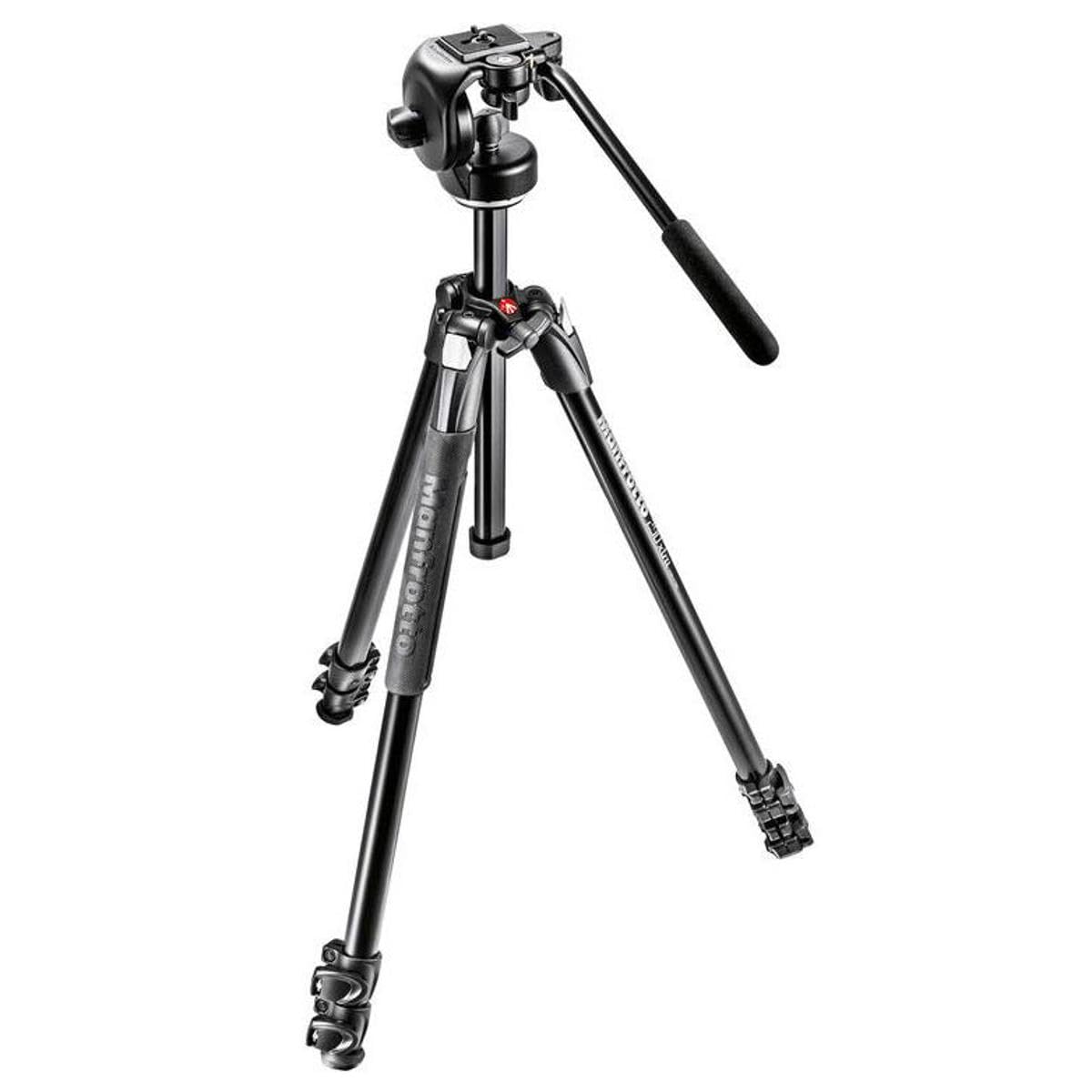
Manfrotto 290 Xtra

89 /100
Studio Score Strong Evidence

Key details

Head Drag
128RC micro fluid head
Leg Locks
3-section 4 angles
Max Payload
11 lb
Portability
5.6 lb
Check Price on Amazon

Manfrotto's Italian build and four independent leg angles make the 290 Xtra a strong option for video shooters who adjust framing on uneven ground. The micro fluid head pans smoothly and holds position through small corrections. Max height is 66.7 inches, which suits average-size event and portrait shooters, and there is no bubble level, so an external level is needed for precise horizons. At full extension the legs can feel wobbly; dropping the center column improves stability. It has fewer height and fluid-head refinements than the top picks, but if you value leg-angle flexibility over extra reach, it remains worth consideration.

Pros

  • Manfrotto build quality justifies the premium price for a name-brand video tripod.
  • Micro fluid head pans smoothly and stays responsive to fine adjustments.
  • Weight distribution keeps the kit manageable when moving between positions.

Cons

  • During a long shoot, the head-to-tripod lock can loosen enough to need a re-tighten before critical shots.
  • Videographers who need a bowl-leveling base or adjustable pan drag won't find either on this head.
Our verdict

For event and portrait shooters who often set up on uneven ground, the 290 Xtra's leg-angle flexibility is the reason to keep it on the shortlist.

Check Latest Price
8

Travel Hiking Shooters

K&F Concept 83in Travel

85 /100
Studio Score Strong Evidence

Key details

Head Drag
Fluid head
Leg Locks
4-section legs
Max Payload
11 lb
Portability
3.66 lb
Check Price on Amazon

At 3.66 lb and 83 inches tall, the K&F Concept 83-inch Travel combines an integrated fluid head with tripod-to-monopod conversion, so a hiker can cover stills, panning video, and walking shots without adding much pack weight. The fluid head offers 360° pan and +90°/-90° tilt, and the 19.29-inch folded length keeps it feasible for travel. The 11 lb load capacity and light build define the boundary: heavy telephoto video rigs sit outside its range, and full-height or windy outdoor shooting can demand added ballast for a steady frame. This is a convenient traveling companion for light mirrorless and DSLR kits, not a studio platform for heavy ENG-style builds.

Pros

  • 3.66 lb body and monopod conversion make it easy to carry from trail to location.
  • Build quality holds up under light mirrorless and DSLR setups.
  • Integrated fluid head with 360° pan and +90°/-90° tilt covers standard video moves for light kits.

Cons

  • Adjustment knobs can be hard to grip or tighten, especially in cold or gloved conditions.
  • Fully extended or windy shooting can make the light frame feel unsteady without extra ballast.
Our verdict

For hikers and travel creators who keep the payload light, the monopod conversion plus fluid head fits a carry-everywhere kit.

Check Latest Price
9

Budget Beginner Kits

CAMBOFOTO 68in Fluid Tripod

85 /100
Studio Score Strong Evidence

Key details

Head Drag
Fluid head
Leg Locks
Max Payload
8.8 lb
Portability
2.9 lb
Check Price on Amazon

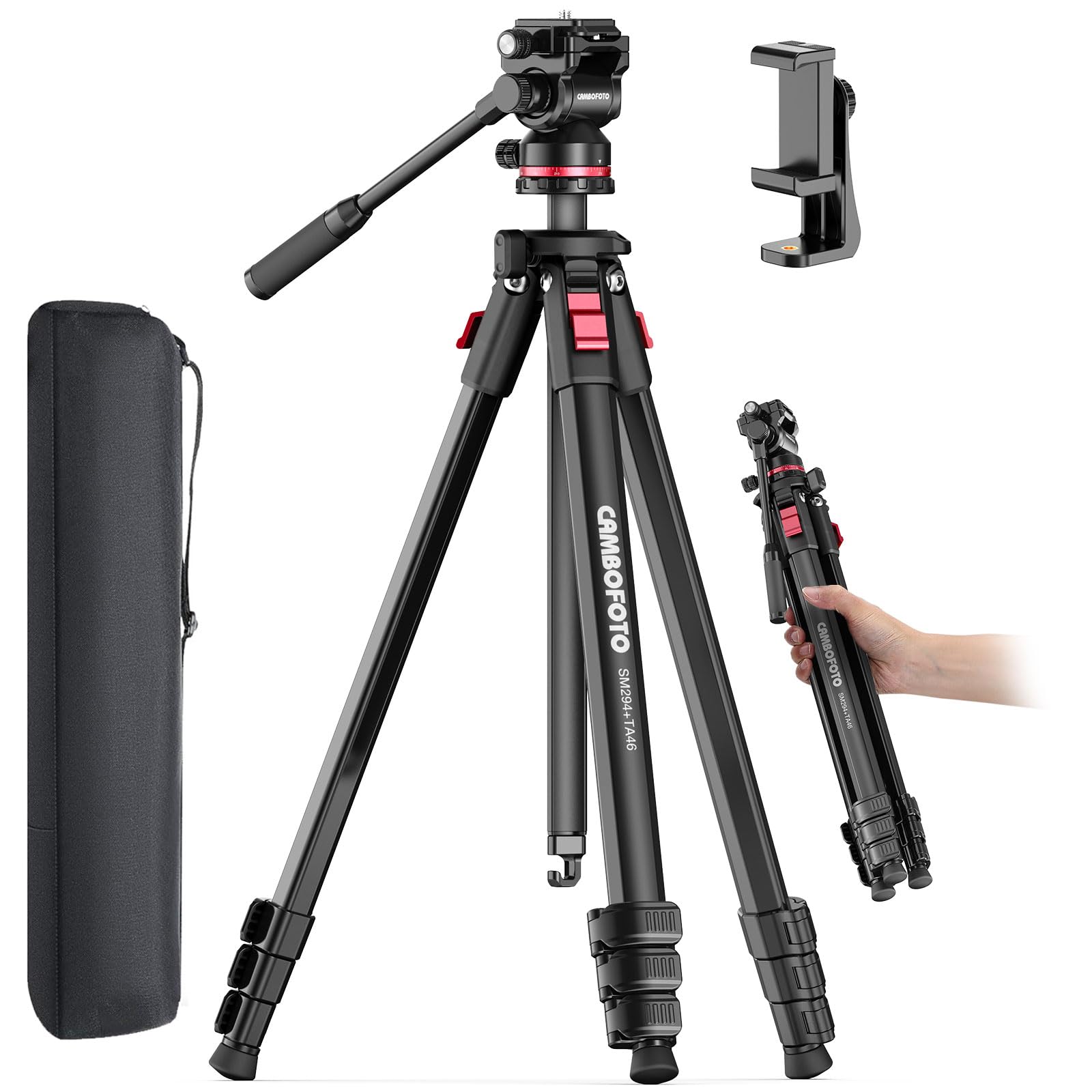
At its price, the CAMBOFOTO 68-inch is a well-made entry point for first-time video: the fluid head moves smoothly enough for slow pans on small mirrorless and camcorder kits, and the reversible center column plus included phone holder add practical value. The 8.8 lb load cap and budget-grade pan damping keep it below the main tiers — larger DSLR or gimbal rigs exceed the head's range, and shooters who need refined, adjustable drag control should look at the K3-equipped all-rounder in this guide. For learning smooth pan/tilt technique with lightweight gear, it is a low-risk starter.

Pros

  • Fit and finish feel well above the entry-level price.
  • Useful extras include a phone holder and a reversible center column.
  • Budget head still moves smoothly across pan and tilt axes.

Cons

  • Pan smoothness falls short of pricier fluid heads, so polished video panning is harder to achieve.
  • 8.8 lb load cap places larger DSLR or gimbal rigs above its intended range.
Our verdict

Keep this on the short list if your kit stays under 8.8 lb and your pans don't need a refined professional finish.

Check Latest Price

How to Choose

Max Payload

Payload ratings describe the head's damping capacity, not just how much the legs can hold. A head pushed near its limit gets stiff and makes slow pans harder to control. Match the rating to the heaviest camera and lens combo you actually mount.

Working Height

Height comes from extra leg sections or a raised center column, and both add flex. More sections fold shorter but create more joints where wobble enters. If you mostly shoot tabletop, a shorter tripod will be stiffer than a taller one at the same price.

Fluid Head Drag

'Fluid head' covers true adjustable damping and fixed-friction damping. A fixed-drag head can feel smooth with a light mirrorless body but sticky with a heavy DSLR. If you switch bodies often, look for adjustable drag controls.

Leg Lock Durability

Leg locks get squeezed and grit-loaded on every setup, so they wear faster than the head. Lightweight locks with small plastic levers can loosen over months of use. A tripod whose legs sag under a 17.6 lb load is not actually a 17.6 lb tripod.

Portability

Tripod weight is a direct trade against stiffness: steady twin-tube legs weigh more than 8 lb, while a 3.7 lb travel pod flexes in wind. Folded length matters as much as weight for packing. Match portability to how the tripod gets to the shoot, not how often you plan to carry it.

Quick-Release Plates

Quick-release plates are the interchange point between tripod and gimbal. A dual plate that works with DJI RS and Manfrotto 501PL saves you from swapping plates mid-shoot. If you switch supports often, choose a head using the same plate standard as your gimbal.

Frequently Asked Questions