7 Best Focus Rail for Macro Photography 2026: Straight-Tracking

The best focus rail for macro photography tracks straight and locks rigid — this guide matches rails to shooting style, from 4-way stacking to budget single-axis.

Most macro rails advertise CNC precision, but what separates a useful rail from a frustrating one is whether the carriage travels straight and stays rigid once locked. A rail that looks accurate on a spec sheet can still drift vertically or wobble when the clamp is not fully tightened.

The practical fix is choosing a rail whose movement matches your setup. Four-way rails let you position in both X and Y without adding a second rail, while single-axis designs often deliver the smoothest fine focus for the money. Travel length, load rating, and clamp compatibility all change which rail makes sense.

For focus stacking, locked rigidity matters more than the number of axes. A short, stable rail with clean tracking will outperform a longer rail that wanders beneath the camera.

1

Best Overall

NEEWER GM-MP1 4-Way Rail

88 /100
Studio Score Strong Evidence

Key details

Max Load
2.5 kg
Mount Type
Dovetail, 1/4 socket
Travel Range
Movement Axes
4-way X/Y
Check Price on Amazon

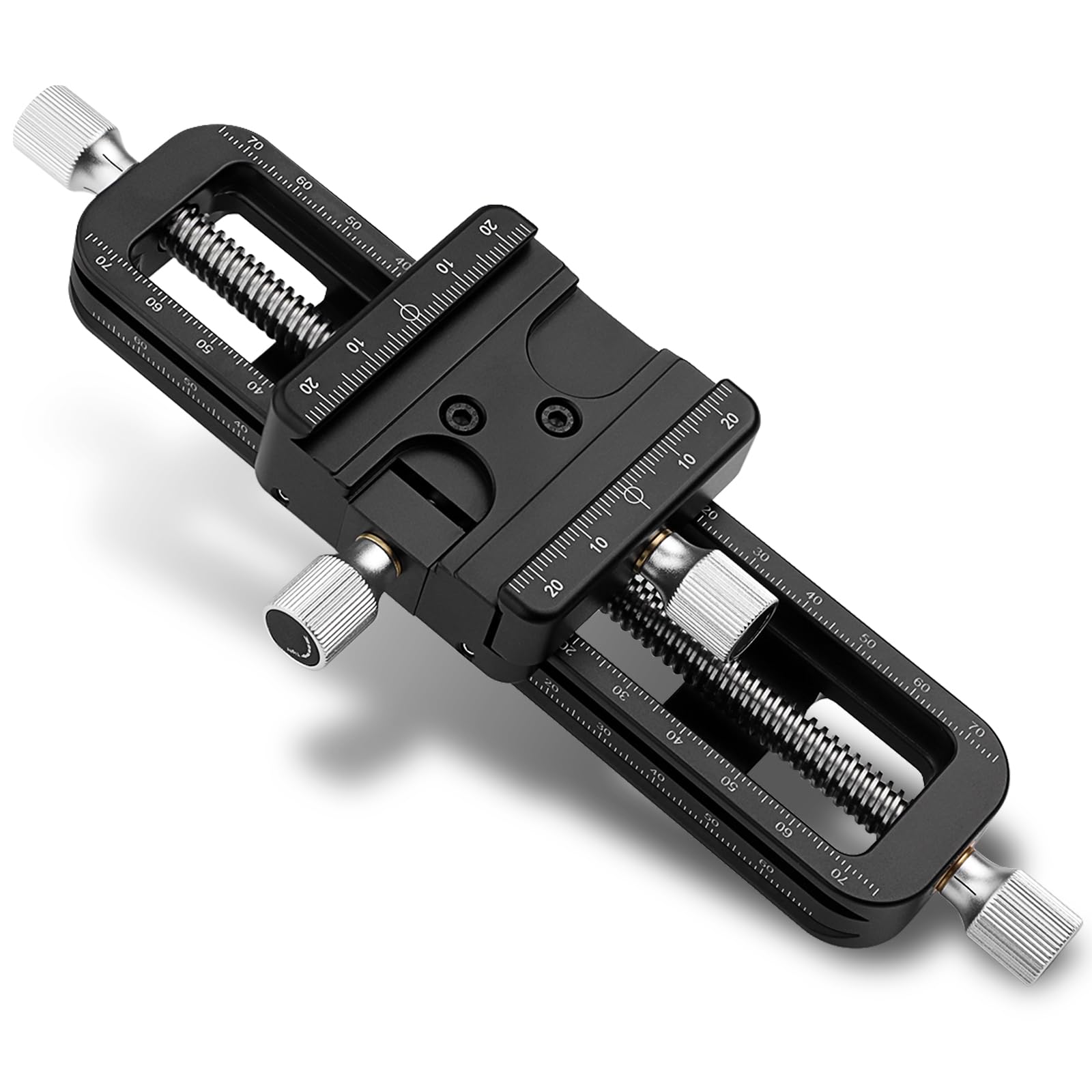
Four-way movement is the rail's central strength: left/right and forward/back adjustment live in one body, so macro shooters can shift framing for focus stacking without bolting on a second rail. Knob response follows that lead — small turns engage the slide almost immediately, and there is little of the dead rotation that makes fine focus dial-in frustrating. At macro magnifications, even a tiny shift changes the frame; the knob's fine engagement keeps those shifts intentional. The machined dovetail and sliding surfaces give a precision-made feel, and the included quick-release plate makes camera swaps fast between stacks.

On a copy stand, the rail behaves the way a macro stage should: lock the dovetail, nudge the camera for composition, fire a stack, then nudge again without the frame drifting. The quick-release plate is sized well for mirrorless bodies, and the dovetail clamp holds the camera firmly enough that moderate setups do not creep while the knobs are locked. When a shot needs a left/right reposition between stacks, the 4-way layout moves in that direction without breaking the setup to slide a single rail. It handles like two single-axis stages joined at the factory, not like an adapter stack. The 4-way layout also lets you change direction without returning the rail to a neutral point, which keeps the rhythm of a stack session fluid.

The mount system is simple: a 1/4-inch-20 socket on the base accepts a tripod ball head, while the dovetail clamp up top takes the included quick-release plate. On a copy stand, the rail can stay attached while the camera comes off for lens changes. The 570g weight is low enough that a compact tripod head handles it without strain, leaving head capacity for the camera and lens.

This rail targets macro photographers running mirrorless or moderately sized DSLR kits who want both X and Y movement from one unit instead of a stacked system. The 2.5kg load rating places a full-frame body with a macro lens and a flash bracket close to the ceiling, so lighter kits and copy stand work are the cleaner fit. Heavy medium-format rigs belong on a higher-capacity modular rail; within the rated range, the movement stays controlled and the clamp holds position. For insects, coins, watch parts, or small product details, the rail's travel and precision line up with the task.

At a mid-range price, the NEEWER undercuts the cost of assembling a 4-way setup from two single-axis rails. That value position puts it ahead of entry-level single-axis options for macro work: you pay once and get both movement axes without extra setup. This rail keeps the capability and still lands in the mid-range price bracket.

Pros

  • Four-way movement handles left/right and forward/back in a single rail, so focus stacking doesn't require a second axis.
  • Knob response is immediate; small turns produce fine, controlled shifts without slack.
  • The dovetail clamp and included quick-release plate hold moderately heavy mirrorless setups without creep.
  • Machined sliding surfaces deliver a precision-made feel at a mid-range price.

Cons

  • Travel range stops short of a 160mm+ sweep, so oversized copy-stand subjects need stand repositioning rather than rail movement.
  • Knob smoothness can vary between units; a quick check of both axes before mounting is worthwhile.
Our verdict

For macro shooters with mirrorless or moderately sized DSLR kits, this rail covers X/Y repositioning in one assembly at a mid-range price. It behaves like a dedicated macro stage for the focus-stacking work it targets.
Check Latest Price
2

Best for Long Travel & 360° Rotation

NiSi NM-180S Macro Rail

85 /100
Studio Score Strong Evidence

Key details

Max Load
5 kg
Mount Type
Arca-Swiss, 1/4, 3/8
Travel Range
160mm
Movement Axes
Single-axis plus rotation
Check Price on Amazon

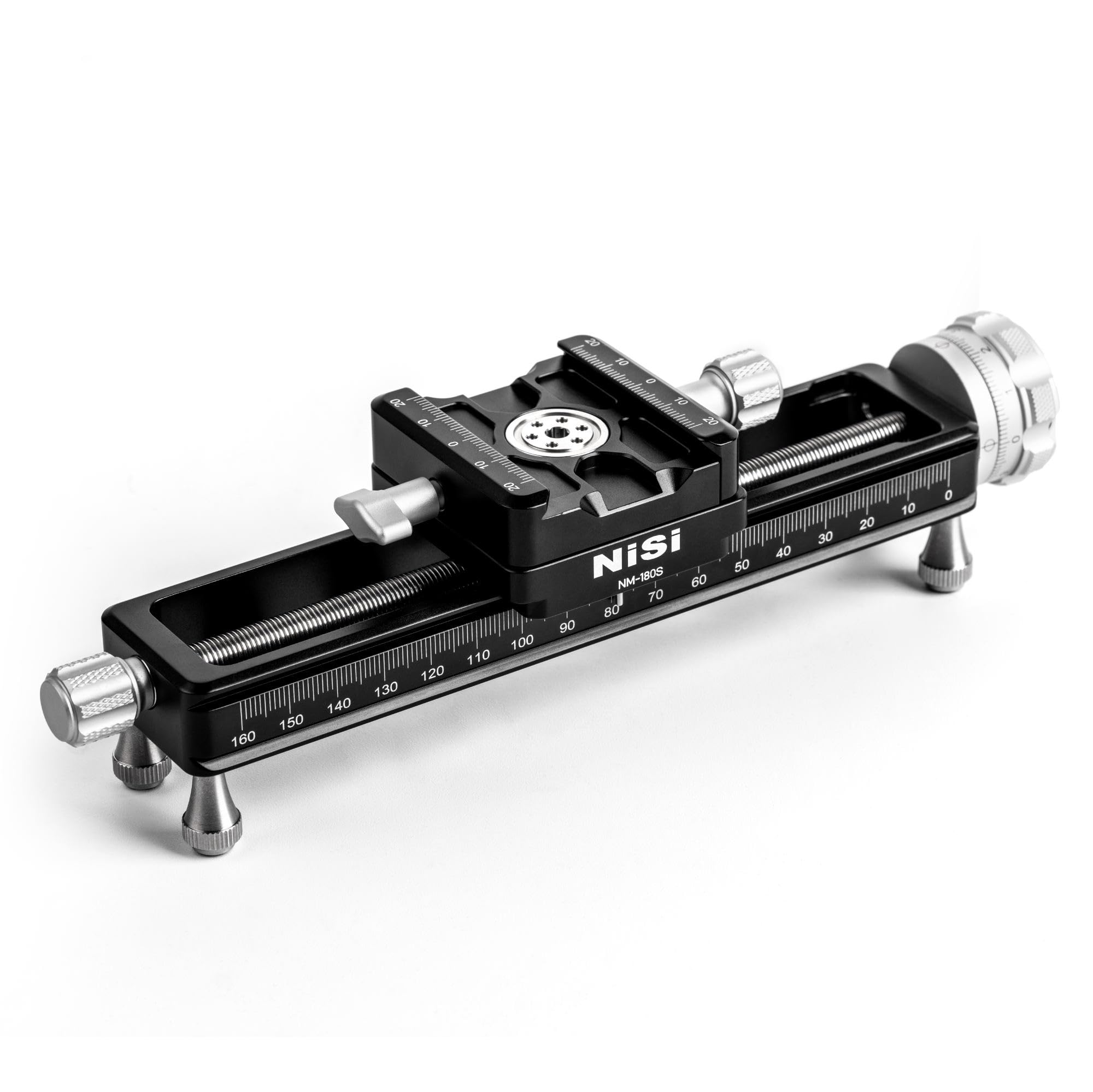
The NiSi NM-180S delivers the longest focus throw in this comparison — 160mm — while its rotating Arca clamp adds an extra compositional degree of freedom. The machined aluminum base and fine-adjustment thread give the rail a solid, precise feel during small increments, and the 360° head lets you switch between horizontal and vertical framing without breaking the clamp connection. Each full turn advances the stage 1.25mm, and the 5kg load rating covers typical full-frame camera and macro lens combinations. The base carries 1/4-inch and 3/8-inch threads, so it fits both camera bodies and lens collars.

The rotating Arca clamp holds standard quick-release plates and lets you re-frame without shifting the rail's base. The adjustment thread works smoothly through the full travel, so long stacks don't require the stage to be reset midway. That keeps a long stack running without extra repositioning.

This rail is best for macro photographers who work on extended focus stacks and want the rotating clamp to frame shots without unclamping. Stability depends on fully locked clamps, and some units show adjustment-path quirks at high magnification, so it suits a patient shooter who checks the rig before each sequence.

💡 Use the rotating clamp for initial framing, then leave it locked through the stack.

Pros

  • 160mm of travel handles extended focus stacks in one long pass.
  • Rotating Arca clamp allows framing changes without unclamping the rail.
  • Machined aluminum base and fine-adjustment thread keep small moves precise.

Cons

  • Single-axis rail has no Y-axis movement unless you add a second rail.
  • Premium price makes sense mainly for long-stack workflows, not casual close-up shooting.
Our verdict

For long-stack macro work, the NiSi NM-180S provides the travel and framing flexibility that single-axis rails rarely combine.

Check Latest Price
3

Best Single-Axis Micrometric

Manfrotto 454 Sliding Plate

83 /100
Studio Score Strong Evidence

Key details

Max Load
8 kg (17.6 lb)
Mount Type
Travel Range
Movement Axes
Single-axis
Check Price on Amazon

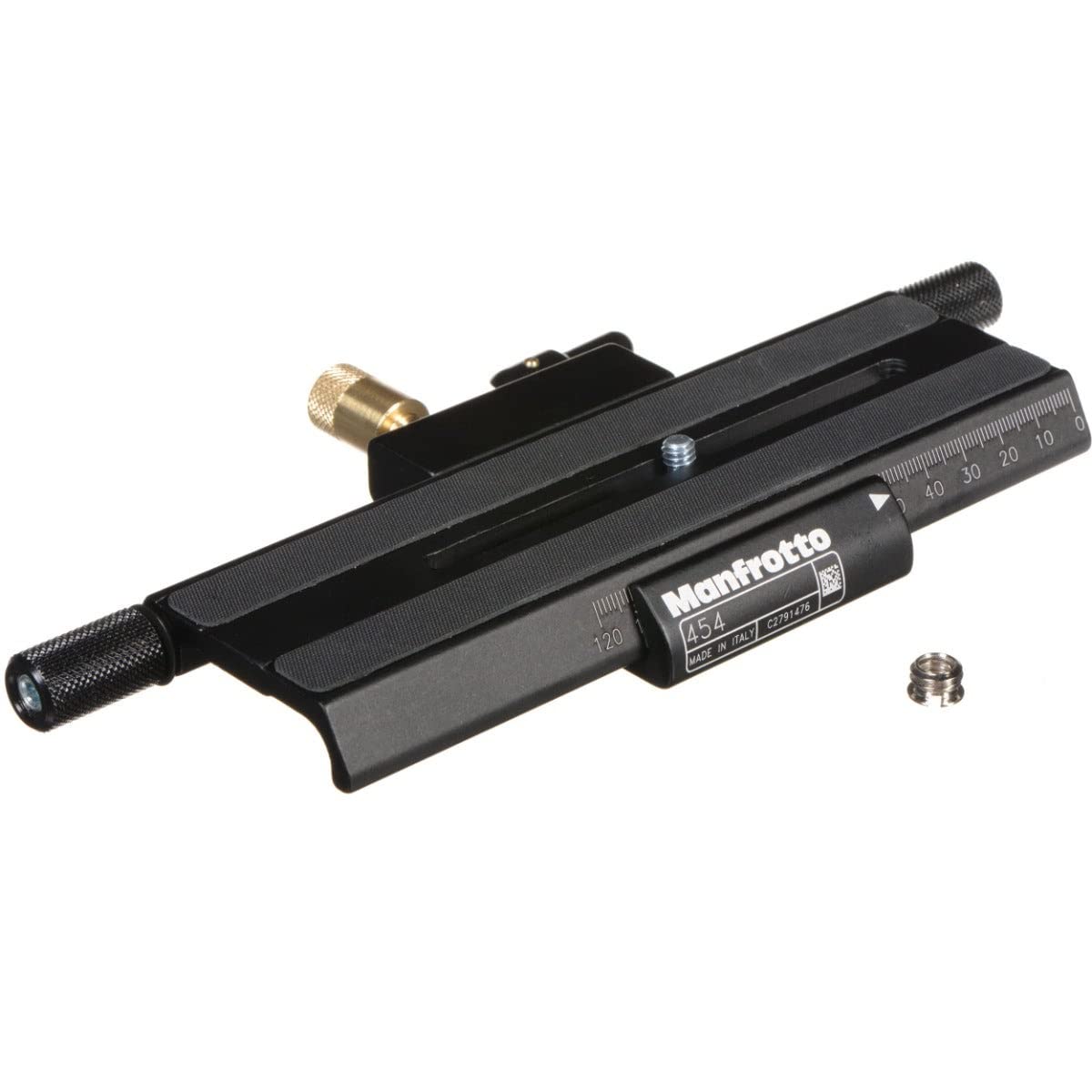
Manfrotto's 454 delivers fine, repeatable focus shifts at roughly 1mm per turn of the adjustment knob, with a rapid positioning lever for coarse moves. That combination suits macro work where focus stacking demands even, tiny increments rather than speed. Flower and product shooters will notice the difference when a half-turn of movement is all they want. Its focused control keeps the setup simpler than a four-way rail while still covering the distance-to-subject changes typical of still-life shots.

The machining has carried photographers through long studio sessions and outdoor close-up work, and the control suits subjects like flower details and small product shots where each millimeter of focus shift shows up in the frame. The price is reasonable for a name-brand plate, and the lever makes quick set changes possible without losing the fine-adjustment position. Its narrow focus is what makes it useful for dedicated macro shooters.

This plate fits photographers already on a Manfrotto head who want a dedicated focus stage for product work, still life, or wildflower close-ups. It is single-axis only, and the slide mechanism can develop play over time, so checking full travel early is worthwhile. For those needs, the 454 offers a direct path to controlled macro focus.

Pros

  • One full turn of the knob shifts focus in 1mm increments, making close-up movements predictable and repeatable.
  • The rapid positioning lever allows quick coarse adjustments between fine focus shifts.
  • The price is reasonable for a name-brand micrometric slider with this level of control.

Cons

  • No Arca-Swiss compatibility, so quick-release users need an adapter or a different clamp.
  • Clearance below the rail can limit stacked ring flash setups and reduce travel.
Our verdict

For controlled still-life focus work with minimal setup fuss, the 454 is a purposeful purchase.

Check Latest Price
4

Budget Precision Pick

Haoge FM-160 Macro Rail

81 /100
Studio Score Strong Evidence

Key details

Max Load
Mount Type
Arca-type, 1/4 threads
Travel Range
115mm
Movement Axes
Single-axis
Check Price on Amazon

The Haoge FM-160’s worm-drive mechanism delivers smooth, controlled 4mm-per-turn shifts, with two damping screws letting you tune resistance to match the weight of your rig. That mechanical confidence is what separates it from cheaper entry-level sliders in this comparison set.

The single-axis design and compact 400g body make it a natural fit for field and travel macro work, where packing light matters more than having both X and Y adjustment on hand. For a full-frame camera with a macro lens and extension tubes, the rail holds position without noticeable sag or play.

Small knobs and a stiff action are the boundaries here. Fine focus stacking increments are pleasant, but extended repositioning across the full 115mm of travel takes more finger effort than on smoother-turning rivals. That tradeoff suits a budget-conscious Arca-Swiss shooter who wants precision per millimeter over speed across the whole rail. This is not a 4-way repositioning tool; it is a purpose-built single-axis focusing rail.

💡 Loosen the damping screws before large repositioning moves, then re-tighten for fine stacking increments.

Pros

  • Worm-drive action with damping screws provides smooth, precise shifts at a budget-friendly price.
  • Sturdy enough to hold a full-frame body, macro lens, and extension tubes without sag.
  • Real value for the price

Cons

  • Damping screws add resistance that makes rapid repositioning across the rail slower.
  • The small control knobs can be less comfortable during long stacking sessions.
Our verdict

For a macro shooter who wants precision mechanics without paying premium prices, the Haoge delivers where it counts: controlled focus shifts and a stable platform.

Check Latest Price
5

Best for Heavy Rigs & Modular Stacking

Sirui MS18 Macro Rail

82 /100
Studio Score Strong Evidence

Key details

Max Load
10 kg
Mount Type
Arca-Swiss, 3/8 socket
Travel Range
Movement Axes
Single-axis stackable
Check Price on Amazon

The Sirui MS18 is the high-load modular rail in this group, with a 10kg capacity, stackable single-axis design, and detachable feet. Where the complete four-way rail covers X/Y movement out of the box, the MS18 is built for photographers who are already running heavy macro kits and can add a second rail for Y-axis work.

Best for still-life and close-up shooters who need to move a full-frame body and macro lens in controlled increments. The 360° rotating head and Arca-Swiss mount give framing flexibility, and the detachable feet make tabletop-to-tripod transitions easy. QC can vary between units, so this rail suits buyers who will verify tracking on arrival and are willing to return an imperfect sample.

The build feels sturdy when the machining is right, and the rotating head handles composition changes without extra clamps. The Arca-Swiss base sits well on common clamps, and the detachable feet add useful stability on both tripod and tabletop. For a single-axis rail at this price point, the MS18 delivers the weight capacity that lighter four-way options cannot, which matters when the camera rig is substantial.

Pros

  • Carries heavy macro rigs up to 10kg, including full-frame bodies and longer lenses.
  • Stackable single-axis design allows a 4-way X/Y setup by adding a second rail.
  • Detachable feet make tabletop and tripod mounting flexible.
  • Controlled incremental movement supports still-life and close-up focus stacking.

Cons

  • Handle tension can vary across units, feeling tight then loose on the same rail.
  • Tracking straightness can vary between units, with vertical drift or oscillation possible during travel.
Our verdict

For shooters with heavy macro kits, the MS18 brings the load capacity and modularity the lighter four-way rail doesn't, provided the unit on hand is a good one.

Check Latest Price
6

Premium Precision Choice

Novoflex Castel-Q

91 /100
Studio Score High Confidence

Key details

Max Load
Mount Type
Dovetail, 1/4, 3/8
Travel Range
140mm
Movement Axes
Single-axis stackable
Check Price on Amazon

The Novoflex Castel-Q is a German-engineered focusing rail built around a stackable dovetail, so it works as a precise single-axis slider today and can grow into an X/Y stage when a second unit is added. That modular character is the core distinction: the rail doesn't try to be a do-everything 4-way slider. Instead, it gives you one well-made axis with 140mm of travel, which covers extended focus-stacking runs without frequent re-clamping.

Each full turn of the adjustment knob moves the stage 15mm, which makes fine focus changes deliberate and repeatable. The Arca-size dovetail and dual 1/4-20 and 3/8-16 threads fit standard quick-release hardware, so it mounts in most existing macro rigs without proprietary parts. Locking the stage holds composition in place between frames, and the straight tracking keeps stacked images aligned in a way cheap sliders miss.

This rail is for professional or serious macro photographers who treat equipment as a long-term investment and want German precision with a modular upgrade path. It is not a one-box 4-way slider: Y-axis movement requires a second Castel-Q. Shoppers who need that capability in a single package will find this rail is only half of the setup; the payoff comes when you commit to building the complete X/Y rig.

Pros

  • Stackable dovetail design allows modular expansion to X/Y control.
  • Long 140mm travel covers extended focus-stacking runs.
  • 15mm per turn keeps fine adjustments precise and repeatable.
  • The rail retains smooth tracking after extended use.

Cons

  • Premium pricing places this beyond budget-focused kits.
  • Single-axis format puts Y-axis movement in a separate purchase.
Our verdict

The Castel-Q is the right rail when you want one axis done properly and a clear path to expand later.

Check Latest Price
7

Budget Arca Buyers

Koolehaoda W-160 Rail

78 /100
Studio Score Established

Key details

Max Load
10 kg
Mount Type
Arca/RRS, 1/4, 3/8
Travel Range
115mm
Movement Axes
Check Price on Amazon

The Koolehaoda pairs Arca/RRS dovetails with 115mm of travel and a 10kg load rating at an entry-level price. That combination makes it one of the lowest-cost ways to move a light camera through focus-stacking sequences on an existing Arca clamp. The 300g weight adds almost nothing to a field bag. The main reason it sits below the higher-tier picks is that real-world tracking precision is harder to verify with this model, so critical high-magnification work is best handled elsewhere. It belongs in the conversation as a budget option, not a precision instrument.

Pros

  • Arca/RRS dovetail compatibility lets it mount to existing clamps without extra adapters.
  • 115mm of travel covers a long focus-stacking range before repositioning.
  • At 300g, the rail keeps a field macro kit light.

Cons

  • The 10kg max load is a static figure, not a guarantee of tracking stability for heavy full-frame rigs.
  • It is a one-axis rail, so side-to-side framing changes need a separate rail.
Our verdict

If you already have an Arca clamp and your macro work stays with light cameras, this is a cost-effective way to get 115mm of travel.

Check Latest Price

How to Choose

Travel Range

Travel range determines how far the camera moves before you reset the rail. Longer travel, such as 160mm, is useful for deep focus stacks or larger subjects, but it adds length to the setup. Shorter rails are easier to carry and often feel more rigid under the camera.

The catch is that long travel is only useful if the carriage keeps the same orientation across the full path. A rail that drifts at one end will ruin a stack no matter how many millimetres it covers.

Movement Axes

Single-axis rails move the camera forward and backward for focus adjustments, while 4-way designs add left-right movement for repositioning within the frame. The convenience of a 4-way rail is that you don't need to stack two units, but the unused axis must be locked during stacking to avoid creep. For most macro focus stacking, X/Y movement becomes essential when you want to shift composition between shots without touching the tripod head.

Mount Type

Arca-Swiss compatibility is the de facto standard because it lets you slide the camera along the rail and lock it firmly. Dovetail rails use a similar profile, but the clamp geometry varies, so a mismatch can reduce contact area and create play. The practical result shows up in the field: a rail that mounts securely to your existing head and plate saves time and avoids awkward adapter stacking.

Max Load

Load ratings describe how much weight the rail can support, but they don't describe how well the carriage holds that weight while moving. A rail with a high rating can still show flex if the sliding carriage has a thin contact surface or the locking mechanism isn't fully engaged. For heavy macro rigs, look for a wide base and dual locking points rather than trusting the number alone.

Tracking Quality

Tracking quality decides whether a 1mm adjustment actually moves the camera 1mm in a straight line. The lead screw and carriage bearing surfaces control this, and manufacturing tolerances determine how smoothly the thread engages across the full travel. A rail that feels smooth at the start can become stiff or loose in the middle if the screw is not straight. That is why inspecting the actual travel path matters more than the CNC claims on the listing.

Frequently Asked Questions