9 Best Canon Zoom Lens of 2026: Right Reach, Weight, Light

Which Canon zoom lens fits your camera mount, reach, and shooting light — without paying for f/2.8 prestige you don't need.

Most Canon zoom listings lead with the fastest f/2.8 badge and L-series branding. The lenses photographers actually keep on the camera are the ones that balance reach, weight, and image stabilization with the light they really shoot in. A 400mm reach at f/8 is a daylight tool; the same reach at f/2.8 is a different tool with a much higher price.

The trade-off that matters most is focal-length range versus maximum aperture. A constant f/4 zoom covers more daily ground for most owners, while an f/2.8 lens earns its weight in dim venues and for shallow depth of field. Knowing which side you land on makes the choice obvious.

This guide matches Canon zooms to the mount, reach, and light they serve best — from budget daylight telephotos to low-light workhorses. Weight and stabilization matter as much as aperture in real-world carry. Match the lens to what you actually shoot, and you stop paying for speed you will not use.

1

Best Overall

RF 24-105mm f/4 L IS USM

92 /100
Studio Score High Confidence

Key details

Weight
680 g
Lens Mount
RF
Max Aperture
f/4 constant
Focal Length Range
24-105mm
Check Price on Amazon

The RF 24-105mm f/4 L IS USM covers a practical wide-to-short-tele range without the bulk and price of an f/2.8 zoom. At 24mm, the field of view handles interiors and group shots; at 105mm, it tightens into a short portrait lens. It holds edge-to-edge sharpness at f/4, so landscape and reportage shooters can crop into frames without losing definition. The Nano USM motor pulls focus quickly and quietly, and the optical stabilizer provides up to five stops of correction. For a lens that stays mounted all day, these traits matter more than an extra stop of light.

Because the aperture remains constant through the zoom range, exposure stays stable as you reframe, which reduces surprises in burst and video work. The 1.5 lb weight balances well on R-series bodies, and the 77mm filter thread matches other RF and EF lenses. The optical stabilizer extends usable handheld shutter speeds, while the silent focus drive keeps attention away from the camera during events. It is a lens built to stay mounted, not swapped at every scene change.

The Nano USM drive helps stills and video alike. Focus acquisition is fast enough for moving subjects in event work, and the quiet action avoids audio spikes in on-camera recording. When paired with eye detection, the lens keeps focus locked during reframing rather than hunting back and forth.

The intended buyer is a travel, landscape, or event photographer who wants one lens on the camera through a full day. It also serves RF full-frame and APS-C owners upgrading from kit zooms, especially hybrid shooters who want stabilization and silent autofocus in the same package. If your work lives in dark venues or demands the separation of an f/2.8 lens, the faster sibling is the better fit; wildlife shooters will still need longer reach than 105mm.

The value case is simple: it delivers the core L-series standard-zoom experience at lower weight and cost than the f/2.8 sibling. The 24-105mm reach is what separates it for travel and event use; you gain reach, save weight, and keep the same L-series build quality. This is the standard zoom to keep on an RF camera when you do not want to plan the day around lens changes.

Pros

  • L-series image quality stays sharp across the frame at f/4, with room to crop in landscape or reportage.
  • The 24-105mm range covers wide and short-tele subjects without swapping lenses.
  • Nano USM autofocus is fast and quiet enough for stills and on-camera video.
  • Weighs less and costs less than f/2.8 standard zooms while keeping L-series build.

Cons

  • Maximum aperture f/4 limits low-light work and background separation compared with f/2.8 zooms.
Our verdict

For an RF shooter who wants one lens for travel, landscape, and event work, this is the standard zoom to keep on the camera.

Check Latest Price
2

Best Pro Standard Zoom

RF 24-70mm f/2.8 L IS USM

94 /100
Studio Score High Confidence

Key details

Weight
898 g
Lens Mount
RF
Max Aperture
f/2.8 constant
Focal Length Range
24-70mm
Check Price on Amazon

The RF 24-70mm f/2.8L pairs a constant f/2.8 aperture with up to five stops of optical IS, so handheld frames stay sharp in dim venues where an f/4 standard zoom begins to struggle. The L-series build and Nano USM motor keep up with event work without drawing attention to autofocus. A constant aperture also holds exposure steady through the zoom range, so shifts from 24mm to 70mm don't change your settings.

At 24mm, close focus is 0.69 ft; at 70mm, 1.25 ft, which gives environmental portraits a usable foreground. The constant f/2.8 keeps depth of field shallow enough for subject separation, and the IS steadies handheld video as well.

The buyer this suits is the working event or wedding photographer on RF who needs low-light speed and quiet AF. It is not for budget-conscious hobbyists or travelers who prioritize a lightweight kit; the f/4 24-105 standard zoom gives up light and depth of field but keeps the bag lighter. Hybrid shooters get the same IS and silent AF for video, so the lens works across stills and clips.

💡 A grip or harness helps during long event days on smaller RF bodies.

Pros

  • Outstanding overall image quality and sharpness across the frame.
  • L-series build quality and rendering hold up under professional use.
  • Nano USM focuses fast, smoothly, and quietly for stills and video.
  • Optical IS steadies handheld shots and video in lower light.

Cons

  • The 24-70mm range is shorter than the 24-105mm f/4 standard zoom, so one-lens reach is tighter.
  • Substantial weight for all-day carry
Our verdict

For RF shooters who need constant f/2.8 for dim venues, this is the standard zoom to carry; those with different priorities have a capable alternative in the f/4 24-105.

Check Latest Price
3

Best Budget Telephoto for RF

RF 100-400mm f/5.6-8 IS USM

90 /100
Studio Score High Confidence

Key details

Weight
816 g
Lens Mount
RF
Max Aperture
f/5.6-8
Focal Length Range
100-400mm
Check Price on Amazon

The RF 100-400mm f/5.6-8 IS USM is the lightweight reach option in Canon's RF zoom lineup: 816 grams, up to 6 stops of stabilized correction when paired with an RF body with IBIS, and a 0.41x maximum magnification at 400mm for close-focus work.

Image quality holds up for wildlife and outdoor sports in good light, with the Nano USM autofocus fast enough for moving targets and quiet enough to avoid spooking birds. The optical stabilizer covers up to 5.5 stops on its own, which keeps handheld 400mm shots sharp when shutter speeds stay high.

The zoom range starts at 100mm, so it pairs cleanly with a standard zoom for a two-lens travel kit, and the light weight makes it a natural companion for hikes where a heavy f/2.8 telephoto would stay home.

This lens is for RF wildlife and outdoor sports shooters on a budget, hikers who want reach without a heavy bag, and APS-C RF owners extending focal length. If you shoot indoor or evening sports, or need f/4 or faster telephoto capability, this is not the lens.

Pros

  • Reach and optical quality that undercut the price of comparable RF telephoto options.
  • Sharp, detailed frames for wildlife and outdoor sports when the light is good.
  • 816-gram carry makes it a packable telephoto for hikers.
  • Nano USM autofocus is fast and quiet, with close focus useful for small subjects.

Cons

  • Slow variable aperture closes to f/8 at 400mm, raising ISO needs in shade or overcast light.
Our verdict

For daylight wildlife, hiking reach, and APS-C reach extension, this RF zoom delivers more reach per dollar than the heavier L-series alternatives.

Check Latest Price
4

Best Telephoto for APS-C DSLRs

EF-S 55-250mm f/4-5.6 IS STM

94 /100
Studio Score High Confidence

Key details

Weight
375 g
Lens Mount
EF-S
Max Aperture
f/4-5.6
Focal Length Range
55-250mm
Check Price on Amazon

The EF-S 55-250mm f/4-5.6 IS STM is the budget tele zoom that stands apart from the earlier 55-250mm IS II: the STM focus motor keeps autofocus quiet during video, and the optical image stabilization keeps handheld frames sharp at the long end. It delivers the same reach as the older model with quieter focus, which matters for Rebel owners who switch between photos and clips.

At 375 grams, this lens is light enough for a full day on a Rebel body, making it a practical walkaround tele for travelers, daylight sports, and beginner wildlife sessions. Autofocus in bright conditions is fast, and the middle of the zoom range delivers sharp images; the far end softens when the aperture is wide open, but stopping down recovers most of that detail. The optical stabilizer also extends usable handheld shutter speeds, so a quick shot at 250mm does not automatically require a solid tripod.

This lens uses Canon's EF-S crop-sensor mount, so it belongs on Rebel and APS-C DSLR bodies that need reach without L-series cost. Full-frame EF or RF shooters would face significant crop constraints that cut into resolution and field of view, so those users should keep this lens out of their kit. For its target audience, the 55-250mm IS STM is the value tele zoom in Canon's APS-C lineup.

Pros

  • Budget-friendly 250mm reach for Canon APS-C DSLR owners without L-series price.
  • Sharpness across most of the zoom range holds up for a lens at this price point.
  • STM autofocus is quiet and smooth for stills and video.
  • At 375 grams, it rides easily on a Rebel for all-day travel.

Cons

  • At 250mm the aperture narrows to f/5.6, so indoor and twilight action scenes will push ISO and shutter speed higher.
Our verdict

Canon APS-C owners who want 250mm of quiet-focusing, stabilized reach on a budget should put this on the short list.

Check Latest Price
5

Best Fast Telephoto for RF

RF 70-200mm f/2.8 L IS USM

93 /100
Studio Score High Confidence

Key details

Weight
1.18 kg
Lens Mount
RF
Max Aperture
f/2.8 constant
Focal Length Range
70-200mm
Check Price on Amazon

The RF 70-200mm f/2.8 L IS USM is Canon's compact 70-200mm f/2.8 design for RF, pairing f/2.8 speed with fast autofocus and up to 5 stops of optical stabilization at both ends of the zoom range.

The constant f/2.8 aperture keeps shutter speeds usable in dim venues and creates smooth bokeh with strong telephoto compression at the long end. L-series optics hold detail at f/2.8 across the focal range, and the optical stabilizer makes handheld shots sharper at moderate shutter speeds, especially at 200mm. The combination keeps you shooting in conditions where a slower aperture would force a higher ISO.

The 2.3 ft close-focus distance lets you fill the frame with a small subject, which helps in tight spaces. Autofocus tracks during continuous bursts, so a fast-moving subject stays in the frame.

This lens is clearly for working sports, event, and portrait photographers who need f/2.8 speed and subject separation. It is still heavy for travel and walkaround use, so RF users who rarely chase moving subjects should compare the lighter f/4 or the value-priced 100-400 RF zoom instead. Budget-conscious hobbyists would be paying for speed they do not need.

Pros

  • L-series optics deliver strong sharpness at f/2.8 across the zoom range.
  • Fast f/2.8 aperture gives smooth bokeh and useful separation for portrait work.
  • Compact body for a 70-200mm f/2.8, making it easier to handle than older EF versions.
  • Autofocus on R-series bodies is fast and accurate for tracking moving subjects.

Cons

  • The zoom ring requires a long rotation to sweep the full range, which can slow quick framing changes.
  • Lighter than the EF version but still not a small lens, and it takes up real pack space.
Our verdict

The RF 70-200mm f/2.8 L IS USM is the f/2.8 telephoto for RF shooters who want L-series optics in a more compact body than Canon's EF design.

Check Latest Price
6

Best Ultra-Wide for Landscapes

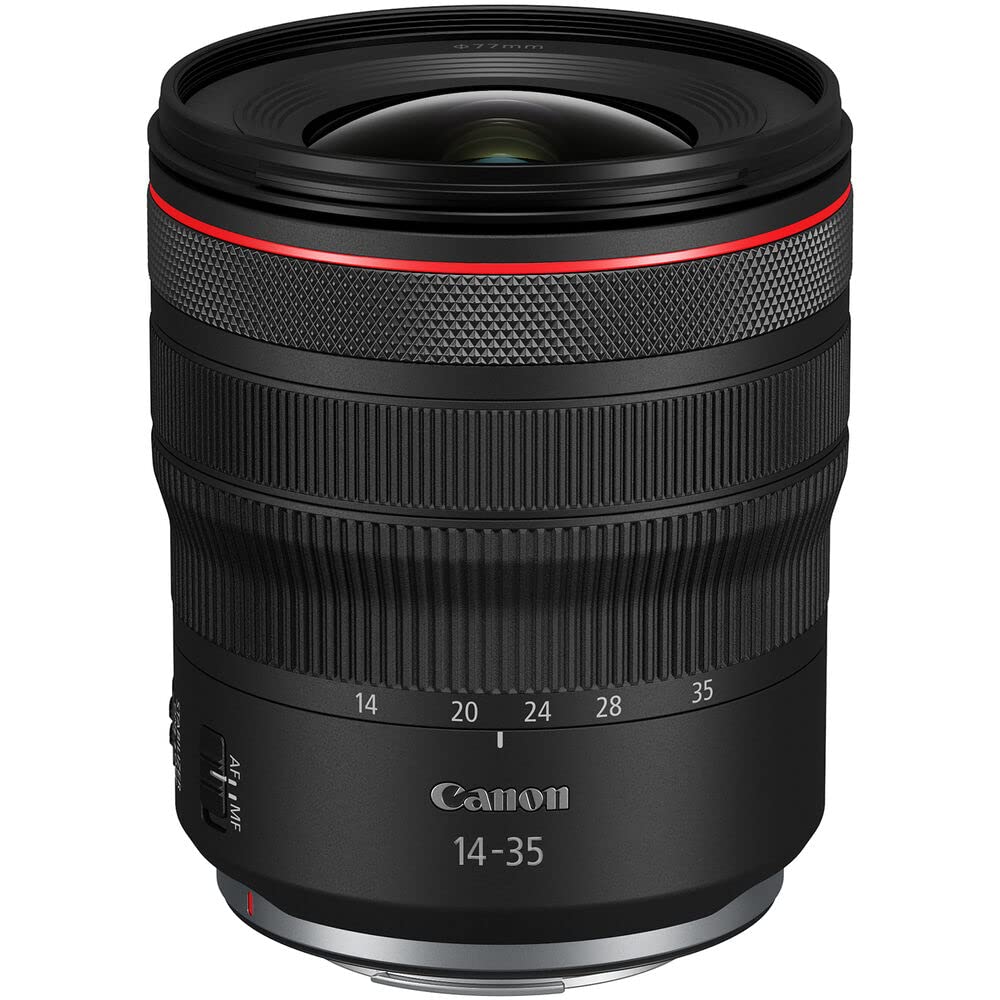
RF 14-35mm f/4 L IS USM

90 /100
Studio Score High Confidence

Key details

Weight
544 g
Lens Mount
RF
Max Aperture
f/4 constant
Focal Length Range
14-35mm
Check Price on Amazon

The RF 14-35mm f/4L delivers true 14mm ultra-wide coverage in a 544g L-series zoom that balances well on RF bodies and gimbals. It gives up the broad focal range of the standard-zoom class leader, but the trade is exactly what wide-angle work requires: a lens that starts where ordinary zooms stop.

Autofocus is fast and quiet, and close focus at 7.9 in holds at every focal length, so you can move from a room-wide establishing shot to a detail insert without switching lenses. On a gimbal, the 544g weight keeps the rig manageable, and optical IS steadies handheld panning.

This is the wide-angle specialist for landscape, architecture, real estate, and gimbal video work, where 14-35mm covers rooms and vistas without demanding a backpack. Some copies show soft or blurry edges at the widest setting, so inspect the wide end before relying on corner sharpness. Real estate shooters who need 14mm interior coverage are the core audience; landscape photographers can stop down for the depth of field they want. For video, the constant f/4 aperture keeps exposure stable while zooming, which reduces surprises in the edit.

Pros

  • Compact L-series ultra-wide that reaches 14mm without becoming a bulky wide zoom.
  • 544g weight suits handheld work and keeps gimbal rigs light.
  • Fast, quiet autofocus with close focus at every focal length.
  • Range matches real estate, architecture, landscape, and video tasks.

Cons

  • Vignetting at 14mm can be noticeable, though post-processing can correct it.
  • Dark interiors may push ISO up because f/4 cannot open wider.
Our verdict

For RF shooters whose work lives between 14 and 35mm, this is the compact L zoom to carry.

Check Latest Price
7

Wildlife, Birds

RF 100-500mm f/4.5-7.1 L

90 /100
Studio Score High Confidence

Key details

Weight
3 lb
Lens Mount
RF
Max Aperture
f/4.5-7.1
Focal Length Range
100-500mm
Check Price on Amazon

The RF 100-500mm f/4.5-7.1L is the RF option for shooters who want 500mm reach without adapting EF glass. L-series sharpness shows at the long end, autofocus tracks moving subjects on R-series bodies, and the 100-500mm range handles framing changes from a close perch to a distant bird. Extenders stretch that reach farther when the subject stays out of range.

The missing zoom lock is the main handling quirk: the barrel can extend or slide while the lens is carried, so keeping a hand on the zoom ring during a hike is the practical fix. The lighter 100-400mm RF zoom is the more sensible casual reach option, which leaves this lens in the dedicated wildlife corner of the lineup.

Pros

  • L-series sharpness holds up at 500mm for feather-level detail in wildlife frames.
  • Autofocus tracks moving subjects on R-series bodies during long shooting sessions.
  • Extenders add reach when birds stay distant, extending the lens beyond 500mm.

Cons

  • At f/7.1, the 500mm end needs strong daylight for action-stopping shutter speeds.
  • Premium price makes it a specialist purchase rather than a casual telephoto.
Our verdict

The right fit for dedicated wildlife shooters who need native RF 500mm reach; casual buyers should take the lighter RF 100-400 route.

Check Latest Price
8

Low-Light Events

RF 28-70mm f/2 L USM

91 /100
Studio Score High Confidence

Key details

Weight
3.2 lb
Lens Mount
RF
Max Aperture
f/2 constant
Focal Length Range
28-70mm
Check Price on Amazon

Canon's RF 28-70mm f/2L is the only constant f/2 standard zoom in the lineup, delivering sharp, high-contrast images and fast USM focus that suit wedding and event work. That speed carries real boundaries: the 3.2 lb barrel is heavy, there is no optical IS (IBIS-equipped RF bodies are the natural home), barrel-coating peel has been noted on some units, and the premium price is aimed at working pros. Those limits keep it a specialist tool rather than a broad recommendation, but portrait and low-light shooters who value f/2 over compactness get a payoff that no other RF zoom matches.

Pros

  • Sharpness and rendering stay clean across the zoom range, giving event photos consistent file quality.
  • Constant f/2 aperture replaces a set of primes for low-light venues and controlled depth of field.
  • USM autofocus locks quickly enough for weddings and moving subjects on RF bodies.

Cons

  • The 28mm wide end is less forgiving in tight interiors than 24mm standard zooms.
  • Non-IBIS EOS R or RP bodies need faster shutter speeds for handheld low light.
Our verdict

This is the RF standard zoom for wedding and event pros whose priority is constant f/2 speed.

Check Latest Price
9

EF Wildlife

EF 100-400mm f/4.5-5.6 L IS

86 /100
Studio Score Strong Evidence

Key details

Weight
1380 g
Lens Mount
EF
Max Aperture
f/4.5-5.6
Focal Length Range
100-400mm
Check Price on Amazon

The Canon EF 100-400mm f/4.5-5.6L IS USM brings classic L-series color, built-in stabilization, and strong resale value to EF DSLR wildlife shooters who want one telephoto zoom for daylight outings. It is sharp at 400mm when technique and light are good. The push-pull zoom feels quick once you learn the motion but divides users; the 1380 g body will test your arms on a full day; and autofocus hesitates in low light — these are why lighter, faster-focusing RF alternatives now sit ahead of it. Still, for an EF shooter who wants classic rendering without switching systems, this old workhorse remains a value.

Pros

  • Classic L-series color gives wildlife frames a familiar Canon look.
  • At 400mm it stays sharp when technique and light are good.
  • EF L mount demand keeps used prices strong.

Cons

  • At 400mm, the f/5.6 maximum aperture narrows your margin in lower light.
  • RF mirrorless shooters who want native mounting must add an adapter.
Our verdict

Daylight EF DSLR wildlife work is where this classic L zoom still makes sense.

Check Latest Price

How to Choose

Focal Length Range

Zoom range sets how close you can get without moving. A 24-70mm or 24-105mm standard zoom handles group shots through environmental portraits; a 70-200mm or 100-400mm pulls distant subjects close and compresses backgrounds.

Longer focal lengths magnify both subject and camera movement, so they need faster shutter speeds or stabilization. On APS-C bodies, the crop factor extends effective reach, making a 55-250mm feel like a much longer telephoto.

Maximum Aperture

Maximum aperture controls light intake and depth of field. A constant f/2.8 zoom gathers twice the light of f/4, which is why event pros carry the extra size.

Variable-aperture zooms like f/4-5.6 or f/5.6-8 lose light as you zoom long because the iris cannot grow to keep the same ratio. They work well in daylight but struggle indoors and at dusk.

Image Stabilization

Image stabilization counters hand shake, not subject movement. At 300mm, a small wobble shifts the frame across many pixels, which is why non-IS tele zooms generate blur complaints.

A stabilized tele zoom like the EF-S 55-250 IS STM or RF 100-400 lets you shoot several stops slower than the old 1/focal-length rule. It still will not freeze a moving subject — use a fast shutter for action.

Weight and Portability

Weight decides whether a lens stays on the camera. A 375g tele zoom is easy to carry all day; an 898g f/2.8 standard zoom is a far heavier load on a small mirrorless body.

L-series construction uses metal mounts, weather sealing, and heavier glass, which adds durability and mass. For day trips and travel, lighter variable-aperture lenses often serve better than pro f/2.8 zooms.

Lens Mount

Mount compatibility comes down to the code next to the Canon name. RF and RF-S lenses fit mirrorless R bodies; EF and EF-S lenses fit DSLRs.

EF lenses can be adapted to RF bodies without losing autofocus, but they add length and older focus motors can feel slower. EF-S is APS-C-only and will not cover a full-frame sensor, so it cannot be used on full-frame bodies.

Frequently Asked Questions