8 Best Canon RF Lens of 2026: Match Light, Reach, and Weight

Find the full-frame Canon RF lens for your shooting style, whether you need fast apertures, long reach, or a lighter carry on EOS R cameras.

Every Canon RF lens looks sharp in the spec sheet, but sharpness alone never settled a real shoot. The practical differences emerge after you carry a heavy zoom up a trail or try to hold focus in a dim room.

A bright constant aperture lets you shoot events without a flash; extra reach covers wildlife from a distance; less weight keeps you shooting longer. Buyers usually discover these trade-offs after purchase, not in the store. The right Canon RF lens is simply the one that matches the light you shoot in, the subjects you chase, and the distances you walk.

2

Best All-Round Travel Zoom

RF 24-105mm f/4 L IS USM

92 /100
Studio Score High Confidence

Key details

Focal Length
24-105mm zoom
Max Aperture
f/4 constant
Autofocus Motor
Nano USM
Weight And Balance
700g
Check Price on Amazon

RF 24-105mm f/4 L pairs a constant f/4 aperture with Nano USM autofocus and 5-stop optical IS, giving travel and landscape shooters a single-lens kit that reaches beyond the standard 70mm mark. The 24-105mm span covers wide environmental shots, street details, and tighter framing for event candids without swapping glass. The extra 35mm beyond the f/2.8 standard zoom lets you compress distant layers without moving closer.

Image quality holds steady across the zoom range, with sharp center detail and natural color rendering at typical travel apertures. The Nano USM motor engages quietly, and the optical stabilizer adds meaningful handheld margin at the long end. At 105mm, that margin turns slower shutter speeds into usable handheld shots.

Travel and landscape shooters who want a lighter carry will appreciate the extra reach over the f/2.8 standard zoom. The f/4 aperture is the boundary for dark interiors and shallow depth-of-field portraits; low-light specialists and bokeh-first portrait shooters should take the f/2.8 zoom instead.

The 77mm filter thread accepts standard circular polarizers, and the zoom ring rotates smoothly through the full range. Constant f/4 also keeps exposure stable while zooming, which matters more for video work than for stills.

๐Ÿ’ก In dark interiors, rely on the 5-stop IS for moderate shutter speeds and raise ISO when the light drops; f/4 is the limiting factor.

Pros

  • Covers 24-105mm, so a single lens handles wide scenes and tighter crops.
  • Delivers sharp, rich images across the zoom range.
  • Nano USM autofocus is quick and quiet for stills and video.
  • Focal range supports a one-lens travel kit.

Cons

  • Background separation at f/4 is shallower than an f/2.8 zoom, so portraits lean on distance and composition.
  • Evening event work requires a faster lens or higher ISO.
Our verdict

For travel and landscape shooters who want extra reach without the f/2.8 weight or price, this is the RF zoom to carry.

Check Latest Price
3

Best Budget Prime

RF 50mm f/1.8 STM

94 /100
Studio Score High Confidence

Key details

Focal Length
50mm prime
Max Aperture
f/1.8
Autofocus Motor
STM
Weight And Balance
160g
Check Price on Amazon

The RF 50mm f/1.8 STM is the lowest-cost fast aperture in the RF system, and it carries the classic nifty-fifty look in a compact barrel that balances easily on full-frame EOS R bodies. It skips the close-focus range of the 85mm f/2 IS macro, but the tradeoff buys a lighter, more affordable prime that covers street and portrait basics without the bulk of a standard zoom.

Sharp center resolution is the headline: the lens stays crisp through the middle apertures, and the f/1.8 opening adds soft background separation that keeps portraits from looking flat. The same aperture captures enough light for indoor evening shots without flash. The 43mm filter thread and short barrel keep the front element unobtrusive, so the lens is easy to pack or leave mounted on an R-series body.

First-time RF owners, street shooters, and portrait photographers on a budget are the natural audience. The STM autofocus can hunt in video or with moving subjects, and there is no optical IS, so the lens suits static stills more than run-and-gun work. Action and video shooters will get better results from the 70-200 f/2.8 L or the 85mm f/2 IS macro.

Pros

  • Budget-friendly entry into RF fast primes with a compact build and classic nifty-fifty rendering.
  • Sharp center resolution, smooth bokeh, and solid low-light capability at f/1.8.
  • The most affordable fast-aperture prime in the RF system, ideal for first-time owners.
  • Strong subject isolation for portraits without the bulk or cost of L-series glass.

Cons

  • No optical IS, so handheld low-light work depends on the camera body's stabilization.
  • STM autofocus can hunt in video or with moving subjects.
Our verdict

The RF 50mm f/1.8 STM is the sensible budget entry for RF shooters who want fast-aperture stills without L-series size or cost. If close-focus macro is part of your plan, the 85mm f/2 IS is worth the extra spend.

Check Latest Price
4

Best Budget Telephoto

RF 100-400mm f/5.6-8 IS USM

90 /100
Studio Score High Confidence

Key details

Focal Length
100-400mm zoom
Max Aperture
f/5.6-8 variable
Autofocus Motor
Nano USM
Weight And Balance
635g
Check Price on Amazon

The RF 100-400mm f/5.6-8 IS USM delivers 400mm reach in a lens that stays comfortable on a full-frame EOS R-series body during a day outdoors. Its 5.5-stop optical stabilization keeps handheld shots steady, and detail at the long end holds up far better than the price suggests.

Nano USM autofocus is quick on bright days, and the 0.41x maximum magnification at 400mm adds a close-up option that extends the lens beyond distant-subject work. For daylight sports and youth games, the zoom range covers the gap between sideline and action without demanding the weight of a 70-200 f/2.8.

The right buyer is a wildlife or birding beginner, a daytime outdoor sports shooter, or a hiker who wants full-frame reach without carrying an L-series brick. At 400mm the maximum aperture is f/8, so the lens favors bright conditions; shooters who work after sunset or in heavy shade are better served by a faster telephoto.

The optical IS holds steady when you line up birds at the long end, and the compact barrel balances well with smaller RF bodies. For sunlit trails and weekend matches, it covers the reach without the bulk of a professional 70-200 f/2.8.

Pros

  • Sharp detail at 400mm holds up beyond what the price class usually delivers.
  • Long reach and strong image quality for a mid-range telephoto investment.
  • Light enough for a day of hiking with a full-frame RF camera.
  • Handles daylight sports and outdoor events with quick autofocus and steady stabilization.

Cons

  • At 400mm in low-contrast scenes, AF can hunt more than at shorter focal lengths.
  • In low light or overcast shade, the f/8 aperture forces high ISO or a faster lens.
Our verdict

For RF shooters who want 400mm without L-series weight and cost, this is the daylight lens for trails and sidelines.

Check Latest Price
5

Best Portrait & Macro Prime

RF 85mm f/2 Macro IS STM

92 /100
Studio Score High Confidence

Key details

Focal Length
85mm prime
Max Aperture
f/2
Autofocus Motor
STM
Weight And Balance
500g
Check Price on Amazon

The RF 85mm f/2 Macro IS STM is a compact prime that handles classic portrait distance and reaches 0.5x magnification, so the same lens covers head-and-shoulders work and close-up product shots. The f/2 aperture keeps the barrel light while still separating subjects from backgrounds, and 5-stop IS steadies handheld frames at close range.

This lens suits RF shooters who want one mid-range prime for posed portraits, ring shots, and tabletop product work. It favors a deliberate focus system, so it is not aimed at fast action or f/1.2 bokeh chasers; for those needs, the Nano USM telephoto zooms and the premium f/1.2 L portrait prime are more direct fits.

The close-focus range makes food, jewelry, and small product shots practical without extension tubes. Image quality holds up across the frame at working distances, and the IS lets you drop shutter speed rather than push ISO in dim interiors.

Compared with the f/1.2 L portrait lens, this f/2 version trades some background blur for 0.5x macro, image stabilization, and a lower price. That makes it the practical 85mm for photographers who move between people and small objects without switching lenses.

Pros

  • A favorite prime for portrait and product work, with strong center sharpness and smooth bokeh.
  • Ultra-crisp images with nice bokeh at f/2.
  • Mid-range pricing makes sense for an 85mm with macro and IS.

Cons

  • Manual focus throw is long, so quick focus changes take several turns.
  • In low light or at close range, autofocus can hunt before locking.
Our verdict

RF shooters who want one compact 85mm for portraits and product close-ups get a sharp, stabilized prime with useful macro reach at a mid-range price.

Check Latest Price
6

Best Professional Telephoto Zoom

RF 70-200mm f/2.8 L IS USM

93 /100
Studio Score High Confidence

Key details

Focal Length
70-200mm zoom
Max Aperture
f/2.8 constant
Autofocus Motor
Dual Nano USM
Weight And Balance
1070g
Check Price on Amazon

The RF 70-200mm f/2.8 L keeps a constant f/2.8 from 70 to 200mm in a barrel that is noticeably shorter than the EF version, with dual Nano USM and 5-stop optical IS. That makes it the pro telephoto action tool for sports and event work: fast enough to hold exposure in dim arenas and compact enough to move through a crowd.

Sharpness holds at f/2.8, with clean rendering and useful background separation even against backlit stage light. The shorter RF barrel is easier to manage than the old EF 70-200 when pulling it from a bag or working from a monopod, and the autofocus tracks a player cutting across the frame without hunting.

This is the lens to reach for when you need 200mm in a dark venue. Slower telephoto zooms force higher ISO or slower shutter speeds; the constant f/2.8 keeps shutter speeds high enough to freeze motion. For wedding work, the 70-200 range covers processional shots and tight portraits without moving your feet.

The right owner is a sports, event, or wedding photographer who needs f/2.8 telephoto reach and works with a premium equipment budget. The catch is a body that is still heavy for all-day carry and a price that assumes a working professional's income; casual shooters who rarely shoot beyond 100mm in low light are better served by the lighter 100-400 zoom.

๐Ÿ’ก A monopod between sets helps on all-day event schedules.

Pros

  • Sharp L-series rendering with professional build quality across the 70-200mm range.
  • Shorter RF barrel is easier to pack and move than the EF 70-200 f/2.8 version.
  • Dual Nano USM autofocus tracks moving subjects accurately in event and sport settings.
  • Constant f/2.8 aperture keeps exposure and depth of field consistent throughout the zoom.

Cons

  • Long handheld sessions can tire the arms; the f/2.8 build carries noticeable weight.
  • Premium price assumes a working professional; hobbyists may pay for reach they rarely need.
Our verdict

For working pros, the RF 70-200 f/2.8 L is the telephoto lens to keep on the body; the lighter 100-400 zoom covers the budget and daylight niche.

Check Latest Price
7

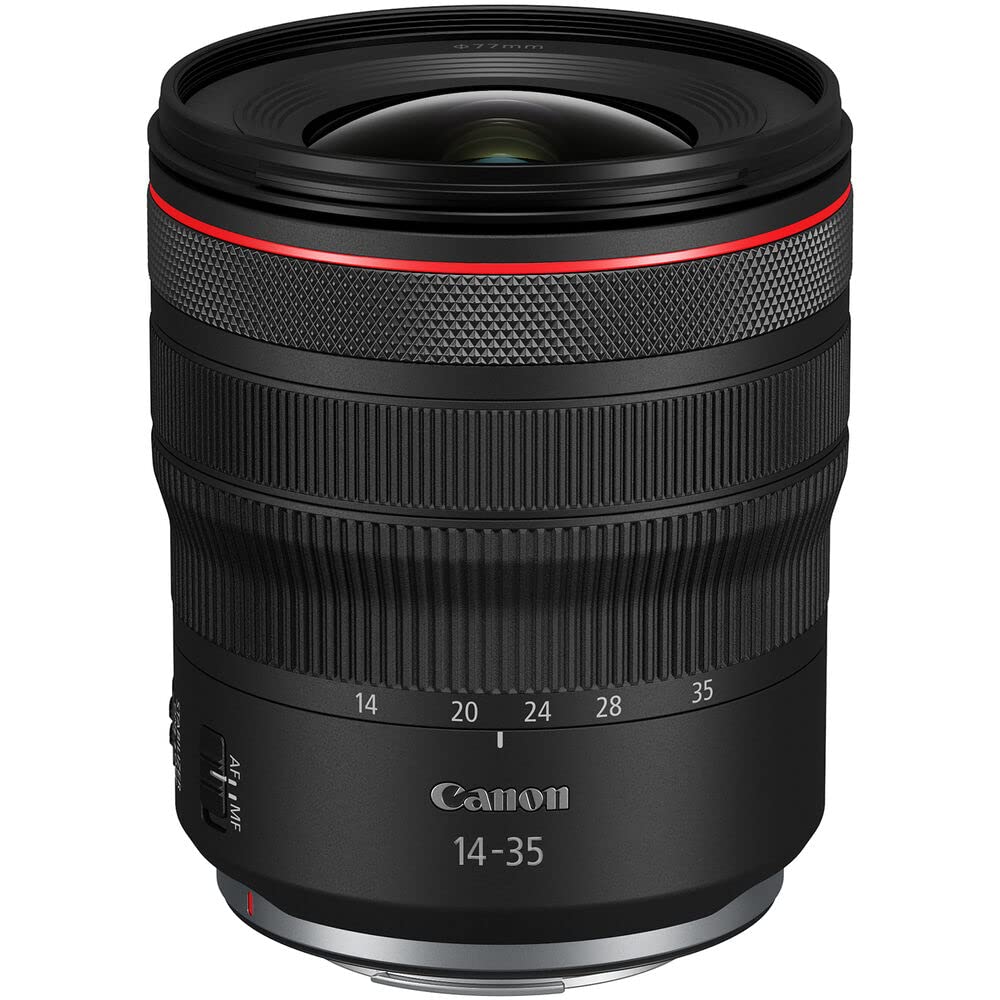
Landscape, Architecture

RF 14-35mm f/4 L IS USM

90 /100
Studio Score High Confidence

Key details

Focal Length
14-35mm zoom
Max Aperture
f/4 constant
Autofocus Motor
Nano USM
Weight And Balance
540g
Check Price on Amazon

The 14-35mm f/4 L is a compact ultra-wide zoom that covers landscape, architecture, and real estate work without the bulk of Canon's faster f/2.8 ultra-wide zoom. Nano USM autofocus is quiet and quick, and the optical stabilizer keeps handheld and gimbal shooting practical. This lens fills a specialist role rather than serving as a general-purpose standard zoom, so buyers who shoot in good light and want a lighter wide-angle kit are the right audience.

Pros

  • Compact L-series ultra-wide with high-quality optics and a useful 14-35mm range.
  • Nano USM autofocus is fast and quiet enough for street and travel shooting.
  • Optical IS keeps real estate, landscape, and gimbal work handheld-friendly.

Cons

  • f/4 maximum aperture pushes dim interior and evening work to higher ISO or a tripod.
  • Wide-end corners can show softness or distortion; profile corrections resolve much of it.
Our verdict

Landscape, architecture, and real estate shooters who want a compact L ultra-wide with IS are the right audience; general-purpose zoom buyers should look at the standard zooms.

Check Latest Price
8

Wildlife, Birding

RF 100-500mm f/4.5-7.1 L

90 /100
Studio Score High Confidence

Key details

Focal Length
100-500mm zoom
Max Aperture
f/4.5-7.1 variable
Autofocus Motor
Dual Nano USM
Weight And Balance
1370g
Check Price on Amazon

Canon's RF 100-500mm F4.5-7.1 L IS USM is a specialized tool for wildlife and bird photographers. Dual Nano USM autofocus keeps moving subjects in frame, optical stabilization helps at 500mm, and L-series glass renders sharp detail at the long end. Extender compatibility pushes reach further, which is why serious outdoor shooters keep it on the short list. The specialized range and premium price keep it from ranking higher for general RF buyers, who get more everyday flexibility from standard zooms. This lens only makes sense when wildlife reach is the primary job.

Pros

  • L-series telephoto zoom gives wildlife shooters solid reach and image quality.
  • Reaches 500mm with extender compatibility for distant birds and animals.
  • Dual Nano USM autofocus locks on moving subjects quietly.

Cons

  • Zoom barrel can extend while carried because no lock is provided.
  • At 500mm, the f/7.1 maximum aperture can require higher ISO in shaded or overcast conditions.
Our verdict

Keep it on the short list if wildlife reach is the main assignment; general RF shooting is better served by a standard zoom.

Check Latest Price
9

Portraits, Weddings

RF 85mm f/1.2 L USM

90 /100
Studio Score High Confidence

Key details

Focal Length
85mm prime
Max Aperture
f/1.2
Autofocus Motor
USM
Weight And Balance
1195g
Check Price on Amazon

The RF 85mm f/1.2 L produces unmatched background separation and tack-sharp center detail wide open, making it the L-series portrait prime for shooters who want maximum bokeh. On a full-frame RF body it suits editorial and wedding portraits where subject isolation carries the frame. The price is luxury-tier, the barrel is heavy and bulky, there is no optical stabilization, and autofocus prioritizes precision over speed, which places it behind general-purpose zooms in a full-system comparison. A portrait specialist with a controlled setup will take those boundaries in stride; action shooters and budget-focused beginners should look at the RF 85mm f/2 or Nano USM zooms instead.

Pros

  • Portrait photography gains exceptional subject isolation and smooth, creamy background rendering.
  • Wide-open shooting at f/1.2 produces crisp, contrasty images with spectacular bokeh.
  • Center sharpness stays tack sharp at f/1.2, keeping detail clean at maximum aperture.

Cons

  • 82mm filter thread means large, pricey filters for anyone using ND or polarizer setups.
  • The fixed 85mm framing requires moving the camera rather than zooming to recompose.
Our verdict

When the shot list is built around posed portraits, this is the RF lens that delivers the signature f/1.2 look.

Check Latest Price

How to Choose

Focal Length and Zoom Range

The zoom range decides how close you can get without moving your feet, but it also forces optical compromises inside the barrel. A 24-105mm zoom covers wide-angle through short telephoto, yet the lens needs more glass elements and smaller apertures to keep the body manageable.

A prime lens trades range for simpler optics, lighter weight, and a wider maximum aperture. If your subjects are close and predictable, a prime is often the sharper and lighter choice.

Maximum Aperture

The aperture number controls how much light reaches the sensor and how strongly backgrounds separate. An f/2.8 zoom lets in twice the light of an f/4 zoom at the same focal length, which can turn an indoor reception into a no-flash situation.

Constant apertures hold that brightness across the zoom range; variable-aperture telephotos lose light as you zoom in. Wider apertures require larger front elements, so the f/2.8 penalty shows up in cost and weight.

Image Stabilization

Image stabilization shifts lens elements to counteract hand shake, letting you shoot static scenes at much slower shutter speeds. A lens with 5-stop IS can make handheld 1/8s shooting possible at moderate focal lengths, but it does not freeze a moving athlete or a child running past you.

For handheld video and dusk landscapes, IS is worth more than many sharpness tests suggest.

Autofocus Motor

STM and Nano USM are the two motor families in Canon RF lenses. Nano USM drives larger focus groups quickly and silently, so it tracks moving subjects better for weddings and sports.

STM is smoother for video but can hunt when contrast is low or the subject is moving fast. The autofocus motor often determines whether a lens feels responsive in real life more than the aperture does.

Weight and Balance

The weight that looks fine in a spec sheet becomes obvious after hour three on a trail or a full wedding day. Heavy lenses pull the camera forward and change how you grip, which is why some sharp zooms feel less capable than their numbers suggest.

Balanced lenses, even at similar weights, sit differently in the hand and fatigue you more slowly.

Frequently Asked Questions