8 Best Canon EF Lens of 2026: Spend on Aperture, Not Reach

The best Canon EF lens for your shooting style — choose between budget primes with wide apertures and L-series zooms with reach and stabilization.

Many Canon DSLR owners reach for the longest zoom they can afford, then find a slow aperture and missing stabilization limit where they can shoot. A budget 300mm zoom at full reach becomes a tripod-only tool outside of bright daylight. A cheap 50mm prime with an f/1.8 aperture often saves the same dim scene handheld.

That does not make telephoto reach a mistake. Wildlife, sports, and event work genuinely need long focal lengths; portrait and indoor shooting need a wide aperture. Match the lens to your usual subjects instead of the largest number in the spec sheet.

The deciding specs are focal length, maximum aperture, image stabilization, autofocus, and build quality. Choose the combination that fits how you shoot, and the best Canon EF lens is the one you will want to carry.

1

Best Overall

Canon 50mm f/1.8 STM

96 /100
Studio Score High Confidence

Key details

Autofocus
STM
Focal Length
50mm prime
Max Aperture
f/1.8
Build & Sealing
Consumer, no sealing
Check Price on Amazon

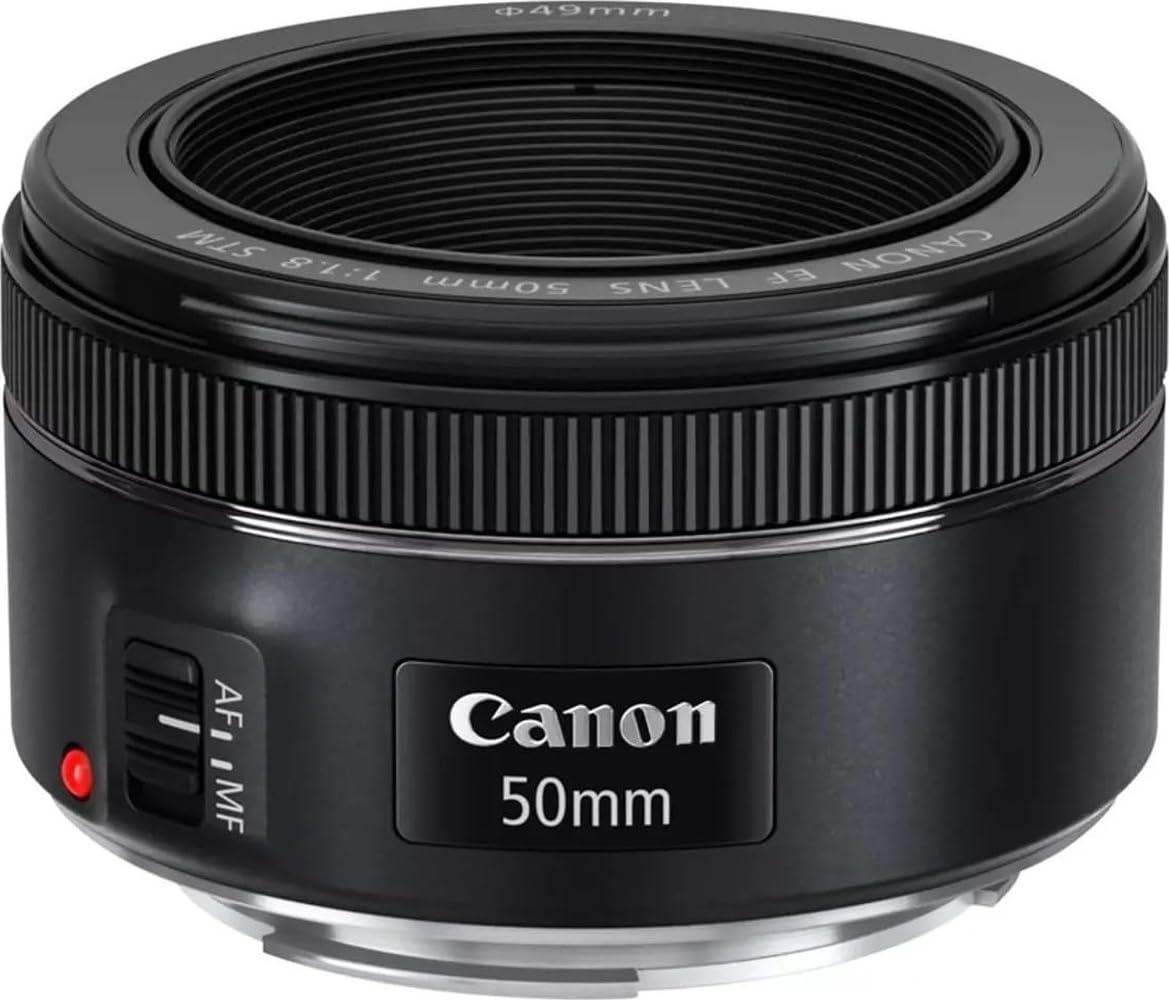
The 50mm f/1.8 STM pulls in roughly two and a third stops more light than a typical f/4 kit zoom, which is the difference between a shutter speed you can handhold at dusk and one that turns into a blur. Wide open at f/1.8, background highlights turn into soft orbs and subjects lift cleanly away from the backdrop; close-up portraits show creamy bokeh that flatters skin tones without an expensive lens formula. Stopping down to f/2.8 or f/4 keeps that separation while sharpening detail across the frame, so the lens moves easily from portraits to still-life or detail shots. This single optic answers the two requests new Canon owners make first: brighter images and blurry backgrounds.

The 50mm focal length works like a normal lens: close enough to isolate a face, wide enough to include a slice of environment. The 5.6-oz body and 0.35m minimum focus cover head-and-shoulders portraits, cafe-table candid shots, and market scenes without a heavy bag. At typical portrait distances, facial features stay proportionate, a reason this focal length remains a standard for people shots. Because the lens is small and unobtrusive, it tends to stay on the camera instead of getting packed away, which matters more for spontaneous shooting than any resolution chart. The light build gives little reason to leave it at home.

A beginner moving up from a kit zoom gets the clearest benefit: the f/1.8 aperture makes low-light shots possible without a flash, and the need to move your feet teaches framing habits that zooms tend to skip. The autofocus can be audible and slow in low-contrast or video situations, and there is no zoom flexibility, so video producers who need silent continuous AF in all conditions will find this lens less suitable. For portrait, street, and travel shooters who want a compact prime, those limits are easy to plan around.

Next to the f/1.2 L portrait prime in the same system, this lens gives up some wide-open glow but costs a fraction of the price and weighs far less. At an entry-level price, it delivers prime-lens sharpness and f/1.8 light gathering that kit zooms cannot match. That combination makes it one of the strongest value lens purchases in the EF lineup, especially for a shooter who wants one compact optic for portraits and travel rather than a bag full of gear. It also leaves room in the budget for a second lens later. For a first prime, it sets the right expectations for what a fixed lens can do.

Pros

  • f/1.8 aperture gathers light and produces creamy bokeh for portraits and low-light scenes.
  • Natural 50mm perspective flatters people photography and close-up subject work.
  • Light 5.6-oz body keeps it comfortable for daily street and travel carry.
  • Stopped down, the lens sharpens without losing its prime-lens character.

Cons

  • Manual focus ring can transmit noise and vibration to the camera in quiet settings.
  • Distant subjects like birds or sideline sports need more reach than a 50mm provides.
Our verdict

For a Canon shooter who wants shallow depth of field and low-light capability without L-series bulk or cost, the 50mm f/1.8 STM is the strongest single-lens value in the EF lineup.

Check Latest Price
2

Best Professional Workhorse Zoom

Canon 24-70mm f/2.8L II

92 /100
Studio Score High Confidence

Key details

Autofocus
Ring USM, MF override
Focal Length
24-70mm zoom
Max Aperture
f/2.8 constant
Build & Sealing
L-series, weather-resistant
Check Price on Amazon

The constant f/2.8, ring USM, and L-series build place this zoom squarely in the professional event lane. The 24-70mm range covers group shots, portraits, and reportage without a lens change, and the lens stays sharp across the frame at f/2.8. Next to the 24-105mm f/4 walkaround, it trades reach for two more stops of light.

At f/2.8 the rendering is close to prime-level, with creamy bokeh that separates subjects in crowded interiors. Autofocus is fast and quiet enough for moving subjects, and the aperture keeps shutter speeds higher in dim rooms. The constant aperture also holds exposure steady while zooming, which helps in mixed indoor lighting. Available-light reportage is where this lens earns its place in a professional kit.

This is for wedding, event, and portrait photographers who want a single 24-70mm carry through a full assignment. No image stabilization is part of the tradeoff; handheld low-light work depends on a steady stance or higher ISO. This is a real boundary, but it matters less when subject motion, not camera shake, sets the shutter speed. Budget-first buyers should treat the premium price as the entry barrier; the budget prime remains the easier single-lens decision.

💡 Set Auto ISO with a minimum shutter speed you can hold; f/2.8 keeps the ISO climb modest in dim venues.

Pros

  • Prime-like rendering from a standard zoom; detail holds across the frame at f/2.8.
  • Ring USM focuses quickly and accurately enough for moving subjects in events.
  • Constant f/2.8 keeps available-light work usable in dim rooms.
  • Creamy bokeh separates subjects from busy indoor backgrounds.

Cons

  • Premium price and lens weight make it a commitment beyond casual kits.
  • Slower handheld shutter speeds require a higher ISO or a very stable stance.
Our verdict

For wedding and event pros, this f/2.8 zoom is the single-lens answer; the budget prime remains the value move for casual shooters.

Check Latest Price
4

Best Super-Telephoto for Wildlife & Sports

Canon 100-400mm f/4.5-5.6L II

91 /100
Studio Score High Confidence

Key details

Autofocus
Ring USM
Focal Length
100-400mm zoom
Max Aperture
f/4.5-5.6
Build & Sealing
L-series, weather-resistant
Check Price on Amazon

The Canon 100-400mm f/4.5-5.6L II is the EF telephoto zoom that makes 400mm reach practical: ring USM autofocus, 4-stop IS, and weather-sealed L-series construction in a single lens.

At the long end, autofocus holds its speed with extenders fitted, and the optics keep contrast on distant wildlife and sideline action. The 4-stop image stabilization steadies handheld frames in moderate light, which is why this lens can work without a support in a way the budget 300mm option cannot.

Wildlife and bird photographers, sports shooters who need 400mm reach, and pros who want weather-resistant construction are the audience. It is not an everyday walkaround lens or a compact travel kit; the premium price and over-1.5kg weight belong to dedicated long-lens work. At full zoom, critical sharpness can benefit from a monopod or tripod.

Pros

  • Sharp, clean detail holds up across the 100-400mm zoom range.
  • Autofocus keeps pace with moving subjects and works with extenders.
  • Four-stop image stabilization steadies handheld shots in moderate light.
  • Weather-sealed L-series build stands up to field use.

Cons

  • At over 1.5 kg, long handheld days can tire the arms.
Our verdict

Wildlife, bird, and sports shooters should treat this as the long end of a Canon kit; everyone else can rent it for the occasional game or safari.

Check Latest Price
5

Best Macro / Portrait Hybrid

Canon 100mm f/2.8L Macro IS

94 /100
Studio Score High Confidence

Key details

Autofocus
USM, MF override
Focal Length
100mm prime macro
Max Aperture
f/2.8
Build & Sealing
L-series, weather-resistant
Check Price on Amazon

The 100mm f/2.8L IS USM is the macro/portrait hybrid: true 1:1 magnification, L-series optics, and hybrid IS in one prime. That combination gives product shooters working distance at close range and gives portrait photographers a pleasing 100mm perspective, so subjects between tiny details and head-and-shoulders frames are covered without a lens swap. It separates itself from a fast 50mm character prime by offering actual macro capability instead of only wide-open bokeh.

Image quality is the main draw. Macro details resolve with sharpness and depth, and the out-of-focus areas stay smooth when you step back to people. Hybrid IS steadies the viewfinder at close distances, making handheld 1:1 work more practical than an unstabilized macro lens.

At 1:1, the 100mm focal length gives more working room than shorter macro lenses, which helps when positioning lights or adjusting a product. That working distance is a real advantage for still-life and product photography.

This is for macro and product photographers who also want L-series rendering for portraits. Budget-only portrait shooters can get the look for less. The lens rewards patient framing and careful focus placement, which is exactly what close-up work demands.

💡 For handheld macro, use the full-time manual override to fine-tune focus.

Pros

  • Exceptional macro sharpness with L-series build for close-up work.
  • True 1:1 magnification for subjects that fill the frame.
  • Doubles as a flattering 100mm portrait lens with smooth bokeh.
  • Handles macro, portrait, and product work without a lens change.

Cons

  • Autofocus can be slow to hunt in macro or low-contrast scenes; this is not an action lens.
Our verdict

For Canon shooters whose subjects hold still, the 100mm L macro is the one lens that combines fine detail and flattering portraits.

Check Latest Price
6

Best Value Telephoto with IS

Canon 70-300mm f/4-5.6 IS

89 /100
Studio Score Strong Evidence

Key details

Autofocus
Micro USM
Focal Length
70-300mm zoom
Max Aperture
f/4-5.6
Build & Sealing
Consumer, no sealing
Check Price on Amazon

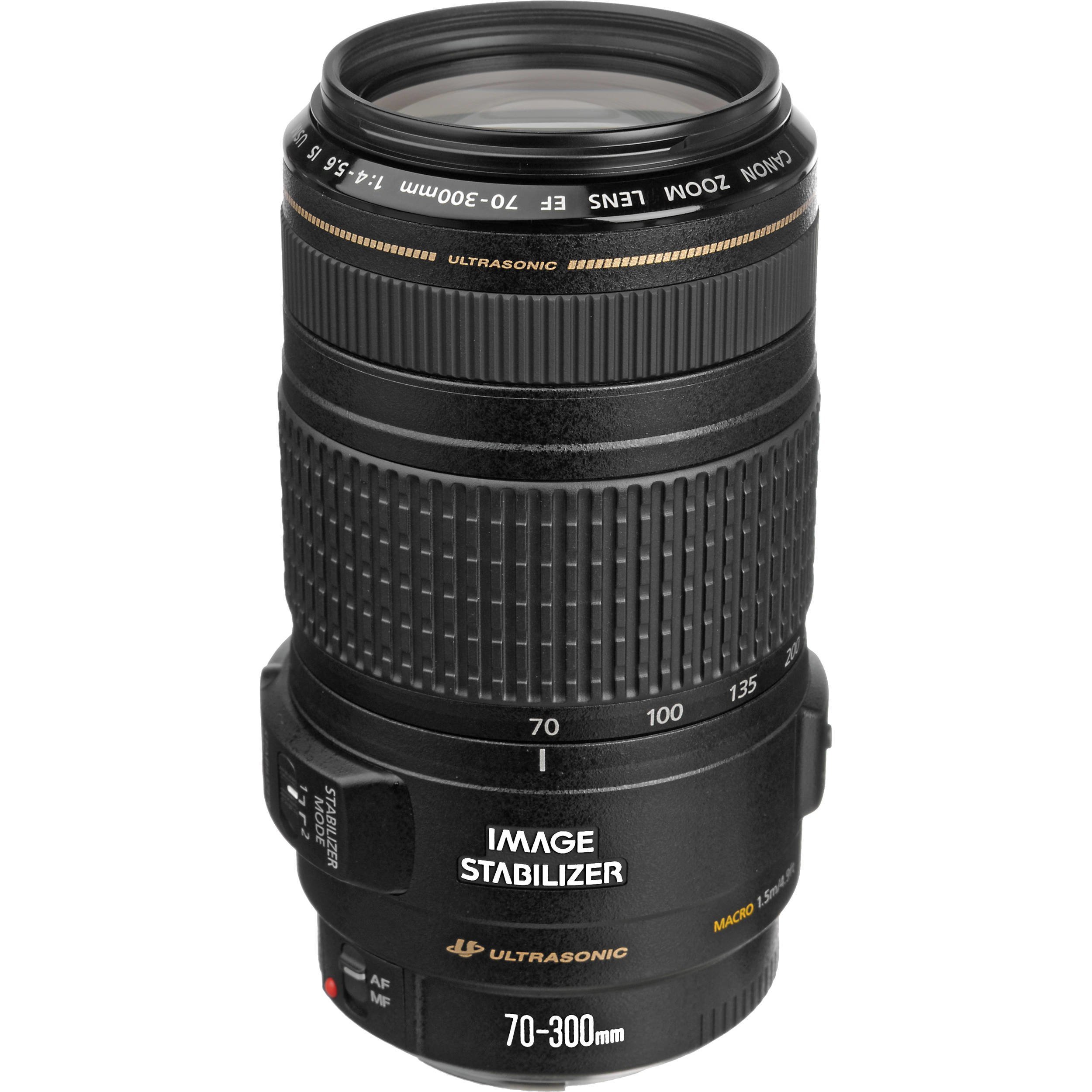
The Canon EF 70-300mm f/4-5.6 IS delivers handheld 300mm reach with 3-stop stabilization at a mid-range price. Anyone coming from the non-stabilized budget 75-300 will notice the sharper images and the option to pan with a moving target.

At 70mm it behaves like a portrait-friendly zoom, with contrasty rendering and gentle background blur at typical focusing distances. Push toward 300mm on a crop-body Canon, and the reach becomes a real upgrade over a basic kit setup. The IS holds its own when tracking a moving subject in sunlight, and the lens stays sharp enough for outdoor sports and daytime wildlife without pushing into L-series territory.

This lens suits a travel or outdoor-sports shooter who wants one telephoto for daylight, not a bag full of primes. The honest boundary is autofocus that can be sluggish in dim light and no full-time manual focus override; buyers who shoot indoor sports or rely on quick manual tweaks should look at faster options.

Pros

  • Outstanding value and optical performance for a mid-range telephoto.
  • Sharp, contrasty images with pleasing bokeh.
  • Effective image stabilization, especially in panning mode.
  • 300mm reach is a big upgrade for crop-body users.

Cons

  • The aperture narrows to f/5.6 at 300mm, so exposure and depth of field shift as you zoom.
  • The f/4 maximum aperture means indoor or evening shooting will need higher ISO or a faster lens.
Our verdict

The EF 70-300mm f/4-5.6 IS is the value telephoto for a Canon shooter who wants reach and stabilization without jumping to L-series glass. Keep a fast prime for low-light work and this lens covers the daylight.

Check Latest Price
7

Travel, Events

Canon 24-105mm f/4L IS II

85 /100
Studio Score Strong Evidence

Key details

Autofocus
Ring USM, MF override
Focal Length
24-105mm zoom
Max Aperture
f/4 constant
Build & Sealing
L-series, weather-resistant
Check Price on Amazon

The updated 24-105mm L zoom improves the standard Canon walkaround with a 10-blade circular aperture and 4-stop image stabilization. Sharpness and contrast in normal light are strong, and the 24-105mm span covers wide landscape views and tighter environmental portraits without changing lenses. USM autofocus responds quickly, and constant f/4 keeps exposure stable for handheld video. Travel and event photographers who want one L-series zoom on an EOS body will appreciate that combination. The f/4 aperture is the boundary: indoor and low-light scenes can require higher ISO or slower shutter speeds, so low-light work is better served by a faster lens. The previous 24-105 L IS covers the same focal range for less, making this version a refinement rather than a value leader.

Pros

  • Strong sharpness and contrast across the range keep it usable as a single travel zoom.
  • USM autofocus responds quickly for event work.
  • 24-105mm span covers wide-angle through short telephoto without a lens change.

Cons

  • Premium price for a standard f/4 zoom.
  • Indoor and low-light scenes can require higher ISO or slower shutter speeds.
Our verdict

As a one-lens kit for a Canon EOS shooter who prioritizes range, sharpness, and stabilization, the current 24-105 L fits daylight travel and event work.

Check Latest Price
8

Budget Telephoto

Canon 75-300mm f/4-5.6 III

95 /100
Studio Score High Confidence

Key details

Autofocus
DC motor
Focal Length
75-300mm zoom
Max Aperture
f/4-5.6
Build & Sealing
Consumer, no sealing
Check Price on Amazon

The cheapest way to put 300mm on a Canon EF mount, this zoom gives EOS DSLR owners long reach for wildlife, sports, and distant subjects without a big investment. Daylight image quality holds up at the long end when the camera is supported, and the lens pairs naturally with Rebel-series bodies. The f/4-5.6 aperture and missing image stabilization make it a bright-light-or-tripod lens, so it sits below the stabilized 70-300 IS in the lineup as the budget entry point rather than the handheld upgrade.

Pros

  • Long 75-300mm reach at an entry-level price for Canon EOS DSLR owners.
  • Daylight image quality at 300mm is respectable when the camera is supported.
  • Pairs with Canon EOS DSLRs, including Rebel models, without compatibility fuss.

Cons

  • Maximum aperture narrows to f/5.6 at the long end, leaving indoor sports and low-light scenes out of range.
  • No image stabilization; sharp handheld shots at 300mm depend on bright light or a tripod.
Our verdict

For a Canon EOS DSLR owner chasing wildlife and sports on a tight budget, this is the most affordable EF route to 300mm reach when shooting in sunlight.

Check Latest Price
9

Portrait, Bokeh

Canon 50mm f/1.2L USM

90 /100
Studio Score High Confidence

Key details

Autofocus
Ring USM, MF override
Focal Length
50mm prime
Max Aperture
f/1.2
Build & Sealing
L-series, weather-resistant
Check Price on Amazon

The f/1.2 aperture gathers enough light for handheld shots in dim settings and produces a smooth, dreamy background blur that smaller primes cannot match. L-series build adds weather-resistant durability for everyday carrying. Its light-gathering advantage keeps ISO lower in dim rooms. Stopped down, the same lens delivers crisp results across the frame. The character is the draw, but wide-open sharpness is softer than the cheaper 50mm f/1.8; this is a specialty portrait look, not an all-rounder. For portrait artists, the distinctive rendering makes those compromises worthwhile.

Pros

  • Renders a distinctive wide-open look and sharpens up nicely when stopped down.
  • Dreamy, smooth bokeh at f/1.2 creates soft subject separation.
  • Weather-resistant L-series build holds up in demanding shooting environments.

Cons

  • Premium price is a significant hurdle for buyers who only occasionally need f/1.2 character.
  • Autofocus can be inconsistent at f/1.2 and the manual focus ring may feel stiff during precise adjustments.
Our verdict

For portrait artists who want that f/1.2 rendering, this lens fits a specific niche. General-purpose buyers should stick with the budget 50mm f/1.8.

Check Latest Price

How to Choose

Focal Length

Focal length decides how much of the scene reaches the sensor. A 24-70mm zoom covers rooms and street scenes; a 100-400mm zoom brings distant animals close. The hidden tradeoff is size: telephoto elements add weight, and long reach magnifies camera shake.

That is why a 400mm lens often ends up on a monopod despite built-in stabilization. If you shoot mostly travel and people, a shorter zoom is easier to carry and more likely to be on the camera when the shot appears.

Max Aperture

The maximum aperture controls how much light reaches the sensor and how much background blur is possible. Moving from f/5.6 to f/2.8 lets in four times as much light at the same shutter speed, which can turn a blurred indoor shot into a keepable frame.

Wide apertures also require larger front elements, which is why f/1.2 primes are heavy and costly. Portrait shooters and event photographers should prioritize this spec over reach; landscape shooters can get away with slower glass.

Image Stabilization

Stabilization uses moving lens elements to counteract hand shake, letting you use shutter speeds several stops slower than usual. It does nothing to freeze a moving subject, so a runner at 1/60s will still blur even with 4-stop IS.

For telephoto work, that difference is practical. A 300mm lens without IS forces a fast shutter or a tripod in ordinary light, while a stabilized 70-300mm stays hand holdable in overcast conditions.

Autofocus

Autofocus motor type decides whether the lens can keep up with action and whether you can fine-tune focus by hand. Ring USM and STM are quieter and faster in most situations; older micro-motor designs can slow down when contrast drops.

If you shoot sports, kids, or wildlife, continuous AF with full-time manual override is worth the extra cost. For static portraits and product work, a simpler motor is usually enough.

Build & Sealing

L-series lenses use weather-resistant gaskets and tougher barrels than consumer lenses, so they handle dust, mist, and hard use better. The tradeoff is weight and price: a sealed 24-70mm f/2.8 weighs far more than a plastic 50mm prime.

Think about where you actually shoot. Hikers, outdoor event shooters, and coastal photographers benefit from weather sealing; studio and street shooters can save money and weight with a consumer build.

Frequently Asked Questions