7 Best Camera for Family Photography in 2026: Keep Up with Kids

Find the best camera for family photography that focuses fast on moving kids, handles indoor light, and fits how you actually shoot.

A family camera listing can promise 88MP, 8K video, and 40x zoom. The photos that actually make it into frames come from something else: a sensor big enough for indoor light, autofocus that locks onto a moving child, and a camera you will carry without thinking.

That is why the most dependable family cameras are APS-C interchangeable-lens models rather than small-sensor superzooms. They cost more, but they solve the two problems parents actually hit: blurry indoor shots and missed focus on kids in motion.

The practical trade-off sits between tracking performance and bundled telephoto reach. A camera with modern eye-detection AF will handle moving kids in uneven light but costs more; a kit with a 75-300mm lens saves money but pushes you back to daylight-only telephoto. Decide which limitation fits your typical shooting before you buy.

1

Best Overall

Sony Alpha a6400 Mirrorless

89 /100
Studio Score Strong Evidence

Key details

Zoom
16-50mm kit
Flash
Built-in
Video
4K UHD
Sensor
APS-C 24.2MP
Check Price on Amazon

The Sony a6400 pairs Real-Time Eye AF with an 11fps burst rate, which is the combination that keeps a running child sharp instead of soft. Its 24.2MP APS-C sensor captures detailed stills and 4K UHD video in a body that is much smaller than most DSLR kits. The 425-point phase-detect system follows a face or eye across the frame, so the camera handles the focus work while you concentrate on framing. The first thing a parent notices is that the camera stops hunting between a child's face and the background.

Eye AF matters most in the quick moments that make up family life. A toddler veering toward the street, a kid turning mid-laugh, a birthday candle blown out from an awkward angle — the focus point stays on the eye rather than drifting to a shoulder or the cake. The 11fps burst captures a short sequence to choose from, and the same focus behavior carries over to 4K video. For parents who want one camera for stills and clips, that consistency lowers the risk of missing a fleeting expression.

This is for parents who want one camera for everyday family photography and are ready to build a small lens kit over time. It is not the entry-level budget option in this group, and it is not the camera for someone who needs telephoto reach straight from the box. The practical boundaries are battery endurance and stabilization: battery life is below average, and the body relies on lens stabilization rather than in-body stabilization. A spare battery and an OSS lens remove the main everyday compromises, so plan for those as part of the purchase.

The a6400 is not the cheapest way into an interchangeable-lens camera, but the extra money lands on the features that affect family results: autofocus speed, burst rate, and 4K video. The lower-cost mirrorless option in this group offers a lighter entry price and more reach out of the box, yet it lacks the same focus density and burst speed. For the specific job of photographing children, the a6400's strengths align with the hardest part of the task.

Pros

  • Real-Time Eye AF and 11fps burst keep a moving child's eye sharp from frame to frame.
  • 4K UHD video and detailed APS-C stills in one body cover the photo-video mix parents need.
  • Compact and lightweight build is easy to bring along for a full day out.
  • Body quality holds up in daily family use.
  • Feature set undercuts the cost of moving up to full-frame while keeping real AF and 4K performance.

Cons

  • The tilt screen does not swing sideways, so front-of-camera framing is less flexible.
  • The 16-50mm kit zoom is workable in daylight, but slow and short for low-light rooms or distant action.
Our verdict

For families, the a6400 solves the hardest part of the job: getting a sharp photo or clip of a child on the move.

Check Latest Price
2

Best Beginner DSLR Kit

Canon EOS Rebel T7 DSLR Kit

94 /100
Studio Score High Confidence

Key details

Zoom
18-55mm + 75-300mm
Flash
Built-in
Video
1080p Full HD
Sensor
APS-C 24.1MP
Check Price on Amazon

The Canon EOS Rebel T7 kit is a full two-lens DSLR setup with an optical viewfinder, priced to fit a first-time buyer. It pairs the 18-55mm everyday zoom with a 75-300mm telephoto for school events, sports sidelines, and wildlife, so a family can cover more ground than a single-lens kit. The newer RF mirrorless alternative adds eye AF and 4K, but the T7 keeps the traditional through-the-lens experience at a lower entry cost.

Auto mode produces sharp, vibrant stills without forcing a beginner into manual controls; when you are ready, the guide mode explains aperture and shutter choices in plain language. The two-lens bundle is the practical centerpiece: the 18-55mm handles daily life, while the 75-300mm reaches a soccer game or a school play. The optical viewfinder keeps framing clear in bright outdoor light, a practical advantage at a soccer field.

The practical value here is easy to see: two lenses cover focal lengths that cost more separately, and the 24.1MP sensor gives enough resolution for prints and cropping. That matters for a distant player on the sidelines.

This is built for first-time DSLR buyers and budget-conscious families who value an optical viewfinder and telephoto reach. The listing's Dual Pixel AF claim does not match this body; the T7 uses the older 9-point phase-detect system, and video is capped at 1080p. That makes it a stills-and-daylight camera rather than a fast indoor action or vlogging tool.

💡 For active kids, using the optical viewfinder gives a more direct view of the action than the rear screen.

Pros

  • Two-lens bundle covers everyday life and distant subjects, making it a strong value for a first DSLR.
  • Auto mode delivers sharp, vibrant stills without demanding manual exposure knowledge up front.
  • Guide mode and simple menus ease new users into aperture, shutter speed, and composition.
  • Entry-level DSLR design gives first-time owners a comfortable route into Canon's EF-S lens system.

Cons

  • A new body can arrive with power-on problems, so an early bench test is worth doing.
  • Live-view autofocus is slower and less decisive than mirrorless bodies when tracking moving kids.
Our verdict

If a family wants a real DSLR viewfinder and long-lens reach without stepping up to a mirrorless budget, the T7 kit delivers for daylight stills and outdoor events.

Check Latest Price
3

Best Beginner Mirrorless

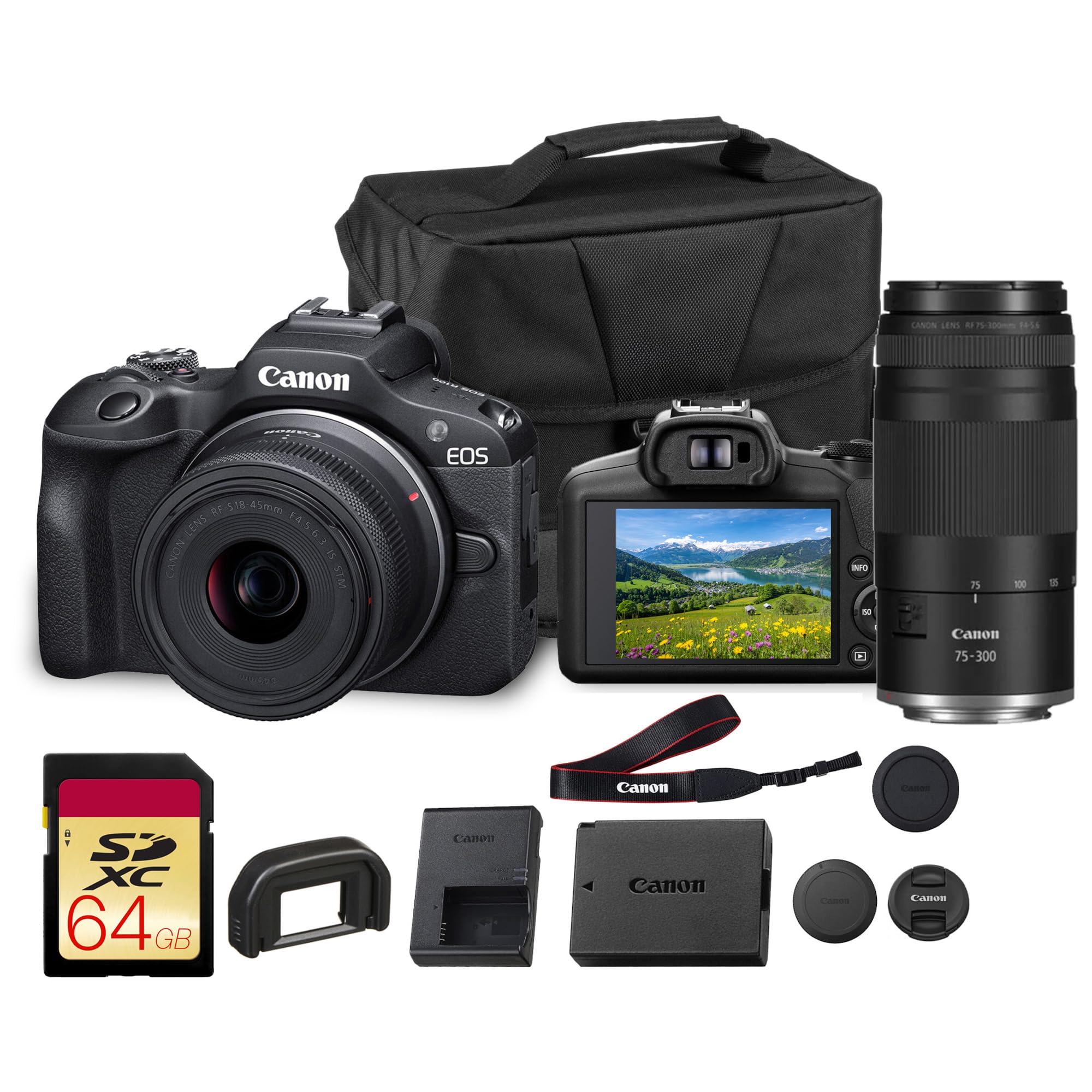
Canon EOS R100 Double Lens Kit

88 /100
Studio Score Strong Evidence

Key details

Zoom
18-45mm + 75-300mm
Flash
No
Video
4K 2160p
Sensor
APS-C 24.1MP
Check Price on Amazon

The EOS R100 double-lens kit is the path into Canon's current RF mount, pairing Dual Pixel Eye AF, 4K video, and two lenses — an 18-45mm standard zoom and a 75-300mm telephoto — in a compact, lightweight APS-C body.

Photos come out sharp with vibrant colors straight from the camera, and the controls are intuitive enough for a first-time mirrorless shooter. The light body stays comfortable through a long day out, and the eye-detection autofocus keeps active children within focus during casual shooting. When the action moves to a park or schoolyard, the 75-300mm lens adds useful reach beyond what the standard zoom offers.

This bundle suits first-time mirrorless buyers, Canon RF newcomers, and families who want 4K and telephoto reach without DSLR bulk. The body has no built-in flash and the rear screen is fixed, so dark indoor events and flexible framing need an external flash or a phone. For mostly daytime outings and well-lit indoor scenes, the kit covers the range families need for everyday scenes, and Canon RF newcomers get a direct upgrade path into the current lens lineup.

Pros

  • Vibrant colors and sharp detail straight from the camera.
  • Intuitive controls that first-time mirrorless users can operate without a steep learning curve.
  • Light body that stays comfortable during long family outings.
  • Dual Pixel AF with Eye Detection holds focus on moving children.

Cons

  • The RF 75-300mm lens has no image stabilization, so the long end needs bright light or a tripod.
Our verdict

For the family that wants Canon's current mirrorless system without the bulk of a DSLR, the R100 double-lens bundle delivers 4K, eye AF, and reach at a mid-range price.

Check Latest Price
4

Best Traditional Learning DSLR

Nikon D3300 DSLR Kit

91 /100
Studio Score High Confidence

Key details

Zoom
18-55mm VR kit
Flash
Built-in
Video
1080p Full HD
Sensor
APS-C 24.2MP
Check Price on Amazon

The Nikon D3300's 24MP APS-C sensor and Guide Mode make it the still-photography teaching camera in this roundup. Guide Mode walks through aperture, shutter speed, and ISO as you frame shots, so a newcomer can learn exposure on a real DSLR instead of relying on auto. An optical viewfinder keeps the shooting process direct.

The controls follow classic Nikon DSLR logic: exposure buttons sit within reach, the menus are organized for learning, and the image files carry enough detail for everyday family use. The competing two-lens Canon kit in this set offers more reach, but this Nikon is focused on the learning experience rather than extra glass.

This camera suits still-photography-focused families and learners who prefer an optical viewfinder over an EVF screen. There is no built-in Wi-Fi, so sharing images from the camera to a phone requires an adapter or cable. The 1080p video uses older contrast-detect live-view autofocus, which works for casual clips but can struggle with fast-moving indoor action. Those are clear boundaries, not deal-breakers, for a stills-first buyer. If your priority is stills and understanding exposure, these limits are easy to plan around.

💡 Use the optical viewfinder for moving subjects and keep Guide Mode active while you learn the exposure controls.

Pros

  • Detailed still-image quality from a 24MP APS-C sensor for prints and everyday family photos.
  • Guide Mode explains aperture, shutter speed, and ISO while you shoot, making it a teaching aid.
  • Retains its value as a mid-range entry DSLR with a capable kit lens.

Cons

  • Video focus can hunt in lower light with the dated contrast-detect live-view system.
  • Phone transfer requires an adapter or cable.
Our verdict

The D3300 does one thing well: it teaches photography on a capable APS-C DSLR and gets out of the way while you do it.

Check Latest Price
5

Best Budget Compact

Kodak Pixpro FZ55 Compact

89 /100
Studio Score Strong Evidence

Key details

Zoom
28-140mm 5x
Flash
Built-in
Video
1080p Full HD
Sensor
1/2.3-inch 16MP
Check Price on Amazon

The FZ55 is this lineup's pocketable budget compact, built around a 5x optical zoom and a body that slips into a coat pocket. It does not chase the long reach of the bridge superzoom here; instead, it trades some low-light performance for convenience and simplicity. That approach keeps controls approachable and makes the camera easy to have along for everyday moments.

This camera fits families who want a backup snapshot camera for day trips and holiday gatherings, not a tool for freezing a toddler mid-sprint in a dim living room. Image quality is capped by the small sensor, and charging or battery behavior can vary between individual units, so treat it as a casual camera rather than a workhorse. Parents who need fast eye-tracking autofocus should look to the top-pick Sony or the Canon RF entry models in this roundup.

Flash photography in casual indoor settings is a highlight: portraits and selfies carry a friendly, nostalgic tone that many phone filters try to copy. The retro body styling is popular with teens, and the simple controls make it easy to hand over to a child without a tutorial. Full HD video is fine for short clips of birthday candles or holiday chaos, though anyone planning serious filmmaking should move up the price scale.

Pros

  • Pocketable body and 5x zoom cover everyday family snapshots without menu digging.
  • Flash photos of people and pets turn out shareable at arm's length.
  • Controls are simple enough for a first-time user or a teenager.
  • The retro styling is a genuine draw for younger shooters.

Cons

  • Autofocus can lag with quick-moving children indoors, so action shots are hit-or-miss.
  • The 2.7-inch screen is small for reviewing photos and framing video.
Our verdict

The FZ55 is the right pocket companion for families who already have a phone and want a fun, separate camera for holiday snaps; rely on a faster-focusing camera when kids are in motion.

Check Latest Price
6

Refurb Budget Nikon

Nikon D5100 DSLR Renewed

83 /100
Studio Score Strong Evidence

Key details

Zoom
18-55mm VR
Flash
Built-in
Video
1080p Full HD
Sensor
APS-C 16.2MP
Check Price on Amazon

The D5100 is the most budget-friendly route into Nikon's interchangeable-lens system for buyers who want an articulating screen while learning still photography. The 16.2MP APS-C sensor and 18-55mm VR kit lens deliver pleasing images when the unit arrives in good condition, and 1080p video covers occasional family clips. Refurbished condition varies across units; if yours is free of issues, it is still a 16MP camera without Wi-Fi or 4K. That puts it in patient-beginner territory, not primary-family-camera territory for quick phone sharing or fast-moving kids.

Pros

  • Budget-friendly entry into Nikon's DSLR system with a flip-out screen for learning shots from low or awkward angles.
  • Bundled 18-55mm VR lens reaches practical family focal lengths and steadies handheld photos.

Cons

  • 1080p video and no Wi-Fi put family clips and phone sharing a generation behind current cameras.
  • Condition can vary across renewed units, including cosmetic marks, a dirty lens, or a body that does not power on.
Our verdict

This is the right fit for a beginner who wants a cheap Nikon body with an articulating screen and plans to inspect the shipment carefully. For a family's main everyday camera, newer mirrorless options in this roundup handle connectivity and action better.

Check Latest Price
7

Outdoor Long Zoom

Kodak Pixpro AZ255 Bridge

84 /100
Studio Score Strong Evidence

Key details

Zoom
24-600mm 25x
Flash
Built-in
Video
1080p Full HD
Sensor
1/2.3-inch 16MP
Check Price on Amazon

The Kodak Pixpro AZ255 is a lightweight bridge camera that puts a 25x optical zoom (24-600mm equivalent) into a simple control layout. At outdoor daytime family events, casual shots work well from wide group photos to distant subjects without changing lenses. The long reach and accessible price make it a practical entry into superzoom photography.

The boundary is indoor and telephoto use: autofocus can hunt in moderate light and at full zoom, and the small sensor limits low-light image quality. This suits fair-weather, daylight photography better than everyday indoor family life.

Pros

  • Simple controls and clear zoom reach make it an approachable first bridge camera.
  • Casual outdoor shots hold up well for family snapshots.
  • Long 25x zoom range delivers wide-to-tele reach at a budget price.

Cons

  • Four AA batteries drain quickly, so carrying spares becomes routine.
  • Power-on behavior can vary between units, so an early check is worthwhile.
Our verdict

The AZ255 is a capable daylight companion for outdoor family events where its 25x zoom is the point.

Check Latest Price

How to Choose

Sensor Size

Sensor size sets the image-quality ceiling in low light. APS-C sensors have roughly 13 times the area of the 1/2.3-inch chips in budget compacts, so they collect more light and produce cleaner photos in living rooms. Birthday parties and cloudy afternoons are exactly where that advantage shows.

A phone can handle bright outdoor shots, but it loses clarity in dim rooms. A larger sensor gives a dedicated camera a real advantage when the lights go down and the candles come out.

Autofocus and Eye Detection

Eye-detection AF locks onto a child's eye and keeps that focus point on the face as the child moves, so parents do not have to focus, recompose, and hope. Continuous shooting speed matters too: an 11fps burst captures several frames of a moment, while a 3fps entry DSLR forces you to time the shutter.

This matters more than megapixels because a perfectly focused 16MP photo beats a blurry 24MP one. For family photography, this is the spec to spend on.

Video and Autofocus

4K alone does not guarantee usable video; autofocus during recording is the real test. Older DSLRs often switch to slow contrast-detect AF in live view, which hunts when a child walks toward the camera.

A 1080p camera with stable video AF produces more watchable family footage than a 4K camera that drifts. If you capture more video than stills, include this in your checklist.

Optical Zoom Range

Telephoto reach is useful for school events, but long zoom comes with a light penalty. A 75-300mm lens at full reach has a small aperture and needs bright daylight or high ISO, and without image stabilization, camera shake makes sharp shots hard.

Prioritize stabilization over extra millimeters, and buy only as much reach as your typical event demands.

Built-in Flash

Built-in flash matters most for dark indoor moments like cake cutting. It is not flattering, but it records the scene when ambient light is not enough.

Cameras without one require an add-on flash, which is an extra item parents have to remember. For most families, the built-in unit is a convenience worth keeping.

Frequently Asked Questions