7 Best Camera for Wildlife Photography 2026: Zooms That Lock Focus

Find the best camera for wildlife photography: models that lock focus at extreme zoom, and budget options that miss the shot.

Camera listings lead with zoom numbers because 40x, 83x, and 125x are easy to grasp. But once the lens reaches past a few hundred millimeters, autofocus decides whether you get a sharp wildlife frame or a series of blurred misses. Reach without focus reliability is just a magnified disappointment.

Wildlife cameras differ in how far the lens truly reaches, how consistently autofocus locks onto a distant animal, and what you sacrifice at budget prices. Cameras with dedicated bird modes and dual-detect stabilization hold focus at full zoom; cheaper bridges hunt, stall, and settle on branches behind the bird.

The trade-off that matters is maximum reach versus focus confidence. An ultra-long zoom that demands a tripod and several attempts to lock a moving animal is not useful; a shorter zoom that locks onto the bird works. Pick based on what you actually photograph, not the biggest number on the box.

1

Best Overall for Wildlife

Nikon COOLPIX P950 83x

86 /100
Studio Score Strong Evidence

Key details

Sensor
16MP CMOS 1/2.3-inch
Optical Zoom
83x, 2000mm eq.
Stabilization
Dual Detect Optical VR
Autofocus System
Contrast-detect AF
Check Price on Amazon

The P950 is the superzoom that balances reach and usability best in this set. Its 83x optical zoom reaches 2000mm equivalent, and the dedicated Bird mode plus Dual Detect Optical VR make that reach usable in the field. For perched birds, moon details, and far-off landscape features, the 16MP sensor delivers images that satisfy serious amateur nature photographers. The zoom range starts at a true wide 24mm, so the same body covers a sweeping scene and a distant subject without changing lenses. At the 2000mm end, a distant heron occupies a meaningful portion of the frame instead of a speck in a wide view.

Bird mode is the standout workflow feature. You set a subject-size priority, and the camera favors nearby perched birds over the background instead of hunting through clutter. In field use, it locks onto a stationary bird quickly enough to capture feather detail before the animal shifts. Moon mode takes the same idea and applies it to astronomy: spot focus and a metering preset bring out crater detail without manual exposure guesswork. The 4K video output is useful for recording behavior clips without carrying a second device.

This camera is for amateur birders, wildlife watchers, and travelers who want a single all-in-one body for daylight nature photography. It is not the tool for professional low-light action work or sports shooters needing fast tracking; the autofocus can be slow for birds in flight. The small sensor favors daylight over dusk, so keep ISO expectations modest after sunset. Those who need fast burst rates for action or clean files at dusk are better served by an interchangeable-lens body with a fast telephoto, but that route costs substantially more and adds weight. Plan on a tripod or monopod at full zoom, and treat the P950 as a specialist for perched subjects, moon phases, and distant landscapes.

The premium-priced body still undercuts a DSLR with comparable reach, and the built-in zoom makes it a practical travel companion. The 125x model in this set reaches further, but its heavier body and slower focus at maximum zoom make the P950 the better everyday balance for a birder who does field work. The 83x reach covers close and distant subjects without a lens change, and that range is the P950's real advantage.

Pros

  • Outstanding quality for an all-in-one wildlife camera
  • Picture quality holds up for birders and nature photographers, with strong feather detail in daylight.
  • 83x optical zoom with dedicated Bird and Moon modes makes distant subjects practical.
  • Costs well below a long-lens DSLR setup while covering a wide range of field situations.

Cons

  • Body is bulky and heavier than expected, so the weight becomes noticeable during extended handheld use.
  • Unexpected shutdowns can occur during extended use.
Our verdict

The P950 delivers the reach of a serious wildlife kit in a single body, making it the default for amateur birders and daylight nature shooters.

Check Latest Price
2

Extreme Reach Superzoom

Nikon COOLPIX P1100 125x

83 /100
Studio Score Strong Evidence

Key details

Sensor
16MP CMOS 1/2.3-inch
Optical Zoom
125x, 3000mm eq.
Stabilization
Dual Detect Optical VR
Autofocus System
Contrast-detect AF
Check Price on Amazon

At 125x optical zoom, the Nikon COOLPIX P1100 reaches a 3000mm equivalent that no other integrated superzoom in this set can match. Distant moon craters, perched birds, and static wildlife that would be a speck in shorter lenses fill the 16MP frame without cropping. Dual Detect Optical VR steadies the view at maximum magnification, and the rotating 3.2-inch LCD helps frame from low angles.

Image quality for birding and moon work is strong enough to satisfy the niche, and 4K UHD video records the same long-distance view in motion. The premium price goes into the lens build and zoom mechanism, which is where this camera's value sits. This is not a camera that hides its purpose; every control arrangement supports a patient, deliberate shooting style.

This camera fits long-distance birders, moon and planetary photographers, and nature enthusiasts who can shoot from a tripod. Focusing is slow in low light and at maximum zoom, and the body is heavy enough that a tripod is effectively required. Fast-action sports or birds in flight and handheld low-light shooting sit outside its boundaries; the top pick in this set is the more balanced all-rounder.

๐Ÿ’ก At full zoom, use the self-timer or a remote release so you don't have to touch the camera during exposure.

Pros

  • Unmatched 125x optical zoom reaches subjects no other integrated superzoom in this set can frame.
  • Good image quality for nature and birding, with fine detail in moon and perched-bird shots.
  • Premium-priced but appropriate for its long-distance niche, with solid build quality.

Cons

  • Front-heavy body is large, so support is strongly recommended at full zoom.
  • Autofocus can hunt at maximum zoom and in dim light, so still subjects matter more than fast framing.
Our verdict

The P1100 is a specialty camera for far and still subjects; it makes sense when reach is the first priority.

Check Latest Price
3

Best Compact Mirrorless Hybrid

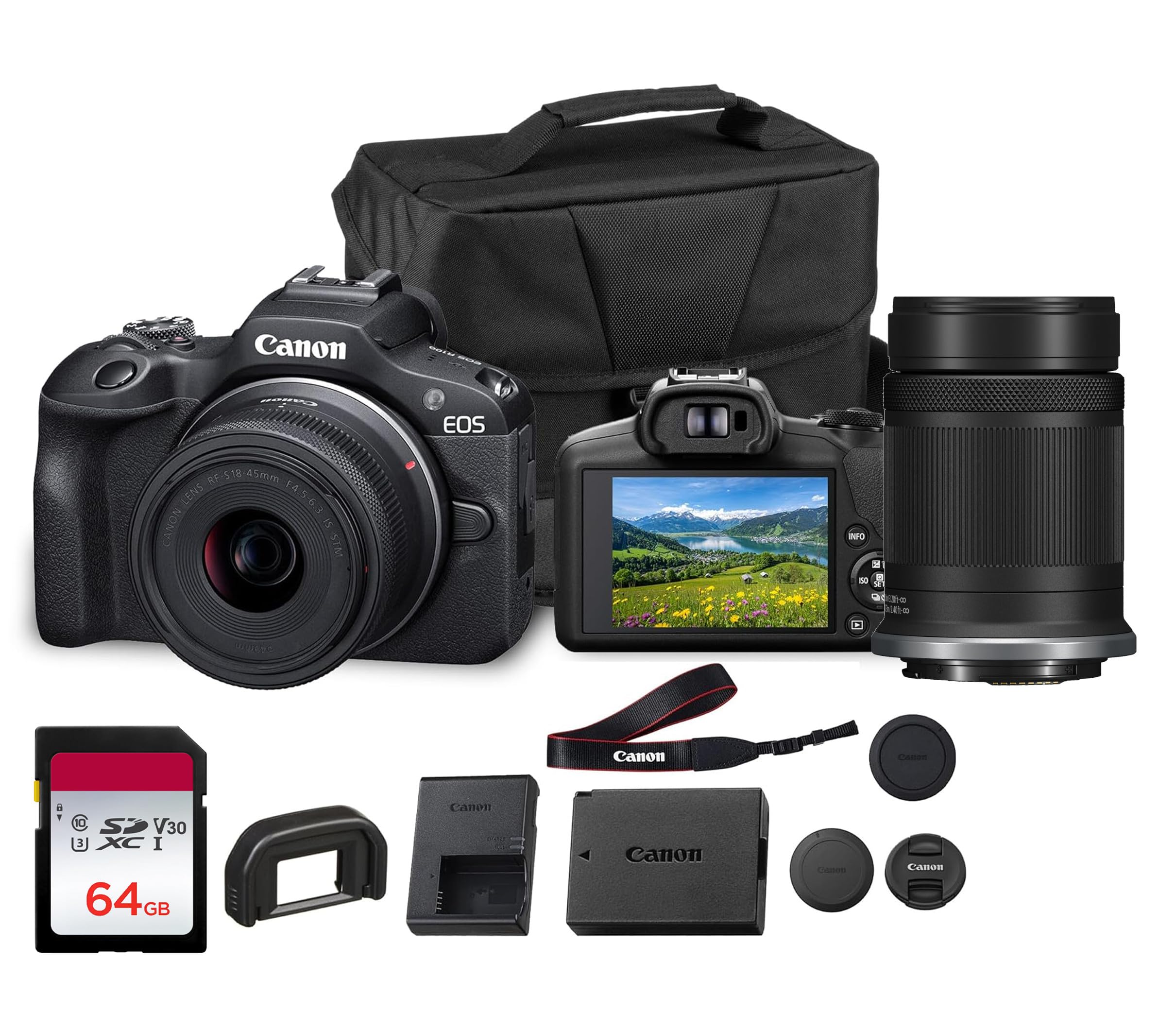
Canon EOS R50 Lens Kit

90 /100
Studio Score High Confidence

Key details

Sensor
24.2MP APS-C CMOS
Optical Zoom
55-210mm, 336mm eq.
Stabilization
Optical IS
Autofocus System
Dual Pixel CMOS AF
Check Price on Amazon

Dual Pixel CMOS AF with eye and subject detection is the most dependable focusing system in this set, and it gives the R50 a clear edge over bridge cameras when an animal shifts position. The 24.2MP APS-C sensor keeps detail clean through the two zoom lenses, so the compact body does not trade away image quality.

The eye-detection AF works in stills and 4K 30p video, which makes the R50 useful for travel clips as well as wildlife frames. The 18-45mm lens covers wide landscape shots, and the 55-210mm lens brings closer subjects into view without the weight of a full-frame system.

The two-lens kit is light enough for a day hike, and the guided setup keeps the learning curve gentle for a first interchangeable-lens camera. Body size is the practical advantage here: it is small enough to carry without a dedicated camera bag.

Travelers who want one camera for landscapes, family, and the occasional wildlife sighting will get the most from this Canon. The bundled reach stops at 336mm equivalent, so distant birds are a longer-lens project rather than an out-of-box task; this pick favors hybrid shooting over dedicated birding.

Pros

  • Subject-detection AF tracks moving people and animals, simplifying focus at telephoto distances.
  • 24.2MP APS-C sensor delivers clean detail through the two-lens kit.
  • Compact body and two-lens kit are light enough for everyday carry.
  • Guided setup keeps the learning curve gentle without locking out manual exposure.

Cons

  • At full zoom, the 55-210mm lens can lock onto the nearest branch instead of the subject behind it, so framing may take extra tries.
  • Premium pricing can strain a budget that also needs a separate long wildlife lens.
Our verdict

Travelers who want a compact mirrorless with dependable autofocus will find the R50 kit the balanced alternative to a bulkier superzoom.

Check Latest Price
4

Best Beginner DSLR Kit

Canon EOS Rebel T7 DSLR Kit

94 /100
Studio Score High Confidence

Key details

Sensor
24.1MP APS-C CMOS
Optical Zoom
75-300mm, 480mm eq.
Stabilization
None
Autofocus System
9-point AF
Check Price on Amazon

Canon's EOS Rebel T7 is a true DSLR starter kit: an optical viewfinder, a 24.1MP APS-C sensor, and two lenses that cover everyday scenes plus a 480mm-equivalent telephoto reach. The 75-300mm lens is what puts this in the wildlife conversation, and the Guide mode walks a first-time owner through manual settings. The kit's appeal is the low entry price to a full interchangeable-lens system โ€” you can upgrade the glass later without replacing the body.

Daylight image quality is clean, with Canon's color rendering making JPGs usable straight from the camera. The 18-55mm lens handles family and travel, while the 75-300mm gives enough reach for deer at the field edge or herons at the pond. In bright conditions, the telephoto lens holds its own for slow-moving subjects; low light and fast motion are where the kit starts to feel limited.

A first-time DSLR buyer who wants to learn composition with an optical viewfinder and shoot a mix of family, general, and occasional wildlife will get real value. The 9-point AF and 3fps burst are dated for action, and live-view AF is slow, so this kit is not the answer for birds in flight or fast-moving wildlife. If that is your main subject, the slimmer mirrorless options in this set with subject-detection AF will serve you better.

Pros

  • Two-lens bundle covers wide-angle family shots and a 480mm-equivalent telephoto for wildlife.
  • Canon color science and a 24.1MP APS-C sensor produce pleasing daylight photos.
  • Guide mode and clear menus help a first-time owner learn aperture, shutter speed, and ISO.
  • Body construction feels substantial for an entry-level camera, with controls placed for learning.

Cons

  • In some cases, power-on behavior can be inconsistent after the camera has been in use for a while.
Our verdict

The T7 two-lens kit is the value play for a first-time DSLR owner who wants telephoto reach without jumping to a bridge camera.

Check Latest Price
5

Best Budget Superzoom

Kodak PIXPRO AZ528 52x

85 /100
Studio Score Strong Evidence

Key details

Sensor
16MP BSI CMOS 1/2.3-inch
Optical Zoom
52x, 1248mm eq.
Stabilization
Optical IS
Autofocus System
Contrast-detect AF
Check Price on Amazon

The AZ528's 52x optical zoom reaches 1248mm equivalent, which is the longest reach in the budget tier and enough to fill the frame with a waterbird across a pond. The range starts at a useful 24mm wide angle, so a travel scene and a distant bird are both covered without changing lenses. The all-in-one body keeps the kit light, letting first-time wildlife shooters experience that reach without learning to juggle lenses.

The 16MP BSI CMOS sensor and optical stabilization work well in daylight, returning steady stills of birds on feeders or fence posts. A 6 fps burst gives you a short sequence to sort for the sharpest pose, and built-in Wi-Fi can send the keeper to your phone for easy sharing right from the field.

This is a first wildlife camera for beginners moving up from a phone, or a daypack travel companion for those who want long reach without an interchangeable-lens kit. The boundary: autofocus can hunt at full zoom and telephoto sharpness can soften for moving subjects, so fast-action wildlife is better left to a pricier camera.

Pros

  • 52x optical zoom puts distant wildlife in the frame at a budget price.
  • Basic bridge image quality is good for daylight stills of static subjects.
  • Controls and menus are approachable for people new to superzoom cameras.

Cons

  • Power-on consistency can vary between units, so testing soon after arrival is wise.
  • The small 1/2.3-inch sensor limits image quality after sunset, making this a daylight-oriented wildlife camera.
Our verdict

For someone testing whether 1000mm-plus reach fits their photography, the AZ528 is the least expensive way to find out.

Check Latest Price
6

AA Battery Travelers

Kodak PIXPRO AZ405 40x

82 /100
Studio Score Strong Evidence

Key details

Sensor
20MP BSI CMOS 1/2.3-inch
Optical Zoom
40x, 960mm eq.
Stabilization
Optical IS
Autofocus System
Contrast-detect AF
Check Price on Amazon

The Kodak PIXPRO AZ405 pairs AA battery convenience with 40x optical reach at entry-level pricing, and its controls are simple enough for a first-time bridge owner. The zoom range handles casual nature observation, and setup stays uncomplicated. The tradeoffs are that AA cells can drain quickly during extended sessions, and telephoto sharpness softens when subjects move or you push toward the long end. Those limits are acceptable for a starter bridge or travel backup, where AA convenience and low entry cost matter more than pixel-level clarity. The AZ528 is the more consistent camera in the lineup for shooters who need steadier telephoto frames.

Pros

  • Easy to set up and operate, with controls a first-time bridge owner can grasp quickly.
  • 40x optical zoom brings distant subjects into view without the cost of an interchangeable-lens telephoto kit.
  • AA power means spare cells are cheap and easy to carry for travel.

Cons

  • 40x reach trails the 52x budget sibling, so very distant subjects need more cropping.
  • Power-on and lens-extension behavior can vary between units, so a full setup check is wise before relying on it.
Our verdict

As a budget gap-filler for a first camera or an AA-powered travel backup, the AZ405 fits; for serious wildlife reach, the 52x sibling or the AZ528 is the better spend.

Check Latest Price
7

Casual Nature Observers

Minolta MN40Z 40x

79 /100
Studio Score Established

Key details

Sensor
20MP CMOS
Optical Zoom
40x
Stabilization
Optical
Autofocus System
Contrast-detect AF
Check Price on Amazon

Compact and easy to carry, the Minolta MN40Z pairs 40x optical zoom with optical stabilization and AA power for a first camera. Daylight shots come out sharp at moderate distances, and the body stays light enough to take on a walk. It sits below the stronger superzooms in this guide because full-zoom autofocus can be unpredictable and it doesn't deliver a clear performance edge over the lower-priced 52x budget bridge. This is a starter camera for someone who wants grab-and-go telephoto without building an interchangeable-lens kit, not a tool for low-light action or serious birding.

Pros

  • Sharp daylight photos from a compact body that stays light on a walk.
  • 40x optical zoom reaches distant daytime subjects without extra lenses.
  • AA power keeps spare batteries cheap and easy to find.

Cons

  • AA battery drain varies with usage, so a long zoom-heavy outing demands spare cells.
  • A unit may malfunction early on and need an exchange.
Our verdict

Treat it as a low-cost way to learn whether a long-zoom camera fits your style before stepping up to a more capable superzoom.

Check Latest Price

How to Choose

Optical Zoom

Optical zoom is the lens's physical magnification range, and the 35mm equivalent shows how it compares to a full-frame camera. A 1000mm-plus equivalent reach lets a small bird fill the frame from a distance.

The catch is that magnification also magnifies movement. At 2000mm equivalent, a hand wobble invisible at 24mm becomes a scene-wide blur. Extreme zoom ranges routinely require a tripod or a high shutter speed at the long end.

Autofocus System

The autofocus system decides whether the lens locks onto the animal or the branch in front of it. Phase-detect AF measures distance directly and tracks moving subjects; contrast-detect AF searches for edges, which gets slow at long focal lengths and in flat light.

That explains why a budget 40x bridge can nail a static bird on a sunny branch but miss a duck swimming across a pond. If the subject moves, a slow contrast-detect system falls behind. Choose phase-detect AF or a dedicated bird-tracking mode if your subjects will not stay still.

Sensor Size

Sensor size controls light collection and detail. A 1/2.3-inch sensor, standard in superzooms, permits the compact 83x or 125x lens, but gathers less light than APS-C. That difference shows as noise in shadows and at dusk.

An APS-C body produces cleaner high-ISO files, but reaching distant wildlife means adding a large, heavy, expensive telephoto lens. The superzoom builds the long lens in; the trade-off is the small sensor behind it.

Image Stabilization

Stabilization reduces camera shake by moving lens elements or the sensor to counter hand motion. At long telephoto focal lengths, it separates a sharp static bird from a smeared one at handheld shutter speeds.

Stabilization does not freeze a moving animal โ€” it corrects your hands, not the subject. A walking deer still needs a fast shutter speed, which demands good high-ISO performance. Count on it for static subjects and a tripod or speed for everything else.

Burst Rate

Burst rate is how many frames the camera captures per second while you hold the shutter. A 3 fps camera forces careful timing; a 6-7 fps camera gives a short sequence and a better chance at the right wing position.

The catch is that superzoom burst modes slow down while autofocus tracks at full zoom, and the buffer fills quickly. Shutter lag and autofocus speed matter more than the burst number for birds in flight.

Frequently Asked Questions