5 Best Battery Grip of 2026: Sony Body Match Without Overpaying

Best camera battery grip depends on body generation, battery type, and budget. Match your Sony body for dual-battery runtime and vertical controls.

Battery grips for Sony mirrorless bodies have a clear price split: OEM models carry a large premium, while aftermarket grips deliver the same dual-battery and vertical-shutter function for a fraction of the cost. The functional gap is far smaller than the price gap. The real differences are build tolerance, button feel, and weather sealing.

Matching the grip to your camera generation matters more than any other spec. VG-C2EM grips fit A7 II-series bodies, VG-C3EM grips fit A9/A7 III/A7R III, and VG-C4EM grips fit newer Sony bodies. These generations are not interchangeable.

This guide sorts the trade-offs by generation and budget, so you can add a full day of battery life and a comfortable vertical shutter without overpaying for sealing you may never need.

1

Best Overall

NEEWER VG-C3EM Grip

91 /100
Studio Score High Confidence

Key details

Mounting
1/4-inch tripod thread
Battery Type
1 or 2 NP-FZ100
Build & Sealing
Plastic/rubber body
Vertical Controls
Shutter, dials, AF-ON, AE-L
Check Price on Amazon

Dual NP-FZ100 support gives the A7 III, A7R III, or A9 two-battery endurance from one grip, and the vertical shutter, front/rear dials, AF-ON, AE-L, and multi-selector put the essential controls in portrait position. The 11.3-ounce body adds counterweight for long glass, which steadies the camera in vertical orientation. The grip uses the same NP-FZ100 cells as the body, so there is no second battery platform to track. For a body that already handles well in landscape, the grip makes the same setup feel planted in portrait, especially with a telephoto zoom mounted. The 1/4-inch tripod thread at the base keeps the grip usable even on a monopod or tripod plate without removing it.

During an event day, the extra cell is what you notice first: instead of planning a mid-shoot battery swap, you can rotate through two batteries and keep the internal slot as backup. A full day of event coverage is realistic without touching the body battery. The vertical shutter sits under the index finger, and the dials stay within reach without shifting your grip. The multi-selector and AF-ON button are placed for portrait shooting, which avoids the awkward thumb reach that comes from rotating the body. Portrait photographers who switch often will find the transition from landscape to vertical faster because the grip uses the same muscle memory as the body.

This is the grip for A7 III / A7R III / A9 owners who want dual-battery power and vertical controls without Sony OEM pricing. It is not a VG-C4EM replacement for A7 IV, A7S III, A1, or A7R V, and buyers who need guaranteed OEM build tolerance should stay with the Sony grip. If you accept aftermarket tolerances, test the vertical shutter and dials soon after mounting. Budget for two NP-FZ100 cells if you don't already own them.

The value case is clear: entry-level money buys the battery and control basics that used to require a premium OEM grip. The NEEWER is not mistaken for a magnesium-alloy OEM grip, but for indoor events, studio sessions, and general portrait work it covers the same ground. That makes it the reference point for aftermarket VG-C3EM-style grips.

๐Ÿ’ก After mounting, check the camera's battery readout; if only one cell appears, reseat the grip fully.

Pros

  • Dual NP-FZ100 support removes mid-shoot battery swaps for all-day events.
  • Entry-level pricing delivers near-OEM function for a fraction of Sony's premium.
  • Grip mass balances long lenses and steadies vertical handheld framing.
  • Vertical shutter, dials, AF-ON, and AE-L work without reaching for the body.

Cons

  • No Sony-grade weather sealing, so weather-exposed shoots are better served by the OEM grip.
  • Vertical shutter and dial behavior can vary between units; occasional sticking or unintended activation has been noted.
Our verdict

The NEEWER is the value benchmark for A7 III-generation shooters who want dual-battery power and a workable vertical shutter without paying Sony OEM prices.

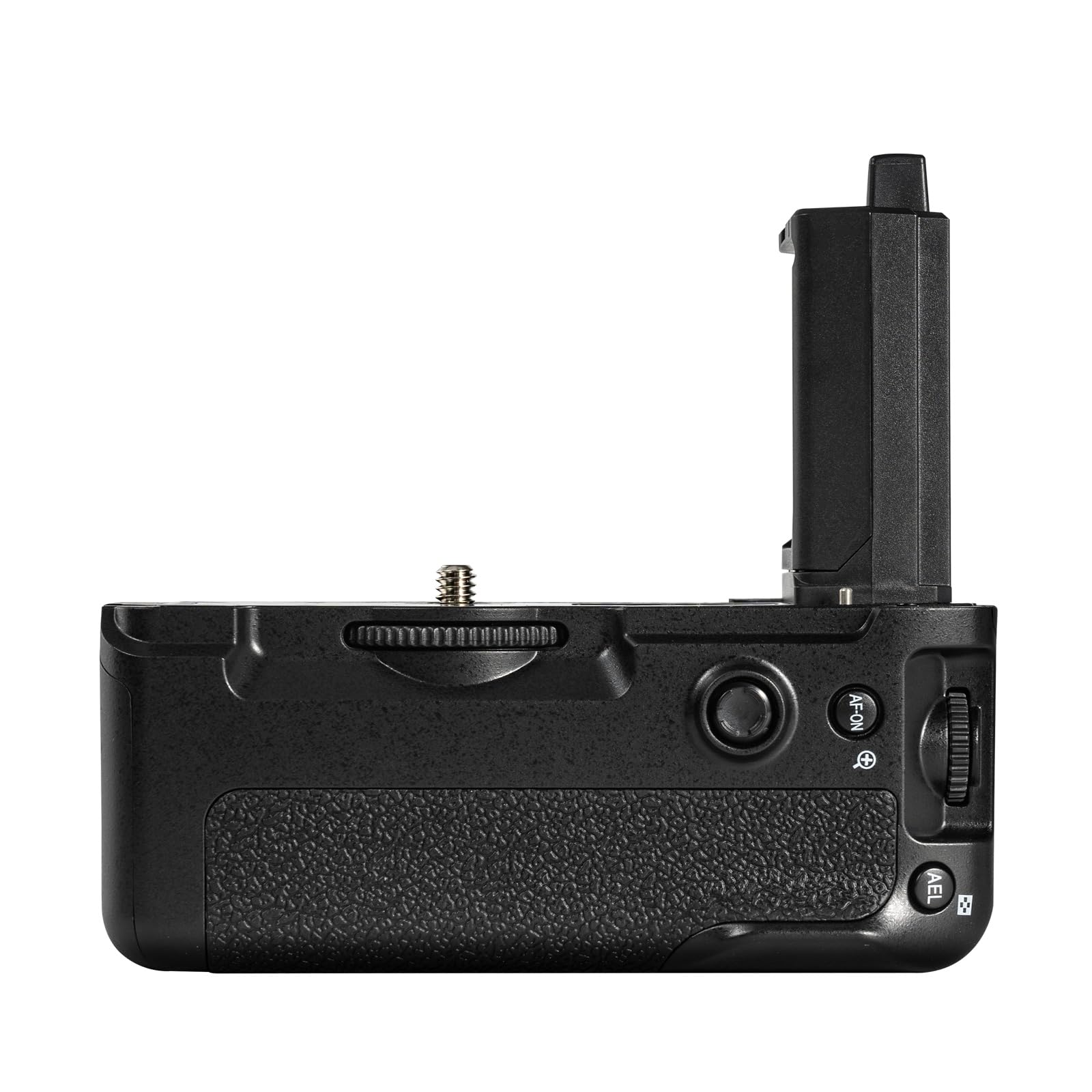
Check Latest Price
2

Best Professional/OEM Choice

Sony VG-C4EM

90 /100
Studio Score High Confidence

Key details

Mounting
1/4-inch tripod thread
Battery Type
2x NP-FZ100
Build & Sealing
Magnesium, weather-sealed
Vertical Controls
Shutter, dials, AF-ON, AE-L
Check Price on Amazon

The VG-C4EM is the OEM vertical grip for the Alpha 7R IV generation, built around a magnesium-alloy shell that carries the same sealing and rigidity as the camera body. It holds two NP-FZ100 batteries and adds a vertical shutter, exposure dials, and a grip contour that mirror the body's portrait controls. The mount locks flush with the camera with no play, so there is no wobble during portrait-orientation shooting. The result is a solid extension of the body rather than a bolt-on accessory.

Wedding and event photographers use this grip through long days of repeated vertical shooting. The sealed magnesium body keeps dust and moisture out of the battery chamber, and the controls maintain the same finger position as the camera's native grip, reducing fumbling when switching between landscape and portrait.

This grip is for shooters already using VG-C4EM-compatible bodies who need OEM build tolerance and weather protection in paid work. The price is several times higher than functionally similar aftermarket grips, and the value appears mostly in sealing, rigidity, and control feel rather than extra battery runtime. Hobbyists who just want two NP-FZ100 batteries should look at the lower-cost VG-C4EM-style alternatives.

Pros

  • OEM magnesium build and sealed gaskets hold up in dusty and wet shooting conditions.
  • Mounts flush with compatible Alpha bodies, eliminating the gap and wobble that affects some aftermarket grips.
  • Vertical shutter and dials mirror the camera body, keeping portrait-oriented control positions consistent.

Cons

  • Compatibility is limited to VG-C4EM-generation bodies; older Sony Alpha models need the VG-C3EM form factor.
Our verdict

This is the body-matched vertical grip for event photographers shooting compatible Alpha bodies in conditions where fit and sealing are non-negotiable.

Check Latest Price
3

Best Aftermarket for Newer Sony Bodies

Bitubol VG-C4EM

85 /100
Studio Score Strong Evidence

Key details

Mounting
1/4-inch screw, positioning hole
Battery Type
1 or 2 NP-FZ100
Build & Sealing
Plastic/rubber body
Vertical Controls
Shutter, dials, AF-ON, AE-L
Check Price on Amazon

The Bitubol grip targets the newer VG-C4EM body generation with a confirmed fit on the A7 IV, A7S III, A1, A7R V, A7R IV, and A9 II. It pairs dual NP-FZ100 batteries with the vertical shutter, quick control dials, and multifunction buttons, and adds a 1/4-inch tripod screw with positioning hole for alignment work. At a budget-friendly price, it brings the essentials of Sony's OEM grip without the OEM premium.

Vertical shutter and double-battery operation carry the load here. The grip reads one or two NP-FZ100 cells, and the tripod positioning hole gives videographers a clear alignment point for gimbal or slider mounting. In portrait orientation, the dials and shutter mirror the body's controls, so switching orientation does not require a change in shooting habits.

This is the aftermarket route for owners of A7 IV, A7S III, A1, A7R V, A7R IV, or A9 II who want VG-C4EM-style controls without Sony OEM pricing. Fit tolerance can vary between units; seat the grip firmly and confirm camera recognition before relying on it. A7 III-generation owners should use the top pick in this guide, since those bodies need VG-C3EM compatibility.

Pros

  • Covers the newer VG-C4EM body generation, including A7R V, A7 IV, A1, A7S III, A7R IV, and A9 II.
  • Budget-friendly alternative to Sony's OEM VG-C4EM that covers the core functions.
  • Vertical shutter release and dual-battery operation work for portrait shooting and longer sessions.

Cons

  • Fit tolerance can vary slightly between units; a less snug fit is possible on some A7R V bodies.
Our verdict

For A7 IV, A7S III, A1, A7R V, A7R IV, and A9 II owners, this is the cost-effective way to add dual-battery runtime and portrait controls.

Check Latest Price
4

Slim-Budget Alternative

mcoplus VG-C3EM

85 /100
Studio Score Strong Evidence

Key details

Mounting
1/4-inch tripod mount
Battery Type
1 or 2 NP-FZ100
Build & Sealing
Rubber-coated plastic
Vertical Controls
Shutter, dials, AF-ON, AE-L
Check Price on Amazon

The mcoplus VG-C3EM is the entry-price way to add dual NP-FZ100 power and vertical controls to a Sony A9, A7 III, or A7R III body. It carries the expected VG-C3EM layout: vertical shutter, front/rear dials, AF-ON, AE-L, and a multi-selector, plus a rubber-coated grip with a 1/4-inch tripod mount. At 0.3 kg, it adds useful leverage in portrait orientation without turning the camera into an awkward block. The price undercuts the safer all-around aftermarket option while preserving the core dual-battery function.

Two NP-FZ100 batteries cover long event days, and the camera body shows both charge levels in the normal battery display. Running a single battery is also an option, which keeps weight lower for walkaround shooting. Portrait handling feels stable and secure; the rubber-coated grip and 1/4-inch tripod mount add support when working one-handed. The vertical shutter and dials respond cleanly enough to function as a real control point, not just a battery holder.

Budget-focused A9/A7 III/A7R III owners who already own NP-FZ100 batteries are the right fit for this grip. The contact-switch connection can be intermittent, and reseating the grip usually restores dual-battery recognition. Newer VG-C4EM-generation bodies and professional outdoor work requiring OEM-grade weather sealing are outside its scope. It suits studio, event, and travel work where an occasional reseat check is an acceptable tradeoff for the entry-level price.

Pros

  • Dual NP-FZ100 power extends runtime well beyond a single battery.
  • Vertical shutter, front/rear dials, AF-ON, AE-L, and multi-selector give portrait shooting a functional control set.
  • Rubber-coated grip and 1/4-inch tripod mount keep the body stable in vertical work.
  • Entry-level price undercuts the OEM grip while retaining core dual-battery and vertical-control function.

Cons

  • Vertical controls work but feel clickier and less damped than the OEM grip.
  • The gold-pin switch can drop the connection until the grip is reseated.
Our verdict

For budget-first A9/A7 III/A7R III owners who already have NP-FZ100 batteries, the mcoplus is a legitimate low-cost route to dual-battery power and vertical controls.

Check Latest Price
5

Legacy A7 II

mcoplus VG-C2EM

85 /100
Studio Score Strong Evidence

Key details

Mounting
1/4-inch tripod screw
Battery Type
1 or 2 NP-FW50
Build & Sealing
Plastic/rubber body
Vertical Controls
Shutter, dials, AF-ON, AE-L
Check Price on Amazon

This grip adds a second NP-FW50 slot plus vertical shutter, dual dials, AF-ON, AE-L, and a multi-selector to A7 II / A7R II / A7S II bodies at a budget-friendly price. Small-to-medium hands get a glove-like fit and a secure vertical hold. A7 II-specific validation is less distinct because the listing pools feedback from other mcoplus grips, but this remains the primary aftermarket route for legacy-body owners.

This suits A7 II-series shooters who want double runtime without Sony OEM pricing. The honest tradeoff: vertical shutter and dials work but feel plasticky and clicky next to OEM parts, and the joystick can be a stretch in portrait orientation. For that buyer, the dual-battery gain outweighs the control compromise.

Pros

  • Adds a second NP-FW50 slot and doubles runtime on A7 II-series bodies at a budget price.
  • Glove-like grip improves vertical hold stability, especially for small-to-medium hands.
  • Cost-effective route for keeping older Sony A7 II-series bodies in service.

Cons

  • No batteries included; existing NP-FW50 cells are required, and a second battery adds cost if you don't have one.
  • In portrait orientation, the joystick can be a reach, and the shutter/dials feel clicky and less damped than Sony OEM parts.
Our verdict

For A7 II / A7R II / A7S II owners who already have NP-FW50 cells and can accept a less premium control feel, this is the aftermarket grip to use. Confirm NP-FW50 compatibility before ordering.

Check Latest Price

How to Choose

Grip Compatibility

Each Sony body generation uses a different grip standard. VG-C2EM grips fit A7 II-series bodies, VG-C3EM grips fit A9/A7 III/A7R III, and VG-C4EM grips fit newer bodies such as A7 IV, A7S III, A1, and A7R V. The contact layout and body contours are not interchangeable.

An aftermarket listing may show a photo that looks universal, but the compatibility code is the only reliable guide. A VG-C3EM grip on a VG-C4EM camera will not seat properly, and the camera will not recognize the second battery or vertical shutter.

Battery Type

VG-C2EM grips run on two NP-FW50 batteries; VG-C3EM and VG-C4EM grips run on two NP-FZ100 batteries. The grip must use the same battery type as the camera body, otherwise you are carrying a separate spare battery format.

The grip reads both cells through contact pins in the camera base. If those pins do not make full contact, the camera reports only the in-body battery. Reseating the grip usually restores dual-battery operation, but a worn or poorly aligned contact can make the issue return.

Vertical Controls

Full vertical controls mean a shutter button, front/rear dials, AF-ON, AE-L, and often a joystick in portrait orientation. This matters most for wedding, event, and portrait shooters who spend hours turning the camera sideways.

Aftermarket switches are lighter and clickier than Sony's OEM controls. The core function works, but the button travel changes over time; if a vertical shutter starts sticking or firing on its own, replace the grip before a paid shoot.

Build and Sealing

Sony OEM grips use a magnesium-alloy chassis and weather-sealed openings. Aftermarket grips are plastic or rubber-coated plastic, which lowers the price but also reduces rigidity and dust/moisture protection.

For indoor studio work the difference is minor. For outdoor shoots in wind-blown dust or light rain, OEM sealing protects the exposed contact area between grip and camera; that is the main reason to pay the premium.

Mounting and Stability

All grips in this category include a 1/4-inch tripod thread. Mounting the camera on a tripod through the grip keeps the rig balanced when a large telephoto or flash bracket is attached.

The less obvious issue is load transfer: a long lens or timelapse rig pulls on the grip's underside, and the grip-to-camera contact area takes the strain. Use the grip's tripod socket for heavy setups and check the screw for tightness after repositioning.

Frequently Asked Questions