4 Best APS-C Mirrorless Cameras in 2026: Match AF and 4K to Your Needs

Choose the right APS-C mirrorless camera for stills and video without overpaying for capabilities you won't use.

Shopping for an APS-C mirrorless camera means wading through spec sheets that all claim fast autofocus and sharp 4K. The real differences show up after you start shooting: battery life, heat limits, and how the camera actually fits your hands.

Megapixels are the least useful number on the box. The cameras that satisfy owners over time are the ones with current processors, dependable subject tracking, and a 4K mode that matches how you actually shoot.

This guide centers on the trade-offs that affect daily use, so you can pick a body that fits your budget and your real workflow.

1

Best Overall

Canon EOS R50 Kit

89 /100
Studio Score Strong Evidence

Key details

Video
Uncropped 4K30, 1080p120
Sensor
24.2MP APS-C CMOS
Autofocus
Dual Pixel CMOS AF II
Ergonomics
Small grip, vari-angle
Check Price on Amazon

The Canon EOS R50 combines DIGIC X processing and Dual Pixel CMOS AF II with uncropped 4K30, giving a compact APS-C kit the same autofocus generation as Canon's higher-tier mirrorless models. The 24.2MP sensor delivers crisp stills, while 4K is oversampled from 6K and 1080p120 is available for slow-motion work. A vari-angle touchscreen and 2.36M-dot EVF cover both self-shooting and eye-level composition. The 651-zone AF system covers a generous portion of the frame, so subject tracking works across much of the scene rather than only near the center.

Autofocus tracks faces and eyes with minimal hunting, and the touchscreen drag-to-focus makes selecting a subject quick. The small kit lens keeps the camera balanced for gimbal use, and the vari-angle screen suits vlogging positions. In normal indoor light, the camera holds focus well enough for everyday clips, and the 4K30 file quality is visibly sharper than the cropped 4K found on the tier below it. The touchscreen response is immediate, which matters for changing focus without diving into menus.

This camera targets content creators, vloggers, and travelers who want a lightweight interchangeable-lens body with modern autofocus and 4K in one kit. It is also a natural stepping stone for beginners who plan to grow within the RF mount system rather than replace the camera after a year. The compact body is a boundary for larger hands: the grip is short, and there is no in-body stabilization, so handheld video depends on the stabilization built into the kit lens or other RF-S lenses. Smartphone-first users will find the size familiar; DSLR owners should expect a smaller hold and may want to try the grip before buying.

Within this set, the R50 splits the difference between the entry-level RF-S body with a fixed screen and cropped 4K and the premium compact hybrids that add IBIS and 10-bit 4K60. It carries a mid-range price that reflects the DIGIC X generation, and it is the broadest all-rounder for someone buying their first interchangeable-lens camera. The kit lens covers the everyday focal range for travel, while the body itself is light enough to stay on a neck strap for hours. The absence of dual card slots and heavy-duty weather sealing is not a concern for this buyer profile, but it is a clear divider between the R50 and a professional tool.

Pros

  • Broadly satisfying image quality makes it a well-rounded starting point for a first mirrorless camera.
  • Sharp stills and uncropped 4K video come from the same 24.2MP sensor.
  • Modern DIGIC X processing and Dual Pixel AF II make the kit a strong value at a mid-range price.
  • Small, light body keeps travel simple, and the interface stays approachable for beginners.

Cons

  • For larger hands, the short grip can feel cramped during longer shooting sessions.
  • Handheld video relies on lens stabilization; the body has no IBIS.
Our verdict

The Canon EOS R50 is the broadest mid-range APS-C kit in this set for first-time mirrorless buyers, pairing current autofocus with uncropped 4K in a travel-friendly body.

Check Latest Price
2

Premium APS-C Performer

Sony a6700 Body

89 /100
Studio Score Strong Evidence

Key details

Video
4K60/120 10-bit
Sensor
26MP APS-C Exmor R
Autofocus
AI, 759-point AF
Ergonomics
Compact, complex menus
Check Price on Amazon

The a6700 steps up from the older compact E-mount option by adding a 26MP sensor, 5-axis IBIS, 4K60/120 10-bit recording, and AI-assisted subject tracking in the same travel-friendly format.

The 26MP sensor produces sharp stills with strong dynamic range, and the AF tracks moving subjects with minimal hunting. The compact body keeps the kit easy to carry, which is a real advantage in street and travel work.

This premium-priced hybrid suits enthusiasts moving from earlier Sony APS-C bodies, travel and street photographers who want 26MP and IBIS in one camera, and hybrid shooters who need 4K60/120. Sustained 4K has a thermal ceiling, and the menu system has a learning curve, so this is not a pick-up-and-record body for uninterrupted events.

๐Ÿ’ก Body-only delivery means the lens is a separate purchase; budget accordingly.

Pros

  • Compact body with premium build and strong feature set
  • Stills and video show strong dynamic range and detail
  • Autofocus is fast, with accurate subject and eye tracking
  • Strong value within the compact hybrid tier

Cons

  • Menu organization is layered, so initial setup takes time
  • Long 4K takes can overheat and shut down after about 45 minutes
  • Power-on behavior can vary between units; test the camera early
Our verdict

This is the E-mount hybrid to pick when premium specs matter more than kit price. It delivers strong stills and tracking AF in a body that carries well.

Check Latest Price
3

Compact All-Rounder with Proven AF

Sony a6400 w/ 16-50mm

89 /100
Studio Score Strong Evidence

Key details

Video
4K UHD
Sensor
24.2MP APS-C CMOS
Autofocus
425-point Real-Time Eye AF
Ergonomics
Compact, EVF included
Check Price on Amazon

The a6400 pairs Sony's Real-Time Eye AF with a built-in viewfinder and 4K UHD capture in a body that slips into a day bag. The top pick offers a newer processor and a vari-angle touchscreen, but the a6400 keeps the edge for Sony E-mount shooters who want fast face and eye tracking without frequent re-acquisition. The EVF is a clear outdoor-shooting advantage for travel and street work.

The 16-50mm kit lens covers everyday focal lengths, and the body's AF performance makes moving subjects easy to track. 4K UHD output holds up for a mid-range APS-C camera, and the tilting touchscreen works for waist-level shots. The listing mixes bullet points from a different Sony model, so verify the exact kit contents before checkout.

This suits first-time Sony E-mount buyers, travel photographers, and street shooters who want a compact body with a viewfinder and a mature lens system. It also works as a hybrid camera when 4K clips are planned around a tripod or gimbal; treat it as stills-first with video as a secondary. It is not the right body for handheld video shooters who need in-body stabilization, for buyers who want a side-flip screen, or for those who prefer a larger grip.

Pros

  • Real-Time Eye AF locks onto eyes and faces with fast, accurate tracking.
  • Compact body and lightweight design suit travel and everyday street carry.
  • Stills quality and 4K UHD output are strong for a mid-range APS-C hybrid.
  • Build quality holds up through regular stills and video work.

Cons

  • Battery life is short during 4K and continuous AF, and the body can drain while powered off.
  • Power or charging faults can surface after a few months in some cases; a warranty check is practical.
Our verdict

The a6400 is the compact Sony E-mount choice for buyers who want a viewfinder and class-leading autofocus without a larger body.

Check Latest Price
4

Budget Two-Lens Starter Kit

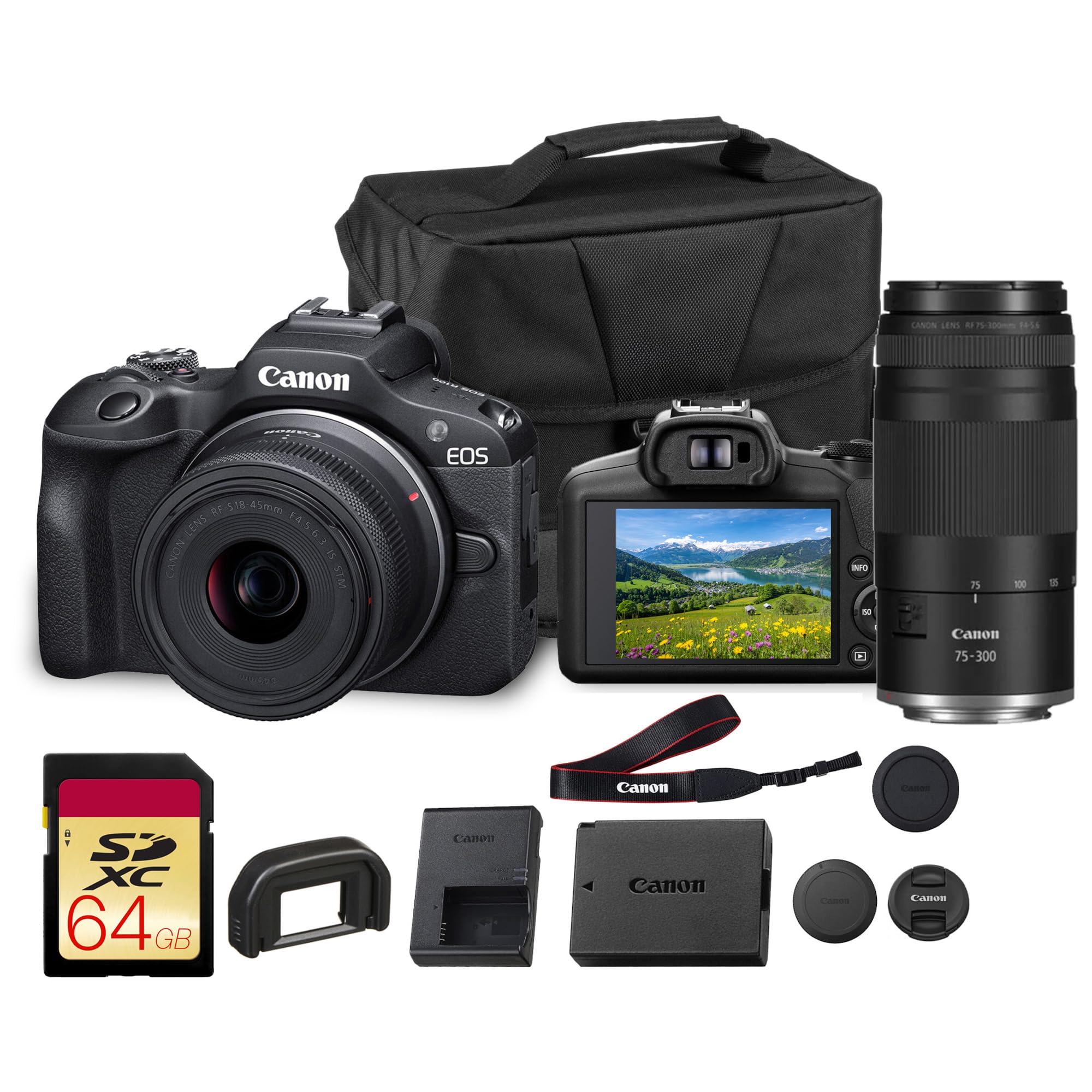
Canon R100 Double Lens Kit

89 /100
Studio Score Strong Evidence

Key details

Video
4K UHD
Sensor
24MP APS-C CMOS
Autofocus
Dual Pixel CMOS AF
Ergonomics
Fixed screen, simple
Check Price on Amazon

Two RF lenses ship in the box: the RF-S 18-45mm for everyday framing and the RF 75-300mm for reach. That pairing gives a first-time buyer a wide-to-telephoto range without a second purchase, which is the main reason this bundle stands apart from single-lens bodies in the same set.

Budget-conscious beginners and family/travel shooters who prioritize simplicity over advanced controls are the right audience. The R100 is an entry-level body with a fixed screen, older AF, and cropped 4K, so it fits casual stills better than action sequences or video-heavy workflows.

The practical rhythm is simple: keep the 18-45mm on for typical days and switch to the 75-300mm when the subject is farther away. The menu system is basic enough for a new mirrorless buyer to learn while shooting, and image colors arrive vivid without editing.

Pros

  • Two-lens kit covers wide-angle and telephoto range straight out of the box.
  • Image quality is sharp, vibrant, and forgiving for beginners.
  • First-time mirrorless buyers will find the controls approachable from the first session.
  • Quality consistency is a clear strength of the kit.

Cons

  • Low-angle or self-framing shots become awkward because the screen is fixed and non-touch.
  • Video editors who need uncropped 4K, 10-bit, or high frame rates will hit a ceiling with this body.
  • Fast-moving subjects will challenge the older autofocus generation before they challenge the top pick.
Our verdict

The R100 two-lens kit is the easiest budget on-ramp to a full wide-to-tele APS-C setup. Buy it for family and travel stills; put the extra money toward the top pick if your sessions lean action or video.

Check Latest Price

How to Choose

Sensor Generation and Resolution

Sensor generation matters more than megapixel count. The 24-26MP APS-C sensors in this class all resolve plenty of detail for prints and crops, but newer sensors pair with newer processors, which drives autofocus speed, rolling shutter, and video features.

A 24MP sensor from an older body will not deliver the same real-world responsiveness as a newer 24MP chip because the processor handles noise reduction, subject detection, and 4K readout. Buy the newest sensor generation your budget allows.

Autofocus System

Autofocus coverage numbers tell you how much of the frame the camera can track, but the more important detail is the detection algorithm. Current systems use deep-learning processors that recognize eyes, animals, and vehicles; older systems need the subject held in a specific focus area.

For people shooting kids or pets, a modern AF system with real-time eye tracking is the difference between a high keeper rate and a frustrating session. If you shoot mostly static subjects, an older but proven AF system still works well.

Video Implementation

4K on the spec sheet is not a single feature. Some cameras read the full sensor width and oversample for sharpness; others crop the sensor, which changes your effective focal length. Frame rate also varies, with many entry bodies limited to 4K30 while premium bodies offer 4K60 or 4K120.

Heat is the hidden limit. Sustained 4K recording in a compact body can trigger overheating shutdowns, especially in warm rooms or direct sun. If you record long interviews or events, look for a body with a proven heat record or plan for shorter takes and cooling breaks.

Stabilization

In-body stabilization shifts the sensor to counteract hand movement, while lens-based stabilization uses elements inside the lens. IBIS works with every lens you mount, making it the better choice for handheld video and slow shutter work with unstabilized primes.

Cameras without IBIS rely on stabilized kit lenses, which is workable for stills but leaves handheld video with residual shake. If you plan to shoot video without a gimbal or tripod, IBIS is the spec to prioritize.

Ergonomics and Portability

A small body is only an advantage if you can actually operate it. The R50's vari-angle touchscreen and EVF make it flexible for vlogging, while the a6400 keeps an EVF and a smaller footprint. The a6700 adds a deeper grip that suits heavier lenses.

If you have larger hands, try the body before you buy if possible. A compact camera with a cramped grip can be exhausting on a long shoot, no matter how capable the sensor is.

Frequently Asked Questions