8 Best Telescope for Beginners in 2026: Pick a Stable 70-80Mm Scope

The best telescope for beginners balances aperture, tripod stability, and realistic magnification — so first-time stargazers actually see the Moon and planets.

Most first-telescope listings lead with a magnification number. On a wobbly tripod and small 50-70mm lens, that number is mostly sales talk; the view blurs long before you get there. Aperture plus a stable mount is what actually shows Saturn's rings.

The practical first scope is a 70mm or 80mm refractor with eyepieces that keep magnification between 30x and 90x. That gathers enough light for lunar craters and Jupiter's moons without a heavy mount. You also choose between a proven 70mm kit and a similarly priced 80mm that picks up more light.

The right choice depends on which trade-off matters more for your first year. A familiar 70mm kit suits most families. An 80mm tube gives brighter views of the Moon and bright planets at this price.

1

Best Overall

EACONN 80mm Refractor

88 /100
Studio Score Strong Evidence

Key details

Mount
Altazimuth
Aperture
80mm
Adapter & Case
Backpack, phone adapter
Eyepieces & Finder
20mm, 9mm, 5x24 finder
Check Price on Amazon

The 80mm objective and 600mm focal length give this more usable light grasp than the best-selling 70mm family scopes in the same class: the Moon shows crater detail, and Jupiter's main cloud bands and Galilean moons are within reach at 66x. The included 20mm and 9mm eyepieces cover 30x and 66x, which are sensible powers for a manual telescope; the extra 10mm of aperture is the difference between a bright dot and a recognizable planet on a decent night. The eyepiece choices avoid the inflated magnification numbers found in toy-grade ads; every power in the box is actually usable. This is a real step up from a 70mm beginner kit, not just a larger number on the box.

The kit is complete out of the box. A 5x24 finder, phone adapter, backpack, and a rough-adjustment gimbal ship with the tube and tripod, so a family can go from unboxing to Moon viewing without buying extras. The phone adapter clips over the eyepiece and holds a phone in place; it is a practical way to share the view with kids, though it will not replace a dedicated astrophotography setup. The backpack zips the whole package into one carryable unit, making this one of the easier 80mm scopes to take to a darker sky.

This is a first telescope for adults, families, and kids 8 and older who want a real manual instrument rather than a toy or a computerized scope. There is no GoTo assistance, so learning to find objects by hand is part of the experience; anyone expecting automatic target location should look elsewhere. Serious deep-sky observers will want more than 80mm and a larger mount, but that is not what this kit is for. As with manual telescopes at this level, the focuser and tripod reward patience and careful setup, and the simple altazimuth head is easy for a child to understand.

The 20mm eyepiece is the best starting point because its wider field makes objects far easier to find; once a target is centered, the 9mm eyepiece delivers the closer look. The Moon's terminator is the best target for testing the 66x power, where craters and mountain shadows become clear. The ability to swap eyepieces and re-focus quickly is the core of learning to use a manual telescope, and this kit encourages that habit. Younger observers should stick with 30x until they are comfortable aiming, since the wider view forgives small hand movements.

💡 Let the tube settle for a second after focusing before deciding the image is blurry.

Pros

  • Build quality and satisfaction lead the kit; it feels like a real instrument rather than a toy.
  • The altazimuth mount sets up quickly and works intuitively for a family's first night out.
  • The backpack, phone adapter, and two eyepieces cover the basics in one purchase.
  • Moon and bright-planet views stay sharp at the supplied magnifications.
  • The complete kit makes a strong gift for a curious kid or teen with no extras to buy.

Cons

  • The finder can arrive misaligned, leading first-time users to the wrong sky patch until a daylight alignment.
  • No slow-motion control means high-power targets drift and need manual nudges.
Our verdict

A family-first starting kit that gives real Moon and planet views without the cost or complexity of a computerized mount.

Check Latest Price
2

Best-Selling Family Refractor

Gskyer 70mm AZ Refractor

88 /100
Studio Score Strong Evidence

Key details

Mount
Altazimuth
Aperture
70mm
Adapter & Case
Carry bag, phone adapter, remote
Eyepieces & Finder
2 eyepieces, 3x Barlow, 5x24
Check Price on Amazon

The Gskyer 70mm kit is the family-first entry in this beginner lineup. Its wireless remote and phone adapter are built around sharing the Moon from the eyepiece, and the carry bag keeps the scope ready for a trip to a darker yard. The 70mm objective and 400mm focal length make it a lightweight alternative to the bulkier 80mm kit, and the altazimuth mount needs no power or app.

The Moon at low magnification is the standout target. Jupiter's moons appear as a tidy row, and the brightest planets resolve into small discs. Phone shots from the eyepiece come out crisp because the adapter clamps onto the eyepiece instead of hovering behind it.

This is a first telescope for families with kids 8 and older, adult beginners, and gift buyers who want one box with everything. The 70mm aperture and finicky focusing mean the realistic targets are the Moon, Jupiter's moons, and the brightest planets at low power; anyone expecting substantial planetary magnification should move up to the 80mm kit in this lineup.

Pros

  • Assembly is quick enough to do before the first night, and the altazimuth mount needs no power or app.
  • The wireless remote and phone adapter make it easy to capture Moon shots the whole family can see.
  • A complete bundle with eyepieces, Barlow, and carry bag covers the essentials for a first scope.
  • Controls are simple enough for kids 8 and up to operate with minimal coaching.

Cons

  • A misaligned finder makes centering targets harder, especially for new users who skip the daylight alignment step.
  • The 70mm aperture is a step below the 80mm kit in this group, so high-power planetary detail stays modest.
Our verdict

This is the first telescope to buy when the goal is a family Moon night rather than a planetary observing program.

Check Latest Price
3

Best Budget Family Starter

Koolpte 70mm Refractor

87 /100
Studio Score Strong Evidence

Key details

Mount
Altazimuth
Aperture
70mm
Adapter & Case
Carrying case, phone adapter, remote
Eyepieces & Finder
25mm, 10mm, 3x Barlow, 5x24
Check Price on Amazon

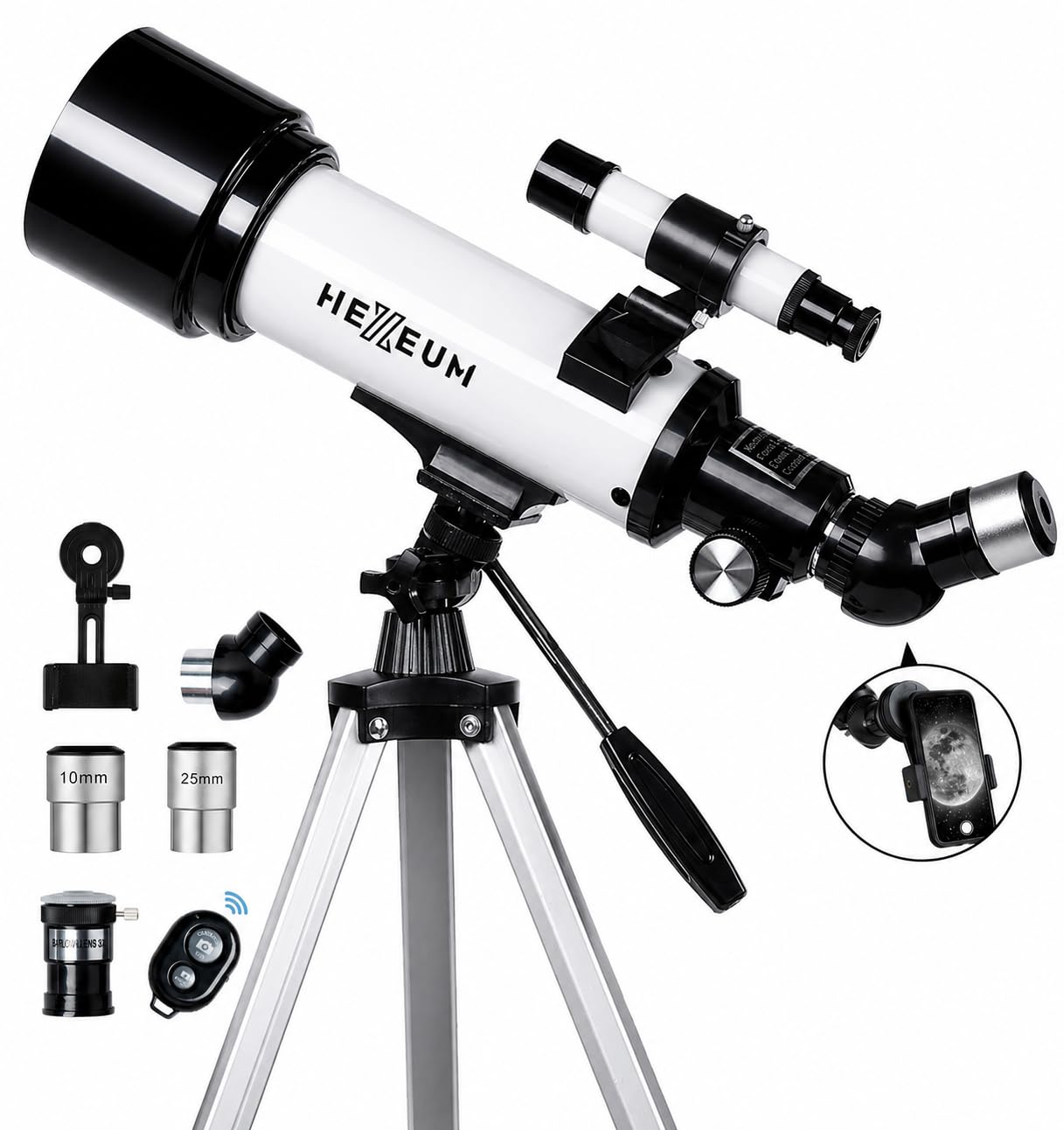
What sets the Koolpte 70mm apart in this price band is the complete carry-ready package: a 70mm altazimuth refractor, 5x24 finder, 25mm and 10mm eyepieces, a 3x Barlow, phone adapter, wireless remote, and a padded carrying case. It is a first telescope that arrives ready to go outside on the included tripod.

The 500mm focal length and 70mm aperture are enough for the Moon, Jupiter's moons, and the brightest planets at low to medium power. Young users can line up the finder, center the Moon, and grab a phone-adapted image in a few minutes. The setup process is simple enough that a child can help, and the carrying case keeps the kit together between outings.

This scope suits kids 8-12, grandparents, and families who want a simple first telescope without spending heavily. It is not a step up for adults who already want 80mm light gathering; the larger-aperture kit is the better route to dimmer objects. Focusing at higher magnifications is tricky, and the Barlow demands patience, so the Moon and brightest planets at low power are the realistic targets.

The strongest use is a family night in the backyard: the wireless remote avoids shake, and the phone adapter makes Moon photos easy enough to share. This is not a deep-sky instrument, but that boundary is clear at this price.

💡 Keep the 25mm eyepiece on first; once low-power focus feels natural, try the 10mm before adding the Barlow.

Pros

  • Budget-friendly package includes phone adapter, wireless remote, and padded case instead of leaving those as extras.
  • Assembly is manageable enough for a child to help, so the first outing does not require an adult expert.
  • The Moon and the brightest planets are visible with the 25mm eyepiece, giving beginners a satisfying first target.
  • The kit suits kids 8-12 and adults who have never aimed a telescope; no steep learning curve.

Cons

  • The printed manual is brief; some families will supplement it with a setup video.
  • The stock tripod can feel light in a breeze; a sheltered yard keeps the view steady.
  • The 3x Barlow may be the last accessory you reach for; the 25mm and 10mm eyepieces cover the useful range.
Our verdict

For a family's first telescope, the included extras and simple layout matter more than the missing 10mm of aperture.

Check Latest Price
4

Best for Growing Enthusiasts

Dianfan 90mm Refractor

87 /100
Studio Score Strong Evidence

Key details

Mount
Altazimuth
Aperture
90mm
Adapter & Case
Carry bag, phone adapter
Eyepieces & Finder
2 eyepieces, 3x Barlow
Check Price on Amazon

The 90mm aperture and stainless steel tripod give the Dianfan the strongest light grasp in this group of beginner refractors, a real step up from the 70mm and 80mm kits that dominate entry-level listings. The 800mm focal length keeps lunar and planetary views detailed, and the steel legs reduce the wobble common on lightweight aluminum tripods.

This is the grow-into-it option for adult beginners and older kids who want a scope that stays useful beyond the first season. It costs more than an impulse gift and the 800mm tube takes up more space than a backpack model, so it belongs on a home balcony or in a garage rather than a suitcase. Tall observers should check the tripod's height and locking mechanism before purchase; the mount is the least refined part of an otherwise well-balanced kit.

The package includes two eyepieces, a 3x Barlow, a phone adapter, and a carrying case, so beginners can observe immediately without extra purchases. Assembly takes minutes, and the straight-through finder aligns well enough for bright targets. The maximum listed magnification is optimistic; comfortable high-power views land around 100x, which is plenty for the Moon, Jupiter's moons, and Saturn's rings on steady nights.

💡 Set the tripod legs to a comfortable working height and lock them before aiming at high-angle targets; a low stool gives tall observers a steadier stance.

Pros

  • 90mm aperture gives serious beginners noticeably more light grasp than 70mm and 80mm starter kits.
  • Setup takes minutes; the stainless steel tripod and clear finder get new users observing quickly.
  • The included eyepieces, Barlow, phone adapter, and carrying case cover the first-year essentials.
  • A worthwhile step up for teens and adults ready to move past toy-grade refractors.

Cons

  • Tall users may need to lower the tripod or use a seat; the mount is less polished than the optical tube.
Our verdict

For a beginner who knows the hobby will stick, the Dianfan's light grasp and stable tripod justify the premium over smaller starter kits — just expect a learning curve when pushing past 100x.

Check Latest Price
5

Trusted Brand Travel Scope

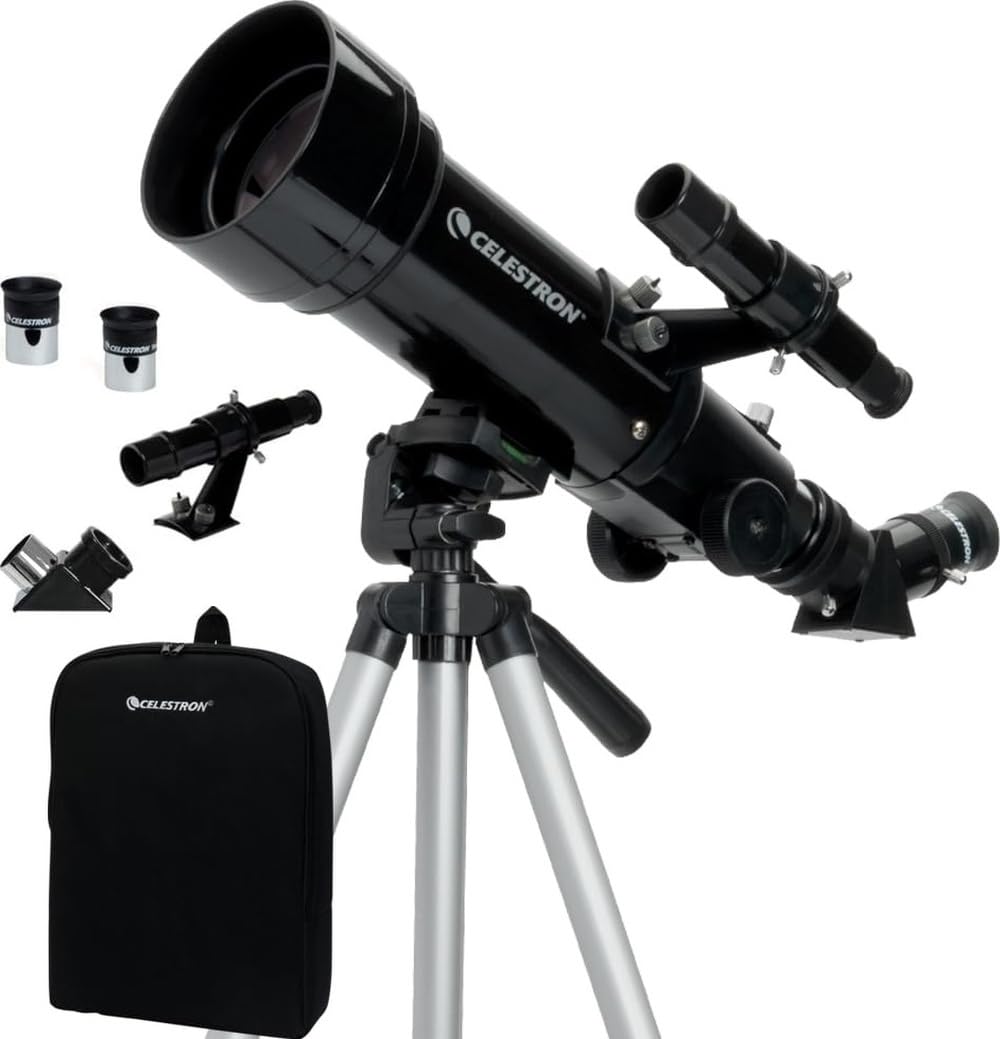
Celestron Travel Scope 70

86 /100
Studio Score Strong Evidence

Key details

Mount
Altazimuth
Aperture
70mm
Adapter & Case
Padded backpack, star diagonal
Eyepieces & Finder
20mm, 10mm, 5x24 finder
Check Price on Amazon

The Travel Scope 70 is a compact 70mm refractor built around the idea that a first telescope should be easy to take along. The padded backpack holds the tube, altazimuth mount, 20mm and 10mm eyepieces, and 5x24 finder, so the whole kit arrives at a campsite or backyard table in one carry. Assembly takes a few minutes, and the low-power view of the Moon is a reasonable reward for that effort.

For travelers, campers, and gift-givers who want a name-brand first scope, the Travel Scope 70 is a comfortable match. The tripod is the weak point: it is compact and light, so for steady high-power views a sturdier mount is recommended. Casual viewing of the Moon and daytime landmarks at low magnification is where this kit earns its keep.

The 20mm eyepiece frames the Moon well and gives a bright enough image for a first-time observer. The 10mm eyepiece extends magnification on nights when the air is steady, but it is best treated as a bonus rather than the main reason to buy. Low power remains the best place for beginners to get acquainted with the sky.

💡 Firm ground and a short wait for the mount to settle help steady the view before high-power focusing.

Pros

  • Padded backpack and lightweight tube make the whole kit easy to carry.
  • Beginners can assemble it without tools, and setup is quick enough for a first night out.
  • First-time users find the included kit enjoyable for Moon and daytime viewing.
  • The 70mm aperture and 400mm focal length form an accessible starter layout for beginners.

Cons

  • The stock tripod can feel wobbly, especially at high magnification or in a breeze.
  • High-power clarity can be inconsistent, so sharp planetary detail is not guaranteed.
Our verdict

For campers and gift-givers, the Travel Scope 70 is a complete, packable first telescope for Moon and daytime viewing.

Check Latest Price
6

Travel Families

Celticbird 80mm Refractor

87 /100
Studio Score Strong Evidence

Key details

Mount
Altazimuth
Aperture
80mm
Adapter & Case
Backpack, phone adapter, moon filter
Eyepieces & Finder
20mm, 9mm, 5x24 finder
Check Price on Amazon

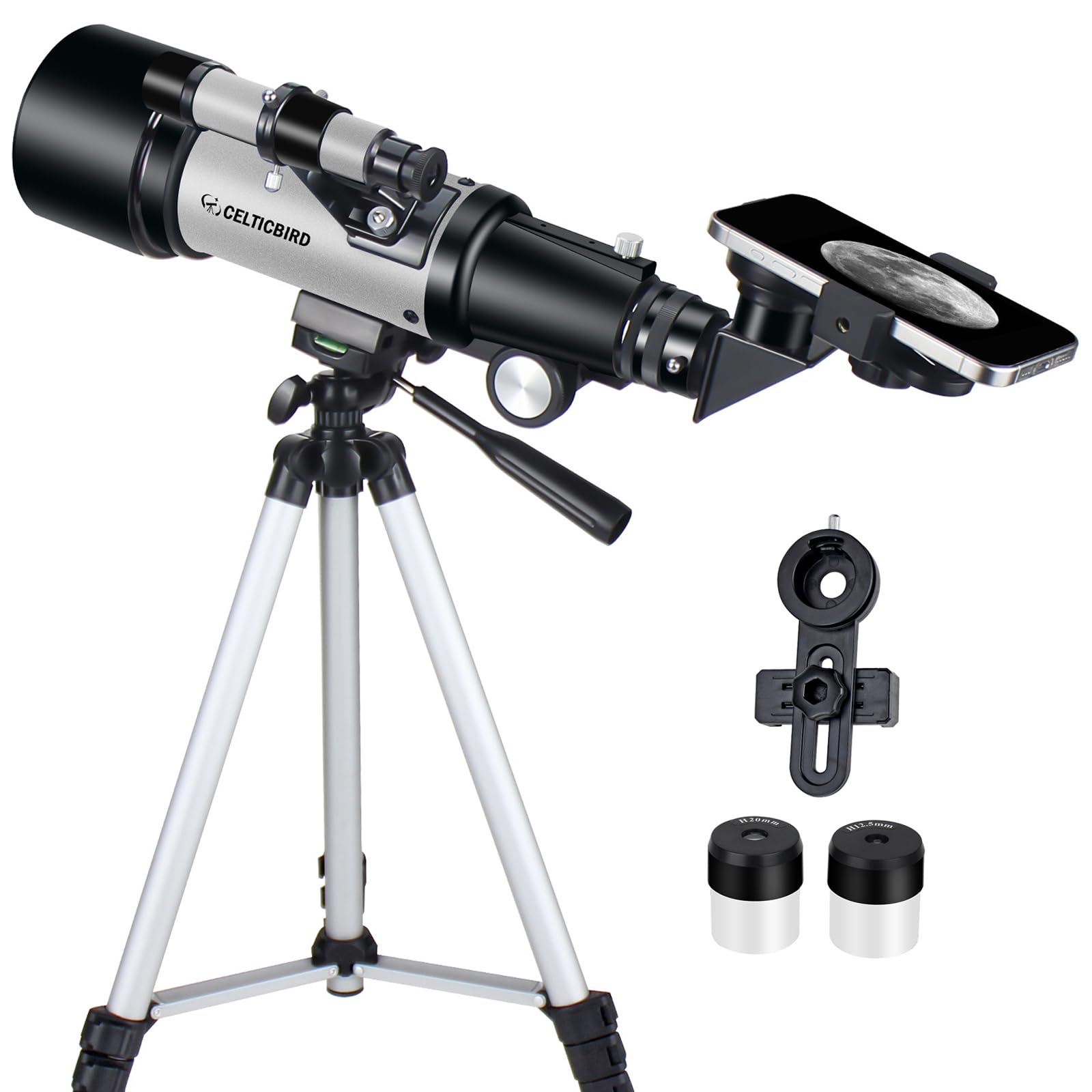
The Celticbird 80mm refractor delivers a genuine step up in light grasp for buyers who have outgrown 70mm toy-grade scopes, pairing that aperture with a padded backpack, phone adapter, and moon filter in a travel-friendly kit. Setup is simple enough for families to move from box to first Moon view in minutes, and the 600mm focal length provides useful 30x and 66x views with the included eyepieces. Occasional build-quality variation between units—sometimes a damaged lens, sometimes a cheap-feeling exterior—keeps it a step behind the leading 80mm option, so careful inspection on arrival matters.

Pros

  • A genuinely useful 80mm aperture that shows the Moon and Jupiter's moons without pushing buyers toward premium-priced telescopes.
  • The padded backpack keeps the tube, tripod, and accessories together for road trips and camping.
  • Kids and adults both report real enjoyment, making it a family activity rather than a solo hobby.

Cons

  • Faint deep-sky targets like nebulae and galaxies fall outside this scope's reach; Moon and planets are the realistic targets.
  • The 80mm tube and full tripod are too much for a very young child to manage alone.
Our verdict

The strongest case for this scope is its portability: it is a grab-and-go 80mm kit that fits the first-time buyer's budget.

Check Latest Price
7

Young Kids

Celticbird 70mm Refractor

82 /100
Studio Score Strong Evidence

Key details

Mount
Altazimuth
Aperture
70mm
Adapter & Case
Phone adapter, adjustable tripod
Eyepieces & Finder
20mm, 12.5mm, 5x24 finder
Check Price on Amazon

The Celticbird 70mm is a gentle first refractor for ages 6-10. Its deliberately low magnification and simple altazimuth mount keep the Moon and daytime scenery easy to find, while the included phone adapter lets a child share that first view. Low power also sidesteps the shaking that appears when a lightweight tripod is pushed hard. Planets remain small and distant at this magnification, so anyone expecting Saturn's rings or Jupiter's bands should look at an 80mm kit. That limitation keeps this scope below larger-aperture starters: a Moon-and-landscape gift for young children, not a serious astronomy instrument.

Pros

  • Simple enough for children ages 6-10 to aim at the Moon and nearby scenery without fighting high magnification.
  • Budget-friendly kit includes tripod and phone adapter for sharing a first Moon view.
  • At this scope's low-power setting, the 70mm lens delivers a bright Moon and landscape view.

Cons

  • The 400mm focal length and included eyepieces cap magnification at 20x-32x, keeping the view at Moon-and-landscape level.
Our verdict

For a 6-10 year old's first telescope, this is a safe, affordable Moon-and-backyard starter. Larger-aperture kits serve adults and teens who want planetary detail.

Check Latest Price
8

Tech Beginners

Celestron StarSense 114AZ

84 /100
Studio Score Strong Evidence

Key details

Mount
Altazimuth with slow motion
Aperture
114mm
Adapter & Case
StarSense app, phone dock
Eyepieces & Finder
25mm, 10mm, 2x Barlow, StarPointer
Check Price on Amazon

The Celestron StarSense Explorer LT 114AZ pairs a 114mm Newtonian reflector with a phone-dock StarSense app, giving tech-comfortable first-timers brighter deep-sky views than a typical 70-90mm refractor. The app can recognize what is overhead and point the way, but recognition can vary between sessions, and the tripod may shift while aiming. That friction is why it stays below easier-to-use refractors for first-time stargazers who want simple observing. It is a fit for patient beginners willing to troubleshoot the phone app in exchange for more aperture, not for families who want quick, out-of-box observing.

Pros

  • 114mm aperture brings brighter views of the Moon, planets, and bright deep-sky objects than entry-level 70-90mm refractors.
  • StarSense phone dock uses the phone camera as a guided locator for first-timers who do not know the sky.
  • Includes 25mm and 10mm eyepieces plus a 2x Barlow for several magnification choices out of the box.

Cons

  • Aligning the phone dock and balancing the mount takes several steps before observing can start.
  • At higher power, the tripod can wobble or slide while making fine adjustments.
Our verdict

For the beginner who enjoys learning a telescope, the 114mm aperture payoff is real.

Check Latest Price

How to Choose

Aperture

A wider aperture collects more light, which is why an 80mm refractor shows fainter stars and more lunar detail than a 70mm scope. A 70mm tube is enough for the Moon and Jupiter's moons; an 80mm tube begins to reveal Saturn's rings as more than a sliver. The trade-off is that bigger apertures usually mean longer and heavier tubes, so the mount needs more strength.

Mount and Tripod Stability

Magnification magnifies movement along with detail. A tripod that feels steady at 30x can feel shaky at 90x, and every touch of the focuser turns the target into a bouncing blur. This is why a modest aperture on a stable mount outperforms a high-magnification toy on a wobbly tripod.

Eyepieces, Finder, and Barlow

Eyepieces set the actual magnification: a 25mm eyepiece gives low power and a wide view, while a 10mm eyepiece gives higher power and a narrow field. A 3x Barlow triples magnification, but it also darkens the image and magnifies focus errors. For a first scope, a 25mm and a 10mm eyepiece cover the useful range; extra Barlow power is for targets that are already bright and focused.

Phone Adapter and Carry Case

A phone adapter turns the eyepiece into a camera lens for Moon shots and daytime views. A backpack or carry bag makes a telescope more likely to leave the house, but it does not improve the view. The practical trade-off is portability versus setup friction: a packed scope has to be re-aimed every time, so a simple altazimuth mount beats a more complex setup for casual use.

Ease of Focusing and Assembly

Manual refractors require three steps before observing: assemble the tripod, attach the tube, and align the finderscope to the main telescope. Most early 'can't see anything' problems come from a finder aimed somewhere other than the target. Choose a kit with a 5x24 finder and a smooth focuser; these parts determine whether a first night is enjoyable or frustrating.

Frequently Asked Questions