7 Best SD Card of 2026: Match Speed Class to Your Camera

Find the best SD card for your camera by matching capacity and video speed class to how you shoot, from trail cams to 4K.

SD card listings love to print big read-speed numbers, but read speed is rarely the reason a card struggles in a camera. The write speed and video speed class determine whether a card records 4K without dropping frames or locks up during a burst. Most compatibility issues trace back to buying the wrong class for the camera's demands.

That mismatch shows up in the field as a card-error prompt, a camera that will not format the card, or footage that stops mid-record. The fix is not to buy the cheapest or the fastest label, but to match the card's speed class and capacity to the shooting situation. This guide sorts the options by that fit.

For stills-only shooters, a basic U1 card keeps costs low. For 4K or bursts, U3/V30 is the floor. UHS-II only pays off in cameras with UHS-II slots. Choose the tier your camera actually needs, and the card becomes the last thing you think about.

1

Best Overall

SanDisk Extreme PRO 128GB

96 /100
Studio Score High Confidence

Key details

Warranty
Lifetime limited
UHS-II Support
UHS-I only
Capacity & Format
128GB, single card
Video Speed Class
U3, V30
Check Price on Amazon

The SanDisk Extreme PRO 128GB delivers U3/V30 write performance in a full-size SDXC package, with 200MB/s read speeds and 90MB/s write speeds. For 4K recording, V30 is the rating that matters: it guarantees sustained write bandwidth at common bitrates, so recording stays steady through long clips. Burst shooters get the same headroom when the camera dumps a buffer to the card; the write rate is enough to keep up with rapid-fire sequences found on enthusiast UHS-I bodies. The 200MB/s read speed also shortens the wait when offloading a full card to a computer. For UHS-I-only cameras, the card is not the bottleneck.

Long recording sessions and repeated file transfers hold their pace on this card, without the slowdown that can appear on less expensive UHS-I cards after sustained writes. The 128GB capacity gives a hybrid shooter room for RAW sequences plus a generous amount of 4K footage before reaching for another card, making it a practical single-card setup for mixed work. In a UHS-I slot, the card operates near the speed ceiling of that interface, so the body becomes the limiting factor rather than the card. In dual-slot bodies, it earns the primary slot while a slower spare handles overflow.

This is a full-size SDXC card, not a microSD card with an adapter, which removes a point of physical failure in camera card slots. The body is built for field use, and the lifetime limited warranty covers long-term ownership for regular work. At 128GB, it avoids the waste of smaller cards without stepping into the high-capacity tier where the larger 256GB version in the same series becomes the better fit for no-swap event days.

This card suits enthusiast photographers, hybrid shooters, and event work where one full-size SD card has to handle both 4K video and burst stills. It is the card to try first in a UHS-I camera because the speed class is matched to what those bodies can use. A few specific Nikon and Canon bodies may show recognition quirks, so run a short in-camera test before a paid shoot; once confirmed, it can sit in the primary slot without a second thought.

Event photographers who shoot long bursts and 4K clips in the same job can treat this as the default primary-slot card. The 128GB capacity serves as a practical middle ground for a day of mixed shooting. UHS-II shooters will get more speed from a UHS-II card, but this one is aimed squarely at the installed base of UHS-I cameras.

Pros

  • Sustains 4K recording and burst capture with U3/V30 write performance.
  • Keeps its write pace through long shoots and repeated card rewrites.
  • 128GB capacity pairs with durable construction for field work.
  • Lifetime limited warranty covers the long haul for regular users.

Cons

  • Budget-only shoppers pay for V30 write speed that stills-only U1 cameras will not use.
Our verdict

The Extreme PRO 128GB is the full-size SD card to buy when the camera will actually use U3/V30 speed.

Check Latest Price
2

Best for High-Capacity 4K Shooting

SanDisk Extreme 256GB

95 /100
Studio Score High Confidence

Key details

Warranty
Lifetime limited
UHS-II Support
UHS-I only
Capacity & Format
256GB, single card
Video Speed Class
U3, V30
Check Price on Amazon

The 256GB Extreme pairs U3/V30 write performance with enough capacity to skip card swaps on long shoots. With 180MB/s reads and 130MB/s writes, it is one of the faster UHS-I cards at this size. The V30 rating puts minimum sustained write speed at 30MB/s, the threshold for 4K-capable UHS-I cameras, so recording and burst stills stay on a single card from first frame to last.

Build quality follows the Extreme family's standard and holds up to the jostle of a packed camera bag. The per-gigabyte cost undercuts smaller V30 cards, which matters for event and travel photographers who would rather carry one card than a stack of 64GB spares. At typical 4K bitrates, the card records for hours before filling, so a full wedding or travel day fits comfortably.

This is a capacity-first card for UHS-I shooters who fill memory quickly and want future headroom without jumping to UHS-II. It is not for budget stills-only shooters who would pay for write speed they don't use, and older SDHC-only cameras won't recognize the SDXC format. A backup habit is part of the deal, especially when one card carries a full day's work.

Pros

  • 256GB capacity at a strong per-gigabyte cost, so high-volume shoots fit on one card.
  • U3/V30 write speeds sustain 4K UHD recording and burst photography without stalling.
  • Build quality holds up to travel-camera use and repeated card swaps.

Cons

  • Unit-to-unit quality control can vary, so test a new card before a paid shoot.
  • Corruption after repeated use has been noted as the main failure mode.
Our verdict

For capacity-focused UHS-I shooters, the 256GB Extreme is the pick that makes card swaps a rarity on long event days.

Check Latest Price
3

Best UHS-II Upgrade

Lexar Silver PRO 2-Pack

95 /100
Studio Score High Confidence

Key details

Warranty
Lifetime limited
UHS-II Support
Yes, UHS-II
Capacity & Format
2x 128GB
Video Speed Class
U3, V60
Check Price on Amazon

The only UHS-II V60 2-pack in this set, the Lexar Silver PRO kit puts two 128GB full-size SDXC cards in front of working pros. Read speed tops out at 280MB/s, write speed at 120MB/s, and the V60 class covers 4K recording without the buffer warnings you get from slower cards.

This is not a replacement for the UHS-I all-rounder in this set; it is a specialist option for shooters who need two high-capacity cards in one box. The speed and V60 recording are the differentiators, not the capacity alone.

Those numbers show up in actual capture: V60 sustained write performance handles 4K smoothly and keeps burst shots moving when the buffer fills. File transfers move quickly, which matters when a wedding card needs to be offloaded between sets.

Full UHS-II speeds require a UHS-II-capable camera or reader; in UHS-I slots these cards fall back to UHS-I speeds. This 2-pack is therefore aimed at wedding and event photographers with UHS-II bodies who want dual-slot coverage without carrying two separate purchases. Casual photographers or anyone leaning on an older UHS-I camera will see the capacity benefit but not the speed premium.

💡 Use a UHS-II card reader for offloads; only then will the 280MB/s read speed appear.

Pros

  • Dual-slot 4K shooters get two cards that keep capture steady when the buffer fills.
  • Build quality holds up under repeated use, and file offloads finish quickly.
  • V60 write speed clears 4K recording needs without the buffer warnings slower cards produce.

Cons

  • Full UHS-II speeds require a UHS-II-capable camera or reader; in UHS-I slots these cards run at UHS-I speeds.
Our verdict

This is the set's only UHS-II V60 two-card kit, and it pairs naturally with dual-slot UHS-II cameras. Working pros get both slots covered in one purchase.

Check Latest Price
4

Best Budget Multi-Pack for Trail & Multiple Cameras

Gigastone 32GB 5-Pack

93 /100
Studio Score High Confidence

Key details

Warranty
5-year limited
UHS-II Support
UHS-I only
Capacity & Format
5x 32GB
Video Speed Class
U1, V10
Check Price on Amazon

Five 32GB U1/V10 SDHC cards come in one pack with five mini cases, making it easy to keep multiple trail cameras or basic digital cameras loaded. Among budget multi-packs, the Gigastone set stands out by pairing that convenience with a 5-year limited warranty and a cleaner quality record than the cheapest alternatives. The per-card price is low enough that stocking a classroom kit or a handful of trail cams does not require a big upfront decision.

These cards handle 1080p clips and still photos comfortably, which is what trail cameras and point-and-shoots ask for. Image capture stays clean in those settings, and the mini cases keep five cards organized when you rotate them between cameras. For a trail-cam grid or a family camera drawer, the bundle behaves like a set of simple consumables rather than a single precious piece of gear.

This bundle is for buyers who prefer several 32GB cards over fewer high-capacity ones: trail-cam owners can leave a card in every camera, classrooms can hand a card to each group, and households can rotate cards freely. U1/V10 limits the pack to 1080p and stills, so 4K shooters will need a V30/U3 card; the occasional out-of-box DOA card means a quick test before field use is worthwhile. For those low-stakes uses, five ready cards keep every camera loaded without overthinking storage.

💡 Run every card through a format and recording check before field use.

Pros

  • Five cards with mini cases equip a multi-camera household or trail-cam setup from one purchase.
  • Trail cameras and basic digital cameras read these cards without formatting headaches.
  • The mini cases keep five cards neat, which helps rotate them across cameras.

Cons

  • The 80 MB/s read speed works for casual transfers, but bulk offloads will not benefit from high-speed transfer.
  • At 32GB per card, an all-day event in a single-slot camera requires several card swaps.
Our verdict

For a trail-cam network or a classroom kit, five loaded cards matter more than one big card, and this pack delivers that at a budget price.

Check Latest Price
5

Budget 5-Pack Alternative

PNY 32GB 5-Pack

92 /100
Studio Score High Confidence

Key details

Warranty
Limited lifetime
UHS-II Support
UHS-I only
Capacity & Format
5x 32GB
Video Speed Class
U1, V10
Check Price on Amazon

The five-card PNY Elite pack is the cost-first route to filling multiple full-size SD slots: 32GB per card, Class 10/U1/V10 speed, and a limited lifetime warranty. At this per-card price, the value proposition is simple: you are buying capacity and coverage rather than peak write performance. That makes it a practical first multi-pack for a family with several HD cameras.

Read speeds up to 100 MB/s move stills and Full HD clips off the card quickly enough for everyday transfers. The U1/V10 rating is aligned with this tier of multi-pack: it keeps 1080p recording and trail-cam triggers running without demanding premium-priced silicon. They work in older point-and-shoots and trail cams without a microSD adapter.

This pack is for HD camcorder owners, trail-cam networks, and classroom kits where 32GB per slot and 1080p recording are the ceiling. The U1 speed class is the limit: stills and Full HD are in scope, while serious 4K or heavy burst work belongs on a U3/V30 card.

You are paying for five independent cards, so the realistic workflow is to format each card and shoot a short test clip before relying on it. Buyers who want zero verification would do better with the cleaner budget multi-pack in this set, but those who accept that checkpoint get the lowest per-slot cost in the full-size SD category.

💡 Format all five cards and shoot a short test clip before relying on any of them.

Pros

  • Five 32GB cards at a per-card price that undercuts typical single-card budget options.
  • 32GB per card suits full days of HD shooting or extended trail-cam deployments.
  • Class 10/U1/V10 speed keeps 1080p recording and trail-cam triggers moving.

Cons

  • Some cards can arrive unformattable or unrecognized until a forced format is run.
  • Counterfeit units can show up in some marketplace listings, so buy from a reputable seller.
Our verdict

The right call for cost-first multi-camera setups: five full-size slots at a per-slot price that undercuts typical single-card prices.

Check Latest Price
6

Trail-Cam Bulk

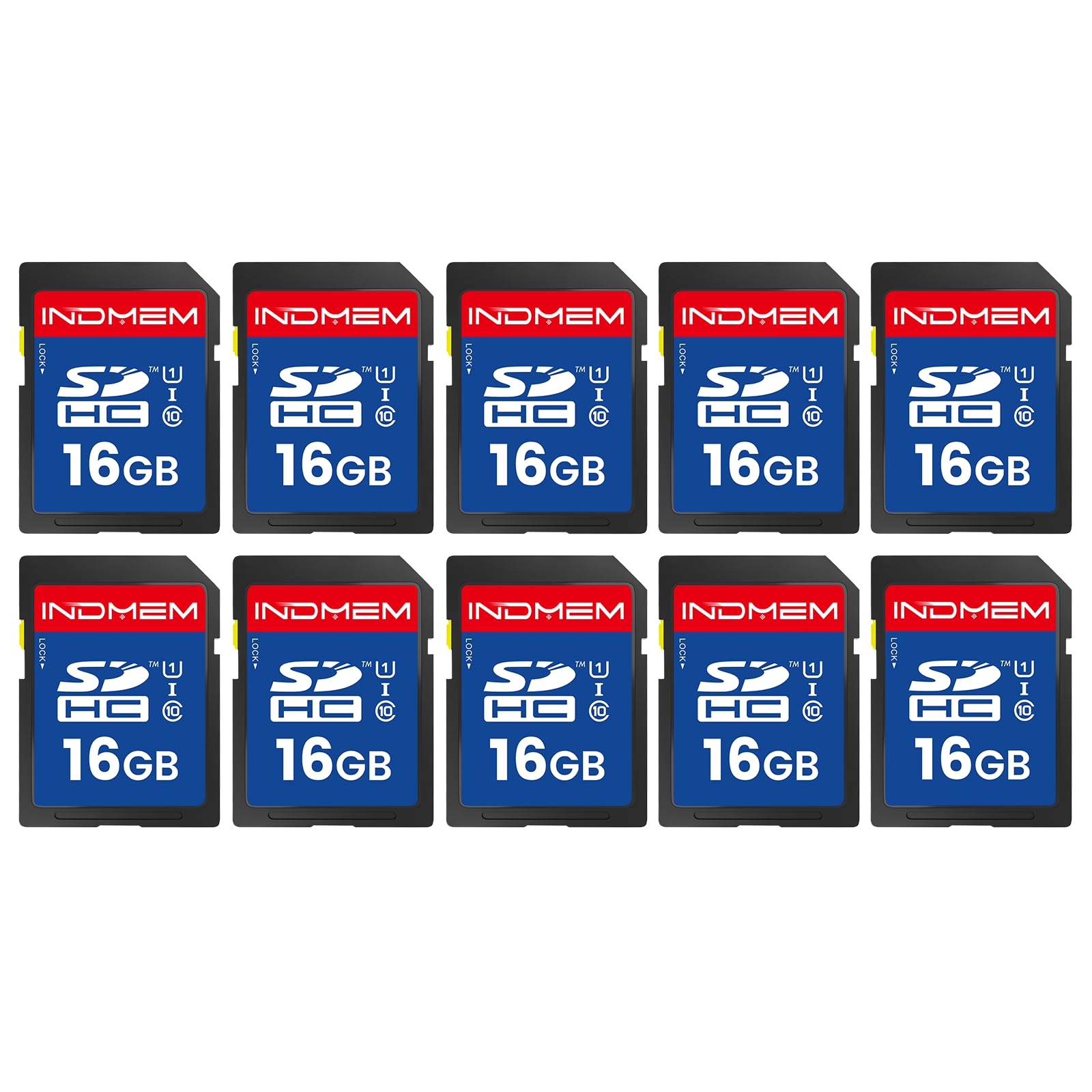
INDMEM 16GB 10-Pack

87 /100
Studio Score Strong Evidence

Key details

Warranty
1-year limited
UHS-II Support
UHS-I only
Capacity & Format
10x 16GB
Video Speed Class
Class 10
Check Price on Amazon

Ten 16GB full-size SDHC cards in one box is the fastest way to stock a bank of trail cameras without separate packs. Per-card cost is low enough to treat them as consumables, and cards perform fine for still-image trail-cam triggers. This is not for photographers who need high write speeds or large capacity; it belongs in low-stakes cameras where an occasional dud is acceptable. A card can arrive unresponsive, and a card can save images that don't show up on review, so test each before field use. For a trail-cam rotation with spares, that tradeoff is manageable — just not a mainstream SD-card buy.

Pros

  • Ten full-size 16GB cards in one box covers a multi-camera trail-cam setup without extra orders.
  • Per-card value is strong for a budget 10-pack.
  • Basic quality is acceptable for low-stakes cameras.

Cons

  • A card in the ten-pack can arrive unresponsive out of the box.
  • A card can save images that don't show up on review.
Our verdict

Buy this 10-pack for a multi-camera trail-cam network where every card can be tested before it goes into the field; skip it for anything that matters.

Check Latest Price
7

Disposable Trail-Cams

INLAND 16GB 5-Pack

91 /100
Studio Score High Confidence

Key details

Warranty
3-year limited
UHS-II Support
UHS-I only
Capacity & Format
5x 16GB
Video Speed Class
U1
Check Price on Amazon

This five-pack supplies 16GB Class 10 cards to trail cameras or classroom kits at a lower per-card cost than separate retail cards. Basic quality is acceptable for standard stills and game-cam photo capture, and the 60 MB/s read speed handles simple file transfers without fuss. For any job where files are irreplaceable, the pack is a gamble: the buyer gets five cheap cards, and the tradeoff is how consistently each one behaves in different devices. That keeps it at disposable trail-cam duty rather than primary storage for a paid shoot or family archive. For low-stakes cameras where losing a card is a minor inconvenience, the value is hard to beat.

Pros

  • Trail-cam owners get five full-size cards at a lower per-card cost than buying singles.
  • Basic quality is acceptable for standard stills and game-cam photo capture.

Cons

  • A card in a pack can be unrecognized by a device or refuse to format.
  • Handling varies between packs, so the safe use is disposable storage for low-stakes cameras.
Our verdict

Best used as a bulk trail-cam supply after each card has been tested, not as storage for irreplaceable images.

Check Latest Price

How to Choose

Video Speed Class

Video speed classes set the minimum sustained write speed for recording. U1 guarantees around 10MB/s; U3/V30 guarantees 30MB/s. A camera writing 4K needs that sustained speed, not a burst of speed.

A U1 card can record 1080p and then stop mid-clip in 4K when the camera buffer fills. Match the class to the camera's recording mode before choosing capacity.

Write Speed Matters

Read speed measures transfers off the card; write speed measures how fast the card accepts files. A listing advertising 100MB/s reads can still write at 10-30MB/s.

In burst shooting, the camera fills an internal buffer, then drains it to the card. A low write speed keeps the buffer full, so the camera slows or stops. Sports and wildlife shooters need a documented write speed.

Capacity vs. Card Count

One large card reduces card swaps, but every file lives in one place. A 256GB card that stops working is a larger loss, while smaller multi-packs spread risk and make swaps easier.

Trail cams and family cameras usually shoot short clips, so a 5-pack of 16GB or 32GB cards is more practical than one large card. Match the format to the workflow.

UHS-II Support

UHS-II cards add pins to reach read speeds above 200MB/s. In a UHS-I slot, they fall back to UHS-I speeds, so the extra cost does not make a UHS-I camera faster.

UHS-II speed appears only in UHS-II-capable cameras and readers. For everyone else, a fast UHS-I card is the better price-to-performance point.

Warranty and Authenticity

Lifetime warranties matter because cards can stop working after months of use. A warranty only helps if the card is genuine, and counterfeit cards often show lower capacity or slower sustained writes.

Buy from a known seller and test a new card by filling it completely before relying on it. That test is more useful than a warranty claim.

Frequently Asked Questions