9 Best Pelican Case for Camera Gear in 2026: Match Size and Weight

Find the Pelican case that fits your camera kit, travel style, and airline limits without paying for empty space you don't use.

The right Pelican case for camera gear is the one whose empty weight, interior setup, and dimensions line up with how you actually travel. The classic mistake is buying a roomy case and then discovering it needs foam before it can hold anything, or hits airline weight limits once loaded.

Every model balances portability against protection differently. Lighter shells save at the gate but often ship empty. Wheeled cases are convenient, but a loaded shell can feel heavy in an overhead bin and push against carry-on limits.

This guide matches each case's interior volume, latch design, and weight to a specific camera setup — from action cams to full production kits — so you carry the protection you need without extra pounds.

1

Best Overall

Pelican 1510 Padded Dividers

94 /100
Studio Score High Confidence

Key details

Wheels
2 wheels
Latches
Double throw
Empty Weight
13.6 lbs
Interior Fit
27 L
Check Price on Amazon

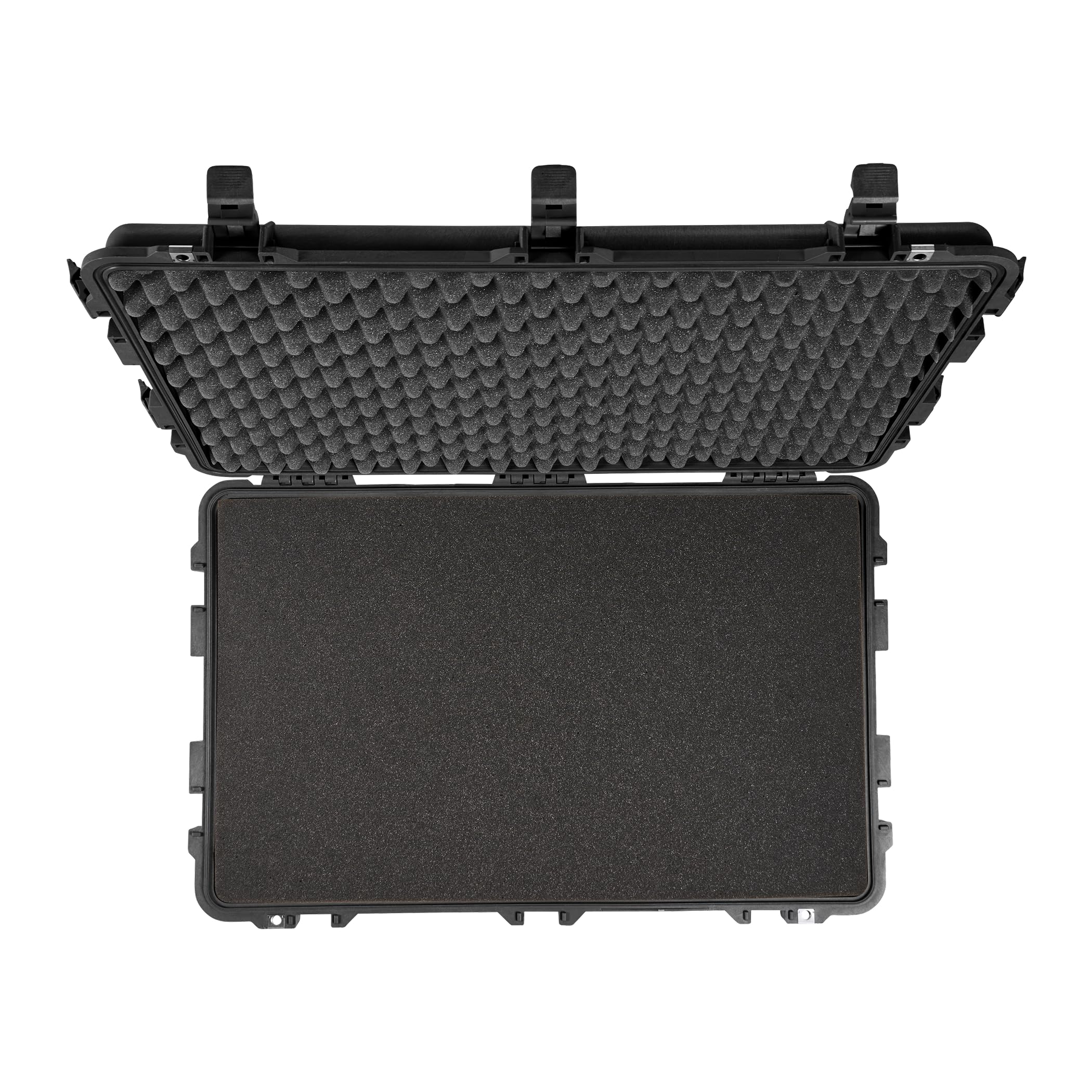
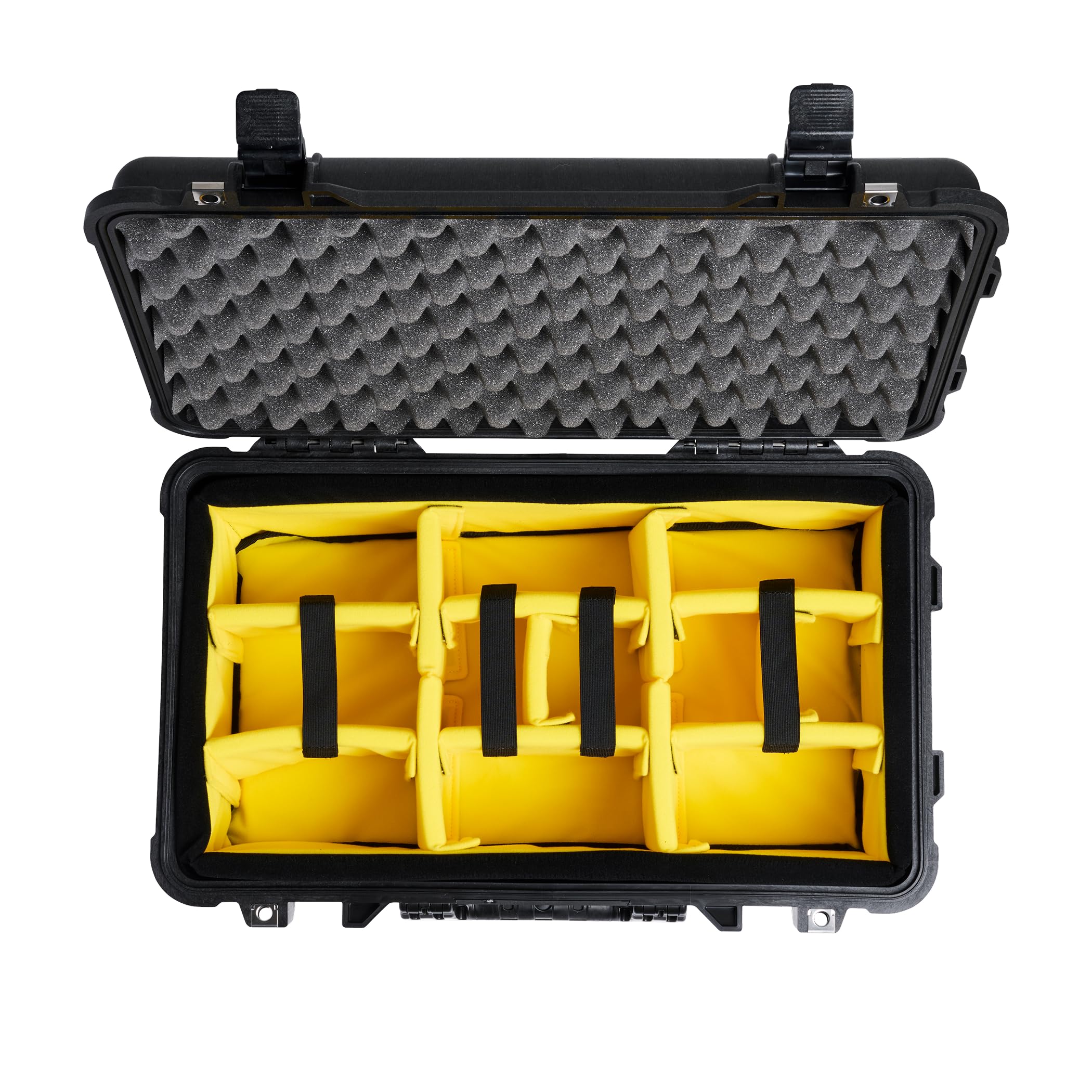
The Pelican 1510 is a carry-on-sized wheeled case that arrives with padded dividers already in place, so it goes from box to a packed camera kit without any extra foam or insert purchases. The 27-liter interior fits multiple DSLR bodies and up to seven or eight lenses, with room for flash units and small accessories once the dividers are arranged. This ready-to-use interior is what separates it from shell-only Pelicans in the same footprint.

The case rolls on two wheels and works equally well in trunks, fields, and airport terminals. The 22-inch exterior fits overhead bins on typical airline flights, so a full kit can stay in the cabin instead of being checked. The hard shell absorbs baggage-handling abuse that would crush a soft bag, and the outside dimensions keep it within common carry-on restrictions. It also takes the worry out of tight overhead-bin stacking.

The interior depth is 7.6 inches, so a larger attached zoom sits better when the lens is separated from the body. The 19.75-by-11-inch footprint is a practical layout for a body, lenses, and flash, and the dividers hold each piece in place during transit. The padded divider system reconfigures cleanly between a one-body-two-lens job and a two-body-seven-lens kit. Oversized telephoto lenses are outside this case's scope; that kit belongs in a larger checked model.

Location shooters and working photographers who want one case for a full DSLR system are the right audience here. At 13.6 lb empty, a loaded 1510 can feel heavy when lifted into overhead bins and may approach airline carry-on weight limits, so anyone who counts every pound should consider the lighter Air shell in this set or a backpack. Ultralight travelers who want the lightest possible carry-on should look elsewhere, and travelers who only need a small lens case or an accessory box will be overpaying for the footprint.

The premium price is easier to accept when measured against camera-specific soft rolling bags that lack a hard shell. For shooters who would otherwise buy a fabric bag and then add a padded insert, the cost spreads across years of field work.

💡 Place heavier gear over the wheels so the loaded 1510 stays controllable when stowed in an overhead bin.

Pros

  • The shell survives rough baggage handling, drops, and weather without compromising the gear inside.
  • Holds multiple DSLR bodies and up to seven or eight lenses with flash gear in one carry-on-sized case.
  • Padded dividers isolate bodies and lenses so expensive glass doesn't shift during transit.
  • Two wheels and the carry-on footprint make airport and location moves easier than carrying a case.
  • Exterior dimensions fit overhead bins on typical airline flights, which is hard to find in a hard camera case.

Cons

  • The usable interior can run smaller than expected given the carry-on exterior footprint.
  • Empty weight is substantial at 13.6 lb, and airline weight limits can be reached once gear is added.
Our verdict

The 1510 is the case a working photographer packs when the camera kit has to survive airline travel and still be easy to move through a terminal.

Check Latest Price
2

Lighter Carry-On Alternative

Pelican Air 1535 No Foam

93 /100
Studio Score High Confidence

Key details

Wheels
2 wheels
Latches
Double throw
Empty Weight
8.69 lbs
Interior Fit
0.95 cu ft
Check Price on Amazon

The Air 1535 matches the carry-on footprint of the padded-divider 1510 but weighs 8.69 lb empty, about 5 lb less. That difference is noticeable every time the case is lifted into an overhead bin, carried up stairs, or loaded into a vehicle. The Air shell keeps the hard-sided structure intact while trimming the load, which is the main reason a shooter would choose this version over the heavier 1510.

The 21.96 x 13.97 x 8.98 in exterior slots into typical airline overhead dimensions, and the 20.39 x 11.2 x 7.21 in interior leaves enough depth for a mirrorless body with a mid-size zoom or a DSLR with a compact prime. Two wheels handle smooth terminal floors, and the top handle gives a secure grip for stairs and curb drops. A 0.95 cu ft capacity means the case suits a compact kit rather than a bag full of telephoto lenses.

This is the case for frequent flyers who count every pound, overlanders packing gear in and out of a truck bed, and shooters who already own a divider system or will order custom foam. It is not for photographers who want a ready-to-use padded interior straight out of the box; the heavier 1510 covers that buyer with included dividers. For anyone with an interior plan already in mind, the Air 1535 keeps the Pelican protection while cutting the weight that has to be carried.

💡 Measure your tallest lens against the 7.21-inch interior depth before ordering foam.

Pros

  • Weighs 8.69 lb empty, trimming carry-on weight without giving up a hard shell.
  • Carry-on footprint that fits common airline limits without overhead-bin friction.
  • Molded shell protects cameras and laptops while staying easier to lift than the 1510.

Cons

  • Latch action can be inconsistent; a new case may have a latch that snaps or binds.
  • For a camera kit, the empty shell needs a separate foam or divider purchase before it offers protection.
Our verdict

A shooter with a clear kit plan and their own insert gets the lightest carry-on Pelican in this comparison.

Check Latest Price
3

Best Compact/Action Cam Case

Pelican 1200 Case With Foam

96 /100
Studio Score High Confidence

Key details

Wheels
None
Latches
Double throw
Empty Weight
2.9 lbs
Interior Fit
—
Check Price on Amazon

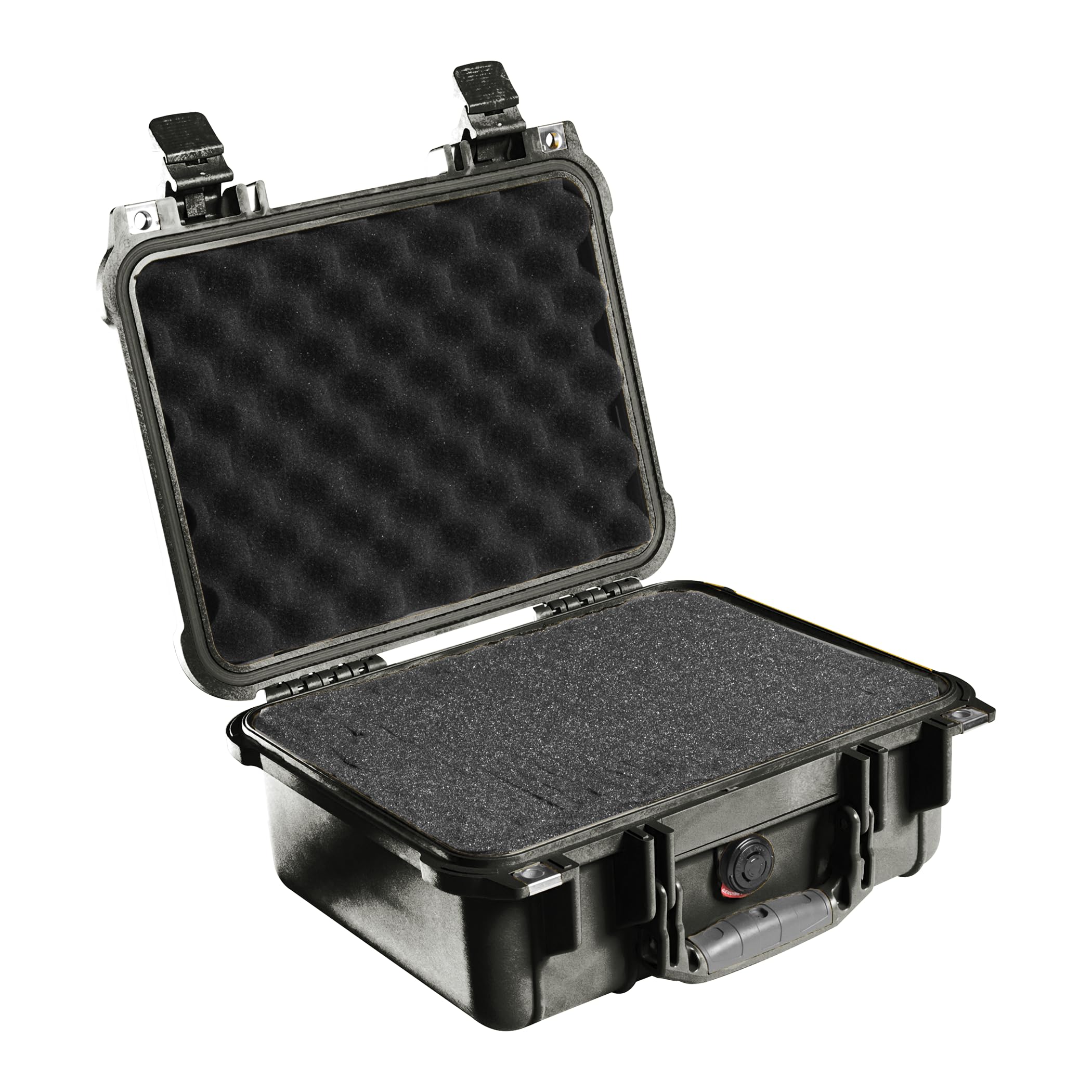
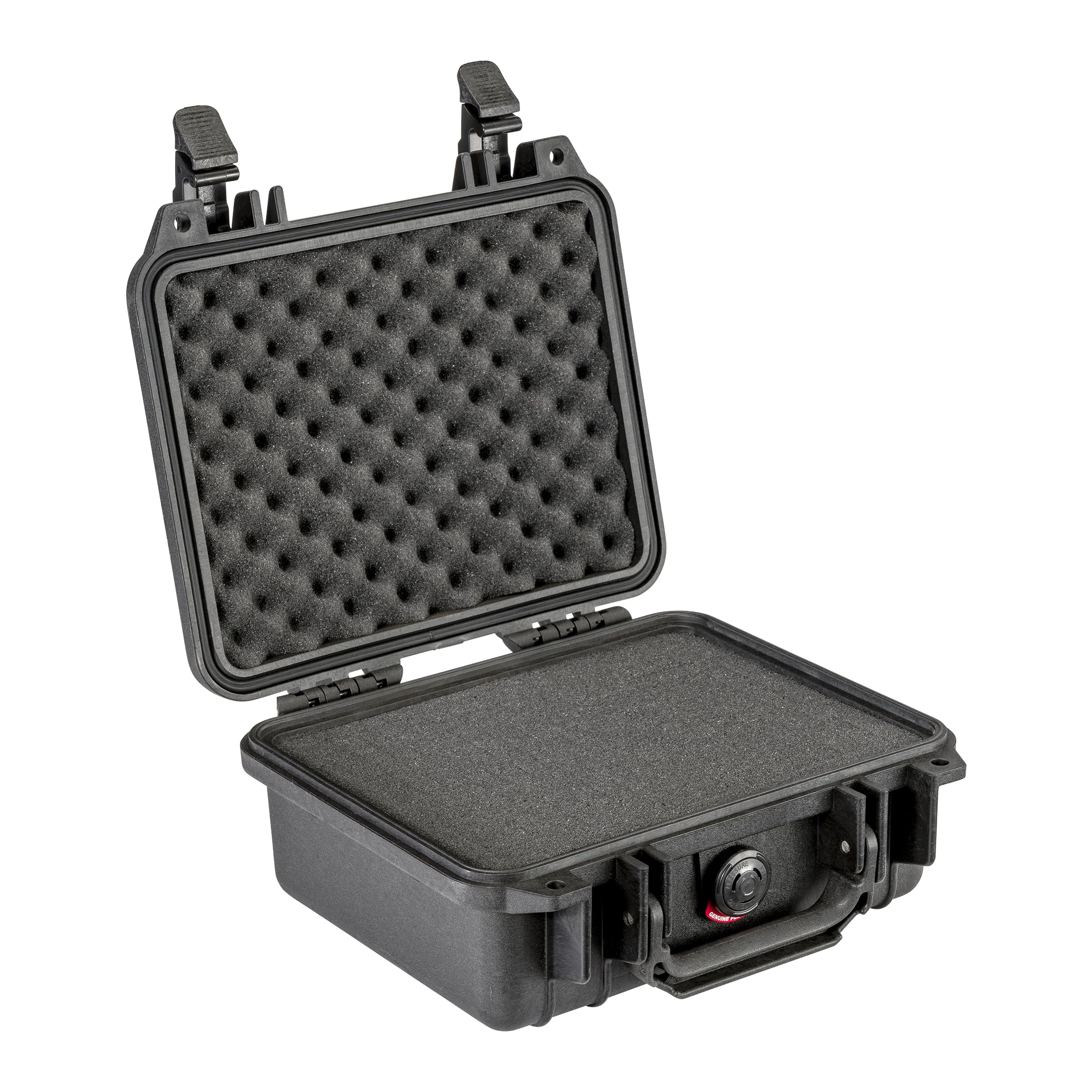
The 1200 is the action-camera and compact-kit box in Pelican's small-case lineup. Its Pick N Pluck interior fits GoPros, external drives, and mirrorless bodies with small lenses, wrapped in a watertight shell. Next to the slimmer body-plus-lens cube in this set, the 1200 adds room for batteries, chargers, and accessories without creeping into carry-on territory.

The interior measures 9.25 x 7.12 x 4.12 inches, and the foam pulls out in cubes so you can carve slots that match each item exactly rather than leaving everything loose. The case weighs about 2.9 lbs, light enough to slip into a backpack or grab by the handle for a quick shoot. Small lenses, spare batteries, memory cards, and a compact camera body sit snugly with foam supporting them from all sides.

This case suits GoPro and action-cam shooters, photographers with compact mirrorless kits, and anyone who wants a rugged box for external drives or small lenses. The interior is compact: full-size DSLRs with large attached lenses won't fit, and anyone expecting a carry-on-size lens vault should look to the wheeled case in this lineup. For the intended small-gear audience, the 1200 is a cost-effective runner-up that covers smaller kits at a lower price.

💡 Pluck foam in small sections and close the lid before committing to cutouts.

Pros

  • Packs GoPro kits, external drives, and small mirrorless bodies into a compact footprint.
  • Watertight, impact-resistant shell keeps small camera gear dry and cushioned.
  • Pick N Pluck foam lets you cut exact slots for each item.
  • At roughly 2.9 lbs, the case slips into a backpack or carries by hand.

Cons

  • Interior volume is modest relative to padded camera bags; confirm larger items before ordering.
Our verdict

Action-cam shooters and compact-mirrorless owners get a watertight, foam-lined shell at a budget price without the bulk of a full-size camera case.

Check Latest Price
4

Best Mid-Size for DSLR Kits

Pelican 1450 Case With Foam

94 /100
Studio Score High Confidence

Key details

Wheels
None
Latches
Double throw
Empty Weight
5.5 lbs
Interior Fit
15 L
Check Price on Amazon

The 15-liter cavity fits a DSLR body, two lenses, flash, and battery, which is more than the slimmer mirrorless case in this lineup can manage. Compared with that smaller option, the 1450 gives up some portability for the extra width and depth needed for a flash and spare battery. Pick N Pluck foam pulls out in pre-scored blocks, so a custom layout for your specific gear takes a few minutes. The thick shell and lid seal keep the contents dry and shock-protected.

This case is for DSLR shooters who want one hard box for a body, two lenses, flash, and battery, and who prefer a hand-carry case over a wheeled travel case. The stiff new latches can be difficult to open and close at first, so users with limited hand strength should test before buying.

Roughly 5.5 lb empty, the shell feels substantial without being unwieldy, and the US-made build quality holds up to repeated travel. It costs less than the wheeled carry-on pick and still delivers the same core protection for a DSLR kit. The 15-liter volume also leaves room for a spare battery and small accessories beyond the body, lenses, and flash. For the price, you get a hard case that does not need careful babying to keep gear safe.

Pros

  • Interior holds a DSLR body, two lenses, flash, and battery in one well-organized layer.
  • Thick shell handles hard drops and rough handling without transferring impact to gear.
  • Waterproof lid seal and foam cushioning keep expensive photo equipment safe from moisture and bumps.
  • Mid-range price undercuts wheeled hard cases while matching their protective core.

Cons

  • At 5.5 lb empty, it is heavier than the slimmer mirrorless option in this lineup, so compact kits are better served elsewhere.
  • New latches can require firm thumb pressure to close until they wear in.
Our verdict

For DSLR shooters who want hard-shell protection without wheeled bulk, this is the practical mid-range buy.

Check Latest Price
5

Best Large Transport Case

Pelican 1650 Case With Foam

94 /100
Studio Score High Confidence

Key details

Wheels
4 wheels
Latches
Double throw
Empty Weight
28.1 lbs
Interior Fit
3.08 cu ft
Check Price on Amazon

The 1650 is the volume leader among the traditional Pelican cases in this set, with a 3.08 cu ft interior and four wheels for moving complete production kits. Where the large checked case in this set leans on interior organization, the 1650 simply offers more cubic space for lighting gear, long telephoto lenses, and multiple camera bodies.

Pick N Pluck foam adapts the interior to the actual gear: pull out blocks to match a body-plus-grip setup or a long telephoto, and keep the convolute layer for filters, chargers, and accessories. The shell holds up to the hard contact of crew transport, and the wheeled base rolls a full payload across flat surfaces without needing to be carried. A fully carved layout keeps thousands of dollars of camera equipment securely seated through loading and transit.

This case fits studio and crew photographers moving large lighting, long telephoto lenses, or multiple camera bodies, and anyone shipping or checking a full production kit. It is not a carry-on piece; it travels as checked baggage or freight. The heavy empty weight consumes baggage allowance before the first lens goes in, which is why this case suits ground transport and freight better than passenger flights with strict limits.

💡 Weigh the sealed case before airline check-in, and pack the heaviest items low and near the wheels.

Pros

  • Shell stands up to rough handling on sets and in cargo holds.
  • Interior fits large lighting, long telephoto lenses, and spare bodies.
  • Gear arrives secure after checked travel and freight transport.
  • Pick N Pluck foam can be shaped into exact cutouts for each component.

Cons

  • Fully loaded, the case can exceed typical airline checked-bag weight limits.
Our verdict

The 1650 pays off for crews that actually fill its interior; flyers with strict weight limits are better served by a lighter case in this set.

Check Latest Price
6

Mirrorless Kits

Pelican 1400 Case With Foam

94 /100
Studio Score High Confidence

Key details

Wheels
None
Latches
Double throw
Empty Weight
1.5 lbs
Interior Fit
0.31 cu ft
Check Price on Amazon

Pick N Pluck foam is the main draw: you can pull out cubes to shape a custom layout around a mirrorless body, a few small primes or zooms, adapters, and batteries. The compact shell is easy to carry, and the rigid build handles the bumps of everyday camera-pack use. Compared with the larger 1450, the 1400 has less interior volume and no wheels, so it suits compact-to-mid kits rather than large transport cases. It slips into a daypack or car cubby without the bulk of a rolling case.

Pros

  • Pick N Pluck foam can be shaped around mirrorless bodies, small lenses, adapters, and spare batteries.
  • Compact shell is easy to carry and slots into a daypack or car cubby.
  • Rigid construction protects delicate camera gear from the bumps of transport.

Cons

  • Full-frame DSLR bodies with large attached telephoto zooms are outside this case's interior limit.
Our verdict

Mirrorless shooters with a few compact lenses and small accessories get a stowable, custom-foam hard case that fits their gear without the weight of a roller.

Check Latest Price
7

Body Plus Lens

Pelican 1300 Case

93 /100
Studio Score High Confidence

Key details

Wheels
None
Latches
Double throw
Empty Weight
1.3 lbs
Interior Fit
6.9 L
Check Price on Amazon

The Pelican 1300 is a compact body-plus-lens cube that delivers classic Pelican protection at a budget price. It fits a Canon 5D Mark III with a 200mm L-series lens attached, and the waterproof seal handles rain and travel drops. The interior is sized for that single kit: large telephoto lenses and multi-lens setups fall outside its range. The latches are stiff when new, which can be an issue for users with limited hand strength. That combination keeps it behind the 1200 for action kits, but for a photographer carrying one body with an attached lens, this is a cost-effective way to get Pelican-grade protection without paying for a bigger case.

Pros

  • Fits a camera body with attached lens, including a Canon 5D Mark III with a 200mm L-series lens.
  • Waterproof seal keeps camera gear dry during rain and travel drops.
  • Classic Pelican build at a budget-friendly price.

Cons

  • Large telephoto lenses and multi-lens kits are outside this case's capacity.
  • Latches can be stiff when new and require a firm grip from users with limited hand strength.
Our verdict

For a photographer whose kit is one body with one attached lens, this is a cost-effective way to get Pelican waterproof protection in a compact box.

Check Latest Price
8

Small Gear

Pelican Storm iM2050

93 /100
Studio Score High Confidence

Key details

Wheels
None
Latches
Press and pull
Empty Weight
3 lbs
Interior Fit
—
Check Price on Amazon

The iM2050 is the easy-open end of the Pelican lineup: press-and-pull latches release with less effort than stiff traditional latches, and the slim 3 lb shell makes it a practical backpack case for a small mirrorless body, a spare lens, and accessories. The stock foam is not a camera-ready layout; it is pluck-and-cut, so you will likely spend time carving a custom multi-level fit. Seal quality can vary between units, so the O-ring deserves a quick inspection before the case is trusted near water. Large DSLR kits and wheeled travel are outside its scope, and the fiddly foam setup keeps it below the larger 1200 for photographers who want a ready-to-use interior.

Pros

  • Press-and-pull latches open and close with less effort than stiff traditional Pelican latches.
  • Slim 3 lb shell slips into a backpack or carry-on bag with a small mirrorless kit.
  • Build quality holds up to daily commutes and hot, humid environments.

Cons

No notable drawbacks to flag.

Our verdict

For a photographer carrying one mirrorless body and a spare lens, this is the easiest-latching compact Pelican around.

Check Latest Price
9

Medium-Large Kits

Pelican 1610 Case With Foam

93 /100
Studio Score High Confidence

Key details

Wheels
2 wheels
Latches
Double throw
Empty Weight
19.5 lbs
Interior Fit
2.23 cu ft
Check Price on Amazon

The 1610 serves crews moving medium-large camera systems, drones, or optical gear that have outgrown a carry-on. Its 2.23-cubic-foot interior and Pick N Pluck foam accept a range of layouts, and the dual wheels make terminal hauling less of a chore than the largest Pelican case in this set. That said, the empty weight near 19.5 lb and 24.83 x 19.69 x 11.88 in exterior push it firmly into checked-bag territory, and a small mirrorless kit will be lost in the space. It overlaps with the larger 1650's role but with less interior volume; pick it when the 1650 is too big to justify.

Pros

  • 2.23-cubic-foot interior holds medium-large camera, drone, and optical kits that outgrow carry-on cases.
  • Multi-layer Pick N Pluck foam simplifies building custom cavities around bodies, lenses, and accessories.
  • Dual wheels and exterior handles make large-case movement through studios and terminals noticeably easier.

Cons

  • A single-body mirrorless kit can feel lost in this interior; the case assumes a fuller kit.
  • A 19.5 lb empty weight and near-20-inch width make it a checked case, not a carry-on.
Our verdict

If you're regularly checking a medium-large camera, drone, or optical kit and the biggest Pelican case in this set is too much, the 1610 fits the gap.

Check Latest Price

How to Choose

Interior Fit

Interior dimensions decide what physically fits, but the real limit is depth and width, not overall volume. A case can hold a mirrorless body with a small prime yet reject a full-frame body with a 70-200mm f/2.8 because the interior depth is too shallow. Measure your longest lens with the hood reversed, then compare that against the case interior depth and width. Padded dividers compress usable width, while Pick N Pluck foam can be shaped for a tighter fit but is less flexible later.

Empty Weight

Empty weight is the hidden spec because it compounds quickly. A 28 lb empty case with 20 lb of gear already hits a 50 lb checked-bag limit before batteries and chargers. For carry-on, the limit is usually lower, so a wheeled case that feels fine on the ground can become a problem at the gate. Weight savings matter most on trips where every pound is measured.

Interior Setup

Padded dividers are ready to use and reconfigurable; foam needs cutting or plucking but gives a custom cradle. The hidden cost is time and money: a case that ships empty needs aftermarket foam or dividers before it can protect anything. Budget for that when comparing models. Empty shells usually cost less upfront but can cost more once you add inserts.

Wheels and Handle

Wheels and a telescoping handle make airport travel easier, but they add weight and reduce usable interior space. A four-wheel case rolls upright and handles better in checked baggage, while a two-wheel case still needs a tilt to pull. Choose based on whether you roll through terminals or lift into a vehicle. A bare compact case is easier for backpacks and trunk storage but less comfortable across long distances.

Latch Style

Classic double-throw latches are secure but can be stiff on new cases. Press-and-pull latches are easier for frequent hand access but appear in fewer large cases. If you open the case daily, latch feel matters more than a spec sheet shows. Hand strength is a legitimate filter, not a minor footnote.

Frequently Asked Questions