7 Best Nikon Flashguns of 2026: Match the Flash to Your Work

Which Nikon flashguns actually fit your shooting style — dependable i-TTL for events or budget radio slaves for off-camera work.

Choosing a Nikon flashgun starts with one decision: how much of its life will be spent on the camera versus off it. On-camera event work rewards dependable TTL exposure and controls that can be changed quickly. Off-camera lighting pushes you toward radio triggering and battery endurance, and the two priorities lead in different directions.

Budget and mid-range options now include features that once belonged to flagships: high-speed sync, round heads, and lithium power. Price alone won't tell you what fits. A manual-only budget flash will not replace a TTL speedlight in a wedding kit, and a flagship radio unit is overkill if you only need occasional bounce flash at home.

The result is a category where the right match depends on your shooting workflow, not on a single spec. Nikon-native optical control and third-party 2.4GHz radio systems both work; the question is which one supports the pace and subjects you actually shoot.

1

Best Overall

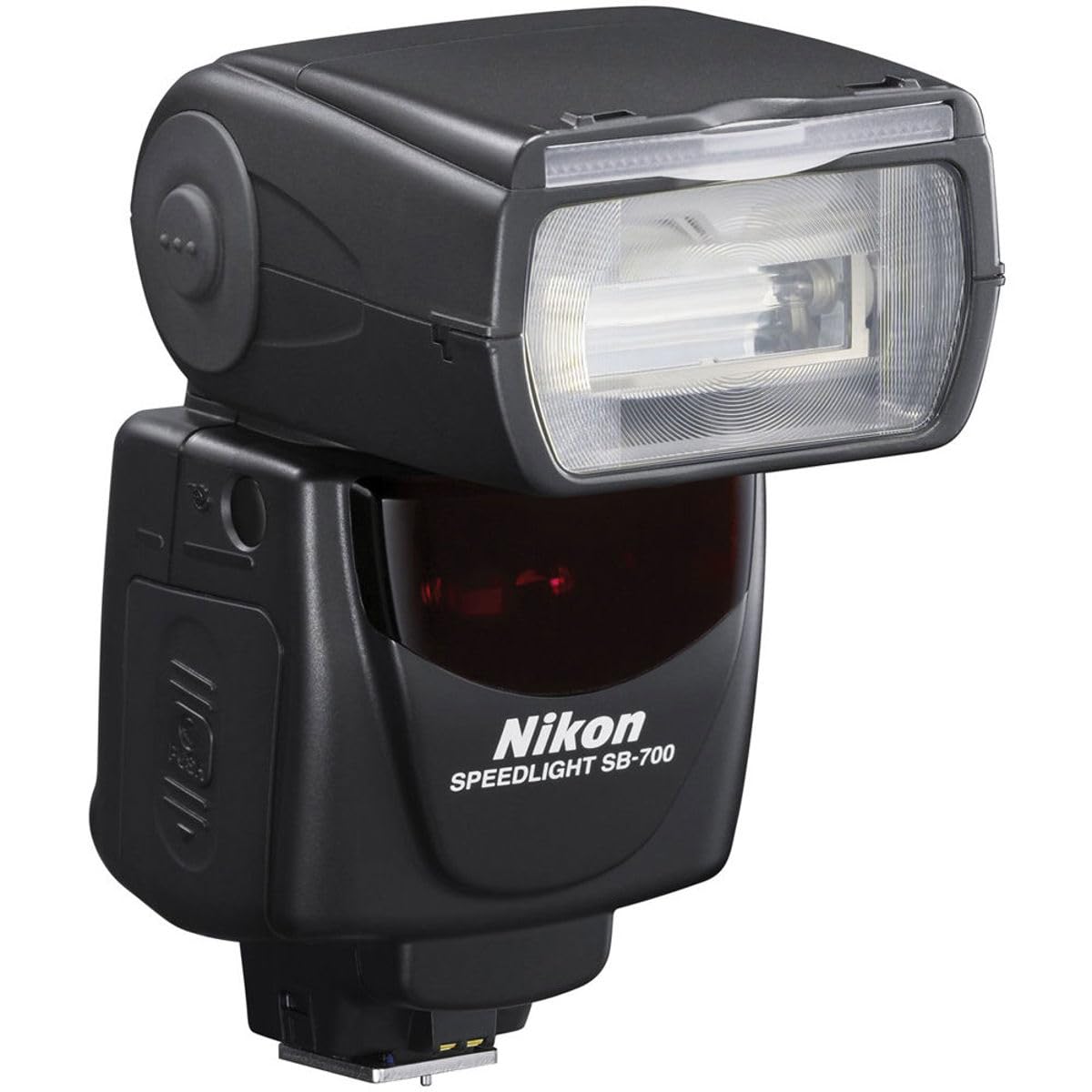
Nikon SB-700

92 /100
Studio Score High Confidence

Key details

Guide Number
92 ft / 28m
Head Movement
Full bounce/swivel
TTL Or Manual
i-TTL / CLS
Wireless System
Optical CLS commander
Check Price on Amazon

The SB-700 is the safest all-round Nikon speedlight: verified i-TTL/CLS behavior, enough output for events and portraits, and controls that do not demand a manual. Setup takes under a minute with four AAs, a simple lock ring, and a mode selector that clicks into place. The bounce head swivels fully, the zoom range covers common event focal lengths, and four AA batteries recycle fast enough for a normal shooting pace. It also works as an optical CLS commander, so the camera can trigger remote SB-700s without extra triggers. That combination is rare among Nikon-brand flashes: the SB-700 sits below the flagship tier but above entry models, and it keeps the features that matter without the bulk or menu complexity of the bigger units.

The flash carries its weight through a full evening of event coverage. Recycle times stay short with fresh AA cells, and the auto zoom tracks the lens without extra menu steps. Exposure stays even across a mix of bounce and direct flash, which keeps post-processing simple. Indoor off-camera setups respond well to CLS commands, which makes group portraits and small bounce placements easy to adjust from the camera position. For event photographers who alternate between the hotshoe and a light stand, this is the simplest way to stay within the Nikon system.

The SB-700 suits Nikon shooters who want a single flash for on-camera bounce, event coverage, and portrait fill, with optical CLS handling indoor multi-flash work. It is a natural fit for wedding and event shooters who stay within the Nikon system and prefer a flash that behaves identically from the hotshoe to a light stand. Its output sits below the SB-5000/SB-910 tier, so large-group bounce with heavy diffusion can hit power limits and may push you to a higher ISO or a stronger flash. For typical room-sized venues, the power ceiling is not the limiting factor.

The flash noticeably improves indoor photo quality by adding catchlights to portraits and letting you hold lower ISO values in dim spaces. The auto zoom and full swivel cover a wide range of rooms, and the quick mode selector means switching between TTL, manual, and remote slave is a short sequence rather than a menu crawl. The four-cell AA design keeps weight manageable, and the SB-700 slides easily into a bag that already carries camera gear. It also has no external pack or extra receiver to account for, which keeps a minimal event kit simple. For Nikon shooters who want dependable flash behavior without chasing the flagship tier, this is the practical balance.

💡 When rotating the flash head, seat the mode dial first to keep the turn smooth.

Pros

  • Delivers dependable all-around performance for event and portrait work.
  • Strong value for a Nikon-brand TTL speedlight when weighed against flagship models.
  • Predictable i-TTL/CLS exposure across on- and off-camera setups.
  • Adequate output for common event and portrait distances without excessive bulk.
  • Adaptable for on-camera bounce and off-camera optical CLS use.

Cons

  • No built-in 2.4GHz radio wireless control; outdoor multi-flash setups need extra triggers.
  • Premium-priced compared with third-party alternatives that add battery and triggering conveniences.
Our verdict

For Nikon shooters who want one flash that works on the hotshoe and off camera through optical CLS, the SB-700 is the balanced choice.

Check Latest Price
2

Best Value TTL/HSS + Radio

Godox V860III-N

91 /100
Studio Score High Confidence

Key details

Guide Number
60m ISO 100
Head Movement
Full bounce/swivel
TTL Or Manual
TTL, HSS 1/8000s
Wireless System
Godox 2.4GHz X
Check Price on Amazon

The V860III-N pairs TTL and high-speed sync with Godox's 2.4GHz radio system inside a single flash head, so off-camera shooters can leave a separate transmitter behind and carry one unit from camera to light stand.

Event and wedding photographers get a 480-pop lithium battery with a 1.5-second full-power recycle, which is enough for a day of mixed bounce and direct flash. The 10-level modeling light helps preview shadow falloff between frames without adding another light source.

The Godox X ecosystem is the main reason to choose this over a Nikon-brand speedlight: the V860III-N can run as an on-camera TTL/HSS flash and as a radio slave in a multi-light setup, and the control interface carries across other Godox flashes. The 60-meter guide number at ISO 100 is enough for a small studio or location stand, and radio slave mode does not require line of sight back to the camera.

This suits Nikon shooters building a Godox radio kit who want one flash for both on-camera and off-camera work. Nikon shooters who prefer native CLS optical control should stay with a Nikon-brand speedlight, and the hotshoe foot can show wear under repeated mount/dismount cycles, so handle that connection deliberately.

💡 Seat the flash fully on the camera shoe before locking, and release the lock before removal.

Pros

  • Built-in radio, TTL, and HSS cover on- and off-camera work without a separate trigger.
  • 480-pop lithium battery and 1.5-second recycle fit a full event day.
  • Godox X system ties the flash into a larger multi-light setup.
  • Mid-range price undercuts Nikon-brand speedlights while keeping the core TTL/HSS modes.

Cons

  • No native Nikon CLS optical commander mode for shooters who rely on camera-menu wireless control.
  • Hotshoe foot can wear in the lock area under repeated mount/dismount cycles.
Our verdict

For Nikon event shooters building a Godox kit, this is the speedlight that delivers TTL/HSS and radio in one mid-range package.

Check Latest Price
3

Best Pro Radio AWL

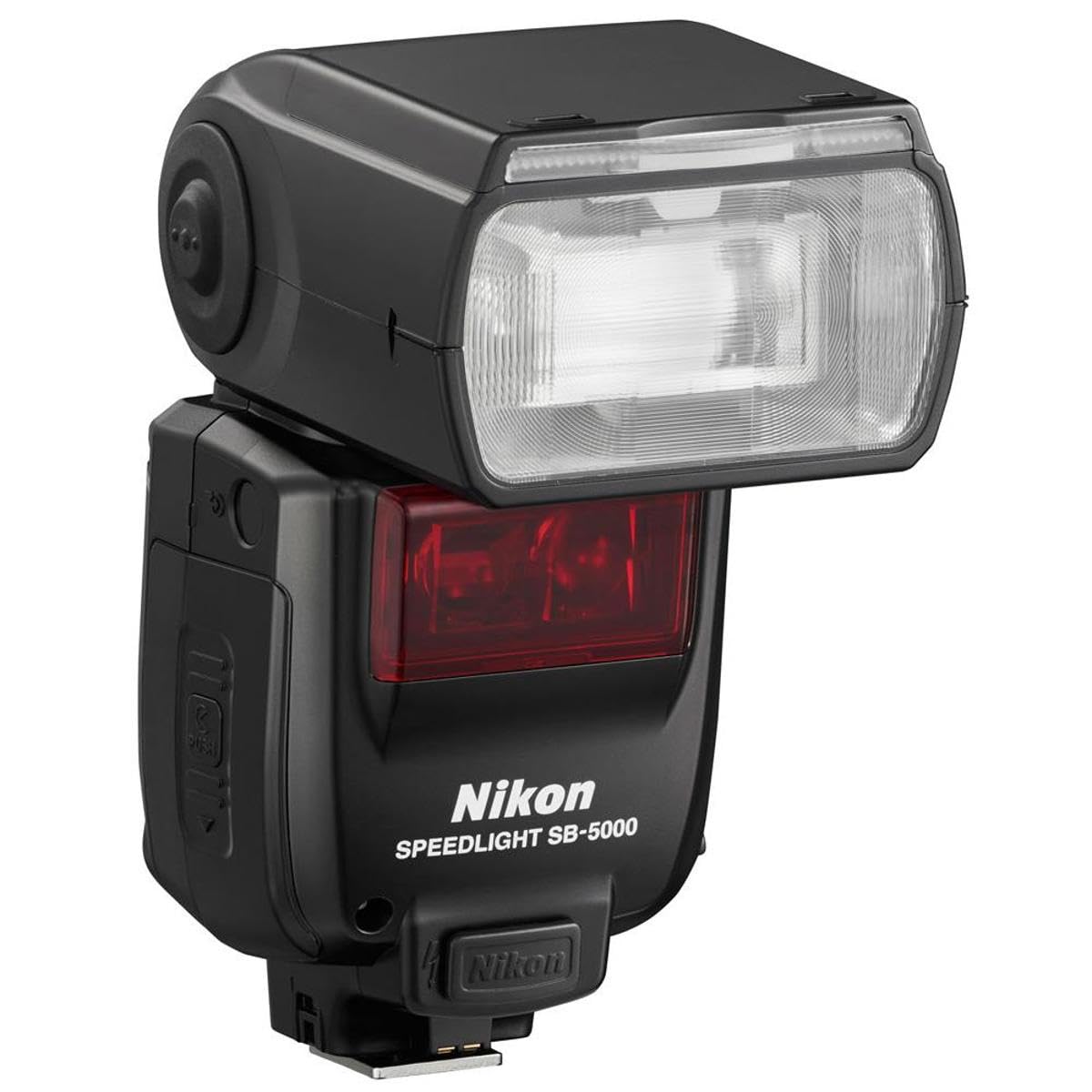
Nikon SB-5000

88 /100
Studio Score Strong Evidence

Key details

Guide Number
113 ft ISO 100
Head Movement
Full bounce/swivel
TTL Or Manual
i-TTL
Wireless System
Radio AWL
Check Price on Amazon

The SB-5000 brings built-in radio AWL to Nikon speedlights, so multi-flash setups fire without optical line-of-sight or extra radio triggers. That puts it in a different working category from the all-round Nikon pick: this one is for photographers who regularly run three or more flashes from camera position.

Active cooling sustains 100 consecutive full-power shots, and recycle runs 1.8-2.6s on four AAs. The 113 ft guide number covers ballroom receptions and portrait sessions, while the fan keeps output consistent through the long sequences where non-cooled speedlights start pacing themselves.

Camera-menu integration covers flash groups, channel settings, and TTL behavior, making the SB-5000 feel like part of the camera body rather than a separate controller. That same menu logic carries across modern Nikon DSLR and mirrorless bodies, which shortens the learning gap when you switch camera bodies.

This is for working wedding and event photographers who need sustained output and radio-controlled groups. The premium price is the main boundary; casual and enthusiast buyers get more value from the all-round Nikon speedlight in this guide.

Pros

  • High-speed output keeps pace with event sequences, with recycle times that allow continuous shooting.
  • Active cooling holds up through 100 consecutive full-power shots.
  • Full camera-menu integration controls flash groups and wireless settings without side controls.
  • Compatibility spans modern Nikon DSLR and mirrorless bodies.

Cons

  • More output and radio features than casual or enthusiast shooters need.
  • Menu layout is deeper than older Nikon speedlights, so initial setup takes longer.
Our verdict

For working event shooters running multiple flashes, the SB-5000 is the Nikon speedlight that brings radio AWL into the camera system. If you shoot one on-camera flash, the all-round pick in this guide is the easier fit.

Check Latest Price
4

Best Budget Off-Camera Manual

Godox TT600

92 /100
Studio Score High Confidence

Key details

Guide Number
60m ISO 100
Head Movement
Full bounce/swivel
TTL Or Manual
Manual only
Wireless System
Godox 2.4GHz X
Check Price on Amazon

Full 2.4GHz radio slave control, a guide number of 60, and manual power output make the Godox TT600 the cheapest practical route into the Godox X system for Nikon shooters. It joins any of five groups across 32 channels, so a single compatible trigger can fire it as part of a multi-light setup.

The S1/S2 optical slave modes give the TT600 a fallback when no radio trigger is on hand, and the manual dial changes output between frames without menus. The high guide number is enough for a key light in a small product setup or a rim light in portraits.

This is the right fit for Nikon photographers who already own or plan to buy a Godox trigger and want budget off-camera manual lights. Manual-only output and noticeable AA drain are the tradeoffs to accept; if the priority is on-camera TTL or single-flash event coverage, the complete TTL/HSS Godox speedlight in this lineup is the better match.

Pros

  • Radio triggering with five groups and 32 channels turns one trigger into a multi-light setup.
  • Manual output and S1/S2 optical slave modes cover off-camera work without a proprietary receiver.
  • Guide number 60 output is enough for product and portrait lighting at typical working distances.
  • Cost-effective entry into the Godox X system for Nikon shooters building a manual flash kit.

Cons

  • High-speed sync requires a compatible Godox trigger, so it won't act as an on-camera HSS flash by itself.
  • There is no battery level indicator, so a fading set can arrive without warning.
Our verdict

Nikon shooters who already use a Godox trigger can add a manual off-camera flash without paying for TTL they won't use. If the plan is one on-camera flash with TTL, the complete TTL/HSS Godox speedlight is the right stop.

Check Latest Price
5

Budget Manual

Neewer TT560

91 /100
Studio Score High Confidence

Key details

Guide Number
38m ISO 100
Head Movement
Full bounce/swivel
TTL Or Manual
Manual only
Wireless System
S1/S2 optical slave
Check Price on Amazon

The Neewer TT560 pairs simple controls with S1/S2 optical slave modes for a low-cost introduction to off-camera flash. Nikon shooters should verify that their camera uses a standard center-pin hotshoe, because some bodies will not trigger this flash. Unit-to-unit firing consistency can vary, though the eight-step manual power control and output per dollar are strong at this price. The Godox TT600 adds 2.4GHz radio for similar money, which is the main reason to step up; this Neewer remains a functional backup or learning flash for those who accept these boundaries.

Pros

  • Solid build quality for an entry-level manual flash.
  • Simple controls and S1/S2 optical slave modes make off-camera flash easy to learn.
  • Bright output for the price and a useful manual power range.

Cons

  • AA batteries drain quickly at higher manual power settings.
  • Manual-only exposure means event photographers who need TTL/HSS will need a different flash.
Our verdict

For Nikon shooters who want a cheap manual flash for learning or backup use, this is a workable entry point.

Check Latest Price
6

Budget TTL

Meike MK430N

86 /100
Studio Score Strong Evidence

Key details

Guide Number
42m ISO 100
Head Movement
Full bounce/swivel
TTL Or Manual
i-TTL, Manual, MULTI
Wireless System
S1/S2 optical slave
Check Price on Amazon

The Meike MK430N puts Nikon i-TTL in a dedicated flash body at an entry-level price, with manual and MULTI modes plus an S1/S2 optical slave for basic off-camera use. The 42-meter guide number and four-AA power supply are enough for casual indoor bounce and event shots. It is not a system platform: the feature set and accessory ecosystem are narrower than the Nikon-brand SB-700 or the radio-equipped Godox V860III, so it stays practical for simple on-camera flash rather than advanced wireless work.

Pros

  • Adds Nikon i-TTL to a budget kit without the usual Nikon-brand price premium.
  • Build quality exceeds the entry-level price point in day-to-day use.
  • Simple controls keep the learning curve short for first-time flash buyers.

Cons

  • The S1/S2 optical slave modes are manual-only, so TTL wireless triggering is not part of the package.
  • In a large hall, the 42-meter guide number pushes you toward higher ISO or a faster lens.
Our verdict

Best for first-time Nikon flash buyers who want TTL and simple bounce control for family gatherings and small events.

Check Latest Price
7

Round-Head Value

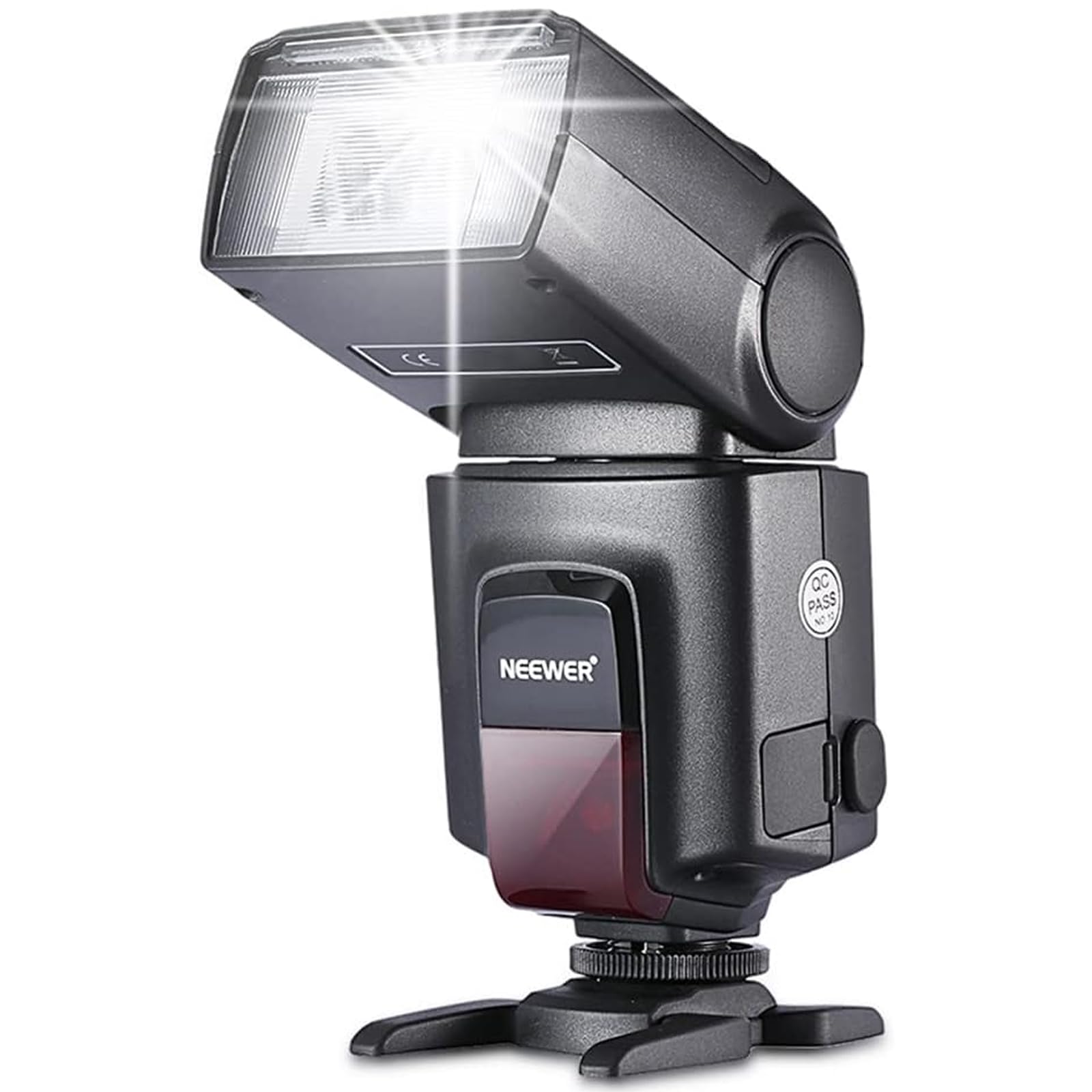
Neewer Z2-N

80 /100
Studio Score Strong Evidence

Key details

Guide Number
Head Movement
Round head, magnetic
TTL Or Manual
i-TTL, HSS 1/8000s
Wireless System
2.4G Q, Godox X slave
Check Price on Amazon

The Neewer Z2-N combines a round Fresnel head, 76Ws output, i-TTL/HSS, a 3000mAh Li-ion battery with USB-C charging, and a 2.4G Q-system radio that can be triggered as a Godox X slave. That is a strong feature set for a mid-range Nikon-compatible flash, especially for general, portrait, and off-camera work where round-head light and long battery life reduce setup friction.

The boundary is field validation: real-world TTL behavior and long-term durability are still being established, so the Z2-N fits a shooter who can verify their copy before a client job. Event photographers who need consistent multi-flash output across a full day should look at a more established round-head Godox option.

Pros

  • Round Fresnel head creates a softer, more even beam than conventional rectangular speedlights.
  • USB-C charging and a 3000mAh Li-ion battery replace the AA rotation for extended off-camera sessions.
  • Godox X slave compatibility lets it fire alongside an existing Godox X radio trigger setup.

Cons

  • Godox X compatibility works as a slave only, so it cannot command other X-system lights by itself.
  • The built-in Li-ion battery removes the AA fallback on multi-day shoots without USB-C charging.
Our verdict

The Z2-N fits Nikon shooters who want round-head output and USB-C convenience as a Godox X-compatible off-camera light, not as a primary event workhorse.

Check Latest Price

How to Choose

TTL vs Manual Control

i-TTL meters the scene and sets flash output automatically, while manual control fixes output at fractions like 1/8 or 1/32. That choice changes how you shoot: TTL keeps up with moving subjects and changing distances, but manual gives consistent exposure when subject distance stays fixed.

For an event where you move from group to group, manual-only means stopping to adjust power; TTL is the reason a flash can keep up with a reception. For a product table or studio setup, manual is simpler and more repeatable.

Guide Number and Reach

Guide number (GN) is a rough measure of reach before light becomes too weak. Because flash light falls off with distance squared, a small GN difference matters more than it looks: doubling distance needs four times the power.

A GN 26 flash can do a small room bounce but will be too weak in a large hall. A GN 60 flash gives room for diffusion, bounce, or bigger groups. Buy the highest GN you can reasonably carry if your work involves venue shots or modifiers.

Wireless System

Optical CLS uses light pulses between Nikon flashes and needs a clear line of sight. It is dependable in rooms but can be confused by bright windows or flashes hidden behind sets.

2.4GHz radio triggers do not need line of sight and can fire flash units in another room or behind a wall. If your off-camera flashes stay in the same room, optical is simple; if they move around a venue, radio is the safer bet.

Battery Platform

AA-powered flashes are easy to refill with rechargeable NiMH cells, but recycle time and total pops drop as the batteries drain. Li-ion packs hold more energy and deliver a faster, consistent recycle until they die.

An event shooter covering a full wedding with bursts needs li-ion or a stack of ready AAs. A casual user shooting a few hundred frames can manage with AAs. The hidden trade-off is end-of-life: a dead Li-ion pack means no quick swap unless you carry a spare.

Head Movement and Modifiers

A tilt-only head bounces off a ceiling, but side-to-side swivel lets you bounce off walls and change light direction without moving the camera. That swivel is what makes event flash work practical.

Round-head flashes create a more even field of light and often accept magnetic modifiers without adapters. Rectangular heads work with traditional gels and grids. Match the head design to how you will shape and soften the light.

Frequently Asked Questions