7 Best Mini Tripod of 2026: Picks That Match Real Load Limits

The best mini tripod for your camera, phone, or webcam depends on real load limits, not just listed specs — here is what stays steady.

Mini tripod listings often lean on big load numbers and DSLR promises that do not survive real angles. Extend the legs, tilt the ball head vertical, or mount a heavy phone, and the working load drops far below the label. That gap between marketing and physics is why some tiny tripods feel rock-solid with one camera and wobble with another.

The fix is not to avoid mini tripods; it is to match the tripod to the shooting style. A flexible leg model that wraps around a railing solves a different problem than a rigid aluminum base that holds a mirrorless kit at desk height. The right support depends on what you carry, how high you need it, and whether you also want to mount a light or mic.

Before buying, check the vertical rating rather than the headline capacity, because that is where top-heavy phones and long lenses cause the most trouble.

1

Best Overall

NEEWER TP34 Flexible Tripod

91 /100
Studio Score High Confidence

Key details

Head Type
360° ball head, 90° tilt
Included Mounts
Phone, action cam
Weight & Material
ABS + aluminum
Real-World Capacity
4.4 lb
Check Price on Amazon

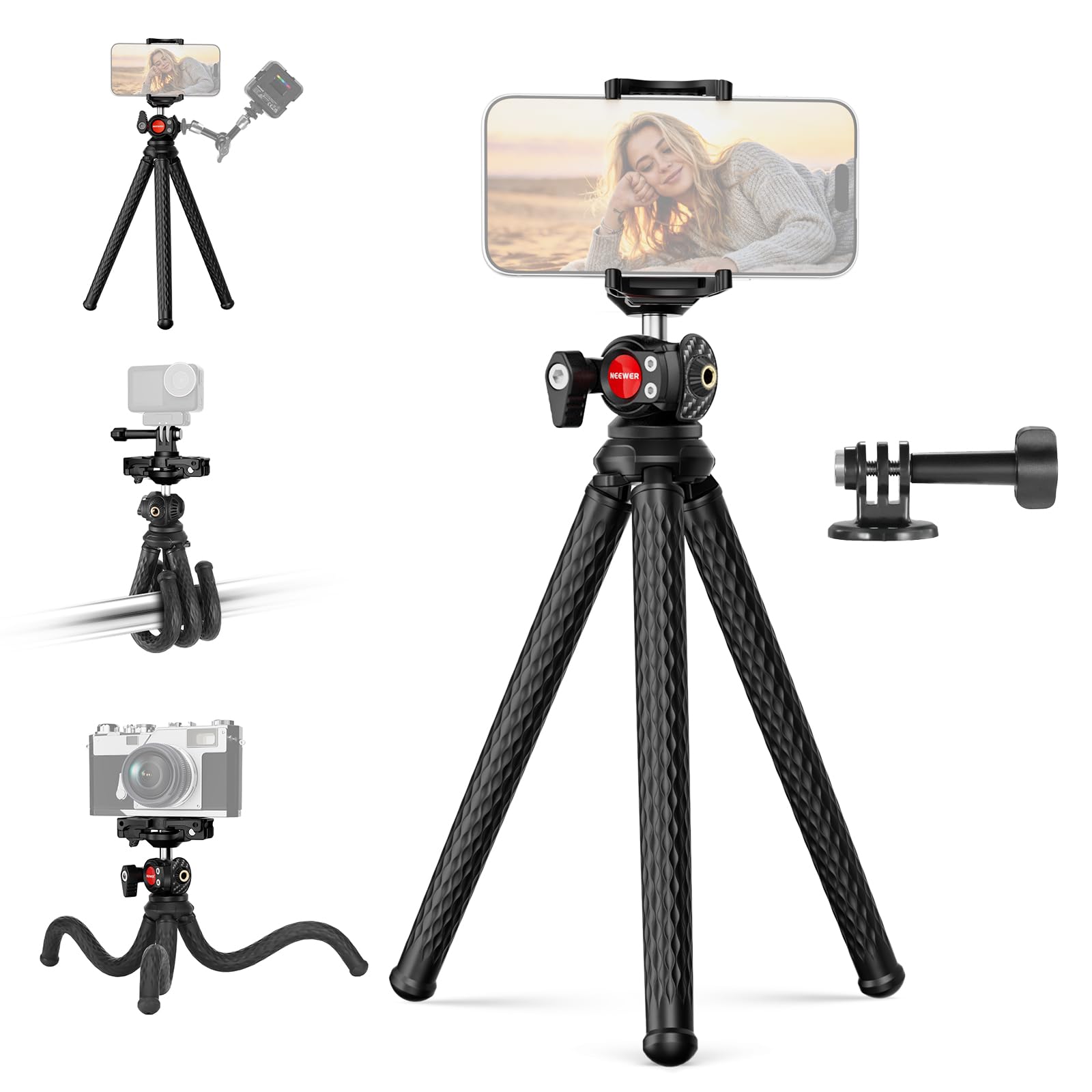
The NEEWER TP34 bundles a phone clamp and an action-cam mount into a flexible mini tripod with a 4.4 lb load rating, so one compact kit covers phones, GoPros, DJI Pocket or Osmo units, and small mirrorless bodies. Its 11.8-inch folded length is easy to pack, the detachable top adds extra reach for low-angle product shots, and the 360° ball head tilts 90° for quick switches between vertical phone framing and horizontal action-cam shots. The flexible leg design is what lets it grip irregular surfaces.

Wrapped around a stair rail or tree branch, the seven-strand legs hold their shape while the ball head stays easy to adjust. On a desktop, the legs sit flat for a stable streaming base; moving the same setup to an outdoor branch takes a few seconds. The bundled mounts remove the usual adapter swapping between phone and action cam, and the same base can accept a compact mirrorless camera when you need more control. For creators who move between indoor and outdoor shots, that flexibility reduces the amount of gear in the bag.

This is for multi-device creators who switch between a phone, action cam, and lightweight mirrorless camera during a shoot and want one small tripod for tabletop, travel, and low-angle work. The leg-bend limit is worth respecting: a leg can snap if forced past its intended range, and a heavy phone can push the ball-head lock past its comfort zone. Heavy DSLR or long-lens kits stay out of the picture; within that range, the TP34 has enough height, grip, and head movement for the jobs it targets.

The package costs less than typical fixed-leg mini tripods that lack phone-mount support, yet it includes both a phone holder and an action-cam mount. For a creator who jumps between devices, that bundle lowers the cost of building a travel kit and makes the TP34 an easy default in the flexible mini-tripod category. The modest load rating matches the intended mix of small cameras and action cams rather than overstating its reach.

Stability follows the usual flexible-tripod logic: a wide leg stance with the payload low gives the most secure hold. Keeping the legs fully spread in tabletop mode avoids the wobble that appears when a compact tripod is pushed toward its height limit. The same habit makes branch wraps steadier because the legs have more surface contact.

Pros

  • Holds a firm position on tree limbs, railings, desks, and action cameras across repeated uses.
  • Accepts phones, GoPros, DJI Pocket/Osmo, and small mirrorless cameras without extra adapters.
  • Flexible legs wrap around branches and railings while holding their shape.
  • Smooth ball head and detachable top make angle changes and low extension easy.

Cons

  • Fixed aluminum tabletop legs provide more rigidity at full extension than flexible legs.
  • The phone clamp can sit less securely with very large or heavy phones.
Our verdict

For mixed-device creators packing for a trip or setting up a desk, the TP34 is the one flexible mini tripod that covers phone, action cam, and small mirrorless in a single case.

Check Latest Price
2

Best Premium Camera Mini Tripod

Manfrotto PIXI Mini Tripod

94 /100
Studio Score High Confidence

Key details

Head Type
Ball head, auto-lock button
Included Mounts
None
Weight & Material
220 g aluminum/technopolymer
Real-World Capacity
Compact to entry DSLR
Check Price on Amazon

The Manfrotto PIXI is a rigid tabletop tripod for compact system cameras and entry-level DSLRs, built around a one-button auto-lock ball head and a 220 g aluminum/technopolymer body. The head locks with a single push-button release, so angle changes are quick and hold firm once set. At 13.5 cm folded, it slips into a coat pocket or a corner of a camera bag without adding noticeable weight.

On a tabletop, the PIXI holds compact DSLR and mirrorless kits without sagging; it has handled a Canon R6 with a 24-105mm lens, a meaningful load for a mini tripod. The fixed aluminum legs create a stable footprint on desks, tables, and similar flat surfaces. For uneven or non-flat surfaces, the rigid leg design is less adaptable than a flexible pod.

This is for photographers who want a small, sturdy base for macro, tabletop, or travel camera work. If your main body is a compact system camera or entry-level DSLR, the predictable tabletop support is the main payoff.

Pros

  • Compact 220 g body and 13.5 cm folded length slip into travel bags.
  • One-button auto-lock ball head makes angle changes quick and holds firm.
  • Holds compact system cameras and entry-level DSLRs without sagging.
  • Tabletop footprint stays put through macro and desktop work.

Cons

  • Ball release button can require more force than expected during quick head-angle changes.
  • Phone clamp is not included; smartphone users need a separate KLYP or compatible holder.
Our verdict

A rigid tabletop tripod for camera users who prefer a dependable ball head and compact build over bundled phone flexibility.

Check Latest Price
3

Best for Action Cams & Vloggers

ULANZI MT-16 Mini Tripod

89 /100
Studio Score Strong Evidence

Key details

Head Type
360° ball head, cold shoe
Included Mounts
None
Weight & Material
170 g rubberized ABS
Real-World Capacity
500 g vertical
Check Price on Amazon

The MT-16 puts a cold shoe on a 170 g tripod handle, so GoPro, DJI, Insta360, RX100, and G7X shooters can add a mic or LED without bolting on extra brackets. Unlike the slimmer extension-pole hybrid, it skips the telescoping handle in favor of a short, stable base and a dedicated accessory mount.

The rubberized ABS body feels more solid than its weight class, and the 360° ball head holds low angles and framing for webcam or streaming work. Sony A6400, GoPro, Insta360, game-camera builds, and desktop streaming setups fit comfortably within the listed load range. The cold shoe keeps audio or light gear off the camera's own mount.

As a travel piece, it doubles as a low stand on a picnic table or desk and as a handgrip for walking shots with an action cam. The 170 g body disappears in a bag, and the folded length matches the max height, so it doesn't add awkward bulk.

The sweet spot is travel and vlog setups built around compact cameras. Vertical mode is rated around 500 g, and larger cameras can flex the center column, so leave the DSLR kit at home. If you stay within that limit, the cold shoe and ball head cover the main asks of a travel vlog support.

Pros

  • Sturdy rubberized shell feels more solid than its 170 g weight suggests.
  • Compact cameras, action cams, and streaming cams sit securely on the ball head.
  • Cold shoe mounting is the standout, letting you rig a mic or LED without extra clamps.
  • Packs features found on pricier mini tripods without a premium price tag.

Cons

  • No phone clamp or Bluetooth remote in the box; phone-first setups need a separate holder.
  • At 22.5 cm max height, a desktop webcam setup may need a riser to reach eye level.
Our verdict

For compact-camera creators who want microphone or light mounting in a tiny package, this is the focused alternative to the flexible-leg bundle's phone-first approach.

Check Latest Price
4

Best for DSLR & Mirrorless Tabletop

NEEWER 20-in Tabletop Tripod

92 /100
Studio Score High Confidence

Key details

Head Type
360° ball head, Arca plate
Included Mounts
None
Weight & Material
1.7 lb aluminum alloy
Real-World Capacity
11 lb
Check Price on Amazon

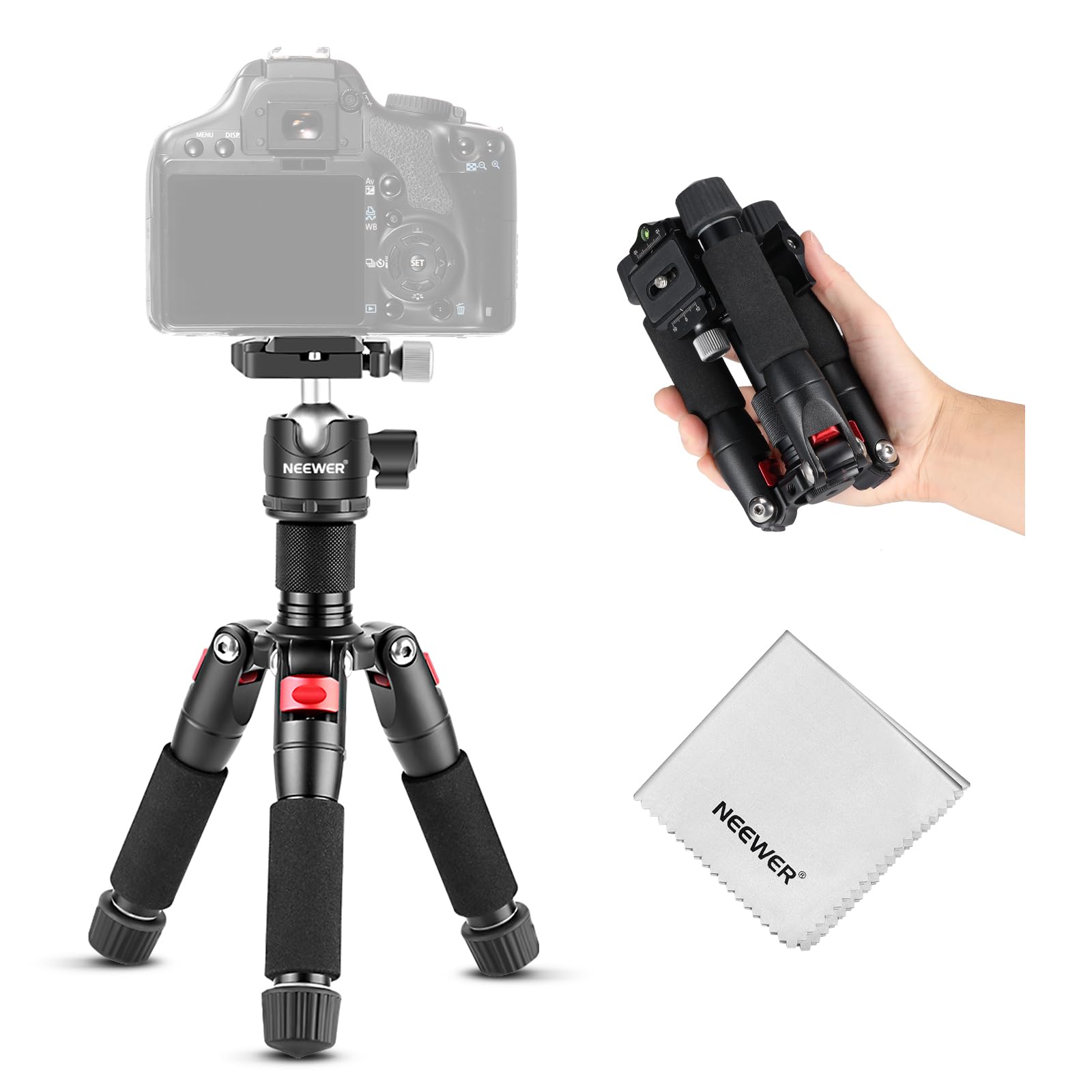
The NEEWER 20-inch tabletop tripod reaches 19.7 inches while keeping an 11-pound load rating, giving it real height beyond the phone-stand class. The aluminum legs and 360-degree ball head hold a DSLR or mirrorless body with flash in place, and the Arca-style quick release makes plate changes simple. The folded length is 6.7 inches, so it travels in a camera bag rather than ruling your carry-on.

The leg-angle adjustments open several positions, which keeps macro and low-angle work from requiring a separate ground pod. The ball head locks with enough force to hold a gripped camera-plus-flash setup steady during tabletop shots. Its 1.7-pound weight sits between noticeable in a bag and reassuring on a desk, which is the right balance for a rigid mini tripod.

This is a camera-first tripod: mirrorless and DSLR users working on macro, product, or desktop video get the height and rigidity they need. It will not fold into a pocket or wrap around a railing, so look to the flexible TP34 in this roundup for that portability. At maximum extension with a long lens, keep the load centered or drop the height a step.

💡 Carry it with the legs folded and the ball head locked to protect the mechanism in transit.

Pros

  • Aluminum build feels dense and professional, with hardware that looks more expensive than the price tag.
  • Stable under DSLR and mirrorless bodies even with flash and larger lenses.
  • Folds to 6.7 inches while still offering 19.7 inches of tabletop height.

Cons

  • Phone and webcam work requires a separate mount; no clip or remote is included.
  • Leg-angle and rotation locks can loosen over time, which can surface as wobble during longer exposures.
Our verdict

For camera-first shooters, this aluminum tabletop tripod is the runner-up that behaves like a full-size tripod in a smaller package: more rigidity than flexible-leg models, with real height that keeps full-size gear off the floor.

Check Latest Price
5

Best Ultralight Travel Tabletop

Oben CTT-1000 Carbon Tripod

88 /100
Studio Score Strong Evidence

Key details

Head Type
Arca-compatible ball head
Included Mounts
None
Weight & Material
0.98 lb carbon fiber
Real-World Capacity
Rated 11 lb
Check Price on Amazon

The CTT-1000 is under one pound with a carbon-fiber build and an Arca-compatible dual-action ball head, making it the ultralight tabletop choice for backpacking photographers. At 10.4 inches folded and 15.5 inches tall, it disappears in a pack side pocket and still frames low-angle camp or trail shots.

The dual-action head takes standard Arca-type plates, so photographers already using that mount can swap cameras in seconds. Carbon-fiber legs and rubber feet stay planted on rock, wood, and picnic tables, which covers the typical surfaces a hiker actually stops at.

This is for ultralight travelers with compact mirrorless bodies and short lenses. The 11 lb rating overstates real-world comfort: front-heavy DSLR or macro combos can strain the head, and budget-focused buyers may not need the weight savings this premium price buys.

💡 Set it on a flat rock, stump, or tabletop; the low 15.5-inch height is an advantage for ground-level compositions.

Pros

  • Weighs just 0.98 lb, so it nearly vanishes in a hiking or travel pack.
  • Carbon-fiber construction feels well made in hand despite the compact size.
  • Folds to 10.4 inches and slips into a camera bag's side pocket without fuss.

Cons

  • Best used as a light-camera support on stable surfaces, not a full-size tripod replacement.
  • The premium price buys weight savings rather than load capacity; budget buyers can find cheaper tabletop stands.
Our verdict

A gram-conscious travel tool for mirrorless shooters who already use Arca plates; ignore the load spec and keep the lenses light.

Check Latest Price
7

Budget Pocket

UURIG TP05 Mini Tripod

90 /100
Studio Score High Confidence

Key details

Head Type
Ball head
Included Mounts
None
Weight & Material
80 g ABS plastic
Real-World Capacity
About 1 lb actual
Check Price on Amazon

At 80 g and a 5-inch folded length, this pocket tripod delivers genuinely stable tabletop behavior for ultra-light gear. It works as a webcam stand, a handle grip for a gimbal, or a ground-level support for an action camera, and the push-button leg extension is quick to set up. The practical support is about 1 lb, so DSLR kits with heavy lenses are outside its range, and on uneven ground its splayed feet can settle with a lean. Those limits keep it in the secondary tier rather than the top pick; within those boundaries, it is a strong entry-level buy.

Pros

  • Pocket-sized frame feels sturdy enough for everyday desktop and travel use.
  • Locking legs and splayed feet deliver stable low-angle shots on flat surfaces.
  • Small enough to double as a grip for a gimbal or action camera between shots.

Cons

  • ABS shell has an entry-level finish compared with aluminum-bodied tabletop tripods.
  • No phone mount is included, so direct phone use requires a separate clamp.
Our verdict

The traveler who wants a barely-there support for a small gimbal or compact camera gets a lot here for very little money.

Check Latest Price
8

Webcam Point-And-Shoot

Amazon Basics Mini Tripod

86 /100
Studio Score Strong Evidence

Key details

Head Type
Mini ball head
Included Mounts
None
Weight & Material
3.89 oz metal alloy
Real-World Capacity
1.1 lb recommended
Check Price on Amazon

At 7.5 inches tall and with a 1.1 lb recommended load, the Amazon Basics Mini Tripod gives webcams and point-and-shoot cameras a stable-enough perch for occasional tabletop work. The entry-level price keeps it an easy addition to a desk drawer or travel bag. The legs, locks, and ball head can be inconsistent, so this is best for light devices that would not be damaged by a fall.

It ranks below the rigid tabletop options in this guide for a clear reason: the same entry-level hardware that keeps the price low also limits angle-lock confidence. For a webcam or point-and-shoot that stays close to the desk, the low cost and small footprint make that tradeoff acceptable.

Pros

  • Works with webcams, point-and-shoot cameras, and action-cam devices when the load stays light.
  • Entry-level price makes it an easy first tripod for low-stakes desk use.
  • Accepts phone adapters, microphones, and mini projectors within its load limit.

Cons

  • No phone mount or remote is included, so phone-first use needs separate accessories.
  • Pivot joints can loosen with handling, so this is more of an occasional-use tool than a daily professional one.
Our verdict

For occasional desk use with a webcam or point-and-shoot, this is an easy entry-level pick when the job is low-stakes.

Check Latest Price

How to Choose

Height and Folded Size

Short tabletop tripods gain rigidity from a low stance; taller extendable models trade that rigidity for reach. A 5-inch base is nearly immune to lever-arm sway, while a 20-inch column catches more vibration and needs a wider footprint or heavier legs to compensate.

For travel, folded length matters more than unfolded height because a tripod that pokes out of a bag gets left behind. Match height to real shooting positions: macro and desktop work need little reach, while waist-level product shots need more.

Real-World Load Capacity

Listed load ratings usually describe a straight, level setup with the center of gravity directly over the ball head. Tilt the head vertical, extend the column, or mount a top-heavy phone and the effective capacity drops noticeably. That is why a tripod rated for 5 lb can still sag under a lighter phone when angled downward.

Check the vertical-mode rating and behavior with your specific camera or phone before buying. A capacity figure is a starting point, not a guarantee.

Ball Head vs. Pan-Tilt Head

Head type dictates how precisely you can frame and how much torque the lock must resist. Ball heads are fast and compact, but a small ball with a short clamp can slip under a long lens. Pan/tilt heads move one axis at a time and are less prone to droop, but they add bulk and complexity.

For a mini tripod, choose a head whose lock clamps securely in one motion and stays put when you lean on it. That behavior matters more than the number of axes.

Weight and Build Material

Material determines the trade-off between carrying weight and vibration damping. Carbon fiber is light and stiff, but costs more and feels less substantial in the hand; aluminum adds heft that steadies longer lenses but weighs on a backpack.

Plastic legs are fine for phone and webcam duty, but thin injection-molded joints are where most entry-level tripods show wear. Choose metal or reinforced composites if the tripod will live in a camera bag with heavier gear.

Included Mounts

A phone-compatible camera tripod does not always include a phone clamp. Several camera-focused models require a separate Arca plate, KLYP, or universal holder, which adds cost and changes the footprint.

If you switch between phone and camera, confirm the kit includes both a phone holder and a standard 1/4-inch screw. If you already use Arca-Swiss plates, an integrated clamp shortens setup time.

Frequently Asked Questions