9 Best Microscopes of 2026: Buy the Specs That Actually Matter

The best microscope isn't the highest magnification number. This guide helps students, homeschoolers, and phone-documenting hobbyists choose by stage, focus, and light.

Microscope listings love a big magnification number. 2000x, 2500x, even 5000x on a sub-$150 scope sounds like a serious lab instrument, but the lens, stage, and light source determine whether that number means anything at the eyepiece.

The practical ceiling for most budget and mid-range compounds is far lower than the sticker claims. Buyers who focus on the mechanical stage, focus mechanism, and dual illumination end up with a scope that stays usable across real specimens; buyers who chase 2000x often find the image falls apart before they get there.

For photographers and phone-documentation users, the trade-off is sharper: a trinocular port or a solid phone adapter matters more than another 500x on the label. Either pay for precise mechanics and camera-ready optics, or save money with a simpler scope and work around the limits.

1

Best Overall

Swift SW380T

88 /100
Studio Score Strong Evidence

Key details

Head Type
Trinocular, camera-ready
Stage Type
Mechanical stage
Illumination
LED
Camera Options
Trinocular port
Check Price on Amazon

The Swift SW380T is the standout all-rounder in this microscope set, pairing a Siedentopf trinocular head with a mechanical stage and precise focus that make the full magnification range genuinely usable. The 30-degree inclined head lets you switch between eyepieces and the trinocular port without losing the specimen, and the stage holds slides steady while you scan. This is the kind of mechanical confidence that separates a serious instrument from a budget optic.

Image quality through the included achromatic objectives is sharp enough for routine biological observation. The practical strengths show up at the everyday magnifications, where the optics stay clear and the fine focus lets you dial in detail. The 1000x end of the range remains composed, and the stage does not drift as you work. Buyers moving up from a starter monocular will notice the difference immediately.

Serious home users, students, and hobbyists who plan to add a camera or share views through the trinocular port are the right buyers. The mechanical stage rewards longer slide review, and the ergonomics hold up through a session. The illumination tradeoff is part of the package: dense or thick specimens at the top of the range may need a supplemental light source.

The build quality supports the premium price. The head, stage, and focus mechanism feel substantial enough for regular use, and setup is easy even for buyers who have not handled a mechanical stage before. A basic monocular gets your eye to the slide; this scope gives you mechanical stage control and a trinocular path that make slide review and camera work feel intentional. For a general-purpose compound scope used at home or in a classroom, the SW380T pairs ergonomics and optical clarity in a way that cheaper options in this set do not.

The trinocular port is the feature that makes this scope flexible over time. With a camera mounted, the SW380T becomes a small documentation station; without one, the same port provides an easy upgrade path. The precision feel carries through the whole magnification range, and that consistency matters more than a high magnification number for buyers who intend to keep a microscope for years.

Pros

  • High-quality optics and metal build hold up under regular home or student use.
  • Worth the premium for serious use; the mechanical precision supports longer sessions.
  • Crisp, sharp image quality makes specimen details easy to identify.
  • Setup and operation are easy, even for buyers new to a mechanical stage.

Cons

  • At higher magnification, the occasional dust spec inside the optics can show up, and parfocal tolerance can vary.
  • For dense or thick specimens at high magnification, the built-in light may need help from an external source.
Our verdict

When the microscope is expected to handle regular slide work and camera documentation, the SW380T delivers that capability in a package that fits a home or classroom bench.
Check Latest Price
2

Best Entry-Level Pick

AmScope M150C

90 /100
Studio Score High Confidence

Key details

Head Type
Monocular, 360° rotatable
Stage Type
Manual stage
Illumination
Cordless LED
Camera Options
None
Check Price on Amazon

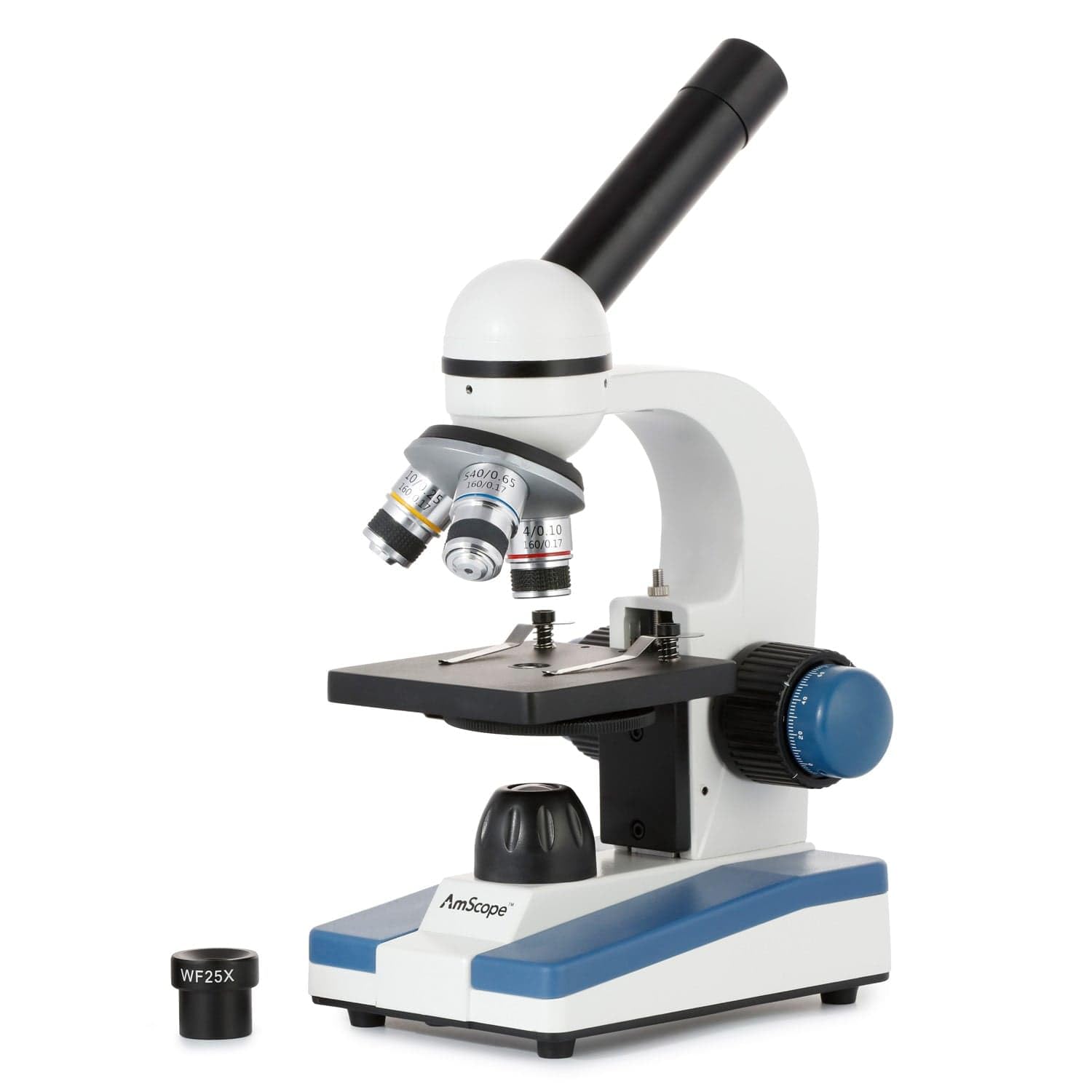
The M150C is the most approachable all-metal compound scope in this set: a 360° rotatable monocular head, cordless LED, and uncomplicated controls reduce friction for first-time viewers. The 4 lb body moves between rooms easily, and the all-metal frame handles desk-to-desk transport. The simple focus and stage controls require no more than a one-sentence explanation.

Achromatic glass lenses produce clear images on common classroom specimens in the 40x to 400x range, which covers the bulk of homeschool and introductory biology work. The LED runs on AC or three AA batteries, so outlet placement doesn't dictate where you set up, and the rotating head lets several students share one eyepiece without moving the entire microscope. Prepared slide kits and household samples like onion skin or cheek cells are the typical workload.

This is a first-scope purchase for beginners, students, and homeschool families who plan to view prepared transparent slides. Its manual stage and transmitted-only light are workable for that routine; they show their limits when you need precise slide scanning or want to view opaque objects. Buyers who expect a mechanical stage or top-down illumination should choose the mechanical-stage option in this lineup instead.

💡 For multi-field viewing, use the 4x objective to frame the slide before switching to 10x or 40x.

Pros

  • All-metal frame holds up to classroom handling and travel between rooms.
  • Cordless LED runs on three AA batteries, freeing table placement from outlet locations.
  • Simple controls get new users to a focused slide quickly.
  • Engaging enough to hold young users' attention beyond the first sample.

Cons

  • At 1000x, the image can blur, so the practical working range is 40x to 400x.
  • Fixed stage clips require a careful hand when moving between viewing fields.
Our verdict

For families and classrooms that want a tough, cordless first microscope, this is the one to start with.

Check Latest Price
3

Best Budget Homeschool Kit

PalliPartners Monocular Kit

86 /100
Studio Score Strong Evidence

Key details

Head Type
Monocular, inclined
Stage Type
Manual stage
Illumination
Dual LED
Camera Options
Smartphone adapter
Check Price on Amazon

The PalliPartners monocular kit arrives ready to document what you see: prepared slides, a phone adapter, dual LED, and battery/AC power are all in the box. That bundle puts it ahead of bare-bones starter scopes in the same price class, where the phone mount and slides usually have to be sourced separately.

The optics hold up well at the magnifications that school and hobby work actually calls for. An onion skin or cheek swab under the lower-power objectives shows enough contrast and detail to keep a student engaged, and the dual LED supplies even light for typical prepared slides.

The included prepared slides cover common biology topics, and the phone adapter clips over the eyepiece securely enough for quick record shots. That combination makes the first session feel productive rather than fiddly.

Homeschool families and adult beginners are the best match. The bundle removes the usual setup friction, and battery power means lessons can happen at the kitchen table or outside without hunting for an outlet. This is a starter instrument, not a long-term lab tool; a unit can develop power problems after several months, so longevity is not guaranteed.

💡 For group viewing, set up the phone adapter and let the screen be the shared eyepiece — it works better than passing the scope around.

Pros

  • Complete kit means first views happen without extra purchases.
  • Solid body and stable optics for an entry-level price.
  • Entry price covers the essentials other budget scopes charge extra for.
  • Students and families enjoy it, with phone sharing a highlight.

Cons

  • The 2000x top magnification is more a spec-sheet number than a daily setting; lower objectives deliver the usable performance.
  • Extended professional use will want a binocular or trinocular head; this monocular body suits shorter sessions.
Our verdict

For a family or student buying the first compound scope, the PalliPartners kit bundles everything needed for immediate phone-documented observation. Buy it for the included slides and battery flexibility, and treat the scope as a capable starter rather than a lab career.

Check Latest Price
4

Best Lab-Style Digital Bundle

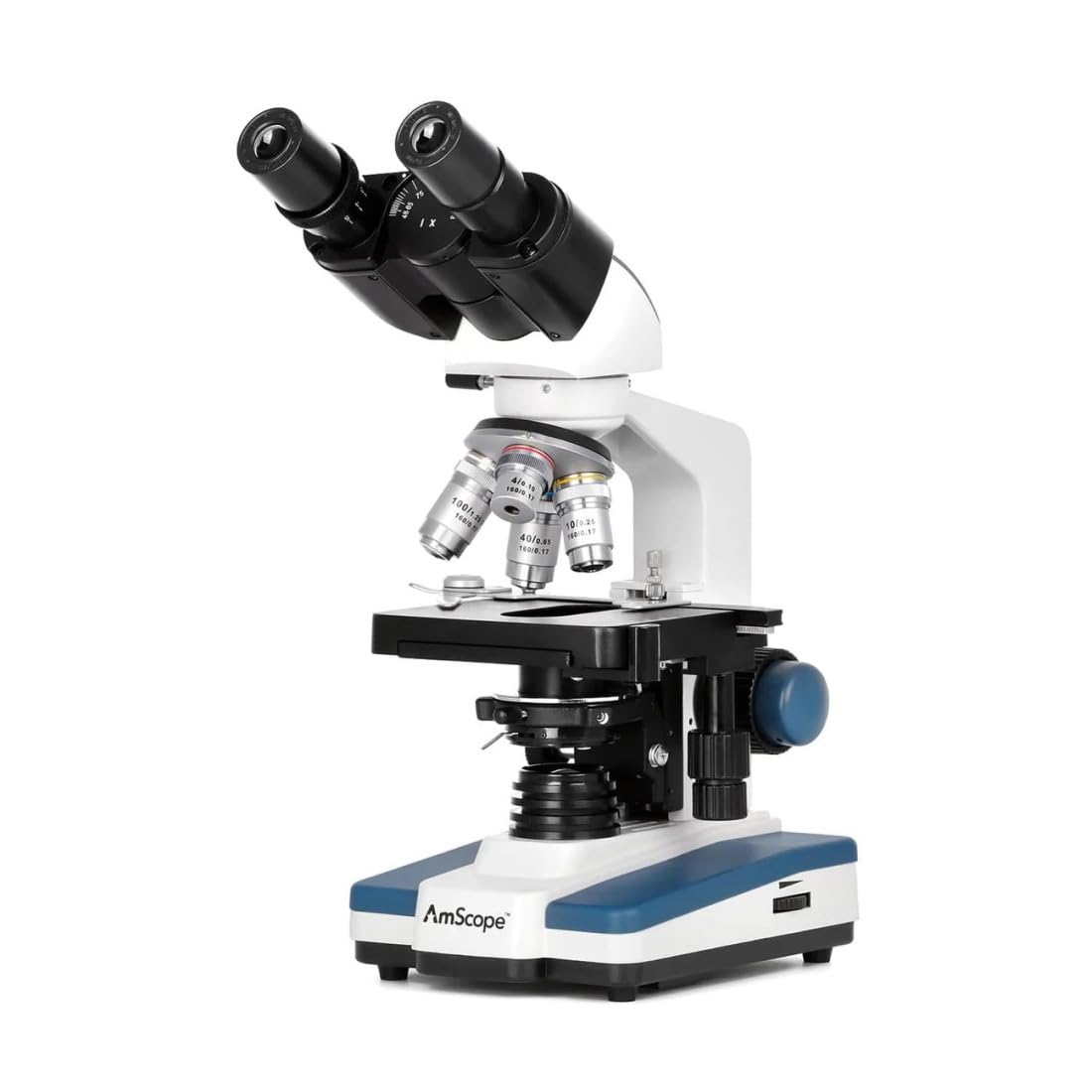
AmScope B120C-E5

85 /100
Studio Score Strong Evidence

Key details

Head Type
Binocular
Stage Type
Mechanical stage
Illumination
LED, fly-eye lens
Camera Options
5MP USB camera
Check Price on Amazon

The B120C-E5 brings a professional binocular body and mechanical stage to the general-purpose microscope category, with a 5MP USB camera for record keeping. The emphasis is on sustained observation, not casual inspection, and the binocular head makes long sessions noticeably more comfortable.

The LED fly-eye illuminator distributes light evenly across the field, and the 40x-2500x range handles standard biological specimens from cheek cells to stained bacteria. At 9.9 lbs, the body stays planted on a bench, which is useful when you are fine-focusing at the upper end of the range. Prepared slides and wet mounts both benefit from that even light.

Advanced students, educators, and small labs will get the most from the B120C-E5. It assumes some familiarity with compound microscopes, and beginners on a tight budget are better served by a simpler monocular before moving up to this class. Buyers who plan to upgrade the bundled camera over time will find the optical path a solid foundation.

The optical path is the main investment here. The included 5MP camera can produce soft or uneven captures, so for work that needs accurate digital records, plan to add a better camera later.

Pros

  • Binocular head and mechanical stage hold up to regular use in classrooms and small labs.
  • Lab-focused functionality handles routine biological observation and teaching.
  • Fits home, school, and hobby projects without feeling like a starter instrument.

Cons

  • Mechanical stage and slide holder can feel less fluid than the optics suggest during fine scanning.
  • Mac software for the bundled camera is limited, so digital capture is best for quick record-keeping.
Our verdict

Advanced students and small labs get a lab-oriented binocular with a mechanical stage and even LED illumination; the optical build is the reason to own it.

Check Latest Price
5

Best Portable Digital Scope

Skybasic Wireless Digital

86 /100
Studio Score Strong Evidence

Key details

Head Type
Handheld digital
Stage Type
Adjustable stand
Illumination
8 adjustable LED
Camera Options
WiFi, USB
Check Price on Amazon

The SKYBASIC is the handheld option in this group: a 0.31 kg WiFi/USB digital scope that streams 1080P video to your phone and uses eight adjustable LEDs to light whatever you point it at. Where the screen-based alternative in this lineup carries its own display, this scope treats your phone as the viewfinder and the leaf, fabric, or small object as the stage. It is a pocket magnifier with a camera attached, not a compound microscope replacement.

This one suits amateur naturalists and families who want immediate photos for sharing rather than precise slide work. The honest boundaries: the wireless connection can drop and app pairing can take a couple of tries, and practical magnification lands closer to 100x-200x despite the 1000x label. Those limits are fine for inspecting soil, coins, rocks, or skin at arm's reach; anyone expecting optical compound resolution will want a bench microscope instead.

At this budget price, the 2MP sensor delivers images that read well on a phone screen, and the eight LEDs can be turned down to avoid glare on glossy surfaces. The 3-60 mm focal range suits objects you can hold in your palm, and the included adjustable stand keeps tabletop specimens steady enough for still shots. For a low-cost digital tool, this is a genuinely usable magnifier rather than a toy.

💡 Lower the eight LEDs for glossy objects; full-power direct light creates blown-out highlights.

Pros

  • Pocket-sized 0.31 kg build with eight adjustable LEDs makes quick phone image capture easy.
  • Phone-screen picture quality is satisfying for casual leaf, insect, fabric, or coin checks.
  • At a budget price, it delivers more close-up detail than a phone camera alone.
  • Works as a digital magnifier across its focal range for everyday discoveries.

Cons

  • In phone-only sessions, the WiFi connection may need re-pairing; the USB cable is a steadier fallback.
  • The 1000x label overstates the useful range; expect sharp handheld viewing closer to 100x-200x.
Our verdict

The SKYBASIC is the portable digital scope for anyone who wants to inspect and share the small world without setting up a bench microscope.

Check Latest Price
6

Budget-Conscious Buyers

JECONE Binocular

83 /100
Studio Score Strong Evidence

Key details

Head Type
Binocular, rotating
Stage Type
Mechanical stage
Illumination
Dual LED, dimmer
Camera Options
Phone holder
Check Price on Amazon

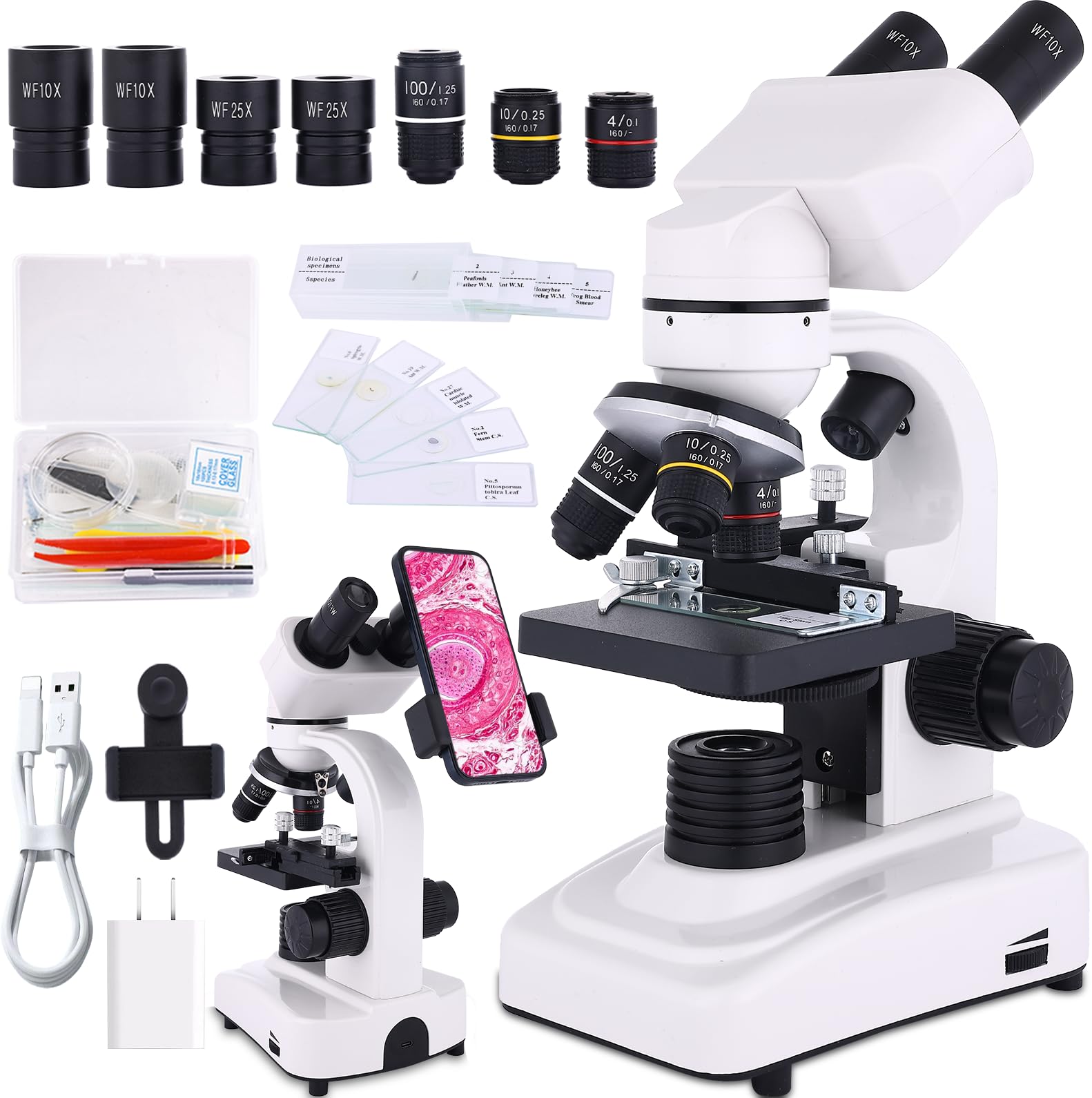
The JECONE binocular pairs comfortable eyepieces with a mechanical stage and dual-LED illumination at a price that makes it a sensible first real scope for school or homeschool use. The bundle adds prepared slides, coverslips, and a phone holder, so the kit matches what a beginner actually needs. Long-term durability under heavy classroom use is a known vulnerability. That makes it an early-value buy for budget-conscious households rather than a lifetime lab instrument.

Pros

  • Binocular eyepieces, mechanical stage, and dual LED at a budget-friendly price.
  • Prepared slides, coverslips, and phone holder cover the basics for immediate use.
  • Rotating 45-degree inclined binocular head lets a few students share the scope comfortably.

Cons

  • Serious camera documentation would need a trinocular port; this body stays with a binocular head.
  • The 2500x figure is a maximum rating; sharper, easier views come from the middle of the magnification range.
Our verdict

For a first binocular scope at home or in a small class, the kit covers the essentials without demanding a premium budget.

Check Latest Price
7

Complete Kit Buyers

Woehrsh Trinocular 40-5000X

81 /100
Studio Score Strong Evidence

Key details

Head Type
Trinocular, electronic eyepiece
Stage Type
Dual mechanical stage
Illumination
LED
Camera Options
USB camera, WiFi
Check Price on Amazon

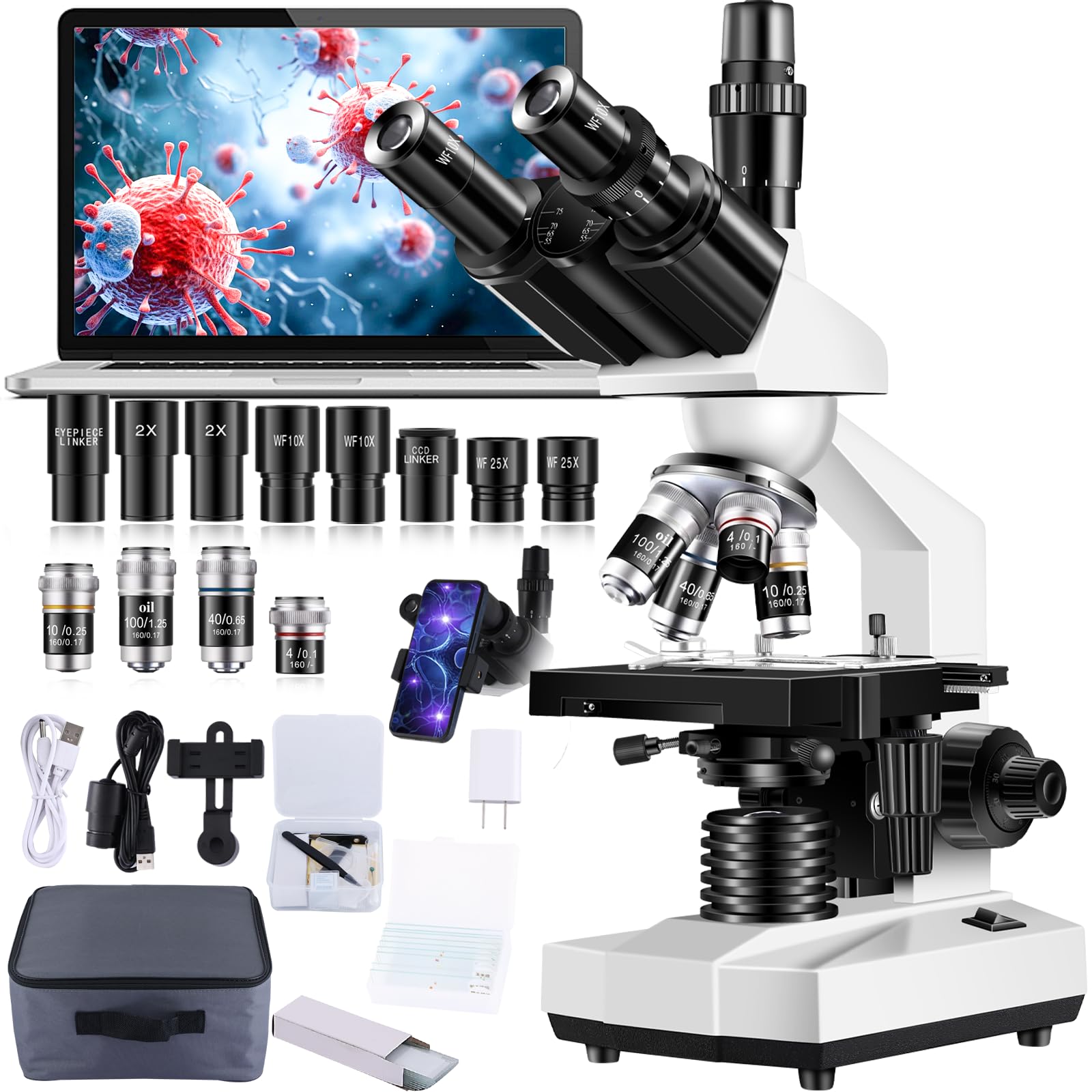
Anyone shopping for a trinocular kit gets a lot of physical hardware for a mid-range price: dual mechanical stage, achromatic objectives, prepared slides, tools, and a hard case all come in the box. Biological observation at ordinary working magnifications is comfortable, and the metal body gives the scope a lab-instrument feel. The digital and top-end claims are where the boundaries show. The bundled camera and software can take extra setup time — USB/WiFi recognition is not always smooth — and image sharpness drops noticeably at the extreme end of the claimed range. This is a capable optical scope for someone ready to troubleshoot the digital side, not a plug-and-play 5000x system.

Pros

  • Metal body and good lens quality support regular bench use and a professional feel.
  • At a mid-range price, the hardware package with slides, tools, and a hard case holds its own against more expensive kits.
  • The dual mechanical stage and trinocular head make biological slide work smooth at practical magnifications.

Cons

  • The bundled USB/WiFi camera and software can take extra effort before the scope is recognized.
  • At the top of the claimed range, images can soften enough that the 5000x figure outruns the optics.
Our verdict

This suits a buyer who values the trinocular head and full accessory bundle enough to work through camera setup; skip it if 1000x+ sharpness is a priority.

Check Latest Price
8

Families with Kids

TOMLOV DM301 Pro

79 /100
Studio Score Established

Key details

Head Type
Screen-based digital
Stage Type
Built-in stand
Illumination
Dual LED, adjustable
Camera Options
8MP camera, WiFi
Check Price on Amazon

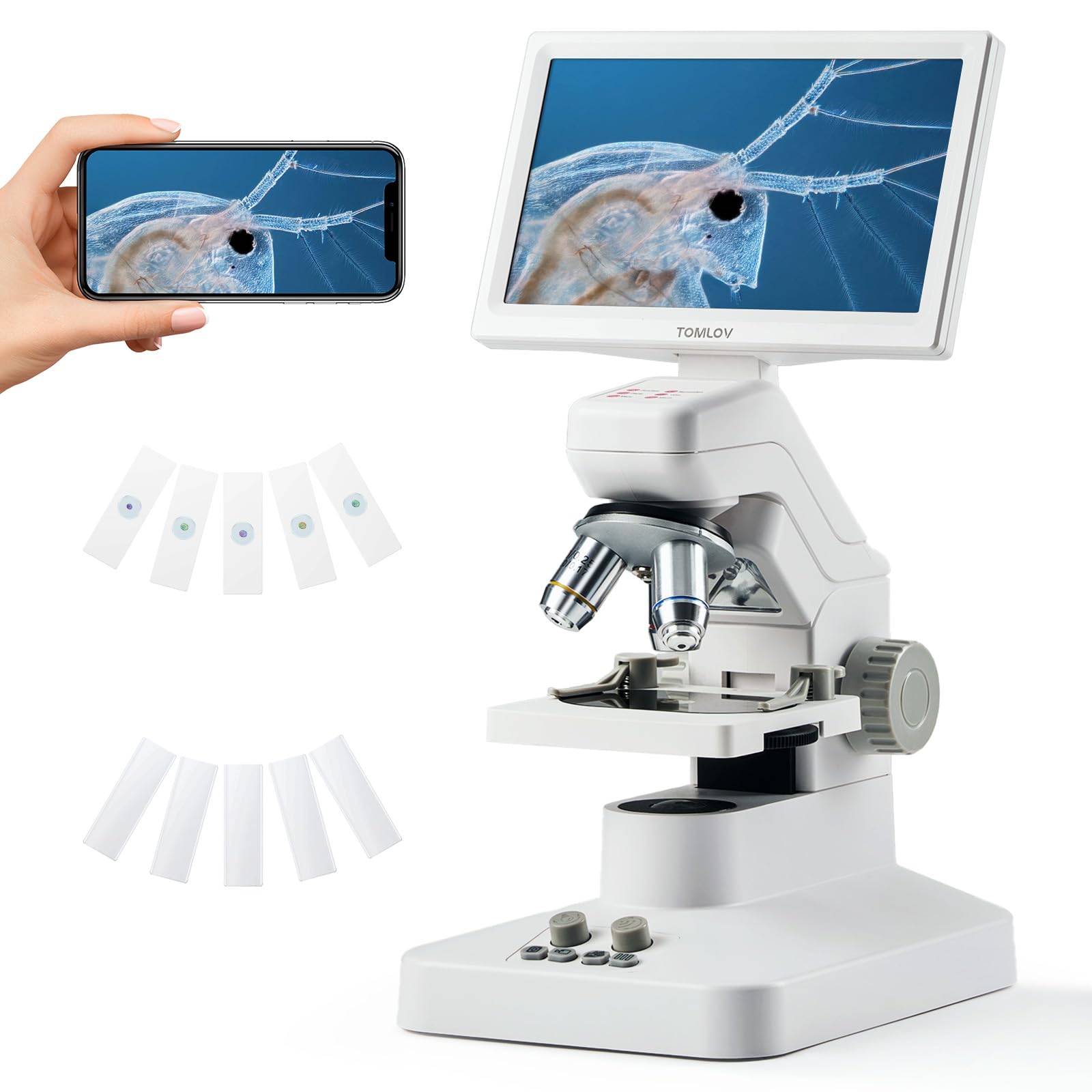
With a 7-inch IPS display and an 8MP camera, the TOMLOV DM301 Pro puts the specimen on a shared screen, so a group of kids or students can watch the same image without fighting over an eyepiece. The adjustable dual LED illumination and built-in WiFi/USB capture make it a convenient learning tool for family science sessions or classroom demos. The 1200x magnification is a digital ceiling, so the image softens before it reaches the fine-detail clarity of an optical compound microscope; serious biological observation is not what this screen-first format is for. Where group viewing and easy digital sharing matter most, that tradeoff is acceptable.

Pros

  • Shared 7-inch screen lets a group watch the same specimen instead of taking turns.
  • 8MP photos and 1080P video make it easy to save and share what the group sees.
  • Adjustable dual LED illumination makes specimens easy to see in classroom settings.

Cons

  • The built-in screen and battery make the unit less portable than a handheld digital magnifier.
  • There is no optical eyepiece, so the entire viewing experience depends on the 7-inch screen.
Our verdict

For a family or co-op classroom that wants one shared image instead of eyepiece turns, this screen-first scope fits.

Check Latest Price
9

Kids and Students

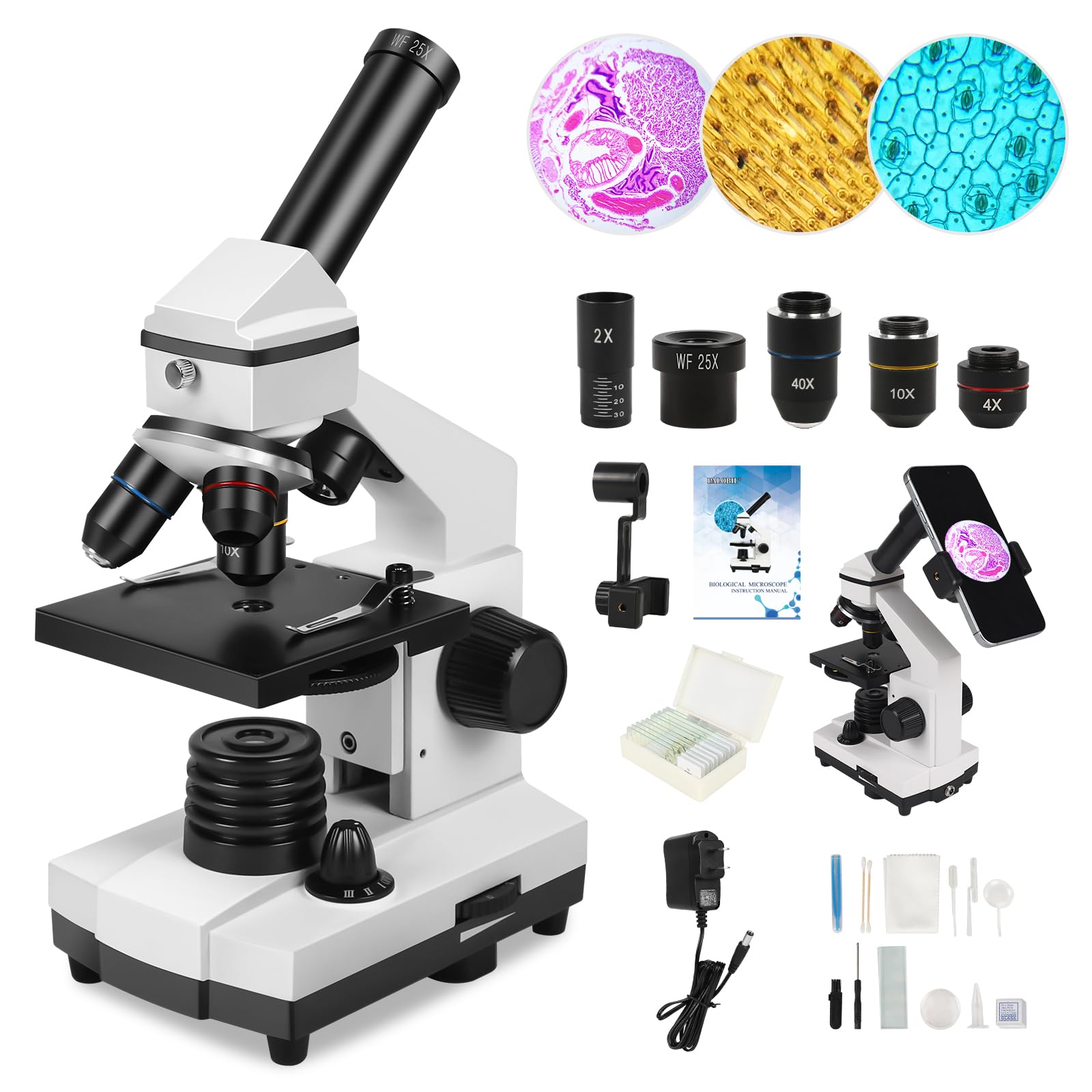
PALOBIL 100-2000X Monocular

86 /100
Studio Score Strong Evidence

Key details

Head Type
Monocular
Stage Type
Manual stage
Illumination
Dual LED, adjustable
Camera Options
Phone adapter
Check Price on Amazon

The PALOBIL is a real compound microscope with an all-metal frame, dual LED illumination, and a kit that includes prepared slides and a phone adapter. For a young beginner, that combination delivers a genuine observing experience at an entry-level price.

The manual stage is the main reason it trails the more precise budget picks; casual slide viewing is fine, but methodical scanning isn't its strength. It is best for kids and first-time students, not adults who need binocular ergonomics or routine work above 1000x.

Pros

  • All-metal build and dual LED lighting give it a genuine microscope feel without the premium price.
  • Prepared slides, phone adapter, and experiment tools let a beginner start observing right out of the box.
  • Complete kit at a budget-friendly price undercuts many toy-brand alternatives.

Cons

  • The monocular head limits viewing to one person at a time, which can make sharing during a lesson awkward.
  • At the 40x objective, image clarity can vary between units, so the top end deserves an early check.
Our verdict

For a young beginner who wants a real microscope without a lab-grade budget, the all-metal kit is a reasonable entry point; expect basic mechanics rather than precision stage work.

Check Latest Price

How to Choose

Usable Magnification

A 2000x label means the objective and eyepiece multiply to that number, not that the image stays sharp there. At high magnification, the objective needs more light and a shorter working distance; cheap optics and weak illumination turn the image into a dark blur. Manufacturers still print the theoretical maximum because buyers compare it first.

Treat anything above 400x-1000x on a budget or mid-range scope as a bonus. Plan around the range where the condenser, stage, and optics work together, and you'll avoid the most common disappointment in this category.

Head Type

The head determines comfort and whether you can document what you see. A monocular head is fine for quick viewing but forces one eye and keeps your other eye open to draw or switch specimens. Binocular heads reduce eye strain, and a trinocular head adds a dedicated port for a camera without stealing light from the eyepieces.

Stage Type

A mechanical stage holds the slide with clips and moves it precisely with knobs. Without it, you have to nudge the slide by hand, which nearly always causes the image to jump out of view. Once you pass 400x, that hand-positioning is the main reason a perfectly good scope feels frustrating.

Illumination

Most scopes advertise dual LED or high-power LED, but the position and adjustability matter more than brightness. Transmitted light from below works for thin biological slides; opaque specimens, coins, or thick samples need top light to show surface detail. A dimmer lets you balance contrast at lower magnifications, where full LED power can wash out fine detail.

Camera Options

If your goal is sharing images, a trinocular port is the cleanest path because it sends light to a camera and your eye at the same time. Bundled USB and WiFi cameras sound convenient, but their drivers, software, and connectivity are the most common weak point in this category. A plain phone adapter often outperforms a low-cost bundled camera for casual documentation.

Frequently Asked Questions