9 Best Manual Focus Lens of 2026: Smooth-Feeling Manual Primes

The best manual focus lens for every mount and style: smooth-focusing primes for Sony, Micro Four Thirds, Canon, and Leica, plus a 420-800mm telephoto for tripod moon shots.

Manual focus lenses are a strange category: the spec sheet promises a fast aperture and all-metal barrel, but the moment you mount one, the handling decides everything. A stiff focus ring or a sloppy mount can turn a cheap prime into a frustration, while a smooth, predictable ring makes the same focal length a joy to use.

The real differences between budget primes are not just glass formulas. Focus ring feel, focus throw, mount tolerances, and the way a lens draws at wide apertures separate an everyday carry from a drawer warmer.

This guide matches manual primes and zooms to your mount and shooting style, whether that means a 50mm-equivalent street prime, an 85mm portrait lens, or a long telephoto for tripod-based moon photography. The right lens is the one that focuses cleanly on your body and suits the shots you actually take.

1

Best Overall Manual Focus Prime

Meike 35mm F1.7 Sony E

85 /100
Studio Score Strong Evidence

Key details

Mount
Sony E
Focal Length
35mm (52.5mm eq.)
Max Aperture
f/1.7
Build & Weight
Metal body, 181g
Check Price on Amazon

The Meike 35mm F1.7 is the budget Sony E prime that gives APS-C shooters a true normal view with a fast f/1.7 aperture in a mostly metal 181g barrel. Wide open it keeps subjects sharp while the background turns into smooth bokeh, and micro-contrast holds up enough for the lens to be useful in low-light street and portrait work. The metal body adds a solid feel that matches its weight, and the five-group, six-element optical layout keeps the lens compact on a6000-series cameras. It rewards steady hands, and the f/1.7 opening gives enough light to shoot indoors without raising the ISO into uncomfortable territory.

On a6000-series bodies, the 35mm focal length frames like a classic normal lens, and f/1.7 opens up enough light for dim interiors and evening street shots. Minimum focus sits at 0.30m, which gets you close enough for tighter tabletop compositions without needing a macro lens. The lens depends on the camera's focus peaking and magnification for precise manual focusing, so the a6000's manual-assist tools are part of the normal workflow.

This lens suits Sony E APS-C shooters who want an everyday normal prime for portraits, street photography, and budget low-light shooting. It is not for full-frame users who need edge-to-edge coverage, nor for buyers who demand a featherweight lens; the 181g body is compact but substantial. Manual focus is the only focus mode, so a patient shooting style matters more than autofocus speed.

The f/1.7 aperture does more than brighten the viewfinder: it creates shallow depth of field for separating a subject from the background, and the 35mm angle of view produces a natural normal framing on APS-C. The lighter Micro Four Thirds normal prime in this set suits size-first shooters, but the Meike's blend of focal length, speed, and handling is a better everyday fit on Sony E.

The lens has gathered a following among budget Sony E shooters, and that reputation is anchored in image quality, not just the low entry cost. It pairs with a6000-series bodies without adapters and takes up little room in a bag, so it tends to stay mounted as a daily normal prime.

Pros

  • Gives Sony E APS-C shooters a popular everyday normal prime at a budget price.
  • Delivers sharp images with smooth bokeh and good micro-contrast for the price.
  • Works well on Sony a6000-series cameras for everyday shooting.
  • Stays sharp wide open at f/1.7, making low-light shots usable without stopping down.
  • Feels solid and durable thanks to a mostly metal body at 181g.

Cons

  • Heavier than expected for its size, so balance turns front-heavy on compact bodies.
  • Focus ring can feel sticky on some units, making fine adjustments harder without focus peaking.
Our verdict

Sony E APS-C shooters who want a manual normal prime for portrait, street, and low-light work can stop at the Meike 35mm F1.7. It is the budget lens that gets the basics right.

Check Latest Price
2

Best Micro Four Thirds Normal Prime

7artisans 25mm F1.8 M43

85 /100
Studio Score Strong Evidence

Key details

Mount
Micro Four Thirds
Focal Length
25mm (50mm eq.)
Max Aperture
f/1.8
Build & Weight
Metal body, 143g
Check Price on Amazon

The 7artisans 25mm f/1.8 packs a 143g metal body, 12-blade aperture, and sharp stopped-down rendering into an M43 prime at a budget price. Its 50mm-equivalent field of view makes street and landscape framing feel familiar, and the barrel is small enough to pair with any M43 body without adding bulk. Compared with the top-pick 35mm for Sony E, this is the lighter, mount-specific normal prime.

At f/1.8, the lens renders with enough contrast for everyday shooting, while stopping down to f/4 or f/5.6 tightens the image across the frame. The clickless aperture ring is convenient for video work, and bokeh stays smooth at moderate distances.

M43 shooters who want a compact, sharp normal prime for everyday stills will find a lot to like here. This is a manual-focus lens, so the buyer is already choosing deliberate control over autofocus convenience. The short focus throw and possible infinity calibration variance make precise focus slower, so shooters who use peaking or magnification will get the most from it. The light weight and f/1.8 speed keep it an easy carry through a full day out.

๐Ÿ’ก For precise focus at f/1.8, keep magnification on and give the ring a little more care.

Pros

  • Metal barrel and smooth control rings give the lens a sturdy feel in the hand.
  • Stopped down, the lens produces sharp stills that hold up on landscape and street shots.
  • An f/1.8 normal prime at this budget price is an easy value choice for M43 shooters.
  • At 143g, the lens stays light enough for everyday carry on a small body.

Cons

  • Printed aperture values can be inaccurate, so checking exposure on screen is the safer route.
  • Wide-open, the quick focus ring can be fiddlier than longer-travel primes.
Our verdict

The 7artisans 25mm f/1.8 is a compact, sharp normal prime for M43 shooters who want an inexpensive everyday lens.

Check Latest Price
3

Best Budget Portrait for Canon DSLRs

Lightdow 85mm F1.8 Canon EF

84 /100
Studio Score Strong Evidence

Key details

Mount
Canon EF/EF-S
Focal Length
85mm
Max Aperture
f/1.8
Build & Weight
6 elements/6 groups
Check Price on Amazon

The Lightdow 85mm F1.8 gives Canon DSLR owners a dedicated portrait focal length with f/1.8 light collection at a price that undercuts native autofocus primes. The center sharpness at f/1.8 is credible, and the background blur has a smooth, creamy character that flatters subjects. The six-element optical layout is a conventional portrait design, and the rendering matches that priority. This is a portrait lens first; it is not built for distant reach.

Stopping down to f/2.8 or f/4 tightens edge sharpness and deepens the usable depth of field for two-person or waist-up portraits. The metal barrel feels denser than the price expects, though fit quality can vary between units: a mount may feel tight, and the alignment dot is not always present.

This is for Canon DSLR owners on a strict budget who want the 85mm portrait look and are willing to shoot in full manual mode. Compatibility is not guaranteed across bodies: with no electronic contacts, the camera must be set to M mode with release-without-lens enabled, and certain Canon bodies may not recognize the lens at all. For a single body you own, the workflow is manageable; for multi-body kits, the uncertainty becomes a real boundary.

๐Ÿ’ก Use live view magnification to focus instead of relying on the optical viewfinder.

Pros

  • Sharp, bright portraits with creamy background blur at 85mm f/1.8
  • Bokeh and crispness exceed expectations at this price point
  • Affordable entry point for the 85mm portrait look on Canon EF

Cons

  • Fit quality can vary between units; a mount may feel tight or lack an alignment dot.
  • Precise focus depends on the photographer's eye because no electronic focus confirmation reaches the camera.
Our verdict

A cost-effective way to get the 85mm portrait look on Canon for shooters who enjoy the manual focus workflow.

Check Latest Price
4

Best Compact Full-Frame for Sony E

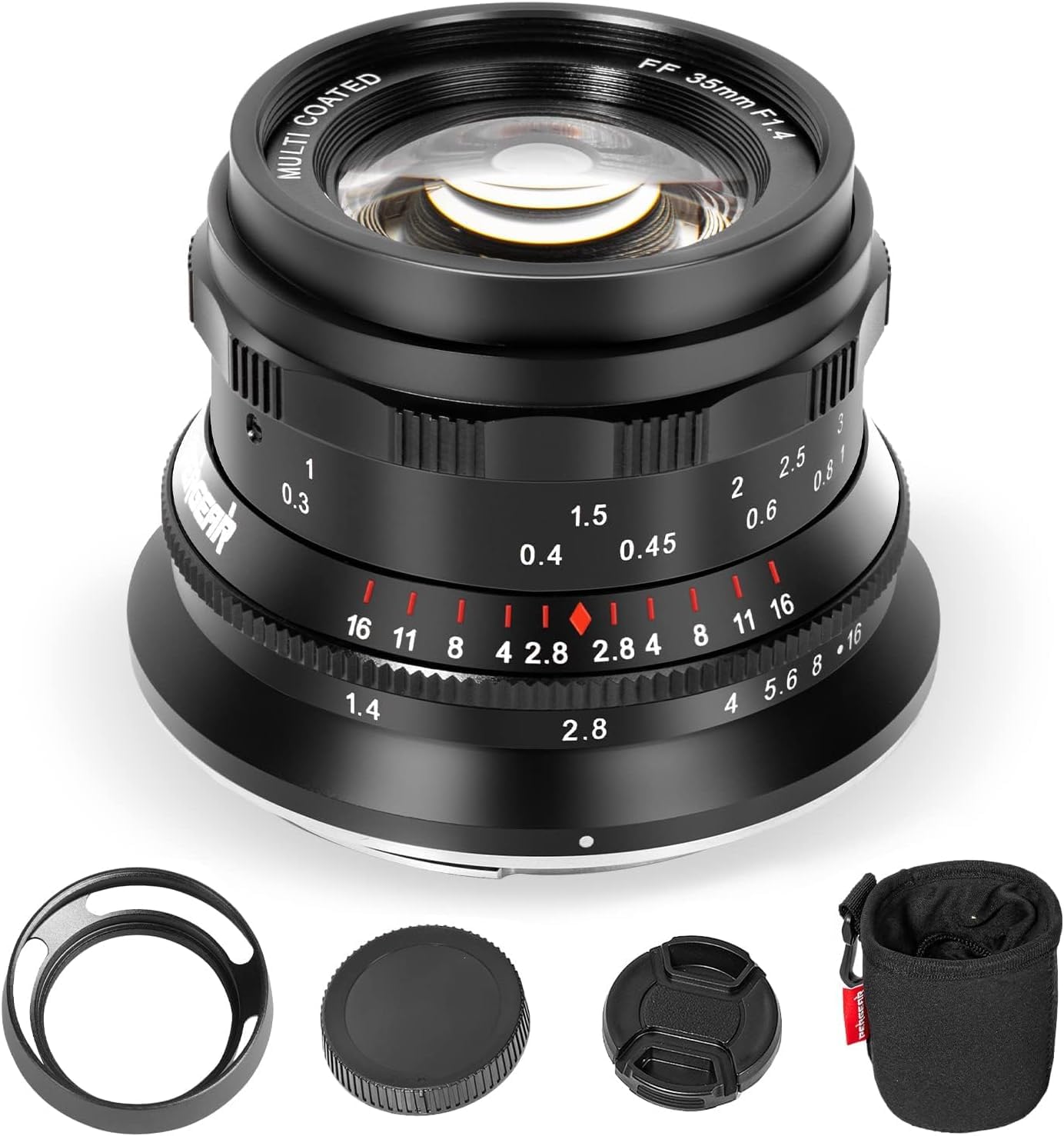
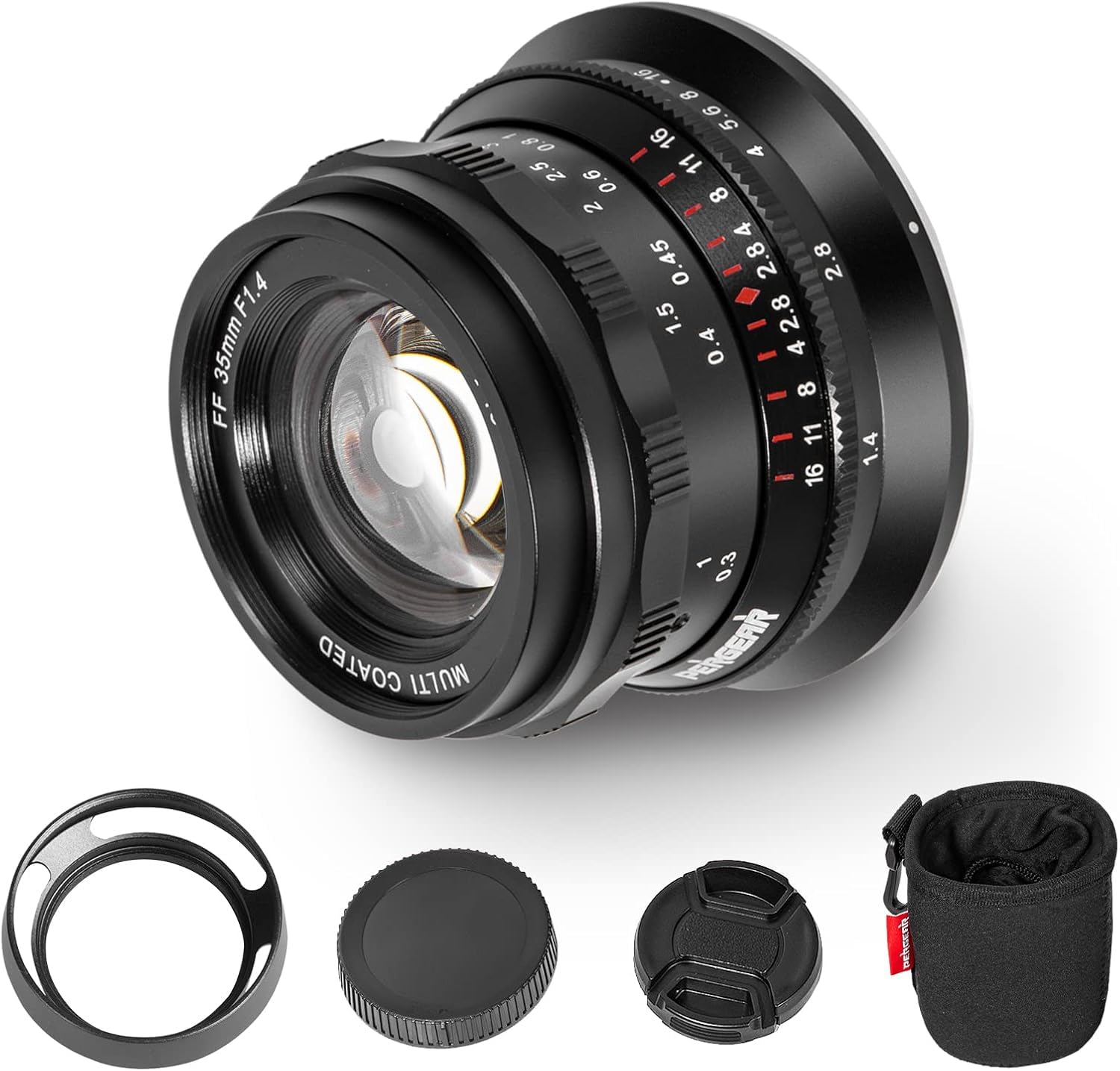
PERGEAR 35mm F1.4 Sony E

79 /100
Studio Score Established

Key details

Mount
Sony E
Focal Length
35mm full-frame
Max Aperture
f/1.4
Build & Weight
Metal housing
Check Price on Amazon

The PERGEAR 35mm F1.4 is the smallest full-frame 35mm in this manual-focus Sony E set, and the 10-blade aperture keeps out-of-focus highlights round. The metal barrel keeps the whole package pocketable, which is the main reason it ends up in street and travel kits. That f/1.4 speed plus compact size is what separates it from the APS-C top pick.

The focus ring turns with a smooth, damped feel, and the short throw lets you move from near to far quickly. Sony's focus peaking reads the transitions well, so manual focusing in street scenes is faster than the price tier suggests. This is a manual-focus-only lens, which suits the shooter who wants full control.

This lens suits Sony full-frame or APS-C shooters who want a tiny manual 35mm for street and travel. It is not for pixel-peepers who need sharp full-frame corners, nor for shooters who regularly work in bright sun without a hood. Full-frame users can keep subjects centered and get the f/1.4 look without carrying a heavy prime.

On APS-C bodies the 35mm becomes a 52.5mm-equivalent, a useful normal field of view for street shots. The f/1.4 speed helps in evening light, and pre-focusing with the short throw lets you shoot quickly without checking the magnifier.

Pros

  • Metal housing with a smooth focus ring feels durable in hand.
  • Extremely compact full-frame 35mm; slips into a small bag or pocket.
  • Short focus throw keeps manual focusing quick between shots.
  • 10-blade aperture yields round bokeh highlights at a budget-friendly price.

Cons

  • At f/1.4 to f/2, the center is soft wide open; stopping down to f/2.8 sharpens it.
  • In bright sun without a hood, flare can reduce contrast.
  • Full-frame corner sharpness falls off; the lens is more convincing on APS-C where the crop hides the edges.
Our verdict

For a street or travel kit where compact size is the priority, the PERGEAR 35mm F1.4 fits.

Check Latest Price
5

Best Pancake for Leica M

Brightin Star 28mm F2.8 M

83 /100
Studio Score Strong Evidence

Key details

Mount
Leica M
Focal Length
28mm
Max Aperture
f/2.8
Build & Weight
Brass body, 125g
Check Price on Amazon

Brass construction, 125g weight, and an ultra-thin profile make this the discreet 28mm for Leica M owners who favor carry comfort over aperture speed. The metal barrel feels dense in hand, and the flat pancake shape lets the whole kit slip under a jacket or into a small bag.

Stopped down, the 28mm delivers pleasing sharpness for this class, with enough center detail for daylight street shots and travel prints. The six-element optical layout keeps the lens compact without obvious compromises at ordinary street and travel distances.

This is a lens for Leica M shooters who treat the camera as an everyday companion: street photographers, travelers, and anyone who wants a flat front element and minimal weight. In dim rooms, the f/2.8 maximum aperture can push you to higher ISO or slower shutter speeds, so anyone who needs f/1.4 or f/2 should look at faster primes.

The asking price feels fair for a brass-bodied M lens, and the slim profile adds value for shooters who prioritize compactness. For daylight use, that combination of slim build, crisp stopped-down rendering, and reasonable outlay gives Leica M owners a low-profile prime that disappears when the camera is out.

Pros

  • Brass body gives the lens a dense, quality feel without adding bulk.
  • Pancake profile keeps a Leica M kit flat enough for discreet street carry.
  • At 125g, the lens is light enough to leave on the camera all day.
  • Stopped-down sharpness is pleasing for a lens this slim in daylight scenes.

Cons

  • The ultra-thin barrel makes the aperture ring tiny and hard to turn when you need a quick adjustment.
Our verdict

For Leica M owners who want a flat, light everyday prime, this brass 28mm makes a small kit smaller.

Check Latest Price
6

Best Budget Super-Telephoto for Canon

BENOISON 420-800mm Canon

80 /100
Studio Score Strong Evidence

Key details

Mount
Canon EF/EF-S
Focal Length
420-800mm
Max Aperture
f/8.3-16
Build & Weight
โ€”
Check Price on Amazon

The BENOISON 420-800mm is a low-cost manual-focus super-telephoto for Canon EF/EF-S bodies. Its 1.9x zoom range reaches from 420mm to 800mm, a modest ratio for this category and one that keeps weight and handling in check. The construction feels more solid than the price suggests, so someone moving up from a kit lens gets an approachable way to try extreme focal lengths without committing to native super-telephoto costs.

Set up on a tripod, the lens produces usable images of the moon and distant wildlife. The long end pays off for framing objects a normal zoom cannot reach, and the manual zoom ring lets you switch from a full-disc moon framing to a tighter crop without changing position. There are no electronic contacts, so focus and zoom are controlled entirely by hand; magnified Live View is the practical way to confirm focus before firing.

Tripod-first Canon DSLR owners get a budget path to long-distance stills with this lens. The f/8.3-16 maximum aperture demands bright daylight, so overcast or dusk sessions are not where it earns its keep. Handheld moving-subject shooting is outside its scope; the target is a patient photographer framing the moon, perched birds, or stationary wildlife from a stable support.

๐Ÿ’ก Use magnified Live View to confirm focus at 800mm before firing.

Pros

  • Construction quality is better than the budget price suggests, with a body that feels substantial in hand.
  • Tripod-mounted shots of the moon and distant wildlife come out usable for hobbyist use.
  • The 420-800mm zoom range gives Canon DSLR owners a low-cost manual-focus path to super-telephoto reach.

Cons

  • Manual focus ring is finicky; beginners may miss sharp focus until they learn the long-end focusing motion.
Our verdict

A tripod-bound Canon DSLR owner gets a low-cost manual super-telephoto for the moon and distant wildlife without the usual native-lens price.

Check Latest Price
7

M43 Everyday Prime

TTArtisan 25mm F2 M43

86 /100
Studio Score Strong Evidence

Key details

Mount
Micro Four Thirds
Focal Length
25mm (50mm eq.)
Max Aperture
f/2
Build & Weight
Metal body
Check Price on Amazon

TTArtisan's 25mm F2 brings a metal barrel and f/2 aperture together at an entry-level price, giving M43 shooters a compact 50mm-equivalent prime for street and everyday carry. The all-metal body feels solid, and the focal length suits beginners learning manual focus on Olympus or Panasonic bodies. Manual focus is workable, though the focus ring sits close to the camera body and can feel cramped on smaller cameras. Mount fit can be very tight on some M43 bodies, making the lens awkward to mount or remove. That inconsistency keeps it behind this category's other M43 25mm normal prime for all-around polish, but budget-first street shooters who accept these handling quirks still get a well-built fast prime.

Pros

  • Metal barrel feels solid for a budget M43 prime and matches the compact size of smaller bodies.
  • f/2 aperture and 50mm-equivalent framing give useful low-light reach for street and daily carry.
  • Takes up little room in a bag or on a camera strap.

Cons

  • Focus ring can sit close enough to the camera body that precise turns feel cramped on smaller M43 bodies.
  • Mount fit can be very tight on some M43 bodies, making mounting and removal awkward.
Our verdict

For M43 shooters buying on price, this compact prime works as an everyday street lens; treat it as a cost-conscious pick rather than a handling-first one.

Check Latest Price
8

Ultra-Budget Creative

Fotasy 35mm F1.6 Sony E

83 /100
Studio Score Strong Evidence

Key details

Mount
Sony E
Focal Length
35mm
Max Aperture
f/1.6
Build & Weight
110g, 4 elements/4 groups
Check Price on Amazon

The Fotasy 35mm F1.6 is a tiny, lightweight lens that pairs naturally with Sony E mirrorless bodies. Its f/1.6 aperture opens up low-light portraits, while the swirly bokeh gives photos and video a distinctive dreamy character. This is a creative tool, not a clinical one: edges are soft wide open and focus ring feel can vary between units, so precision is secondary. Those boundaries keep it in second-lens territory for shooters who want an ultra-cheap way to explore bokeh and manual focus.

Pros

  • Ultra-cheap way to get f/1.6 light and a creative look on Sony E
  • Swirly bokeh gives portraits and video an artistic, dreamy character
  • Light 110g body encourages experimentation with manual focus

Cons

  • Wide-open corners are soft, so critical sharpness falls short
  • Focus ring can feel sticky or loose on some units
Our verdict

For Sony E shooters who prioritize dreamy character over pixel-level sharpness, this budget prime offers a lot for the money.

Check Latest Price
9

L-Mount Budget Prime

PERGEAR 35mm F1.4 L-Mount

78 /100
Studio Score Established

Key details

Mount
Leica L
Focal Length
35mm full-frame
Max Aperture
f/1.4
Build & Weight
โ€”
Check Price on Amazon

The PERGEAR 35mm f/1.4 is one of the few budget manual full-frame primes available for L-mount bodies, and it packs a 10-blade aperture into a compact housing that suits Leica, Panasonic, and Sigma kits. The 0.30m minimum focus adds flexibility for close-in street detail without making the lens bulkier. This L-mount release has a shorter hands-on record than the Sony E version, so it ranks below in confidence; for shooters who already use focus peaking and accept a spec-first purchase, it is a workable value.

Pros

  • Rare L-mount full-frame 35mm f/1.4 at a budget price, in a body compact enough for street carry.
  • 10-blade aperture helps create round out-of-focus highlights for portraits at 35mm.
  • 0.30m minimum focus lets you move in for close details without swapping lenses.

Cons

  • At f/1.4, the thin depth of field leaves little room for focus error on moving subjects.
  • Full-frame corner sharpness at f/1.4 can be soft, so critical landscape work is better stopped down.
Our verdict

For L-mount shooters who want a compact full-frame 35mm f/1.4 and can accept a spec-first purchase, this is a budget-friendly fit.

Check Latest Price

How to Choose

Mount System

Mount compatibility is the first filter. Mirrorless cameras with a short flange distance give you focus peaking and magnification in the viewfinder, while Canon DSLRs with no electronic contacts need 'release without lens' enabled and stop-down metering.

A lens built for a different flange distance cannot mount correctly, and adapters add another variable. If your body lacks focus-assist tools, choose a lens with a longer focus throw.

Focal Length

Focal length determines framing, but the sensor size changes what that number means. A 25mm on Micro Four Thirds becomes a 50mm equivalent, while a 35mm on APS-C acts like a 52mm normal lens.

Longer focal lengths magnify focus errors: at 85mm, a slight ring movement shifts focus more than at 25mm. Choose the length for the subject, and accept that portrait lenses demand more precision from your hand and eye.

Maximum Aperture

A fast aperture matters for low light and background blur, but budget primes are rarely at their best wide open. The f/1.4 or f/1.7 setting delivers bokeh, while stopping down to f/5.6 or f/8 restores edge sharpness and contrast.

Aperture blades also shape the bokeh: more blades create rounder highlights at narrower openings. If you shoot portraits wide open, expect some softness and favor a lens with smooth focus control.

Manual Focus Ring Feel

Focus throw, the rotation distance from near to infinity, decides whether you can fine-tune focus. A short throw feels quick for street shots but makes precise wide-open focusing tricky; a longer throw gives finer control but is slower.

Budget lenses also have variable damping. A ring that moves unevenly undercuts muscle memory, which is why handling matters more than the aperture number on the barrel.

Build Material and Weight

Metal and brass barrels feel solid and resist knocks, but they add weight and change balance on small mirrorless bodies. A 180g lens can make a lightweight camera front-heavy.

Metal mounts reduce flex, but tight tolerances can make mounting harder on some bodies. If you carry the camera all day, weight and balance should weigh as heavily as construction.

Frequently Asked Questions