5 Best Macro Ring Light of 2026: Secure Mounts, Real TTL

Find the best macro ring light for your camera system and shooting style—one that mounts securely, meters close-up, and won't die mid-shoot.

A macro ring light only helps if it stays on the lens and fires when you need it. In practice, the weakest points are the adapter rings and battery door, not the flash tube. Plenty of budget-friendly units look capable on paper but shift, drain, or meter inconsistently at close range.

The right choice depends less on marketing specs and more on how the ring attaches to your specific lens, whether you need TTL or manual control, and how it gets power. A flash freezes a moving insect; a continuous LED lets you preview shadows but only suits static subjects. A TTL model can speed up handheld work, while manual gives repeatable results at the cost of setup time.

Knowing which trade-off matters for your subject is the difference between a ring light that earns a place in your bag and one that gets left behind.

1

Best Overall Macro Ring Flash

Godox MF-R76 Ring Flash

79 /100
Studio Score Established

Key details

Light Type
Ring flash
Power System
Rechargeable lithium
Adapter Rings
49-77mm (8 rings)
Compatibility
Multi-brand hotshoe
Check Price on Amazon

The MF-R76 delivers 76Ws from two independently controlled flash tubes, with a 1/128-1/1 power range and GN14 output. GN14 is not a stadium light, but at macro working distances the flash energy lands with enough punch to stop hand shake and freeze small moving subjects. Because both tubes can be adjusted from full to 1/128 independently, you can shape a highlight-to-shadow ratio on a tiny subject without adding modifiers or moving the ring.

Power comes from Godox VB26, WB100, or V1 lithium cells rather than a drawer full of AAs. The control unit gives direct manual access to each tube's output, so balancing ratios is a matter of dialing two values instead of reconfiguring a light stand. For shooters who already work in manual flash, the workflow is fast: set a starting level, test, adjust, and move on. The lithium pack also makes a spare-cell swap easier than hunting for AAs in the field, and the charge holds long enough for a full close-up session. A spare lithium cell is smaller than a four-pack of AAs, so carrying backup is less awkward.

This is for enthusiast macro photographers who want one ring flash that can move between camera brands without buying a brand-specific TTL unit. Manual-only exposure means no camera-driven flash metering; you choose the output and adjust from the test frame. The screw-in adapter plate may conflict with certain Canon STM lenses, so confirm lens clearance if you use that kit.

The continuous LED ring light in this roundup handles static tripod product work, but it cannot freeze movement. The MF-R76's flash duration is the reason it takes the slot above that option: handheld macro, insects, and other moving subjects are where a flash ring pulls ahead. The flash duration does that job without requiring a tripod or a stationary subject.

The premium price lands below a full macro twin-flash setup but above simple single-tube ring flashes. For the buyer who needs 76Ws and independent tube ratios, the extra cost buys output and battery flexibility rather than metering conveniences. It fills the space between basic ring flashes and twin-flash rigs, and it does that without locking you into one camera brand.

💡 Start both tubes at 1/8 power, take a test frame, then adjust output and left-right ratio from the result.

Pros

  • High 76Ws output leaves enough light for small apertures and fast shutter speeds at close range.
  • Dual independently controlled tubes allow left and right power ratios for directional light.
  • Rechargeable lithium cells use Godox VB26, WB100, or V1 packs instead of AA batteries.
  • Manual power range from 1/128 to 1/1 works across camera brands through a simple hotshoe trigger.

Cons

  • No TTL metering; the photographer must set output power manually for each frame.
  • Screw-in adapter may not seat cleanly on certain Canon STM lenses; check mount clearance.
  • Long-term durability can vary between units; one tube may lose output while the other stays lit.
Our verdict

A manual dual-tube ring flash with lithium power and cross-brand usability for enthusiasts who want high output without TTL.

Check Latest Price
2

Best TTL for Canon

Yongnuo YN-14EX Canon

85 /100
Studio Score Strong Evidence

Key details

Light Type
Ring flash
Power System
4x AA
Adapter Rings
52, 58, 67, 72mm
Compatibility
Canon EOS
Check Price on Amazon

The YN-14EX brings E-TTL II automation and dual-tube control to Canon macro work at a price that undercuts OEM ring flashes. The manual lithium-powered alternative in this roundup asks you to dial output yourself; this Yongnuo meters through the camera while the left/right tube ratio shapes the light.

This is for Canon EOS shooters who want TTL macro flash without OEM pricing and value an AF-assist lamp for low-light close-up work. It is not a multi-brand tool, so Nikon, Sony, and Fuji shooters should move on. Tabletop and studio use suits it better than rugged outdoor conditions; the AA battery system deserves a spare-battery habit, and the battery door needs a careful hand.

Close-up TTL behavior stays consistent for macro subjects, and switching to manual mode gives you fine-tune control when a particular surface confuses the meter. The tube ratio setup remains available in manual, so you do not lose shaping control when you leave automation. At close distances, the two tubes keep shadows soft enough for insect eyes and small product details. Canon shooters moving from a camera-mounted speedlight will notice how much easier framing becomes without a bulky flash head ahead of the lens.

Pros

  • E-TTL II metering with Canon bodies makes close-up flash exposure automatic.
  • Bundles 52-72mm adapter rings, PC sync, and master TTL at a mid-range price.
  • AF-assist lamp helps the camera focus in dim close-up work.

Cons

  • Four AAs drain quickly during long macro sessions, so spare batteries belong in the kit.
  • Battery-door latch can loosen, and tape or a rubber band may be needed to keep it closed.
Our verdict

For a Canon macro shooter, this is the ring flash that makes TTL exposure the easy part of close-up work.

Check Latest Price
4

Best Budget TTL for Sony

NEEWER RF1-S Sony Flash

81 /100
Studio Score Strong Evidence

Key details

Light Type
Ring flash
Power System
4x AA
Adapter Rings
49-77mm (8 rings)
Compatibility
Sony Alpha
Check Price on Amazon

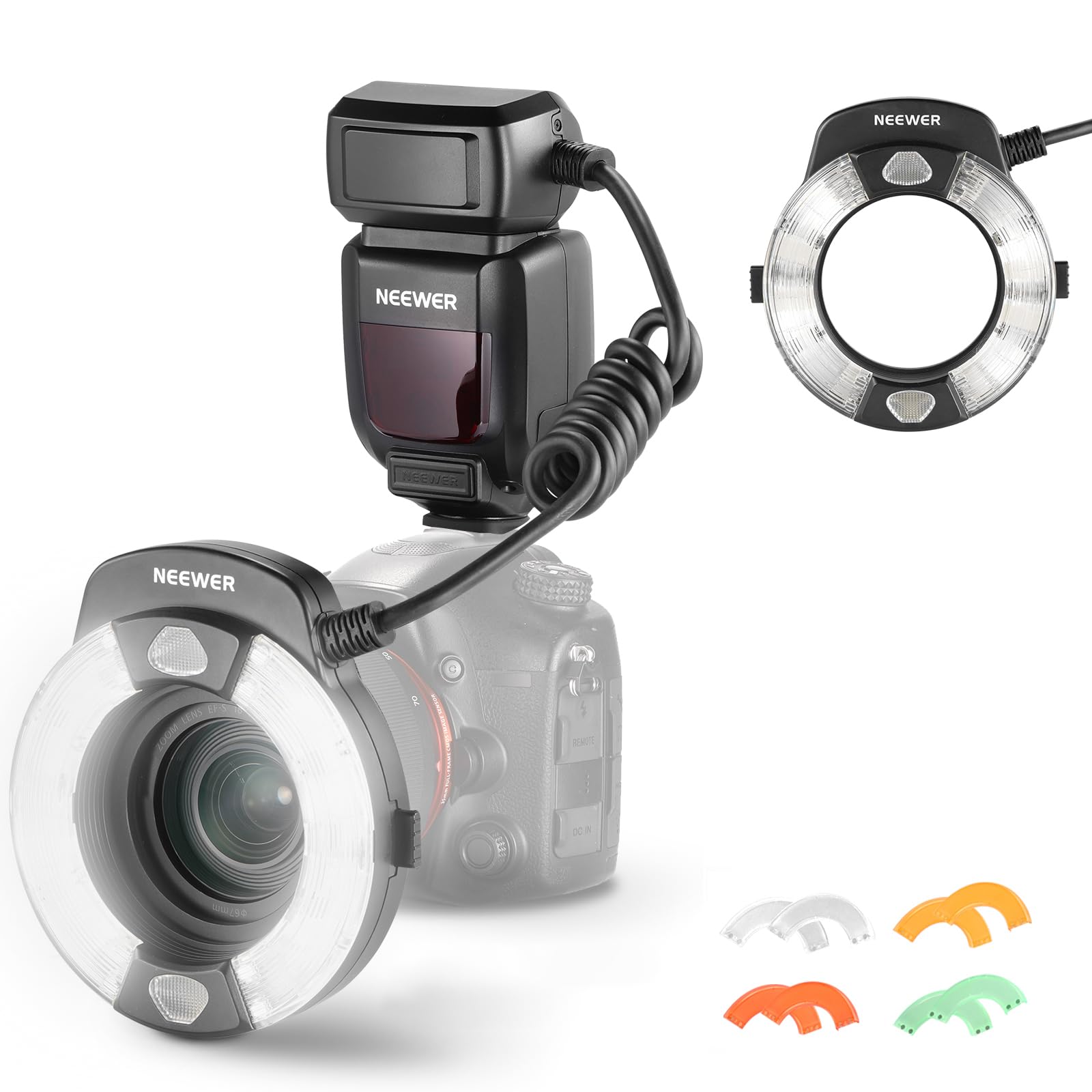
The NEEWER RF1-S brings Sony Alpha TTL, manual, and multi exposure modes to a budget-friendly ring flash. It ships with color gels, so a green or orange cast can be applied directly to the subject without post-processing. Unlike the manual multi-brand option in this group, this one meters automatically on Sony bodies, which keeps the initial learning curve shorter.

This is for Sony Alpha owners, especially a6000-series users, who want a dedicated macro flash without a large investment. Very close subjects can overexpose in TTL, so exposure compensation is part of that workflow. Beginner macro photographers benefit from automatic metering before moving on to manual modes. The eight adapter rings cover 49mm through 77mm filter threads, so common macro lenses can mount the ring directly.

Independent side adjustment lets you balance light around the lens, and manual and multi modes cover cases where TTL needs help. The 76Ws output is enough for common close-up subjects like insects and small products. Build quality is stronger than the budget price implies, and the controls are simple enough for a first-time ring flash user. This suits both handheld outdoor macro and small-object studio work.

Pros

  • Sony Alpha TTL meters automatically on a6000-series bodies, removing manual guesswork.
  • Color gels are included, adding creative color shifts without extra accessories.
  • Manual and multi modes give experienced users more control at a budget price.

Cons

  • The Sony-only TTL system won't work with Canon, Nikon, or Fuji bodies.
  • Four AA batteries are the only power source; no lithium rechargeable pack is available.
Our verdict

Sony Alpha shooters on a budget get a TTL macro ring flash that works with a6000-series bodies and leaves room for manual control later.

Check Latest Price
5

Best Continuous LED Ring Light

Godox Ring 72 LED Macro Light

76 /100
Studio Score Established

Key details

Light Type
Continuous LED
Power System
4x AA or lithium
Adapter Rings
49-77mm (8 rings)
Compatibility
Universal lens mount
Check Price on Amazon

The Godox Ring 72 is a continuous LED ring light, so the light you see before the shutter is the light in the macro frame. Seventy-two LEDs sit around the lens at 5600K with 96+ CRI, and the two halves of the ring can be set to different brightness levels for visible shadow control without a flash. Eight adapter rings cover 49-77mm filter threads, which makes mounting on common DSLR and mirrorless lenses simple at a budget-friendly price.

The live preview is the practical difference for close-up work. A coin, gem, small part, or dental sample can be positioned and checked for glare before the shutter opens, and the split brightness setting lets one side stay brighter while the other remains soft. That kind of control matters when the goal is even, shadow-free lighting rather than drama.

This suits hobby macro and product photographers shooting static subjects on a desk or tripod, especially jewelry, coin, dental, and small-object work. Manual exposure keeps the workflow direct, so anyone expecting TTL auto-exposure should look elsewhere.

The live-preview beam is the point of this light; the tradeoffs sit elsewhere. AA cells drain quickly in continuous use, so the Godox rechargeable lithium pack is the practical fix for longer sessions. Since the Ring 72 is an LED continuous light rather than a flash, it won't freeze moving subjects; action or insect work needs a ring flash.

Pros

  • Even, shadow-free continuous light makes small-object close-ups easy to control without contrasty shadows.
  • Bright 72-LED output with independent half-brightness control creates visible shadow shaping before the shutter.
  • Eight adapter rings cover 49-77mm filter threads, so mounting on common DSLR and mirrorless lenses is simple.

Cons

  • At extreme magnifications, the ring can illuminate around the subject instead of onto it, which affects very tight macro shots.
  • Long-term durability can vary under steady use; individual units may show LED problems around the one-year mark.
Our verdict

The Ring 72 is the continuous-light pick for close-up shooters who value adjustable, shadow-free output on static subjects.

Check Latest Price
6

Budget Hybrid Shooters

Digital Nc 48 Macro Ring Light

77 /100
Studio Score Established

Key details

Light Type
LED and ring flash
Power System
4x AA
Adapter Rings
49-77mm (8 rings)
Compatibility
Universal adapter
Check Price on Amazon

Pairing 48 continuous LEDs with a ring flash behind one LCD controller gives you two light modes for less than most dedicated macro flashes. The eight 49-77mm adapter rings and four diffusers cover common lenses, and the continuous side lamp makes small-object framing easier before the flash fires. The catch is mounting: the ring can sit loose on certain lenses, so this belongs on a tripod for studio-style product work, not in a camera bag for field macro. Hot-shoe controller quality can vary between units, so treat the interface as basic rather than professional. You get solid light output for the price, not precision mounting.

Pros

  • Two light modes in one LCD-controlled unit cost less than separate macro flash and continuous lights.
  • Continuous side light simplifies framing for small-object and product detail shots.

Cons

  • Hot-shoe controller quality can vary between units; a jammed flash on removal has been documented.
  • The ring-to-lens fit can be loose, making tripod use safer than hand-held field macro.
Our verdict

For tripod-based product and small-object macro work, this budget dual light fits — provided you manage the lens mounting yourself.

Check Latest Price

How to Choose

TTL vs Manual Exposure

TTL auto-exposure reads light through the lens and adjusts flash output automatically. At very close distances, the short flash-to-subject gap can confuse the meter and blow out frames. Manual power gives fixed, repeatable output but takes trial and error. For static product work, manual is predictable; for handheld insect shots, TTL can save missed frames.

Continuous LED vs Flash

Continuous LED ring lights let you see shadows before shooting, which helps jewelry and coin work. They cannot freeze motion, so moving insects or handheld camera shake turns to blur. Ring flash fires in a fraction of a second and freezes motion, but you cannot preview the light. If the subject moves, choose flash; if it stays put, LED is easier.

Adapter Ring Sizes

Adapter rings screw into the lens filter thread, so the ring must match your lens's filter diameter. A set labeled 49-77mm sounds complete, but not every set includes every size in that range. Check the actual list for 49mm, 52mm, 58mm, 67mm, and 72mm. A missing ring means the light will not mount securely, no matter how bright it is.

Battery and Power Systems

AA alkaline cells lose voltage as they drain, slowing recycle times and making flash feel inconsistent. Rechargeable lithium packs hold voltage longer and deliver more flashes per charge. The battery door is often the first worn part, so built-in lithium removes that weak point.

Camera and Hotshoe Compatibility

TTL signals vary by camera brand, so a Canon-only ring flash will not meter correctly on a Sony or Nikon. Manual single-contact flashes work across brands but lose automated exposure. Multi-brand TTL is rare, so match the flash to your camera before comparing output.

Dual-Tube Control and Diffusers

Two independently controlled tubes let you vary left/right output, adding modeling to an otherwise flat ring. Diffusers soften light further but can intrude into the frame at short focal lengths. More creative control and softer light mean watching for corner shadows on wide-angle macro lenses.

Frequently Asked Questions