7 Best Lens for Real Estate Photography in 2026: True Ultra-Wide

Tight rooms need true ultra-wide coverage. Match the best lens for real estate photography to your camera mount.

The most common real estate lens mistake is buying a 24-105mm or 24-70mm standard zoom because it seems versatile. They handle general photography well, but start at a focal length that crops off the edges of a bedroom. Tight interiors demand a true ultra-wide lens, roughly 24mm full-frame equivalent or wider, to show the full floor plan in one frame.

The trade-off is physical: a slow f/4.5-5.6 zoom keeps weight down but needs a tripod in darker rooms, while a fast prime handles low light but limits framing flexibility. Stabilized zooms suit handheld video walkthroughs; bright primes suit dim stills. Match the lens to the scenes you actually shoot.

A standard zoom can earn its keep at an open house, but it does not make a room feel bigger. The lens that does has an ultra-wide field and either a stabilizer for video or a wide aperture for available light. That line separates an interior specialist from a travel all-rounder.

1

Best Overall

Canon EF-S 10-18mm IS STM

94 /100
Studio Score High Confidence

Key details

Focal Length
10-18mm APS-C
Max Aperture
f/4.5-5.6
Stabilization
Optical IS
Mount And Sensor Format
Canon EF-S APS-C
Check Price on Amazon

Optical image stabilization steadies handheld video walkthroughs, and the STM autofocus adjusts quietly enough to stay off the audio track. On a Canon APS-C body, the 10-18mm range equals 16-29mm full-frame coverage, so a room can be captured from a doorway and then reframed for a hallway shot without swapping lenses. The light build keeps the camera comfortable through a long day of listing work.

At 10mm, the lens frames an entire room from a doorway; at 18mm, it gives a more natural establishing view for corridors and exteriors. The whole package stays light enough to keep mounted on a camera through a full day of listings. For walkthrough video, the optical stabilizer smooths out the small shakes that show up in handheld clips. On a crop-sensor body, 10mm is wide enough to make a small bathroom read as a usable space.

Center sharpness holds up for wall-to-wall listing photos, and chromatic aberration stays manageable at normal viewing sizes. The corners at 10mm can soften and darken until the lens is stopped down to f/8 or f/11, and the distortion is regular enough that lens profiles clean it up in post. At f/8, the edges catch up enough for photos that will be viewed on screens and printed at listing size. None of these limits stop the lens from getting a usable shot inside a typical home.

The buyer who should choose this is a Canon APS-C DSLR owner shooting real estate photos and video walkthroughs on a limited budget. The f/4.5-5.6 maximum aperture is the boundary: in dark rooms, a tripod or flash is required for acceptable results without high ISO. If you cannot light the space, a faster prime is the better fit; if you can control the light, this lens covers the interior job.

EF-S mounting limits the lens to crop-sensor Canon DSLRs, so full-frame shooters need an RF or EF ultra-wide instead. For APS-C buyers, the combination of built-in stabilization, STM autofocus, and a budget price makes this the widest real estate package in this comparison. It will not replace a tilt-shift lens for architectural verticals, but that is not its role: it covers rooms, not corrected elevations.

๐Ÿ’ก For the cleanest corners at 10mm, shoot at f/8 rather than wide open.

Pros

  • Entry-level price makes it one of the least expensive stabilized ultra-wides for Canon APS-C.
  • Room-filling 10mm coverage captures entire interiors from a doorway.
  • Center sharpness holds up for listing photos, and distortion is predictable.
  • Realtors use it for wide interior shots, and the STM motor keeps focus quiet in clips.
  • The light body keeps the camera comfortable through all-day shoots.

Cons

  • At 10mm, corners may soften and darken until the lens is stopped down to f/8 or f/11.
  • The f/4.5-5.6 maximum aperture means dark rooms need a tripod or flash to avoid high ISO.
Our verdict

For Canon APS-C real estate shooters, this is the room-coverage lens to start with. It pairs wide reach with stabilization at a budget price.

Check Latest Price
2

Compact Full-Frame Prime

Canon RF 16mm f/2.8 STM

92 /100
Studio Score High Confidence

Key details

Focal Length
16mm full-frame
Max Aperture
f/2.8
Stabilization
None
Mount And Sensor Format
Canon RF full-frame
Check Price on Amazon

The RF16mm f/2.8 STM is a 163 g full-frame prime that turns a Canon R-series body into a pocketable real estate kit, something the budget APS-C zoom in this lineup can't match on full-frame, and it does so at an entry-level price.

At 16mm on full-frame, it opens up rooms wide enough for establishing shots, and the f/2.8 aperture keeps handheld work viable in dim spaces. Sharpness holds up well across the frame, and the STM motor keeps focus transitions quiet during walkthrough video. For real estate and vlog hybrid shooting, the 16mm field of view captures enough of a room from a corner while staying forgiving for handheld selfie framing.

This is the lens for Canon R-series owners who want one compact ultra-wide for real estate, vlog, and travel. It mounts directly to RF bodies with no adapter, but the fixed 16mm focal length means framing is done with your feet, there is no optical image stabilizer in the lens, and high-contrast edges can show chromatic aberration.

The 163 g body makes it easy to leave mounted on the camera between shoots, so it's ready for the next doorway shot.

Pros

  • 163 g full-frame prime that slips into a jacket pocket.
  • Budget-friendly RF path to 16mm ultra-wide coverage.
  • Sharp rendering with a fast f/2.8 aperture for dim interiors.
  • Captures enough of an interior for room shots without a heavy zoom.

Cons

  • Slight fisheye character may appear at frame edges when the camera is angled.
  • Autofocus can wander or feel slower in low-contrast or backlit scenes.
Our verdict

For Canon R-series shooters who need a true wide-angle for real estate interiors without carrying a large kit, this budget-priced prime gets the job done.

Check Latest Price
3

Sony APS-C Ultra-Wide Vlog/Real Estate Prime

Sony E 11mm f/1.8

91 /100
Studio Score High Confidence

Key details

Focal Length
11mm APS-C
Max Aperture
f/1.8
Stabilization
None
Mount And Sensor Format
Sony E APS-C
Check Price on Amazon

The 11mm f/1.8 prime is unusually small for an ultra-wide, and that size is what makes it practical for real estate walkthroughs. It frames a room from roughly 17mm full-frame equivalent, while the f/1.8 aperture keeps handheld shutter speeds usable in dim rooms. A standard full-frame zoom in this group starts at 24mm, which misses tight bathrooms and hallways. The lens mounts on Sony E APS-C bodies and stays short enough to leave on the camera between stops.

This fits Sony APS-C vloggers and real estate shooters who want a compact prime for tight interiors, plus travelers who do not want to carry a zoom. The fixed 11mm angle is the tradeoff: you frame by moving through the room instead of zooming. For real estate, that means one wide establishing shot per room and a lot of footwork for alternate angles. It is not for shooters who need a range of focal lengths from one position.

Sharpness holds up across the frame, and the two linear motors focus fast enough for video and stills in the same pass. The f/1.8 opening also keeps the lens from adding bulk to a bag that already holds a body, a microphone, and spare batteries. That combination makes it a practical one-lens pickup for a fast room-to-room walkthrough.

Pros

  • Ultra-wide 11mm view fits tight interior rooms in a single frame.
  • Bright f/1.8 aperture keeps handheld shots practical in dim rooms.
  • Compact, lightweight body keeps the kit easy to carry between rooms.
  • Sharp rendering with fast autofocus handles quick room-to-room transitions.

Cons

  • Handheld low-light shooting depends on the body's image stabilizer; non-IBIS Sony APS-C bodies get less help.
  • Edge stretching can appear when door frames or wall corners sit at the extreme frame edges.
Our verdict

At its price, the Sony 11mm f/1.8 gives APS-C shooters the widest handheld prime view of tight rooms without turning the kit into a burden.

Check Latest Price
4

Sony APS-C Low-Light Prime

Sigma 16mm f/1.4 DC DN

96 /100
Studio Score High Confidence

Key details

Focal Length
16mm APS-C
Max Aperture
f/1.4
Stabilization
None
Mount And Sensor Format
Sony E APS-C
Check Price on Amazon

The Sigma 16mm f/1.4 pairs benchmark sharpness with f/1.4 light gathering at a budget price, giving Sony APS-C shooters a bright wide prime for low-light interiors and video. Next to the wider 11mm f/1.8 prime in this set, it trades a few degrees of coverage for stronger edge-to-edge resolution and a more restrained field of view that some real estate shooters find easier to compose.

The f/1.4 aperture keeps shutter speeds high in dim rooms, so handheld shots stay sharp without pushing ISO. Autofocus responds quickly enough for video, and image quality holds up across landscape and interior work.

Compared with slower ultra-wide zooms in the same budget class, this prime gives you a full stop or more of light and noticeably cleaner files in dark rooms. That advantage matters when you shoot rooms that are too dark for a flash-free handheld zoom.

This is a single-lens answer for Sony APS-C shooters who want one fast wide prime for low-light rooms, landscape, and video rather than maximum interior coverage. At a 24mm full-frame equivalent, it is only borderline wide for real estate; the widest room shots may require a 10-12mm lens.

Pros

  • Resolves fine detail across the frame, so wide interior and landscape shots stay crisp.
  • Fast f/1.4 aperture lets you shoot dim rooms without a tripod or high ISO.
  • Autofocus is responsive enough for handheld video and quick interior walkthroughs.
  • Delivers a notable jump in sharpness and low-light speed without a premium price tag.

Cons

  • Close-range interior shots can show barrel distortion, so correction in post may be needed.
  • Fixed 16mm focal length means framing changes come from moving the camera, not zooming.
Our verdict

The Sigma 16mm f/1.4 is the bright, sharp single-prime answer for Sony APS-C shooters who prioritize low-light speed and image quality in one lens.

Check Latest Price
5

Nikon DX Ultra-Wide Zoom

Nikon AF-P DX 10-20mm VR

92 /100
Studio Score High Confidence

Key details

Focal Length
10-20mm DX
Max Aperture
f/4.5-5.6
Stabilization
VR
Mount And Sensor Format
Nikon F DX
Check Price on Amazon

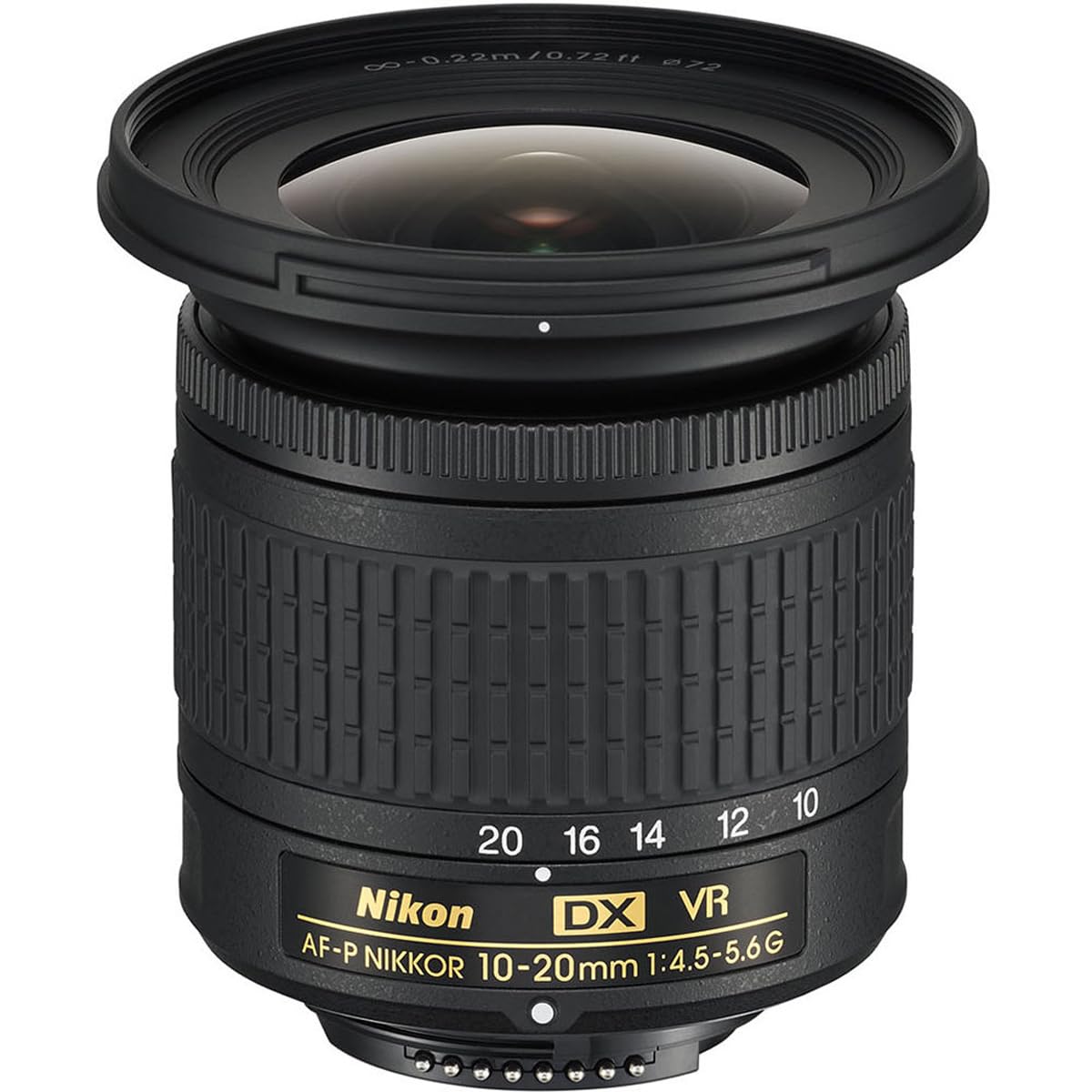
The Nikon AF-P DX 10-20mm f/4.5-5.6G VR delivers true 10mm DX coverage with vibration reduction and quiet AF-P autofocus in a lightweight barrel, making it a genuine interior ultra-wide rather than a general-purpose zoom.

At the 10mm end, the 15-30mm equivalent framing handles tight bathrooms and compact hallways, and the combination of a light body and VR keeps a walkthrough moving without a bag full of support gear.

For Nikon DX shooters on AF-P-compatible bodies, this lens suits real estate walkthroughs, landscape work, and budget travel kits; full-frame Nikon owners should look to FX ultra-wides instead.

Pros

  • True 10mm starting point on DX covers tight real estate rooms with a 15-30mm equivalent view.
  • Lightweight barrel with VR keeps handheld interior frames steady without weighing down a walkthrough bag.
  • Quiet AF-P stepping motor makes video walkthroughs practical without distracting focus noise.
  • Sharpness at the wide end holds up well for a budget ultra-wide zoom.

Cons

  • Maximum aperture starts at f/4.5 and narrows to f/5.6, so dim interiors call for a tripod or flash.
  • Older Nikon DSLRs without AF-P support can lose autofocus entirely; body compatibility matters before purchase.
Our verdict

Nikon DX real estate shooters get a true 10mm wide end, VR, and quiet AF-P in a lens that stays out of the way during a full day of walkthroughs.

Check Latest Price
6

Canon Full-Frame Events

Tamron SP 24-70mm f/2.8 G2

85 /100
Studio Score Strong Evidence

Key details

Focal Length
24-70mm full-frame
Max Aperture
f/2.8
Stabilization
VC
Mount And Sensor Format
Canon EF full-frame
Check Price on Amazon

This constant f/2.8 zoom brings pro-grade sharpness, smooth bokeh, and effective VC to Canon EF bodies at a cost below native L-series equivalents. The barrel feels dense and the optics handle available-light event work well, making it a strong one-lens travel/reportage option. But the 24mm start is not true ultra-wide: tight real estate rooms need the wider coverage of the crop-sensor 10-18mm zoom or the compact RF 16mm in this set. Body weight can wear on all-day handheld sessions, and autofocus may miss in low-contrast scenes where a native Canon lens would lock.

Pros

  • Pro-grade f/2.8 image quality with sharp detail and attractive bokeh.
  • Build quality feels dense and rugged enough for paid event work.
  • Priced below native Canon f/2.8 zooms while delivering comparable performance.

Cons

  • Heavy and bulky; all-day handheld sessions can become tiring.
  • Autofocus can miss occasionally and may not match native Canon speed.
Our verdict

For wedding and event shooters on Canon EF, this is the cost-effective f/2.8 zoom; real estate buyers should opt for a dedicated ultra-wide.

Check Latest Price
7

Sony Full-Frame Events

Sony FE 24-70mm f/2.8 GM

90 /100
Studio Score High Confidence

Key details

Focal Length
24-70mm full-frame
Max Aperture
f/2.8
Stabilization
None
Mount And Sensor Format
Sony E full-frame
Check Price on Amazon

The Sony FE 24-70mm f/2.8 GM pairs GM-grade sharpness with fast, accurate autofocus and a constant f/2.8 aperture, making it a dependable standard zoom for Sony full-frame event and wedding coverage. The 9-blade diaphragm and solid build hold up through paid assignments where image quality matters. For a real-estate-only buyer, the tradeoffs are decisive: it starts at 24mm, so tight bathrooms and closets force you against walls, and the premium price plus heavy body make it a poor fit for room-to-room shoots. A dedicated Sony ultra-wide lens covers the interior angles this zoom cannot.

Pros

  • Sharpness holds across the frame at f/2.8 for clean large prints.
  • Autofocus tracks subjects quickly without hunting in low light.
  • Solid construction supports the demands of event and wedding work.

Cons

  • Quality can vary between units; rubber-ring wear has been noted.
  • Front-heavy balance makes handheld shooting tiring on long assignments.
Our verdict

For Sony full-frame shooters covering events and weddings, this zoom is a professional standard. Real-estate-only buyers need a dedicated ultra-wide.

Check Latest Price

How to Choose

Focal Length

On a full-frame body, 24mm is the practical edge of a wide interior shot. A 16mm or 11mm lens pulls more walls into the frame, but it also expands relative distances, making rooms feel larger.

On APS-C, divide by 1.5 or 1.6 for the full-frame view. A 10-18mm APS-C zoom acts like a 16-29mm full-frame lens, which is why crop-sensor ultra-wides dominate real estate bags.

Max Aperture

Maximum aperture controls how much light reaches the sensor before a tripod or flash is needed. An f/1.4 lens gathers about two stops more light than an f/2.8 zoom and four more than an f/4.5-5.6 zoom.

In dark interiors, that changes shutter speed and ISO: f/1.4 keeps handheld shots clean where a slow zoom forces high ISO noise or a tripod.

Image Stabilization

Image stabilization reduces hand-shake blur in handheld shots and walkthrough video. Optical IS moves lens elements; IBIS moves the sensor; both behave differently on different bodies.

Stabilization matters less on a tripod and does not freeze motion. It matters most when stepping through a hallway or shooting video without a gimbal.

Mount and Sensor Format

The mount locks you into a camera system, and the sensor format sets the usable image circle and focal length math. An EF-S lens fits only Canon APS-C DSLRs, while an RF lens works on Canon mirrorless bodies.

Buying a lens for a mount you do not own, or ignoring crop factor, is the fastest way to get the wrong field of view. Check the body first, then choose among lenses that fit.

Tilt-Shift and Perspective Control

Tilt-shift lenses shift the optical axis so vertical lines stay parallel when the camera points upward at a building. This removes the leaning-wall look in ordinary ultra-wide shots.

That correction suits architectural portfolios, but it means manual focus, a fixed focal length, and a higher price. For listing photos, an ultra-wide plus post-processing correction usually delivers straight lines.

Frequently Asked Questions