4 Best Lens for Food Photography 2026: Pick Your Close-Focus Prime

The best lens for food photography depends on your camera mount, close-focus needs, and budget. This guide helps you choose the right prime.

Most food photography shopping starts with aperture and bokeh, but those specs only matter if the lens can focus close enough to fill the frame. A standard prime with f/1.8 may deliver lovely blur and still force you to back up from the plate. The deciding numbers are minimum focus distance and maximum magnification.

The practical trade-off is close-up capability versus cost. A true macro lens costs more than a simple 50mm f/1.8, but it is the only way to capture the crisp texture of a seared crust or the fine bubbles in a drink. Budget primes have limits; know what your camera mount supports before you spend.

For handheld tabletop work, stabilization and focal length decide whether the shot looks sharp or merely acceptable. A 35mm lens covers overhead flat-lays and crowded tables; a 50mm gives a tighter crop and more compression. Choose the focal length that matches how you actually plate and photograph food.

1

Best Overall

Canon RF 35mm f/1.8 Macro

93 /100
Studio Score High Confidence

Key details

Mount Compatibility
Canon RF
Max Aperture & Bokeh
f/1.8
Autofocus Speed & Noise
STM
Focal Length & Distance
35mm, 0.17m
Check Price on Amazon

Canon's RF 35mm f/1.8 Macro IS STM is the close-focus specialist in this group. It reaches 0.5x magnification at a 0.17m minimum focus distance, which is the practical difference between photographing a plate from above and pulling a single dumpling into the frame. The f/1.8 aperture softens the background enough to separate a dish from a busy table, while the up-to-5-stop image stabilization gives handheld work more margin than an unstabilized prime. For food and product shots, that combination matters more than a longer focal length, especially in tight restaurant spaces.

Center sharpness holds up wide open, so the texture of a crust or the edge of a plate stays crisp. The 35mm angle frames a full table setting without requiring you to back up to the next table, and the fast aperture still isolates one item when you want it. Low-light behavior is good enough for dim dining rooms, and the stabilization lets you drop the shutter speed rather than push ISO in a dark corner. This is a lens that keeps composition simple when the table is crowded.

This lens suits Canon EOS R-series owners who shoot food, products, or tabletop detail and want close focus plus stabilization in one prime. The two tradeoffs are AF hunting at the closest macro distances and an extending barrel during focusing, so shooters who need silent, instant racking at 0.17m should budget for manual focus corrections. In typical food work, the close-focus range outweighs both.

This RF35 is the only lens in the set purpose-built for close food photography. The 50mm primes in this comparison offer a normal view, but none of them reach 0.17m, and that close-focus range changes how a plate is shot. For an R-series owner who has been cropping standard 50mm frames to capture detail, this lens removes that step. It also cuts the need to carry a separate macro tube for everyday tabletop shots.

The price is mid-range rather than entry-level, but the package explains it: a fast normal prime, a close-focus lens, and a stabilized low-light lens in one barrel. For someone who shoots food regularly, that is a better spend than buying a 50mm prime and then adding a separate macro tube or close-up filter. The RF35 is simpler on a shoot because it does the close work without extra gear.

Pros

  • 0.5x magnification at 0.17m lets a single dish fill the frame without a separate macro lens.
  • Center sharpness holds at f/1.8, keeping food textures crisp while backgrounds soften.
  • Image stabilization adds handheld margin for low-light tabletop work.
  • Light enough to carry through a long shoot or a travel day.
  • Strong value for R-series owners who want macro and a fast normal prime in one lens.

Cons

  • The lens barrel extends during focusing, which can feel awkward in tight tabletop setups.
  • Autofocus can hunt at the closest macro distances, so a close-up shot may need a manual nudge.
Our verdict

The RF35 is the lens to take when the shot starts at the table: it reaches details a standard 50mm cannot, and the stabilization keeps close-ups sharp without a tripod.
Check Latest Price
2

Best Budget Canon/DSLR Prime

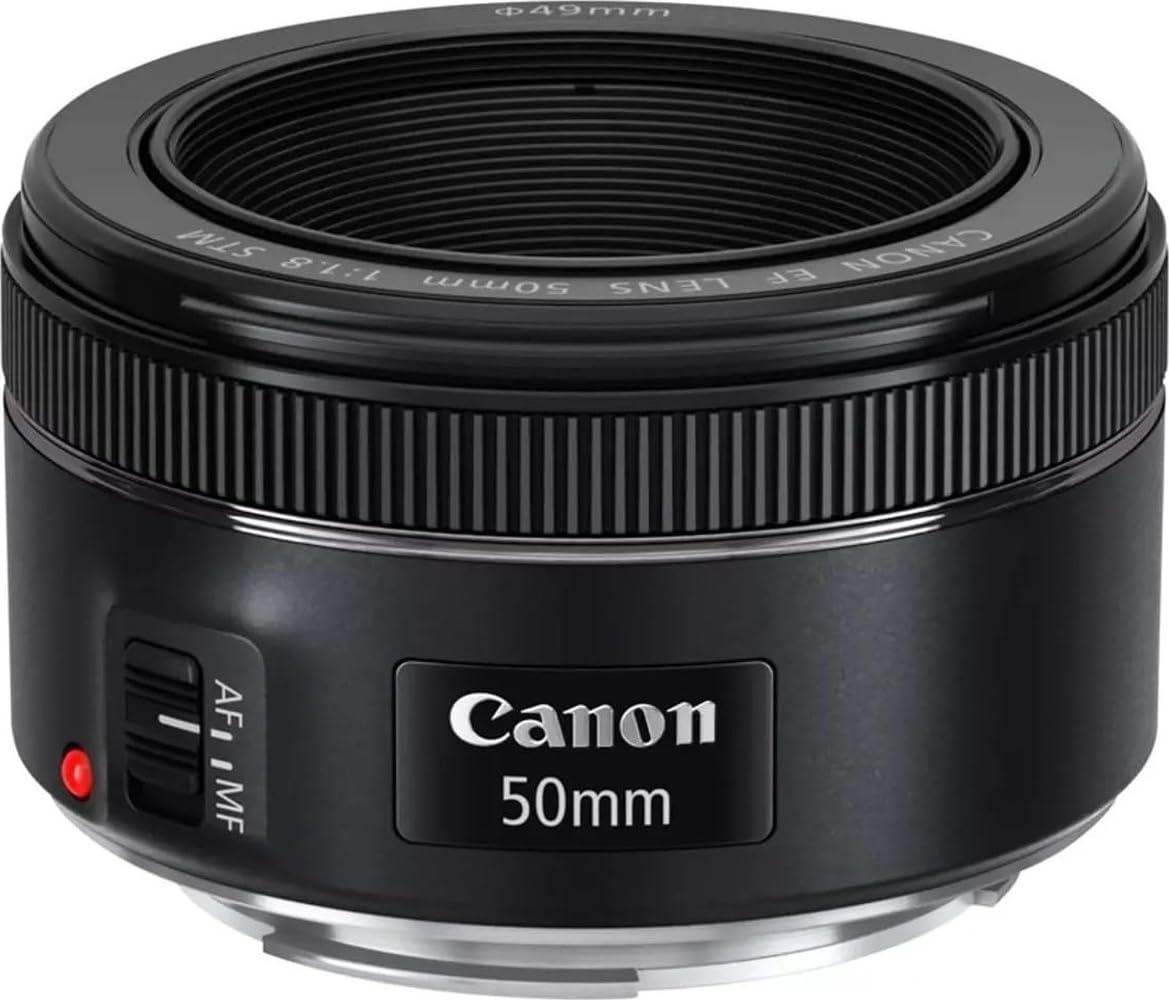
Canon EF 50mm f/1.8 STM

96 /100
Studio Score High Confidence

Key details

Mount Compatibility
Canon EF
Max Aperture & Bokeh
f/1.8
Autofocus Speed & Noise
STM
Focal Length & Distance
50mm, 0.35m
Check Price on Amazon

The Canon EF 50mm f/1.8 STM gives Canon DSLR owners a compact normal prime with sharp detail at f/1.8 and smooth background separation for plated dishes and tabletop scenes. The 0.35m minimum focus frames a full plate from a comfortable distance, with 0.21x magnification suited to whole dishes and larger garnishes.

At f/1.8, the aperture gathers enough light for a dim restaurant without raising ISO, and stopping down to f/2.8 or f/4 keeps the whole dish crisp while the table behind it goes soft. The fixed 50mm view handles overhead flat-lays and across-the-table angles, and the 5.6 oz weight keeps the lens easy to carry through a long shoot. A 49mm filter thread keeps lens filters and close-up accessories affordable.

Best for Canon EF/EF-S DSLR owners who shoot food stills and want a fast normal prime without moving to a macro setup. Autofocus can be slow and audible in quiet or video settings, and it is not a macro lens — for garnish-level detail, this guide's top pick offers 0.5x magnification and a 0.17m close-focus distance. This makes it a practical normal prime for food-focused DSLR kits.

Pros

  • Sharpness at f/1.8 and smaller apertures makes clean, detailed food shots easy without expensive glass.
  • Wide f/1.8 aperture isolates a dish and turns table clutter into smooth bokeh.
  • Budget-friendly price brings fast f/1.8 performance to Canon DSLR owners without a macro-system commitment.

Cons

  • Autofocus can be slow and audible in quiet settings, so handheld video or silent shooting may call for manual focus.
  • At 0.35m minimum focus and 0.21x magnification, tight food details stay out of reach without cropping.
Our verdict

For Canon DSLR shooters who want a fast, sharp normal prime for plated dishes and tabletop scenes, this is the budget pick.

Check Latest Price
3

Best Budget Sony E-Mount Prime

Sony FE 50mm f/1.8

93 /100
Studio Score High Confidence

Key details

Mount Compatibility
Sony E
Max Aperture & Bokeh
f/1.8, 7-blade
Autofocus Speed & Noise
Focal Length & Distance
50mm
Check Price on Amazon

The Sony FE 50mm f/1.8 weighs 6.6 oz and uses a 7-blade aperture to deliver sharp, compact glass at a budget price. It is the native-mount answer to the classic DSLR nifty-fifty, pairing with full-frame and APS-C E-mount bodies while keeping the normal focal length for food flat-lays, street scenes, and portraits. The light body keeps it comfortable for travel and easy to balance on a gimbal.

At the table, the f/1.8 aperture can isolate a dish from a busy background while retaining enough detail in the main subject. The 50mm view suits overhead food scenes and half-body portraits, so it earns its place in a kit bag without the bulk of a zoom. It is not a macro lens, so extreme close-ups of food texture require a dedicated close-focus prime.

Sony full-frame or APS-C E-mount shooters who want a budget normal prime for food, portraits, and travel should start here. On an APS-C body, the 50mm view becomes a short telephoto, which can tighten tabletop framing. Autofocus is slower and noisier than higher-end Sony primes, making this a stills-first lens; quiet video or rapid AF tracking calls for Sony's premium glass.

💡 For food flat-lays, pre-focus or use AF-S to avoid hunting when the subject distance changes.

Pros

  • Very good sharpness for the price
  • Budget-friendly pricing for a Sony E-mount prime
  • Light enough for gimbal and travel use
  • Useful normal focal length for portraits, street, and food

Cons

  • Not a close-focus specialist, so tight food details need a dedicated macro prime.
  • Autofocus can be slow to lock when focus distance changes quickly.
Our verdict

For Sony E-mount shooters whose food photography stays at tabletop distances, this 50mm f/1.8 is the budget normal prime to carry before moving to premium glass.

Check Latest Price
4

Tripod Still-Life

Lightdow 85mm f/1.8 MF

84 /100
Studio Score Strong Evidence

Key details

Mount Compatibility
Canon EF/EF-S
Max Aperture & Bokeh
f/1.8, 6-blade
Autofocus Speed & Noise
Manual focus
Focal Length & Distance
85mm
Check Price on Amazon

A budget-priced 85mm f/1.8 prime, this Lightdow includes a hood, bag, and cleaning cloth, and can produce sharp images with defined bokeh when the shooter works carefully. For food photographers, it offers a short-telephoto perspective that suits overhead or angled tabletop scenes on a tripod, and the included accessories save a separate purchase. This keeps it a niche choice for food work rather than a top pick; it appeals to Canon DSLR owners who want an 85mm portrait look on a tight budget and are prepared to shoot from a tripod with static subjects.

Pros

  • Budget-friendly entry to an 85mm f/1.8 portrait look.
  • Sharp images and defined bokeh when focus is carefully set.
  • Bundle includes hood, bag, and cleaning cloth.

Cons

  • Manual-only focusing makes handheld or quick tabletop shots frustrating.
  • Compatibility with some Canon bodies may vary, with possible no-lens errors.
Our verdict

Best for a patient Canon shooter who wants the 85mm look for tripod-based food scenes.

Check Latest Price

How to Choose

Mount Compatibility

The lens mount is the first filter. Canon RF lenses work only on EOS R-series bodies, Canon EF lenses work on DSLRs and adapt to RF, and Sony E lenses work on full-frame and APS-C E-mount cameras.

An adapter expands your options, but it changes autofocus and handling, so verify it with your specific body before relying on it for paid work.

Focal Length & Working Distance

A 35mm lens gives a wider view for overhead flat-lays and crowded tabletop scenes. A 50mm lens compresses perspective and lets you shoot from a slightly farther distance, which keeps your camera shadow off the dish. An 85mm lens isolates a single plate but demands more table space.

Close Focus and Magnification

Minimum focus distance is how close the lens can work; maximum magnification is how large a subject appears on the sensor. A standard 50mm usually lands around 0.2x, while a macro prime reaches 0.5x or higher.

That difference decides whether you can fill the frame with a single garnish or only capture the whole plate. For food detail, choose a lens with at least 0.25x; for true texture shots, aim for 0.5x.

Maximum Aperture & Bokeh

A wide aperture such as f/1.8 helps in low light and softens backgrounds. At very wide apertures, depth of field is often too shallow to keep an entire bowl in focus, so you may shoot at f/2.8 anyway.

Bokeh quality depends on aperture blade count and optical design, not just the f-number. More rounded blades produce smoother out-of-focus highlights, while cheaper designs show harsher edges.

Autofocus Speed & Noise

Budget autofocus primes often use basic motors that lock fine for stills but hunt audibly in video or quiet spaces. If you shoot handheld food photos, the lens has to lock focus before the steam moves or the garnish settles. If you shoot video, motor noise is picked up by the microphone.

Check the motor type, use AF-S for stills, and rely on focus peaking or manual override when the subject is still.

Frequently Asked Questions