7 Best Grey Card and Color Checker of 2026: Find True Neutral

Find a grey card and color checker that holds true neutral color for white balance, exposure, and video matching — without overpaying.

A grey card looks like the simplest piece of kit in a camera bag, yet the two things buyers assume about it are often wrong: that every 18% gray card is equally neutral, and that a card that fixes white balance also fixes color response. Grey cards set exposure and white balance. True color correction needs a multi-patch checker.

The useful question is whether the card is actually neutral and matte. Many pocket-size sets ship with white patches that lean purple or warm, which shifts every image that relies on them. Matte surfaces matter too: gloss introduces reflections that throw off readings.

The trade-off buyers face is popularity versus neutrality. A wide owner base says a card is easy to carry, but it does not make its gray neutral. Prioritize a card that passes the neutral, matte test, and step up to a multi-patch target only when your workflow requires camera profiles or vectorscope matching.

1

Best Overall

Macolink 18% Gray Card Set

91 /100
Studio Score High Confidence

Key details

Card Size
2.2 x 3.35 in
Finish & Matte
Matte, waterproof, scratch-resistant
Reference Type
18% gray, black, white
Workflow Support
Custom white balance only
Check Price on Amazon

The set pairs a genuine 18% neutral gray card with matte, waterproof, scratch-resistant plastic and separate black and white reference cards. The gray patch gives a camera a neutral anchor for custom white balance, while the black and white cards show highlight and shadow clipping during exposure checks. The same set works for DSLR, video, and infrared capture, and the separable lanyard keeps it close at hand.

The matte plastic body avoids the glare that can skew readings from glossy reference cards, and it resists creases after being packed in a camera bag. The gray card holds its neutral tone in mixed daylight, which matters more than brand name when you need a quick custom balance before a set change. This is a set that earns its place in a bag without needing a dedicated case.

This is for a beginner or event/outdoor shooter who wants custom white balance and exposure sanity checks without building a multi-patch color-managed workflow. The compact 2.2 x 3.35-inch cards mean long telephoto work requires getting the target closer than ideal; the lanyard setup is better suited to close-in event framing and run-and-gun stills.

The lanyard separates into a clip, so the gray card can hang from a bag strap or stay in a pocket between shots. The price point is budget-friendly enough that beginners can treat it as a learning tool for custom white balance, then move to a larger target when color-critical work demands it. Even without the black-and-white cards, the gray card alone handles daily shooting situations.

Pros

  • Sturdy matte plastic resists creasing and bag wear better than paper reference cards.
  • Sets custom white balance for DSLR, video, and infrared work from the same neutral gray patch.
  • Lightweight card with separable lanyard stays accessible on event and outdoor shoots.
  • Covers the essential WB and exposure reference need at a budget price.

Cons

  • Only neutral gray, white, and black references are included, so color response evaluation and video vectorscope targets need a separate chart.
  • At 2.2 x 3.35 inches, the card can be hard to fill the frame when using a telephoto lens.
Our verdict

For still shooters who need a neutral starting point before every frame, this set delivers the white balance and exposure reference without the bulk of a full color target.

Check Latest Price
2

Pro Photo Color Checker

Calibrite ColorChecker Classic

84 /100
Studio Score Strong Evidence

Key details

Card Size
8 x 11.5 in
Finish & Matte
Matte color patches
Reference Type
24-patch color checker
Workflow Support
DNG and ICC profiles
Check Price on Amazon

Calibrite's ColorChecker Classic is a 24-patch photo target that supports DNG and ICC camera profile creation through Calibrite PROFILER. Unlike the video-oriented chart in this lineup, the Classic's 8 x 11.5 inch layout is built for raw still workflows rather than vectorscope matching.

This target fits photographers who work in a color-managed raw pipeline and will actually create and apply camera profiles in editing. Studios and retouchers that need a standardized 24-patch reference for consistent color across sessions will get the most from it. If you only need a neutral grey card for white balance, the profiling requirement is extra work without a visible payoff; this is the boundary between a color checker and a white balance card.

💡 Shoot the target in the same light as your subject, then generate and apply the profile for that lighting setup.

Pros

  • Builds camera-specific DNG and ICC profiles from 24 scientifically formulated patches.
  • Large 8 x 11.5 inch target fills the frame easily for accurate readings in studio setups.
  • Pairs with Calibrite PROFILER software for a complete camera profiling workflow.

Cons

  • The 8 x 11.5 inch card is bulkier than a pocket grey card, so it is not an everyday-carry item.
  • Video colorists who want a vectorscope reference need the separate video-target version; the Classic's patch order is photo-oriented.
Our verdict

Choose the ColorChecker Classic for studio sessions where every frame needs the same color response; a simple grey card is the better tool if white balance is the only adjustment you make.

Check Latest Price
3

Expanded Color Target for Portraits

datacolor SpyderCheckr Photo

87 /100
Studio Score Strong Evidence

Key details

Card Size
—
Finish & Matte
Ultra-matte color patches
Reference Type
62-target color checker
Workflow Support
HSL presets for Lightroom
Check Price on Amazon

The SpyderCheckr Photo brings 62 color targets across four interchangeable cards, including six skin tones and 24 grey scales, so portrait and outdoor photographers have more reference points than a standard 24-patch photo checker offers. The ultra-matte finish keeps glare off the patches in daylight, and the case with lanyard lets you swap target arrays without carrying separate boards.

This is aimed at still photographers who use Lightroom Classic, Adobe Camera RAW, or Hasselblad Phocus and want the automated HSL presets built from chart captures. It is not a video vectorscope chart; video colorists needing waveform-aligned targets should look at video-specific options. Photographers who only need occasional white balance may find the software-linked workflow more than they want — the payoff is for shooters who build presets from chart captures.

Pros

  • Six skin-tone targets and 24 grey scales offer portrait shooters more reference points than a standard 24-patch chart.
  • Four interchangeable cards with case and lanyard let you swap target arrays without carrying separate boards.
  • HSL presets for Lightroom, ACR, and Phocus automate color adjustments from chart captures.

Cons

  • Swapping among the four cards to access all 62 targets adds handling time on location.
  • Editors who work outside Lightroom, ACR, or Phocus miss the automated HSL presets.
Our verdict

For portrait and outdoor photographers already working in Lightroom or ACR, the added skin-tone and grey-scale coverage plus HSL presets make the premium price reasonable; occasional white-balance users can get by with a simpler grey card.

Check Latest Price
4

Pro Video Color Target

Calibrite ColorChecker Video

88 /100
Studio Score Strong Evidence

Key details

Card Size
8 x 11.5 in
Finish & Matte
Matte chips
Reference Type
Video target with WB reverse
Workflow Support
Vectorscope and waveform layout
Check Price on Amazon

The 8 x 11.5 inch target groups six skin tones, saturated and desaturated chips, large gray steps, and a linear grayscale for direct waveform and vectorscope reading. The reverse side is a spectrally neutral white balance reference, so a video crew can set custom WB and match camera color without switching tools.

This suits video-first shooters and colorists, including hybrid crews that also capture stills. It handles multi-camera matching in mixed or shifting light. Still photographers who primarily need ICC or DNG camera profiles should use a standard 24-patch photo checker instead; the video-first layout doesn't serve that workflow.

The chart side works under the same light as the subject, while the reverse white balance side covers color-temperature shifts between setups. That split keeps the two tasks distinct without adding clutter to the kit.

Pros

  • Six skin-tone rows and gray steps read directly on waveform and vectorscope monitors.
  • Large 8 x 11.5 target stays visible for camera matching on a typical set.
  • Neutral reverse side serves as a dedicated white balance reference for mixed lighting.

Cons

  • Premium price is a larger commitment for casual shooters who only need white balance and exposure.
  • Without a waveform or vectorscope, some chip rows add little over a basic grey card.
Our verdict

For video crews that need to match multiple cameras and read color on a scope, this target pairs neutral white balance with a practical chart layout.

Check Latest Price
5

Travel Pocket Card

Anwenk 18% Grey Card Set

90 /100
Studio Score High Confidence

Key details

Card Size
3.35 x 2.17 in
Finish & Matte
Matte, waterproof
Reference Type
18% gray, black, white
Workflow Support
Basic custom white balance
Check Price on Amazon

An ultra-portable set of three matte cards with a lanyard and detachable clip that makes it easy to carry a grey card on every shoot. It handles quick custom white balance in daylight without fuss. But the white patch can carry a purple or off-white cast, so temperature/tint readings should be verified before color-critical studio, product, or video work. That tradeoff is acceptable for travel and street shooters who prioritize convenience; questionable neutrality keeps it behind the top pick for accuracy-focused buyers.

Pros

  • Lanyard and detachable clip keep the grey cards within reach on travel shoots.
  • Quick field reference that gives post-processing a consistent starting point.

Cons

  • Lanyard and clip are lightweight; they suit occasional use more than permanent daily gear.
  • Compact 3.35 by 2.17-inch patches can be awkward to fill the frame with longer lenses.
Our verdict

Fits travel and street shoots where a pocket-sized grey card beats a calibrated chart left in a bag.

Check Latest Price
6

Budget Video Chart

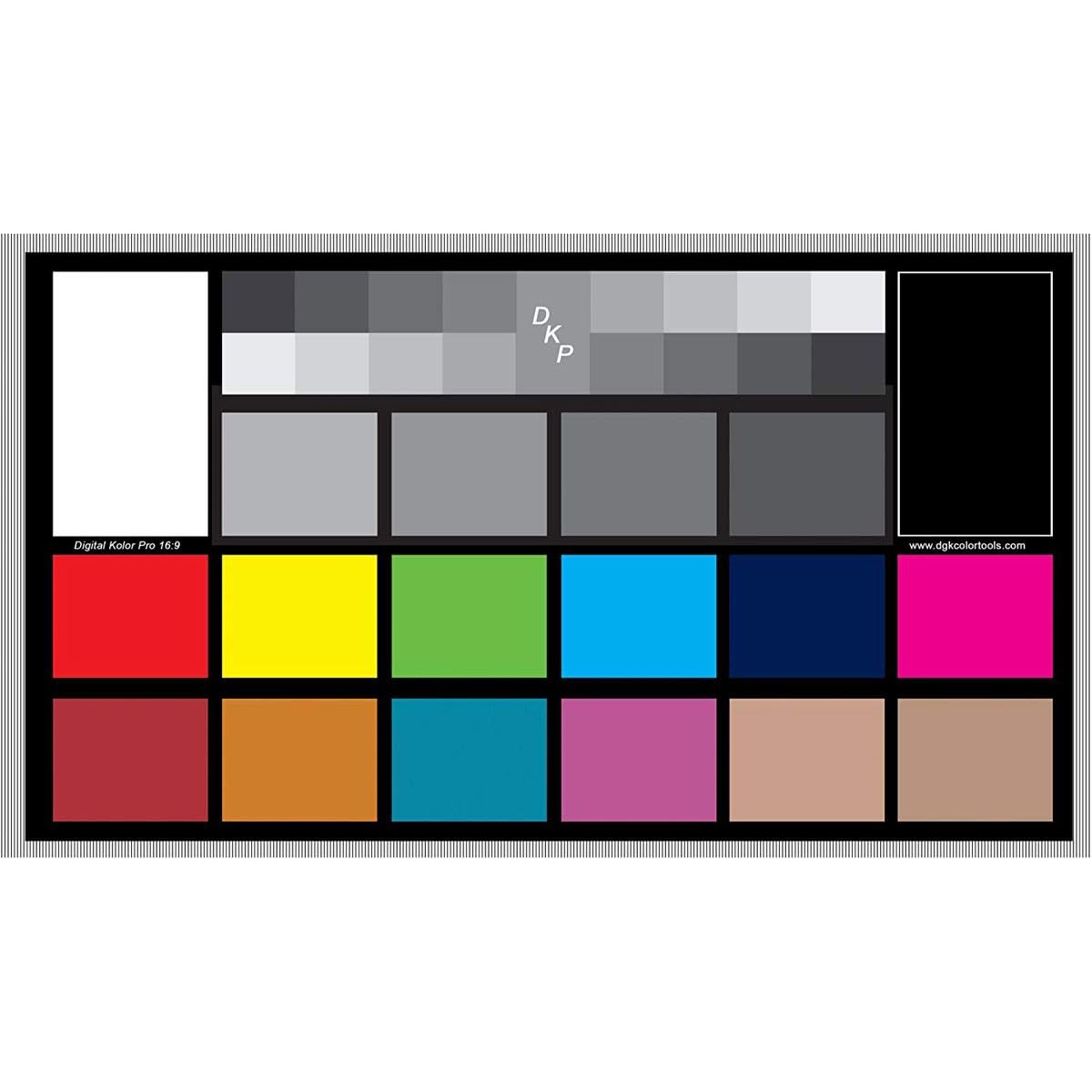
DGK Digital Kolor Pro 16:9

82 /100
Studio Score Strong Evidence

Key details

Card Size
14 x 8 in
Finish & Matte
Cardstock, printed finish
Reference Type
16:9 video chip chart
Workflow Support
Video color reference
Check Price on Amazon

Two oversized 16:9 charts in one budget pack give beginning video crews a large visible frame-wide reference for adjusting white balance and exposure without spending on a dedicated video target. The size is the main draw: the panel stays readable even when the camera is pulled back. Thin cardstock can arrive creased in shipping and will not survive heavy production use, so they suit a teaching kit more than a field kit. Color precision also follows the budget tier, making this a learning reference rather than a final-grade tool.

Pros

  • Two oversized 16:9 charts give a small crew a large on-set reference that is easy to spot.
  • Budget pricing keeps the two-chart pack approachable for beginners learning color correction.

Cons

  • Blue patches can look visibly off, so the chart is not a strict calibration instrument.
Our verdict

For a beginning video crew that wants a big visible chart for learning color and exposure work without investing in a pro target, this two-pack fits.

Check Latest Price
7

Budget All-In-One

Pixiss 4-in-1 Color Card Set

81 /100
Studio Score Strong Evidence

Key details

Card Size
—
Finish & Matte
Matte listed
Reference Type
Gray, white, black, 24-step
Workflow Support
Casual video color correction
Check Price on Amazon

This set is a practical entry point for shooters who want one inexpensive bundle with gray, white, and black exposure cards plus a 24-step gradient for basic color work. The cards provide a quick custom white balance reference, and the gradient helps with simple corrections in an editor. What keeps it from a stronger recommendation is QC: occasional copies arrive glossy or missing accessories, so it is better suited to casual projects than color-critical work.

Pros

  • One bundle combines gray, white, and black cards plus a 24-step gradient for white balance and exposure reference.
  • The included gradient supports simple color-correction work in casual video editing.

Cons

  • Gray patch may not be true 18% gray, so the gradient is a rough guide, not a strict color target.
Our verdict

If you want one budget set for casual white balance and simple color tweaks in video, this covers the basics without a second purchase. For color-critical work, a calibrated target is the better path.

Check Latest Price

How to Choose

Reference Type

A three-card gray, black, and white set anchors custom white balance and exposure. A 24-patch color checker goes further: known patch values let software build a camera profile or correct color response in raw processing.

Listings often overuse 'color calibration.' A gray card cannot teach your camera what true red or skin tone look like; it only anchors neutrality. Choose based on whether you need an in-camera tool or an edit-time correction tool.

Neutrality and Matte Finish

Neutrality is the hidden spec. A truly neutral gray patch reflects equal red, green, and blue. If the patch carries a purple or warm cast, every custom white balance inherits that cast.

Matte finish is just as important. A glossy surface reflects at certain angles, making the patch read brighter or cooler than flat neutral. Hold the card facing the light source, not the camera.

Card Size and Filling the Frame

Size determines whether the card fills enough of the frame. A 2 x 3 inch card is pocketable, but with a telephoto lens it becomes a speck the meter cannot sample evenly. An 8 x 11 inch chart fills the frame from a tripod distance.

Think about focal length before buying. Event shooters with a 24-70mm lens can use a pocket card at the wide end; product shooters with an 85mm or longer prime need a larger target.

Workflow Support

For still photographers, profile creation matters. A 24-patch target with DNG or ICC profile support lets you apply a custom profile to every frame in Lightroom or Capture One.

Video shooters need a different layout. A vectorscope and waveform chart lets you align exposure and saturation on a monitor, while HSL presets speed up work in a specific raw converter.

Carry and Durability

Carry convenience comes from lanyards and small sizes, but durability comes from material. Waterproof plastic cards survive a camera bag; thin cardstock charts crease in transit.

Ask whether the card is a permanent tool or a consumable. A pocket set with a detachable clip is easy to grab; a large professional chart is better stored flat.

Frequently Asked Questions