5 Best Camera Sliders of 2026: Smooth Motion Without Guesswork

Find the camera slider that actually delivers smooth tracking shots for your camera weight, budget, and shooting style — without the guesswork.

The typical camera slider listing promises smooth, silent motion. In practice, movement quality depends on how much weight sits on the carriage, how the rail is supported, and whether a motor or your hand is doing the work.

The central buying decision is manual versus motorized. Manual rails are lighter, cheaper, and simpler, but they put the consistency of each move on you. Motorized sliders add repeatability and hands-free time-lapse, yet they introduce a remote, an app, a motor, and more parts that can go wrong.

Start with the camera you actually shoot with: its weight and lens length decide the payload floor, and the shots you repeat most decide whether motorized control is worth the money. The right rail is the one that disappears into the shot.

1

Best Overall

GVM 31-inch Motorized Slider

84 /100
Studio Score Strong Evidence

Key details

Drive Type
Motorized
Max Payload
20 lb
Track Length
31 inches
Control Method
Remote
Check Price on Amazon

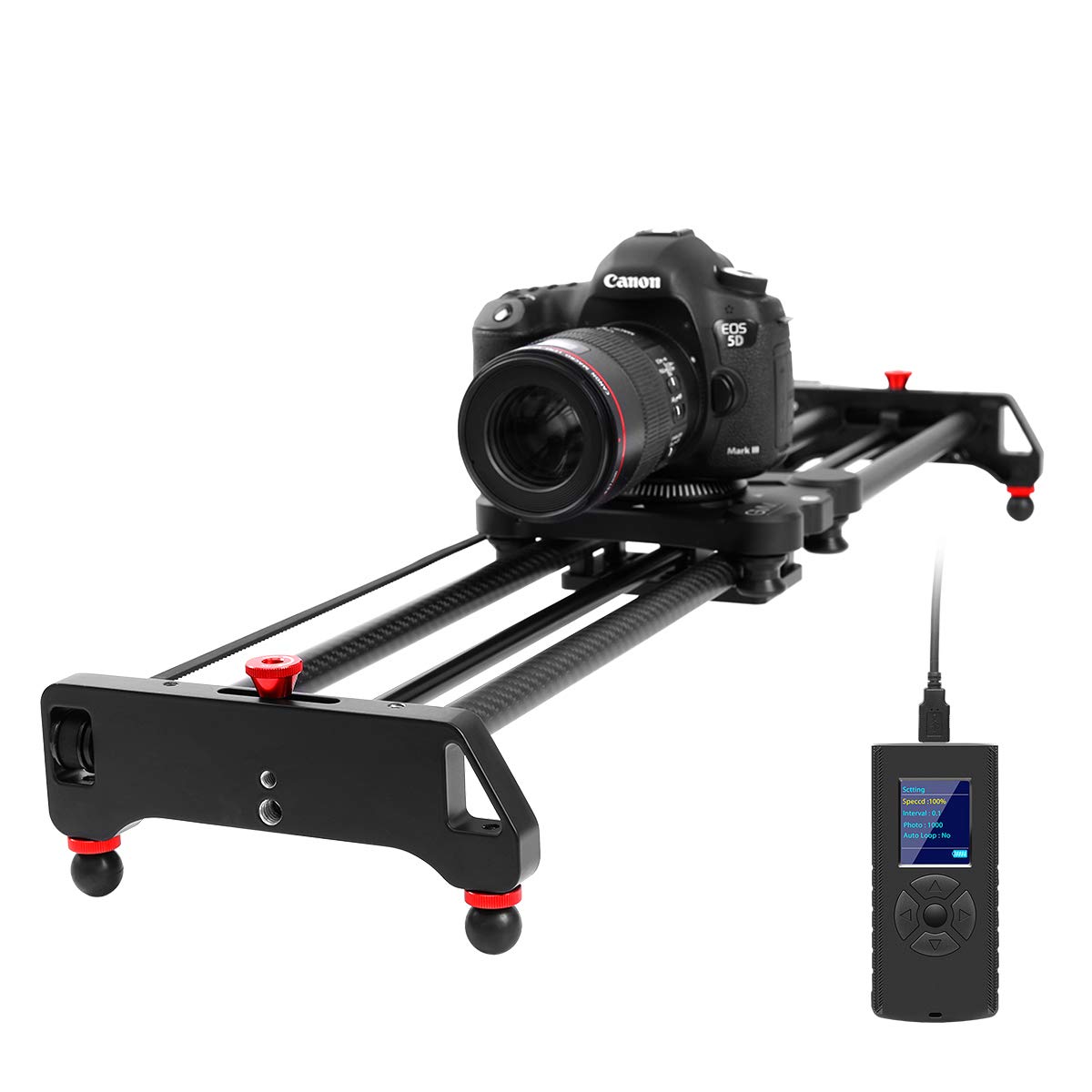
The GVM 31-inch is a quiet motorized slider that puts the core tracking moves on a 31-inch track with a 20 lb payload ceiling. Horizontal tracking, 120-degree panoramic, and timelapse modes are all reachable from the wired remote, keeping the workflow independent of a phone app. The stepper motor holds speed through the middle of a move, and its noise level is low enough for indoor interview work.

The bundle goes beyond a bare rail: a ball head, six shutter release cables, and an NP battery mean the slider can be a working rig the day it arrives. The included NP battery powers the motor for normal location runs, so there is no separate v-mount or dummy battery to arrange. The carriage tracks evenly under normal DSLR/mirrorless loads, and the motor's quiet operation is a practical benefit on location.

The intended buyer is a DSLR or mirrorless owner who wants motorized B-roll, interview coverage, and timelapse from one kit without moving into a multi-axis motion-control system. It is not for buyers who need app-based wireless control, gimbal integration, or a longer track; those needs point toward the long-travel 48-inch motorized rail or the gimbal-integrated system in this comparison. The wired remote feels plasticky and ramp vibration can appear at the start or end of a move, so the fit depends on whether those tradeoffs are acceptable for the price tier. For shooters who can work with those limits, the slider still delivers steady tracking and a complete kit.

For run-and-gun or semi-professional interview work, the 31-inch rail length is a workable middle ground: enough travel for a meaningful dolly move, yet compact enough for a camera bag. For one-person crews, this length avoids the bulk of a 48-inch rail while still producing a visible dolly push. Timelapse users get the bundled shutter cables to trigger common camera bodies, and the panoramic mode adds a single-axis rotation option without extra hardware.

The 20 lb payload rating leaves room for a full-frame body, a standard zoom, and a follow focus, while the rail stays stable on tripod legs. Lighter mirrorless bodies and small video rigs are equally at home, and the carriage does not bind at either end of the track. That headroom separates it from compact manual rails made for phones and action cams, which trade payload and travel for portability.

💡 Frame a little extra run-up and run-off in every move so the motor's start/end ramp can be trimmed in post.

Pros

  • Horizontal tracking, 120-degree panoramic, and timelapse modes cover the moves a one-person video crew needs.
  • Build quality feels above its price tier, with stable carriage tracking over the full 31-inch rail.
  • Quiet stepper motor suits indoor interviews and run-and-gun shoots without adding noise to the soundtrack.
  • Bundle includes remote, ball head, six shutter cables, and NP battery, so no separate accessories are required.

Cons

  • Wired remote's plastic shell and layered menus make quick on-set changes slower than they should be.
  • Motor acceleration can produce visible vibration at the start or end of a move, with no smoothing adjustment.
Our verdict

For DSLR/mirrorless shooters who want motorized B-roll and timelapse without relying on a phone, this is the balanced mid-range slider to start with.

Check Latest Price
2

Best Budget Manual Slider

Zecti 24-inch Carbon Fiber Slider

86 /100
Studio Score Strong Evidence

Key details

Drive Type
Manual
Max Payload
4.4 lb
Track Length
24 inches
Control Method
Manual
Check Price on Amazon

Four precision bearings on dual carbon-fiber rails give this manual slider a steady glide for lightweight cameras, while the 24-inch track keeps the rig small enough for a camera bag. The motorized all-rounder in this set adds automation, but it also adds weight and cost; the Zecti is the lighter, cheaper manual path.

The carbon-fiber build feels consistent with sliders that cost more, and the 24-inch track stays compact for travel or run-and-gun work. Because there is no motor or app, setup stays simple: mount the camera, set the height, and move the carriage by hand. That simplicity keeps the purchase budget-friendly and leaves one less battery to charge.

This is the pick for travel/run-and-gun creators, first-time slider buyers on a tight budget, and shooters with phones, action cams, or light mirrorless bodies. Smoothness can be uneven near mid-rail under heavier loads, and the mounting plate screw is awkward to tighten, so treat the 4.4 lb payload as a firm ceiling. Creators who need motorized or time-lapse automation should look at the motorized sliders in this set.

Pros

  • Smooth, steady carriage for lightweight cameras and small mirrorless kits.
  • Strong budget value for the production quality it adds.
  • Lightweight carbon-fiber build that travels easily.
  • Build quality that feels comparable to pricier manual rails.

Cons

  • Mounting plate screw is awkward to tighten and remove when swapping cameras.
  • Smoothness can be uneven near mid-rail when the load approaches the 4.4 lb ceiling.
Our verdict

For a lightweight, manual-only workflow at a budget price, the Zecti is the most sensible buy in this set; motorized shooters and heavy DSLR owners should pick the motorized all-rounder instead.

Check Latest Price
3

Best Pro Multi-Axis / Gimbal Slider

IFOOTAGE Shark Nano II

83 /100
Studio Score Strong Evidence

Key details

Drive Type
Motorized
Max Payload
7 kg horizontal
Track Length
26 inches
Control Method
Touchscreen + app
Check Price on Amazon

IFOOTAGE's Shark Nano II 660 is the rail here that folds a DJI RS gimbal into the motion path rather than treating it as dead weight. The RS2, RS3 Pro, RS4, RS4 Pro and RS5 models connect to the slider, so the gimbal's motors handle yaw, tilt and roll while the rail provides the linear track. That places it in a different category from the balanced motorized all-rounder in this set, which focuses on a long travel range and a wired remote instead of camera-axis control.

The stabilization algorithm holds up when a sensitive lens rides on the gimbal during combined moves; micro jitter stays low enough for interview and product footage. The touchscreen and app form the control center, and the programming flow suits shooters who need repeatable positions from one take to the next. Power comes from USB-C PD 60W or an F970 battery, which covers both studio and location work.

This is for professional or semi-pro solo filmmakers who already own a compatible DJI RS gimbal and need repeatable multi-axis motion for interviews, product demos or controlled tracking shots. An individual unit can produce judder, so test the carriage after unboxing, and the long rail can need support at both ends on a tripod. The 7 kg horizontal payload carries a gimbal plus mirrorless camera without strain, and once the setup is worked out, the programmed moves hold up for take after take.

Pros

  • DJI RS gimbal integration builds multi-axis moves on top of the rail's linear track.
  • Touchscreen and mobile app make move programming fast enough for on-location changes.
  • Stabilization algorithm keeps micro jitter low even with sensitive lenses.

Cons

  • Vertical operation drops the payload ceiling to 3.5 kg, limiting heavier gimbal and lens combos.
  • Without a compatible DJI RS gimbal, the multi-axis control function has no way to activate.
Our verdict

For an RS gimbal owner, this is the slider that turns the gimbal into a full motion-control rig.

Check Latest Price
4

Best Long-Travel Motorized Slider

GVM 48-inch Motorized Slider

82 /100
Studio Score Strong Evidence

Key details

Drive Type
Motorized
Max Payload
20 lb
Track Length
48 inches
Control Method
App
Check Price on Amazon

The 48-inch carbon-fiber rail and app-based control separate this slider from the shorter 31-inch GVM: it spans interview tables and product sets while the other model relies on a wired remote. Tracking, pan, and time-lapse modes are all programmed from the app, and the 20 lb payload handles DSLR and mirrorless rigs. For a rail this length, the price lands in the mid-range rather than the premium tier.

Motor movement is quiet and smooth during linear and pan shots, with speed settings that suit slow establishing pushes and quicker product passes. The long travel gives interview and product-demo work a real dolly feel without resetting the frame between takes. That combination keeps the setup within reach of a one-person crew.

This is the slider for interview and product-demo shooters who need wide movement in a fixed set and already plan moves on a phone or tablet. The time-lapse menu takes a few sessions to learn, and the controller wire can need attention on some units, so a quick test before a booked shoot is worth your time. Travel-focused users will find the 48-inch rail and 4 kg weight better left in the studio.

💡 Set the app to a slow test pass and confirm the end point before attaching the camera.

Pros

  • Long 48-inch carbon-fiber rail delivers wide, cinematic moves without a multi-section setup.
  • Carbon-fiber construction keeps weight manageable for a rail this long while holding a 20 lb payload.
  • Quiet motor suits interview and dialogue scenes where camera noise carries.
  • Smooth tracking and pan modes cover establishing shots and product passes.

Cons

  • No physical remote means the app is the only way to set speed, endpoints, and modes.
  • Belt tension can slip or loosen on some units, stopping motion until re-tensioned.
Our verdict

For interview and product-demo work that needs a long, repeatable move, this is a cost-effective way to get app-programmed motion without a premium motion-control price.

Check Latest Price
5

Phone / Action Cam

NEEWER 16-inch Carbon Fiber Slider

80 /100
Studio Score Strong Evidence

Key details

Drive Type
Manual
Max Payload
4.4 lb horizontal
Track Length
16 inches
Control Method
Manual
Check Price on Amazon

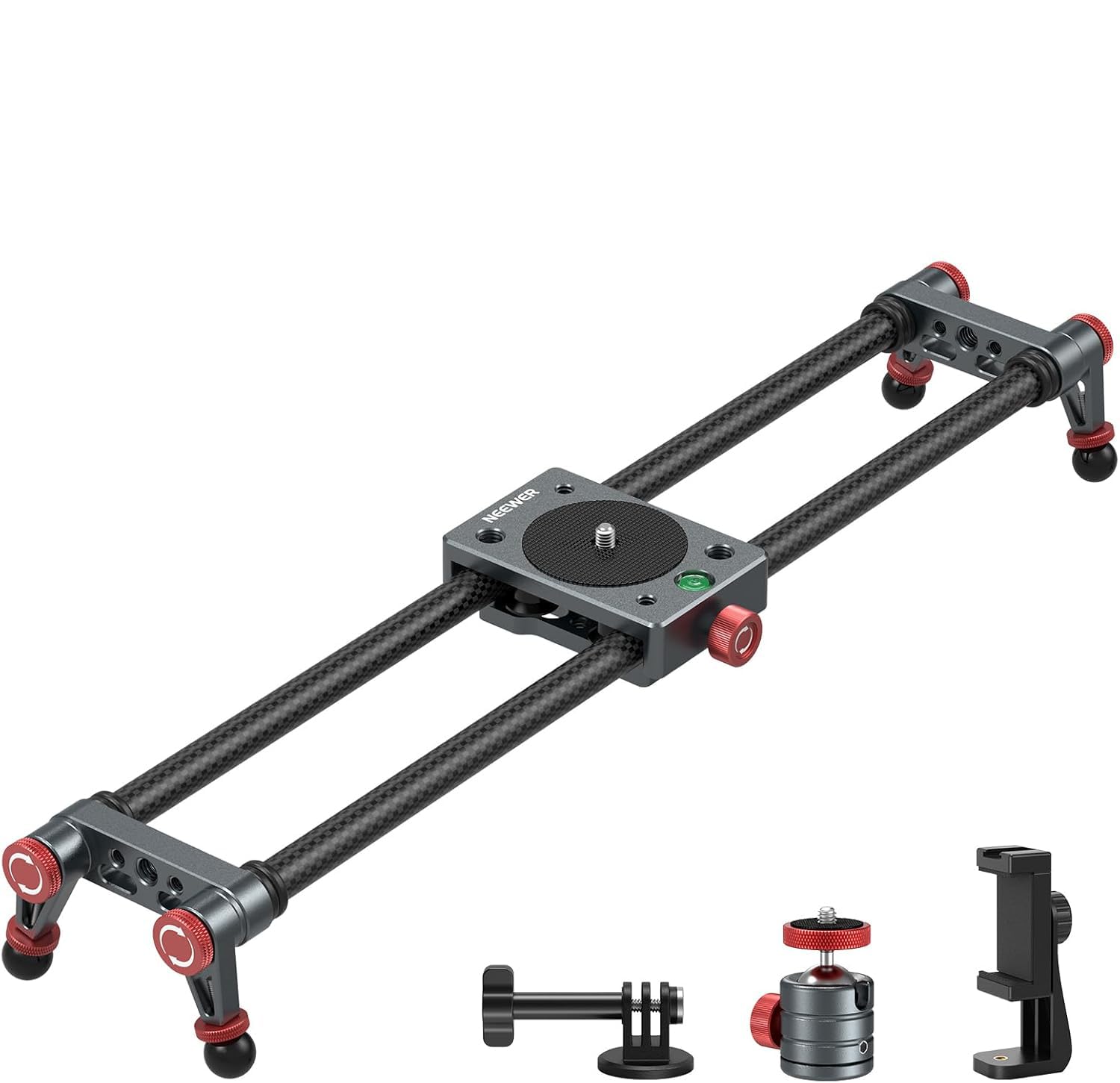
This is a lightweight 16-inch carbon-fiber manual rail with phone and action-cam mounts, so a GoPro or smartphone can move through controlled linear shots without a heavy rig. Four precision bearings carry the carriage, and the included 360-degree ball head, phone clamp, and action-cam mount cover common ultra-light setups. The 4.4 lb horizontal rating (2.2 lb tilted) keeps this in ultra-light accessory territory: it suits backpack travel and short vlog push-ins, while DSLR/mirrorless shooters should pass on this one.

Pros

  • Phone clamp, action-cam mount, and 360-degree ball head cover common light-camera setups.
  • Four precision bearings and a carbon-fiber rail keep the slider light enough for backpack travel.
  • 16-inch footprint fits tight spaces and small bags.

Cons

  • No motor drive, so automated time-lapse moves and repeatable passes are not available.
  • 16-inch travel means longer push-in shots require a reset partway through.
Our verdict

This is for a backpack-travel vlogger shooting phone or action-cam clips who wants a manual rail.

Check Latest Price

How to Choose

Track Length

Longer tracks allow larger moves, but they also turn the rail into a lever. A 48-inch rail on a center tripod can flex at the ends, causing a dip or vibration. Support both ends or keep travel within the supported section.

Short rails are easier to pack and set up, but they limit how far the camera can travel in a shot. For interviews and product moves, 24 to 31 inches covers most push-ins and slides. Longer rails matter for wide establishing shots.

Motorized vs Manual

Manual sliders are simpler, lighter, and cheaper, but smoothness depends on your hand speed and the bearings. A steady pull can look motorized on short moves.

Motorized sliders add repeatability and time-lapse, but the motor and controller create new variables. Some introduce vibration at start or stop, and app or remote issues can interrupt a take. If you only need occasional B-roll, manual is enough; if you need the same move reproduced exactly, motorized earns its cost.

Max Payload

Payload ratings are about smoothness, not just breakage. A camera under the rated load can still stutter if the lens magnifies micro-jitter, so leave a margin.

A 4.4 lb rail suits a light mirrorless body with a compact lens. A DSLR with a telephoto zoom can cross that limit once you add a head or monitor. Staying 20-30 percent below the rating keeps the carriage gliding freely.

Build and Bearings

Carbon fiber cuts weight and dampens vibration, but thin rails can bow under clamp pressure. Rail straightness matters more than the material label.

Bearing count matters less than fit. Four precision bearings glide smoothly on a true rail, while a misaligned carriage binds at the same spot. Test the carriage by hand before buying.

Control Method

Physical remotes give direct speed control without a phone, but the remote hardware and menu can be weak points on budget models. Pick a remote with large buttons if you adjust speed on set.

App control adds programmability but makes the slider dependent on a wireless link. Some units lose physical buttons, so a connection drop can halt a take. Touchscreens on pro models are faster to adjust but cost more.

Frequently Asked Questions